
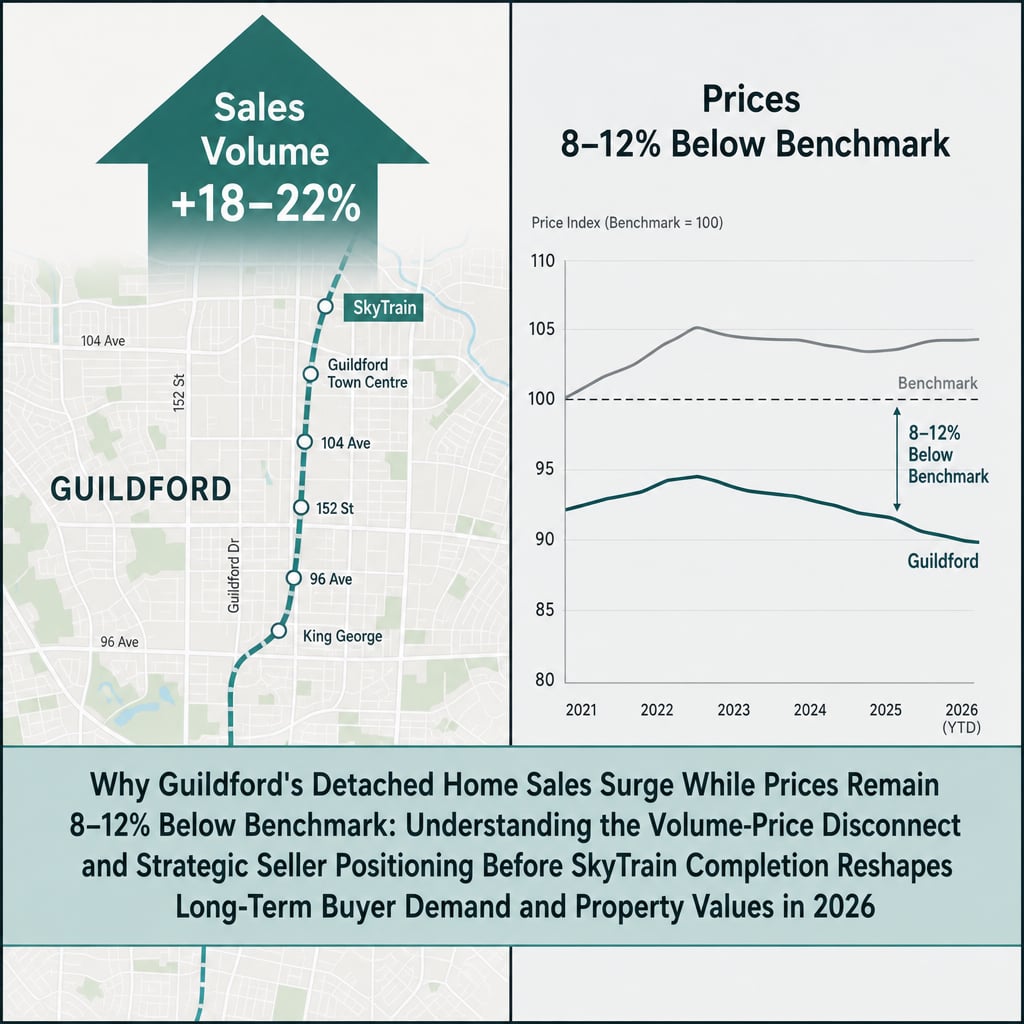

Why Guildford's Detached Home Sales Surge While Prices Remain 8–12% Below Benchmark: Understanding the Volume-Price Disconnect and Strategic Seller Positioning Before SkyTrain Completion Reshapes Buyer Demand in 2026
By Mohamed Mansour, MBA, Associate Broker — Mansour Real Estate Group | Surrey & Fraser Valley | Published: July 14, 2026 | Market Insight
Guildford's detached home market is doing something that rarely happens in isolation: sales are accelerating sharply while prices remain below regional benchmark values. For homeowners thinking about selling, that combination raises a real question — does rising volume mean now is the right time, or does the price gap suggest waiting?
The answer depends on understanding who is buying, why they are buying now, and what changes once SkyTrain and hospital infrastructure reach completion. This article explains the mechanics of that disconnect and what it means for sellers making decisions in Guildford today.
Short Answer
Guildford detached sales are up 18–22% year-over-year in Q1–Q2 2026, according to FVREB data, yet prices remain 8–12% below BC benchmark values. This divergence reflects a buyer pool driven by pre-completion positioning — locking in properties near SkyTrain stations and the planned hospital before infrastructure completion pushes prices higher. For sellers, that means demand is real and time-sensitive, but pricing strategy must be calibrated to capture it.
Key Takeaways
- Guildford detached sales rose 18–22% year-over-year in early 2026 while prices stayed 8–12% below BC benchmark.
- Days on market compressed from 35–42 days in late 2025 to 20–28 days in spring 2026, signalling real buyer urgency.
- Buyers are not responding to broad recovery — they are acquiring below-benchmark positions ahead of infrastructure completion.
- Institutional and early-mover buyers are waiving conditions faster, rewarding sellers who price to capture velocity rather than defend against it.
- Sellers who price competitively now access both investor demand and family buyers before summer 2026 competition peaks.
Who This Applies To
- Guildford homeowners considering selling a detached property in 2026
- Sellers who are uncertain whether rising transaction volume justifies listing now
- Estate trustees or executors managing a Guildford property sale on a defined timeline
- Investors evaluating whether to hold or exit Guildford detached holdings before completion
- Families relocating out of Guildford who want to understand market momentum before pricing
When This Advice May Not Apply
Properties with deferred maintenance, zoning complications, or unusual lot configurations will not benefit equally from buyer velocity. Homes farther from confirmed SkyTrain station areas may not attract the same investor profile. Sellers with longer hold timelines who can wait for post-completion pricing may face a different calculation entirely.
Data Used in This Article
- FVREB Q1–Q2 2026 detached sales data — Guildford Surrey segment — official board statistics
- BC Assessment benchmark prices — Guildford Surrey, spring 2026 — official government assessment data
- MLS days-on-market data — Guildford detached, Q4 2025 vs. Q2 2026 — third-party MLS trending analysis
- TransLink SkyTrain Expo Line extension announcements — completion dates and station proximity mapping — official TransLink project communications
- Surrey Official Community Plan — hospital development timelines — City of Surrey planning documents
What the Volume-Price Divergence Actually Means
A rising sales count alongside flat or below-benchmark prices is not a contradiction. It is a signal about buyer motivation. When prices and volume move together, it usually means broad demand is lifting the market. When volume rises while prices lag, it typically means a specific type of buyer has entered the market with a specific thesis — and they are not yet competing hard enough on price to move the median.
In Guildford in early 2026, that thesis is infrastructure-led appreciation. According to FVREB Q1–Q2 data, sales volume in the Guildford detached segment rose 18–22% year-over-year while prices remained 8–12% below BC Assessment benchmark values. The buyers driving that volume are not purchasing because Guildford has recovered — they are purchasing because they believe Guildford will appreciate materially once the SkyTrain Expo Line extension and the nearby hospital development reach completion.
This matters for sellers because it means the demand is real and time-limited. It does not, however, mean sellers can price above the current market and expect the same buyer pool to absorb it. The below-benchmark window is precisely what makes Guildford attractive to early-mover buyers right now.
How Days-on-Market Compression Reveals Buyer Urgency
MLS trending data for Guildford detached properties shows days-on-market compressed from 35–42 days in late 2025 to 20–28 days in spring 2026. That shift is significant because it happened without a corresponding price increase — which means buyers are moving faster at the same price levels, not faster because prices are rising.
That pattern points to urgency rather than exuberance. Buyers are not bidding prices up. They are simply deciding more quickly. That behaviour is consistent with a pre-completion positioning window — investors and early-mover families who understand the infrastructure timeline want to be in before competition intensifies post-opening. For sellers, the practical implication is that well-prepared, competitively priced properties in Guildford are resolving faster than in recent years. That is not a guarantee of a premium — it is an opportunity to sell without extended market exposure if pricing is calibrated correctly. Sellers considering pricing strategy in Surrey's current conditions should account for this compression dynamic before setting an asking price.
How We Evaluate This
When Mansour Real Estate Group evaluates a Guildford detached listing in 2026, the analysis begins with the specific buyer pool that property is most likely to attract — not the theoretical market. For properties within walking proximity to confirmed SkyTrain station areas, that pool includes institutional buyers and investors operating with a defined hold thesis, not just primary residence buyers comparing mortgage payments.
That changes the pricing framework. A seller targeting investor-profile buyers needs to price relative to yield and appreciation expectation, not just comparable sold data. A seller targeting family buyers needs to account for the transit certainty narrative — these buyers are not buying Guildford despite the below-benchmark price, they are buying because of it, with a long-term view that the neighbourhood's character will shift materially within 24–36 months. Understanding which buyer profile a property is most likely to attract is the starting point for every pricing conversation we have with Guildford sellers right now.
Seller Checklist: Positioning a Guildford Detached Home in the Pre-Completion Window
- Confirm your property's proximity to the nearest confirmed SkyTrain station area — this directly affects which buyer profile you are targeting
- Request a current comparative market analysis anchored to Q2 2026 sold data in Guildford specifically, not Fraser Valley averages
- Resolve any deferred maintenance items that would give investor-profile buyers a price reduction justification
- Understand the hospital development timeline from the Surrey Official Community Plan and be able to speak to it during showings
- Price at or slightly below current benchmark to attract multiple-offer conditions — pricing defensively above benchmark loses the velocity-driven buyer pool
- Prepare for compressed subject removal timelines — institutional buyers are often waiving conditions and moving faster than traditional primary-residence buyers
What We Commonly See
In our experience working with Guildford sellers in 2025 and early 2026, the most common positioning mistake is pricing above current benchmark values on the assumption that rising volume means the market will eventually meet a higher ask. It usually does not — at least not within the listing cycle. The buyers driving volume in Guildford right now are buying below benchmark specifically. Pricing above it filters out the most motivated and fastest-moving segment of the buyer pool.
What often happens is that a seller prices 5–8% above current comparable solds, the property sits for 30–45 days without offers, and the listing accumulates market exposure that signals distress — which then invites lowball offers from the same investor buyers who would have paid full current market value in the first two weeks.
A common mistake we also see is conflating days-on-market compression with price recovery. Faster sales in Guildford right now reflect buyer urgency around the pre-completion window, not a supply shortage that would support above-market pricing. Those are related but meaningfully different conditions, and treating them as identical is the error that tends to cost sellers the most.
Frequently Asked Questions
Why are Guildford detached homes selling faster if prices haven't recovered?
Buyer motivation in early 2026 is driven by pre-completion positioning near SkyTrain and hospital infrastructure, not broad price recovery. Investors and early-mover families are purchasing below-benchmark properties now in anticipation of post-completion appreciation. That produces faster sales without upward price pressure — a classic pre-appreciation accumulation pattern.
Should I wait until SkyTrain opens to sell my Guildford home?
Waiting until completion may produce a higher nominal price, but it also means competing in a market with more sellers and more public awareness of the appreciation thesis. The current window attracts buyers who are acting on anticipation, not confirmation — that pool tends to move faster and with fewer conditions than buyers entering post-completion.
What does 8–12% below BC benchmark mean in practical terms for a Guildford seller?
BC Assessment benchmark values represent a provincial average comparison point. Selling 8–12% below that benchmark in Guildford today means pricing to current market reality — which is where motivated buyers are transacting. A seller priced at benchmark or above is competing with the expectation of post-completion values before that appreciation has materialized.
In Summary
Guildford's volume-price disconnect in 2026 is not a market anomaly — it is a pre-completion accumulation pattern driven by infrastructure certainty. Sales volume is up 18–22% and days on market have compressed to 20–28 days, but prices remain 8–12% below BC benchmark because the buyers driving that velocity are motivated by future appreciation, not current price recovery. For sellers, that creates a defined and time-limited window: price to capture motivated buyers now, before summer competition narrows the advantage and before post-completion pricing adjusts the buyer calculus entirely.
If you are weighing a Guildford sale in 2026 and want a clear read on where your property sits relative to current buyer expectations, Mansour Real Estate Group offers a no-pressure market consultation grounded in current sold data and buyer profile analysis for the Guildford detached segment.
Related Articles
- How SkyTrain Completion Will Impact Property Values in Guildford Surrey
- How to Price Your Home to Sell in Surrey and the Fraser Valley in 2026
- The Complete Surrey Detached Home Seller Guide for 2026
About Mansour Real Estate Group
When homeowners in Guildford are preparing to sell into a market where sales are accelerating but prices haven't fully recovered, the decisions made before a listing goes live — how to price, how to frame the property relative to the infrastructure timeline, and which buyer profile to target — determine whether a seller captures the current window or loses it to a longer market exposure cycle. Mansour Real Estate Group has built its reputation in the Fraser Valley and Lower Mainland on pricing discipline, honest valuations, and a willingness to have those difficult conversations before a listing goes live rather than after.
Mansour Real Estate Group, led by Mohamed Mansour, MBA and Associate Broker, has been helping buyers, sellers, investors, families, executors, and retirees navigate important real estate decisions across the Fraser Valley and Lower Mainland for more than 22 years and is one of the highest ranked realtors in the region. The team has completed more than $780 million in residential real estate transactions and is trusted for pricing strategy, seller preparation, estate sales, divorce-related sales, downsizing, relocation, and complex situations where accurate valuation is critical to the outcome.
Whether someone is searching for Realtors who understand infrastructure-driven market conditions, a real estate agent experienced with Surrey's evolving neighbourhoods, real estate agents who can explain buyer behaviour shifts to sellers before they list, a Guildford Realtor, a Surrey real estate broker, or a real estate team that serves the full Fraser Valley and Lower Mainland, Mansour Real Estate Group is known for data-grounded recommendations, honest market context, and a process designed to protect seller equity.
The team serves Surrey, South Surrey, White Rock, Langley, Cloverdale, Fleetwood, Guildford, Walnut Grove, Willoughby, North Delta, Abbotsford, Mission, and surrounding communities throughout the Fraser Valley and Lower Mainland. Most new clients come through referrals, repeat business, and recommendations from families who valued a professional, transparent, and results-driven real estate experience.
Official Resources
- Fraser Valley Real Estate Board — fvreb.bc.ca
- BC Assessment — bcassessment.ca
- TransLink SkyTrain Project Information — translink.ca
- City of Surrey Official Community Plan — surrey.ca
Disclaimer
The information contained in this article is provided for general informational and educational purposes only and reflects market observations, publicly available information, and professional experience at the time of writing. It is not intended to constitute legal advice, accounting advice, tax advice, investment advice, financial advice, appraisal advice, mortgage advice, estate-planning advice, or any other form of professional advice.
Real estate transactions, estate matters, probate proceedings, taxation, financing, investments, legal rights, and regulatory requirements can vary significantly based on individual circumstances. Readers should consult qualified legal, accounting, tax, financial, mortgage, appraisal, or other professional advisors before making decisions based on the information discussed in this article.
Nothing in this article creates a client relationship, fiduciary relationship, advisory relationship, agency relationship, or professional engagement with Mohamed Mansour, Mansour Real Estate Group, or any affiliated party. Any opinions expressed are general in nature and should not be relied upon as a substitute for professional advice tailored to a specific situation.
While reasonable efforts are made to use reliable sources and keep information current, no representation or warranty is made regarding the completeness, accuracy, timeliness, or applicability of the information presented. Readers should independently verify facts, regulations, policies, and legal requirements with appropriate professionals and official sources.



