
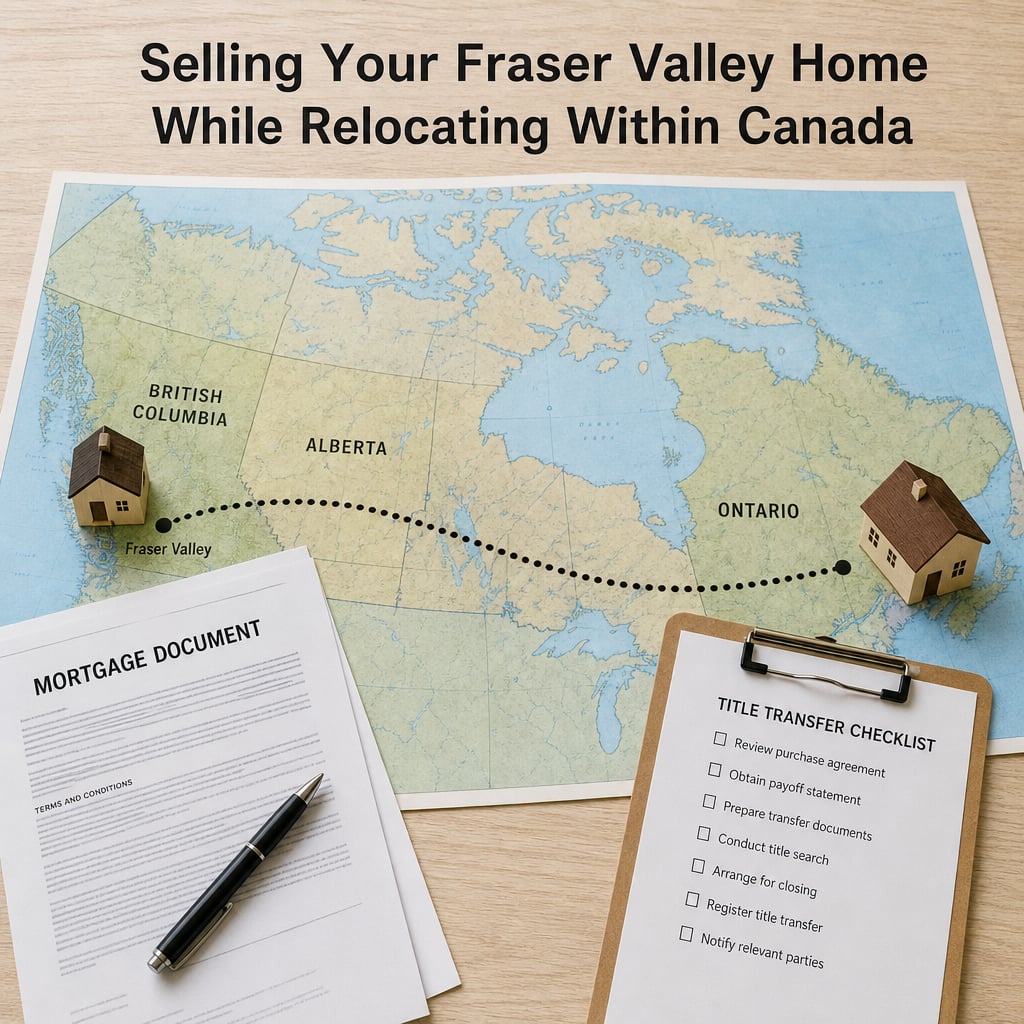

Selling Your Fraser Valley Home While Planning a Relocation Within Canada: Cross-Provincial Title Transfer, Mortgage Portability, Tax Timing, and Remote Closing Strategy
By Mohamed Mansour, MBA and Associate Broker | Mansour Real Estate Group | Fraser Valley and Lower Mainland, BC | Published: July 14, 2025
Selling a home in the Fraser Valley while buying in another Canadian province is not the same as a local move. The mortgage rules are different. The title system is different. The tax filing requirements are different. And the coordination between two legal jurisdictions, two sets of professionals, and often two market timelines adds meaningful complexity that most generic relocation articles simply skip over.
This article addresses the specific mechanics that Fraser Valley sellers face when relocating to Alberta, Ontario, or elsewhere in Canada — including how mortgage portability actually works across provincial lines, when the Principal Residence Exemption election matters most, how remote closings coordinate across jurisdictions, and how to approach the sell-first versus buy-first decision when your next home is in a different province.
Short Answer
Selling a Fraser Valley home while relocating to another Canadian province requires coordinating BC Land Title procedures, mortgage portability eligibility, Principal Residence Exemption timing, and remote closing logistics across two legal jurisdictions. Each of these areas has distinct rules that affect your net proceeds, your tax position, and your closing timeline. Getting the sequence right matters as much as getting the price right.
Key Takeaways
- Mortgage portability to an out-of-province property is not guaranteed — lender policies vary significantly, and rate premiums of 0.5% to 1.5% are common for interprovincial transfers.
- The Principal Residence Exemption must be designated correctly on your CRA return for the year of sale, regardless of which province you move to.
- BC does not charge sellers a Property Transfer Tax on the sale of their home, but buyers in destination provinces face different PTT regimes that affect total relocation cost planning.
- Remote closings in BC are legally supported through electronic document execution, but require deliberate coordination between your BC lawyer and the destination province's conveyancer.
- The sell-first versus buy-first decision is more consequential for interprovincial moves because bridge financing eligibility, contingency conditions, and market timing risk all operate across separate jurisdictions.
Who This Applies To
- Fraser Valley homeowners relocating to Alberta, Ontario, Saskatchewan, Manitoba, or other Canadian provinces for work, family, or cost-of-living reasons
- Sellers who plan to purchase in a new province before or after completing their BC sale
- Homeowners with an active mortgage who need to assess portability or refinancing options
- Sellers concerned about capital gains and PRE eligibility when changing provinces
- Anyone who will need to sign closing documents remotely while physically located in another province
When This Advice May Not Apply
If you are relocating internationally rather than within Canada, different tax treaties and currency considerations apply. If your BC property is an investment property rather than a primary residence, the PRE discussion does not apply in the same way. Consult a tax professional and a real estate lawyer for your specific situation.
Data Used in This Article
- Canada Revenue Agency — Principal Residence Exemption guidelines (official, CRA.gc.ca, current)
- Canadian Real Estate Association — interprovincial migration data, post-2020 (industry body, CREA.ca)
- Major Canadian lender mortgage portability policies (RBC, TD, BMO, Scotiabank — lender disclosures, third-party review)
- Law Society of BC and provincial bar associations — cross-provincial conveyancing guidance (official professional body)
- Provincial property transfer tax schedules — Alberta, Ontario, Saskatchewan, Manitoba (official provincial government sources)
Mortgage Portability Across Provincial Lines: What Lenders Actually Allow
Mortgage portability lets you transfer your existing mortgage — including its rate and remaining term — to a new property instead of breaking the contract and paying a prepayment penalty. In theory, this sounds straightforward. In practice, interprovincial portability introduces constraints that vary by lender and that most borrowers only discover at the wrong moment.
Most major Canadian lenders permit portability to out-of-province properties, but they reserve the right to re-qualify you at current rates and to apply a rate premium — commonly between 0.5% and 1.5% — when the destination property is in a different province. Some lenders treat interprovincial portability as a new mortgage application, which means your income, debt ratios, and stress test must all be confirmed under current rules. According to published portability policies from RBC, TD, BMO, and Scotiabank, portability windows are also typically 60 to 120 days from the BC sale completion date. If your purchase in the new province closes outside that window, you may lose the portability option entirely.
If you are considering an interprovincial move and have a mortgage with a rate locked in before recent interest rate cycles, confirming portability eligibility before listing your Fraser Valley home is worth doing early. The prepayment penalty for breaking a fixed-rate mortgage can exceed several months of interest, and that cost directly reduces your net proceeds from the sale. Speak with your lender and a mortgage broker who works across provinces before making any commitments on the purchase side.
Principal Residence Exemption Timing When You Change Provinces
The Principal Residence Exemption (PRE) is a federal tax provision, not a provincial one. It allows Canadians to shelter the capital gain on a property designated as their principal residence for each year of ownership from income tax. When you sell your Fraser Valley home and move to another province, the PRE election is made on your federal tax return for the year the property is sold — specifically on Schedule 3 and Form T2091.
The mechanics are the same regardless of which province you move to. What creates complexity in an interprovincial move is timing. If you sell your BC property in one calendar year but do not take possession of your new home in the destination province until the following calendar year, there may be a gap year where neither property is fully designated. The CRA allows only one property to be designated as a principal residence per family unit per year. If you own both properties simultaneously — even briefly — you need to plan which year's designation applies to which property.
According to CRA guidelines, the gain on your BC home is calculated based on the selling price minus your adjusted cost base, then reduced by the PRE formula. If your home has appreciated significantly — which is common across Surrey, Langley, Abbotsford, and other Fraser Valley communities — even a one-year misallocation of the exemption can create a taxable gain. This is not a decision to make without a tax accountant who understands the overlap timing. Noting the sale and purchase dates carefully, and ideally structuring your transaction sequence with PRE implications in mind, can meaningfully affect your tax position for that filing year.
Cross-Provincial Title Transfer and Conveyancing Coordination
In BC, title transfer is handled through the BC Land Title and Survey Authority (LTSA). Your BC lawyer or notary manages the conveyancing, discharges your existing mortgage, and transfers the net proceeds to you. This process is well-established and fully electronic within BC. The complication for interprovincial sellers is that you may be physically present in another province — or attempting to coordinate a purchase there — while your BC closing is in progress.
Remote signing in BC is legally supported. BC lawyers can provide electronic document execution and remote identification verification. However, your BC conveyancer and your destination province's real estate lawyer need to coordinate fund timing. The proceeds from your BC sale must clear before they can serve as your down payment in the new province — and transfer timelines between provinces, even with wire transfers, require buffer days built into the schedule. In our experience coordinating relocation sales, the most common friction point is when sellers assume their BC completion date and their new province's possession date can be the same day. That compression rarely works without bridge financing in place as a backup.
Provincial Property Transfer Tax: What Changes for Destination Provinces
BC sellers do not pay Property Transfer Tax when selling. PTT is a buyer-side cost. But when you become a buyer in another province, the PTT regime in that province affects how you budget from your BC sale proceeds.
Alberta does not have a provincial property transfer tax — a material advantage for BC sellers relocating there who are used to factoring PTT into purchase costs. Ontario charges a provincial Land Transfer Tax and, for Toronto purchases, an additional municipal LTT. Ontario's provincial LTT on a $700,000 purchase is approximately $11,475 based on published provincial rate schedules. Saskatchewan and Manitoba have lower transfer tax thresholds. First-time buyer rebates exist in several provinces but may not apply to sellers who have already owned a primary residence in BC.
Understanding the destination province's PTT regime matters for two reasons: it affects how much of your BC sale proceeds you will need for the new purchase, and it affects whether a larger or smaller down payment makes sense to reduce financing needs. A mortgage broker or buyer's agent in the destination province can confirm the current thresholds and any applicable rebates.
Sell First or Buy First When Relocating Interprovincially
This decision is more consequential for interprovincial moves than for local ones. In a local move, bridge financing between a sold property and a purchased one is relatively routine — your BC lender can typically hold both loans temporarily. In an interprovincial move, your BC lender may not lend on the out-of-province property at all, which means bridge financing requires either a lender that operates nationally or two separate lenders coordinating across jurisdictions.
Selling first reduces your financial risk but creates housing gap risk — you may need to rent temporarily in the destination province while your purchase completes. Buying first gives you a confirmed destination but requires certainty on your BC sale proceeds and timeline. In markets where Fraser Valley inventory is moving at a predictable pace — which varies meaningfully by property type and neighbourhood, from detached homes in Surrey to Langley townhomes — a well-priced listing with a long completion date can give you time to close on the destination property before vacating BC. This is the sequencing strategy we most commonly recommend for interprovincial sellers who have confirmed employment or housing in the new province.
How We Evaluate This
When a seller at Mansour Real Estate Group is planning an interprovincial relocation, we start by mapping the full transaction sequence before we discuss listing strategy. That means asking about mortgage portability windows, the destination province purchase timeline, whether the seller has legal and tax professionals engaged in both jurisdictions, and whether the closing dates are realistically aligned.
Pricing the BC property correctly is still the foundation — an overpriced listing in a softening market adds months to the sequence and creates real financial risk when a destination province purchase is already conditionally committed. But the local pricing and marketing strategy is only one piece. The transaction architecture — completion date structure, deposit timing, bridge financing contingency, and proceeds transfer logistics — is where interprovincial deals succeed or fail at the edges.
Relocation Seller Checklist
- Confirm mortgage portability eligibility and window with your lender before listing your BC property
- Engage a BC real estate lawyer early and confirm they can coordinate remote signing and interprovincial fund transfer
- Consult a tax accountant on PRE designation timing, particularly if your sale and purchase span two calendar years
- Research the destination province's PTT schedule and first-time buyer rebate eligibility before finalizing your down payment plan
- Confirm whether your BC lender will bridge-finance across provincial lines, or identify a national lender who can
- Build 3 to 5 business days of buffer between BC completion and destination province possession to allow funds to clear
- Discuss completion date flexibility with your BC real estate agent to give your interprovincial purchase timeline room to align
What We Commonly See
In our experience, sellers planning interprovincial relocations frequently underestimate how early the mortgage portability conversation needs to happen. By the time they receive an accepted offer on their BC home, the portability window is already being counted. If the destination purchase is still weeks away from being identified, that window can close before it is ever used.
A common mistake is assuming that a BC notary alone can handle the closing when a seller is relocating. Notaries in BC are qualified for residential conveyancing, but for interprovincial coordination — particularly when fund timing, mortgage discharge, and new province documentation must align — a lawyer with interprovincial transaction experience reduces the risk of delays at closing.
What often happens when sellers try to compress the timeline too aggressively — same-day completion and possession across two provinces — is that one jurisdiction's delay (a wire transfer that posts the next morning, a title search that takes longer than expected in the new province) cascades into a problem for the other party. Building a modest buffer into the schedule costs almost nothing and avoids what can otherwise become a breach of contract situation on the destination purchase.
Questions and Answers
Can I port my mortgage to an out-of-province property?
Most major Canadian lenders permit interprovincial portability, but policies vary. Some require re-qualification at current rates and may apply a rate premium. Portability windows are typically 60 to 120 days from your BC completion date. Confirm your lender's specific policy before listing.
Does moving to another province affect my Principal Residence Exemption claim?
The PRE is a federal election made on your CRA return for the year of sale. Moving provinces does not change the exemption itself, but if your sale and new purchase span two calendar years, you need careful planning to avoid a gap year where neither property is fully designated. Consult a tax accountant.
Do I pay BC Property Transfer Tax when I sell my Fraser Valley home?
No. PTT in BC is a buyer-side cost. As the seller, you do not pay PTT on the sale. However, you will face PTT as a buyer in your destination province — the rate and structure vary by province, with Alberta having no provincial property transfer tax and Ontario having a tiered Land Transfer Tax schedule.
In Summary
Selling a Fraser Valley home while relocating to another Canadian province involves more moving parts than a local sale — mortgage portability windows, PRE designation timing, cross-provincial conveyancing coordination, and destination province PTT all affect your net proceeds and your closing sequence. The sellers who navigate this most smoothly are the ones who engage their lender, lawyer, and tax accountant early, build realistic buffer into their completion and possession dates, and work with a local real estate team that understands how to structure the BC side of the transaction to give the interprovincial pieces room to align.
Thinking About Selling Before Your Move?
If you are planning a relocation and want a clear picture of what your Fraser Valley home is worth, how to sequence the transaction, and how to structure the completion date to protect your timeline, Mansour Real Estate Group is available to walk through the specifics with you — no pressure, just practical guidance from a team that has done this many times before. Reach out here.
Related Articles
- Selling Your Surrey Home: What the Current Market Actually Means for Sellers
- Selling a Langley Home: What Sellers Need to Know About Timing and Pricing
- Sell First or Buy First in the Fraser Valley: How to Decide What Strategy Fits Your Situation
Official Resources
- CRA — Principal Residence Exemption (T2091 and Schedule 3): canada.ca
- BC Land Title and Survey Authority: ltsa.ca
- Law Society of BC: lawsociety.bc.ca
- Fraser Valley Real Estate Board: fvreb.bc.ca
About Mansour Real Estate Group
For sellers who are planning to leave the Fraser Valley entirely — moving to Alberta, Ontario, or another province — the real estate decisions on the BC side of the transaction carry consequences that extend well beyond the sale price. Coordinating completion dates, managing proceeds timing, and structuring a listing strategy that gives an interprovincial purchase room to align requires a real estate team that understands relocation transactions at a practical level. Mansour Real Estate Group has helped buyers and sellers relocating within and out of the Lower Mainland and Fraser Valley make those transitions smoothly for more than two decades.
Mansour Real Estate Group, led by Mohamed Mansour, MBA and Associate Broker, has been guiding buyers, sellers, investors, families, and relocating homeowners across the Fraser Valley and Lower Mainland for more than 22 years and is one of the highest ranked realtors in the region. The team has completed more than $780 million in residential real estate transactions and is trusted for relocation sales, estate sales, downsizing, divorce-related property sales, and any situation where a structured, experience-based process protects the seller's position and net proceeds.
Whether someone is searching for Realtors experienced with out-of-province moves, a real estate agent who understands interprovincial transaction coordination, real estate agents in Surrey or Langley who work with relocating sellers, a trusted real estate team for a time-sensitive BC sale, a White Rock Realtor, an Abbotsford real estate broker, or a real estate group that serves the full Fraser Valley, Mansour Real Estate Group is known for clear communication, accurate local pricing, and practical guidance that reduces transaction risk at every stage.
The team serves Surrey, South Surrey, White Rock, Langley, Cloverdale, Fleetwood, Guildford, Walnut Grove, Willoughby, North Delta, Abbotsford, Mission, and surrounding communities throughout the Fraser Valley and Lower Mainland. Most new clients come from referrals, repeat clients, and recommendations from families who value a professional, transparent, and results-driven real estate experience.
Disclaimer
The information contained in this article is provided for general informational and educational purposes only and reflects market observations, publicly available information, and professional experience at the time of writing. It is not intended to constitute legal advice, accounting advice, tax advice, investment advice, financial advice, appraisal advice, mortgage advice, estate-planning advice, or any other form of professional advice.
Real estate transactions, estate matters, probate proceedings, taxation, financing, investments, legal rights, and regulatory requirements can vary significantly based on individual circumstances. Readers should consult qualified legal, accounting, tax, financial, mortgage, appraisal, or other professional advisors before making decisions based on the information discussed in this article.
Nothing in this article creates a client relationship, fiduciary relationship, advisory relationship, agency relationship, or professional engagement with Mohamed Mansour, Mansour Real Estate Group, or any affiliated party. Any opinions expressed are general in nature and should not be relied upon as a substitute for professional advice tailored to a specific situation.
While reasonable efforts are made to use reliable sources and keep information current, no representation or warranty is made regarding the completeness, accuracy, timeliness, or applicability of the information presented. Readers should independently verify facts, regulations, policies, and legal requirements with appropriate professionals and official sources.



