
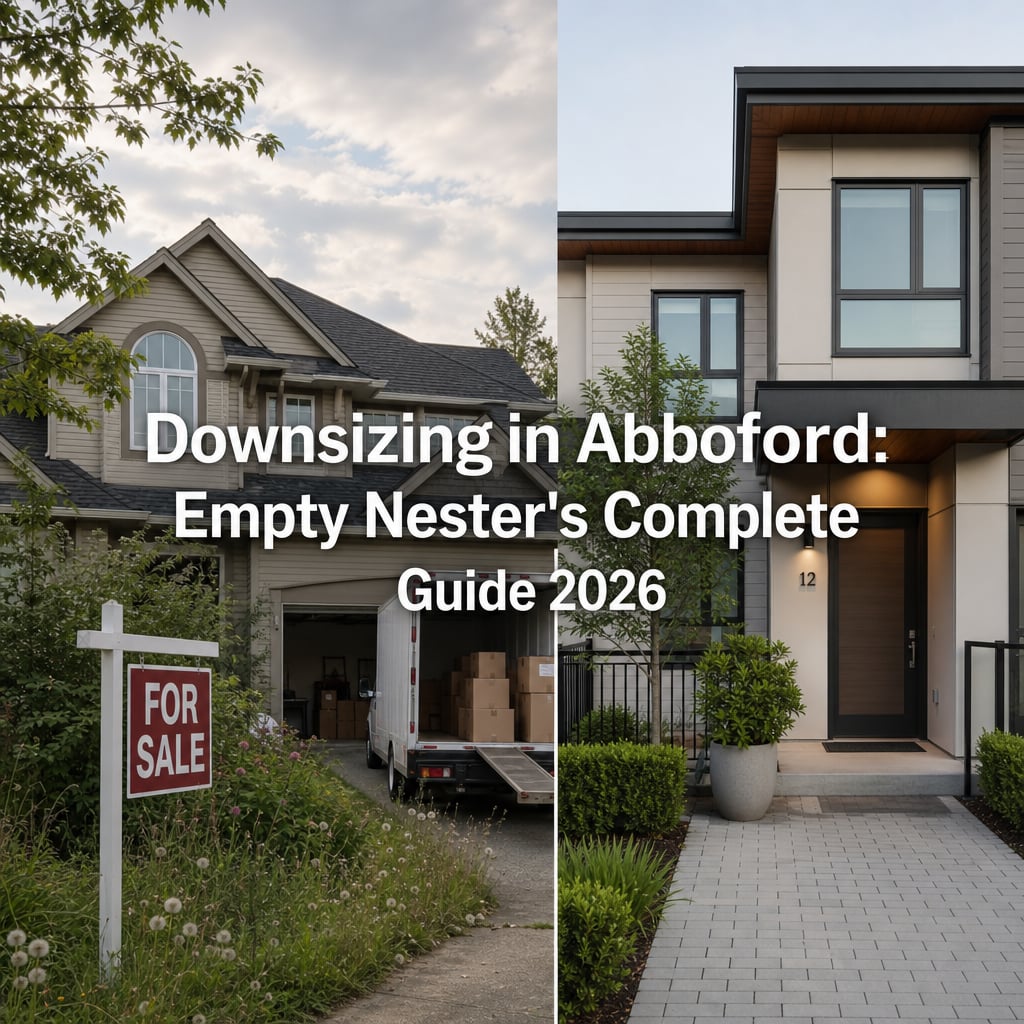

The Emotional and Financial Reality of Downsizing From a Large Family Home to a Right-Sized Condo or Townhome in Abbotsford
By Mohamed Mansour, MBA, Associate Broker — Mansour Real Estate Group | Published: May 13, 2025 | Fraser Valley, BC | Abbotsford Real Estate | Life-Event Sales
For empty nesters in Abbotsford who have spent 25 or 30 years in a family home, the idea of downsizing has probably been circling for a while. The kids are gone. The bedrooms are empty. The maintenance costs keep climbing. The equity is real. But the decision is still hard to make, and for most families, harder to execute than anyone initially expects.
This guide addresses what standard seller content almost never does: the emotional friction, the adult children coordination, the estate contents problem, and the specific financial math that determines whether a downsizing transaction in Abbotsford actually improves your financial position in a 2026 buyer's market.
Short Answer
Abbotsford empty nesters who downsize from a large family home to a condo or townhome in 2026 typically free up $400K–$900K in net equity, but only if they account for property transfer tax, decluttering costs, strata due diligence, and spring market timing. The financial case is usually strong. The execution requires more planning than most families expect.
Who This Applies To
- Empty nesters in Abbotsford with adult children who have moved out within the last 1–5 years
- Homeowners aged 55–72 considering retirement or semi-retirement and looking to reduce carrying costs
- Couples managing differing timelines or readiness levels for selling the family home
- Families with significant estate contents, heirlooms, or furniture that adult children may want
- Owners of detached Abbotsford homes worth $800K–$1.5M considering a move to strata
When This Advice May Not Apply
If you are still actively caring for a family member in the home, if your mortgage balance significantly reduces net proceeds, or if your target property is outside BC’s strata system, some of the financial modeling and timing guidance below may not apply directly. Consult a licensed professional for advice tailored to your situation.
Key Takeaways
- Emotional delays average 6–12 months before listing; naming the friction reduces it
- Estate contents from large family homes cost $5K–$25K to declutter, liquidate, or store
- Property transfer tax on Abbotsford downsizing transactions typically runs $12K–$28K
- Sellers who address strata depreciation red flags upfront sell 15–25 days faster
- Spring 2026 listings closing before May 31 achieve meaningfully stronger pricing than summer
Key Terms
Depreciation Report: A required strata document assessing a building’s physical condition and future repair costs. Under BC’s Strata Property Act, most strata corporations must obtain one. Buyers and their lenders review this carefully.
Property Transfer Tax (PTT): A BC provincial tax payable on the purchase of real property. For most downsizing transactions in Abbotsford, PTT is 1% on the first $200K, 2% from $200K to $2M. First-time buyer exemptions do not apply at this life stage.
Special Levy: A one-time fee charged to strata owners to fund a large, unbudgeted repair. Special levy risk is a leading reason buyers and lenders reject older strata buildings.
Sales-to-Active Listings Ratio: A market health indicator used by the Fraser Valley Real Estate Board. Below 12% signals a buyer’s market. Above 20% signals a seller’s market. This ratio directly affects negotiating power.
Data Used in This Article
- Fraser Valley Real Estate Board (FVREB) sales statistics, April–May 2026 — official
- BC Real Estate Association market data, 2026 — official industry source
- Statistics Canada Census 2021 — demographic aging-in-place and relocation data — official
- CMHC senior housing transition research, 2025–2026 — official
- Mansour Real Estate Group internal transaction data, downsizing files 2024–2026 — professional observation
Why Downsizing Decisions Take Longer Than They Should
Research consistently shows that emotional attachment to a long-occupied family home is one of the primary reasons real estate decisions get delayed. In our experience working with Abbotsford downsizers, the gap between “we’ve been thinking about it” and an actual listing appointment is often 12 to 18 months longer than the homeowners expected when they first raised the idea.
The friction is not usually financial. It is relational. One spouse is ready. The other is not. The house holds the graduations, the holidays, the two decades of ordinary Tuesday evenings that are hard to separate from the walls that held them. That is legitimate, and it deserves to be named rather than rushed past.
What tends to move these conversations forward is not a market argument. It is a practical planning session with clear numbers: what the carrying costs of the current home actually are per year (property tax, utilities, maintenance, insurance), what the equity position looks like after transaction costs, and what the realistic monthly lifestyle improvement looks like on the other side.
According to Statistics Canada Census 2021 data, the majority of Abbotsford homeowners in the 55–74 age cohort have been in their current homes for more than 20 years. That tenure creates deep attachment and often a home that has not been staged, decluttered, or updated in some time — which directly affects both market preparation time and net proceeds.
The Estate Contents Problem: What Sellers Almost Always Underestimate
A 4–5 bedroom family home in Abbotsford accumulated over 25–30 years typically contains far more furniture, belongings, memorabilia, tools, and accumulated household inventory than a right-sized condo or townhome can absorb. This is not a sentimental observation — it is a practical transaction risk.
Sellers routinely underestimate both the time and the cost required to resolve estate contents before a listing goes live. Based on our direct experience with downsizing files in the Fraser Valley, decluttering, liquidating, donating, and storing the contents of a large family home typically costs between $5,000 and $25,000 when you account for estate sale services, junk removal, storage rental during the selling period, and any professional cleaning or staging afterward.
Adult children add a layer of complexity that is almost universal. Someone wants the dining set. Someone else was expecting the tools. The piano nobody plays has sentimental gravity that exceeds its practical value. Without a structured process for working through those conversations, these decisions stall at the worst possible moment — when your listing preparation timeline needs to be moving.
The practical solution is to hold a formal family meeting before listing preparation begins. Set a clear deadline for adult children to identify what they want and arrange removal. What remains after that deadline gets donated, liquidated, or disposed of on a seller’s schedule, not an adult child’s availability window. Abbotsford estate sale process guidance outlines how families can structure this before a listing date is set.
Net Proceeds Math That Most Downsizers Get Wrong
The equity position in a large Abbotsford family home is often real and significant. Homeowners in the $900K–$1.3M range with mortgages that are largely paid down are looking at gross proceeds that feel transformative. The net proceeds, after a full accounting of transaction costs, are frequently $80K–$150K lower than the initial mental estimate.
The items most commonly underestimated include: realtor commission on the sale, legal fees on both the sale and the purchase, property transfer tax on the new purchase (which ranges $12K–$28K depending on the price of the condo or townhome), bridge financing if timing doesn’t align, moving costs, and the estate contents resolution costs discussed above.
On the buy side, strata fees add an ongoing monthly cost that detached homeowners often underweight in their lifestyle math. A townhome in Abbotsford with a $450 monthly strata fee represents $5,400 per year in fixed carrying costs — a real number that belongs in any comparison to the detached home’s annual property tax and maintenance reserve.
According to FVREB April–May 2026 data, Abbotsford’s strata market has approximately 350+ active units, giving buyers meaningful choice and negotiating leverage. That same inventory level creates pricing pressure for sellers of older or under-maintained strata properties. The spread between well-positioned and poorly-positioned strata listings in Abbotsford is not small.
How We Evaluate Downsizing Transactions
At Mansour Real Estate Group, we approach downsizing files with a net-proceeds-first framework. Before a listing date is set, we work through a full transaction cost model with the homeowner that includes both sides of the transaction — the sale and the purchase — so that the equity release number is accurate from the start.
We also evaluate the target property type — condo versus townhome, age of building, strata document quality, depreciation report status, and special levy exposure — before recommending a purchase. In a buyer’s market, the right purchase matters as much as the sale price. Sellers who move into a strata property with undisclosed levy risk have not improved their financial position — they have relocated it.
Strata Due Diligence: What Buyers Are Scrutinizing in Abbotsford
Abbotsford’s strata market includes a mix of well-managed newer townhome developments and older concrete or wood-frame buildings where depreciation reports flag deferred maintenance. Buyers in 2026 are more document-aware than at any prior point, and their lenders increasingly require review of depreciation reports, Form B Information Certificates, meeting minutes, and special levy history before approving financing.
Under BC’s Strata Property Act, depreciation reports are required for most strata corporations of 5 or more units. From July 1, 2024, updated regulations tightened the renewal schedule. Buyers encountering a strata without a current depreciation report, or one that flags significant near-term repair costs without adequate contingency reserve funding, will either reduce their offer substantially or walk away.
In our experience, sellers who obtain and review the depreciation report before listing — and who can address or contextualize any flagged items — consistently sell 15–25 days faster than comparable properties where buyers discover document problems after offer acceptance. Transparency here is a direct financial advantage.
Spring 2026 Timing: Why the Window Matters for Abbotsford Sellers
According to FVREB sales statistics for April–May 2026, Abbotsford’s spring buyer pool is meaningfully more active than the summer period. Families relocating from Metro Vancouver, younger buyers benefiting from improved mortgage conditions, and downsizers purchasing into Abbotsford from more expensive markets all concentrate their search activity in the February–May window.
Listings that go live after June 1 typically face a summer inventory surge that compresses negotiating power. For a downsizing seller who is not yet under time pressure from a purchase commitment, it can feel reasonable to wait. In a buyer’s market, that wait frequently costs $30K–$60K in final sale price. The carrying costs of the large family home during that delay add to the loss. Fraser Valley spring 2026 seller timing strategy provides the broader market context that supports this recommendation.
Downsizing Checklist for Abbotsford Empty Nesters
- Run a full net proceeds model before committing to a timeline — include PTT, legal fees, moving, and estate contents costs on both sides
- Hold a formal family meeting with adult children to identify and schedule removal of wanted items within a fixed deadline
- Hire an estate liquidator or junk removal service for everything remaining after the family meeting deadline passes
- Commission a pre-listing valuation from Mansour Real Estate Group that accounts for current Abbotsford detached market conditions and buyer expectations
- Identify target strata properties early and review depreciation reports, Form B, and meeting minutes before making an offer
- Confirm mortgage pre-approval or bridge financing if buying before the family home sells
- List before May 31, 2026 to capture the spring buyer pool before summer inventory reduces negotiating leverage
- Allocate 6–8 weeks for listing preparation from the day the decision is confirmed — not from when the emotional conversation began
What We Commonly See
In our experience, the most common financial mistake in downsizing transactions is calculating net proceeds from the sale price alone, without subtracting the full cost of resolving estate contents, property transfer tax on the new purchase, and bridge financing during the transition gap. The surprise is rarely small — it is often $80K–$120K below the homeowner’s initial estimate.
What often happens is that one spouse is emotionally ready to move and the other is not, but neither names it directly. Instead, the reluctant spouse raises practical objections — the market isn’t right, the kids haven’t cleared out their things, the basement isn’t cleaned up yet — that can extend the delay by a year or more. A direct, structured planning conversation with a trusted real estate advisor often surfaces the real sticking point faster than months of indirect discussion.
A common mistake is purchasing a target strata property based on the listing price and unit quality without reviewing the depreciation report and contingency reserve fund balance. Sellers who move into a building with a depleted reserve fund and upcoming major repairs have transferred financial risk, not reduced it. We routinely advise Abbotsford downsizers to evaluate the strata financial health with the same rigor as the physical property.
Questions and Answers
How much equity do Abbotsford downsizers typically free up in 2026?
Based on current FVREB data and Mansour Real Estate Group transaction experience, Abbotsford homeowners downsizing from a detached property in the $900K–$1.3M range to a condo or townhome in the $500K–$750K range typically free up $300K–$700K in net equity after all transaction costs are accounted for. The specific figure depends on mortgage balance, PTT, legal fees, and estate contents resolution costs.
What is the property transfer tax on a $650,000 Abbotsford townhome purchase?
For a purchase at $650,000, PTT is calculated as 1% on the first $200,000 ($2,000) and 2% on the remaining $450,000 ($9,000), totaling $11,000. Most empty nesters do not qualify for first-time buyer exemptions. Consult a BC lawyer for confirmation specific to your transaction.
How do I know if a strata building in Abbotsford has special levy risk?
Request the strata corporation’s current depreciation report, the Form B Information Certificate, and the last 2 years of meeting minutes. A depleted contingency reserve fund combined with flagged major repairs in the depreciation report is the clearest signal of elevated special levy risk. Your real estate agent and a strata lawyer should review these together before any offer is made.
In Summary
Downsizing from a large family home in Abbotsford is one of the highest-equity real estate decisions most homeowners will ever make, and it is also one of the most emotionally and logistically complex. The financial case for moving is usually strong. The execution requires a structured process: a full net proceeds model before any commitment, a formal family meeting to resolve estate contents, disciplined strata due diligence on the purchase side, and a spring listing timeline that captures Abbotsford’s strongest buyer pool before the summer inventory surge. Families who plan this transition carefully protect their equity. Those who delay or improvise typically leave the most on the table.
Ready to Talk Through Your Numbers?
If you are an Abbotsford empty nester thinking about what a move would actually look like — financially and practically — Mansour Real Estate Group offers a no-obligation downsizing consultation that starts with a full net proceeds model, not a sales pitch. Reach out to start a conversation when the timing feels right for your family.
Related Articles
- Fraser Valley Spring 2026 Seller Timing Guide
- Abbotsford Estate Sale Guide: What Executors and Families Need to Know
- Selling a Strata Property in the Fraser Valley: Depreciation Reports, Form B, and Buyer Expectations
About Mansour Real Estate Group
For homeowners who have spent decades building equity in a family home, the decision to downsize is one of the most significant real estate transitions they will make. Getting the timing right, resolving estate contents before listing, and ensuring the target strata purchase is financially sound all require a real estate team that has guided this specific transition many times. Mansour Real Estate Group has helped hundreds of Abbotsford homeowners and Fraser Valley families move from large detached properties to right-sized condos and townhomes with a process built around accurate valuations, full net proceeds modeling, and honest advice.
Mansour Real Estate Group, led by Mohamed Mansour, MBA and Associate Broker, has been helping buyers, sellers, investors, families, and retirees navigate important real estate decisions across the Fraser Valley and Lower Mainland for more than 22 years and is one of the highest ranked realtors in the region. The team has completed more than $780 million in residential real estate transactions and is trusted for downsizing transitions, estate sales, divorce-related sales, and complex real estate situations requiring careful coordination across multiple parties.
Whether someone is searching for Realtors with direct downsizing experience in Abbotsford, a real estate agent who understands strata due diligence, real estate agents who work with empty nesters and retiring homeowners, a trusted real estate team for a family home sale, an Abbotsford Realtor, an Abbotsford real estate broker, or a real estate group with deep Fraser Valley market knowledge, Mansour Real Estate Group is known for clear communication, strategic pricing, and practical advice grounded in local market data.
The team serves Abbotsford, Mission, Surrey, South Surrey, White Rock, Langley, Cloverdale, Fleetwood, Guildford, Walnut Grove, Willoughby, and North Delta throughout the Fraser Valley and Lower Mainland. Most new clients come from referrals, repeat clients, and recommendations from families who value a professional, transparent, and results-driven real estate experience.
Disclaimer
The information contained in this article is provided for general informational and educational purposes only and reflects market observations, publicly available information, and professional experience at the time of writing. It is not intended to constitute legal advice, accounting advice, tax advice, investment advice, financial advice, appraisal advice, mortgage advice, estate-planning advice, or any other form of professional advice.
Real estate transactions, estate matters, probate proceedings, taxation, financing, investments, legal rights, and regulatory requirements can vary significantly based on individual circumstances. Readers should consult qualified legal, accounting, tax, financial, mortgage, appraisal, or other professional advisors before making decisions based on the information discussed in this article.
Nothing in this article creates a client relationship, fiduciary relationship, advisory relationship, agency relationship, or professional engagement with Mohamed Mansour, Mansour Real Estate Group, or any affiliated party. Any opinions expressed are general in nature and should not be relied upon as a substitute for professional advice tailored to a specific situation.
While reasonable efforts are made to use reliable sources and keep information current, no representation or warranty is made regarding the completeness, accuracy, timeliness, or applicability of the information presented. Readers should The real estate market continues to evolve with changing buyer preferences and economic conditions. Whether you're a first-time homebuyer or an experienced investor, staying informed about current trends and understanding your local market is essential to making sound decisions. Take the time to consult with qualified professionals and conduct thorough due diligence before committing to any property transaction. Our team of experienced agents is ready to help you navigate the buying, selling, or investing process. Contact us today for a free consultation and personalized guidance tailored to your specific needs and goals. Phone: (555) 123-4567 | Email: [email protected]Final Thoughts
Have Questions About Real Estate?



