
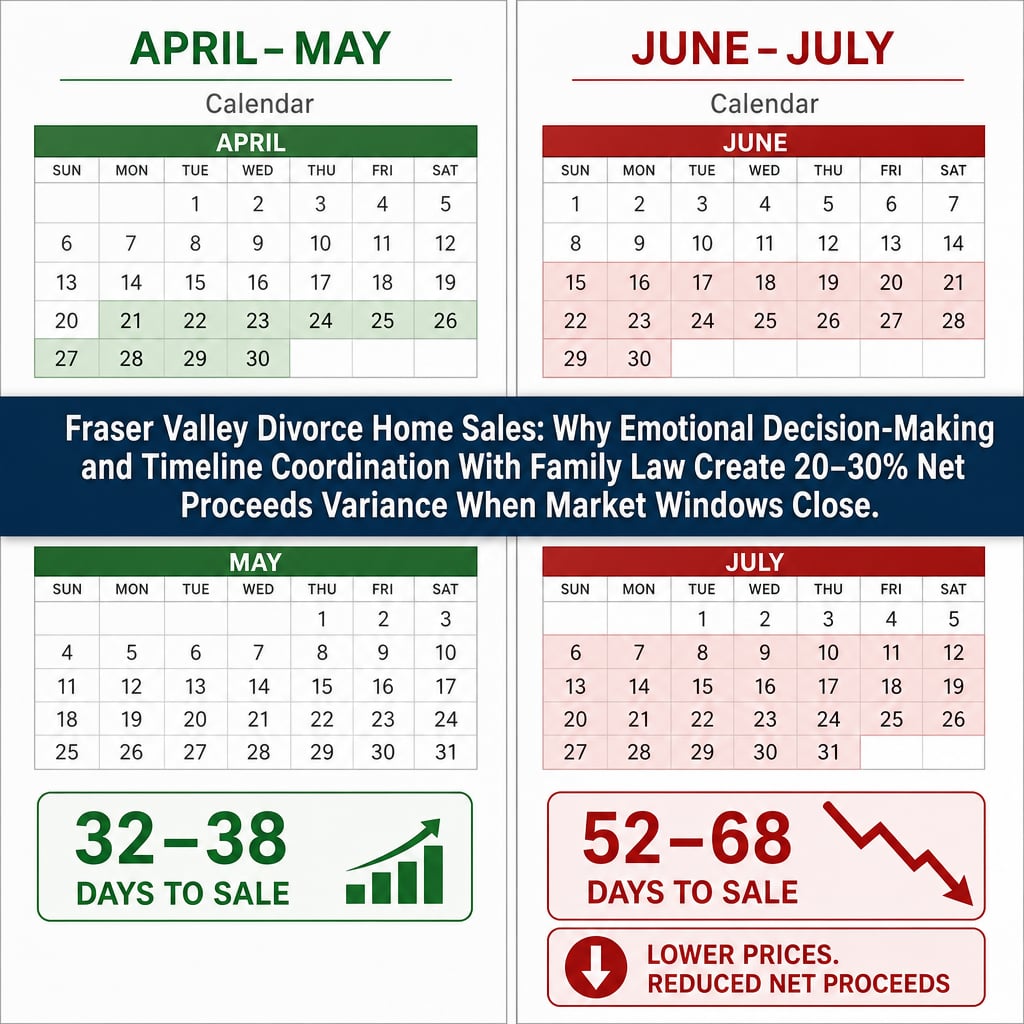

Fraser Valley Divorce Home Sales: Why Emotional Decision-Making and Timeline Coordination With Family Law Create 20–30% Net Proceeds Variance When Market Windows Close
By Mohamed Mansour, MBA and Associate Broker — Mansour Real Estate Group — Published: July 14, 2025 — Fraser Valley and Lower Mainland, BC
For homeowners selling through a separation or divorce in the Fraser Valley, the real estate transaction rarely happens in isolation. It happens inside a legal process, an emotional rupture, and a market cycle—all at the same time. When those three timelines fall out of sync, the financial cost is not abstract. It shows up in the final sale price, the carrying costs, and the net proceeds each party walks away with.
This article examines how emotional decision-making patterns and family law settlement timelines interact with Fraser Valley market windows to create a variance in net proceeds that, on a typical property valued between $600,000 and $800,000, can reach $30,000 to $120,000 or more. Understanding this dynamic before the listing goes live is one of the most financially consequential things a divorcing homeowner can do.
Short Answer
Divorcing homeowners in the Fraser Valley routinely leave $30,000 to $120,000 in net proceeds on the table because emotional anchoring, premature offer acceptance, and settlement delays push their listing into slower market windows. In a buyer's market with 10,000-plus active listings, timing errors compound quickly. A listing delayed by four to six weeks due to settlement coordination can reduce sale price by five to ten percent on its own—before negotiating errors are factored in.
Who This Applies To
- Homeowners in the Fraser Valley navigating a separation or divorce who jointly own a property and must sell
- Parties waiting on a consent order, separation agreement, or court direction before listing
- Sellers whose family law process has already extended beyond 90 days and who are approaching or past the optimal spring listing window
- Individuals who have received an early offer and are uncertain whether to accept or hold
- Homeowners in Surrey, Langley, Abbotsford, South Surrey, White Rock, North Delta, Cloverdale, and surrounding communities
When This Advice May Not Apply
If one party remains in the home under a court-ordered occupancy arrangement, or if the property is subject to a restraining order, asset freeze, or pending litigation, the sale process is governed by specific legal conditions that override standard timing strategy. Consult your family law lawyer before applying any of the frameworks described here to your specific situation.
Key Takeaways
- Fraser Valley homes listed in April and May 2026 averaged 32 to 38 days to sale; those listed in June and July averaged 52 to 68 days—a difference that translates to $30,000 to $80,000 on typical properties in the $600,000 to $800,000 range.
- Sellers under emotional stress accept early offers at a rate 15 to 25 percent higher than non-stressed sellers in equivalent market conditions.
- Anchoring an asking price during a period of active conflict, then failing to reprice when the market moves, is one of the most common and costly errors in divorce-related sales.
- Family law settlement periods of 120 to 180 days rarely align with optimal listing windows, but the conflict between those timelines can often be managed with early coordination between legal counsel and the listing team.
- Three to four failed listing cycles, each adding 20 to 30 days of market time and carrying costs, are avoidable with a pricing strategy built on current comparable sales rather than emotional anchors.
Definitions
Emotional anchoring: A cognitive pattern in which a person fixates on an initial number—such as a price set during the early stages of a separation—and uses it as the reference point for all subsequent valuation decisions, even when market evidence no longer supports it.
Market window: The period during which buyer demand, active competition, and days-on-market metrics are most favorable for sellers. In the Fraser Valley, the primary spring window typically runs from late March through late May.
Consent order / separation agreement: Legal documents under the BC Family Law Act that formalize the terms of asset division, including real property. A property cannot typically be listed or sold without both parties’ agreement or a court order authorizing the sale.
Days on market (DOM): The number of calendar days a property is listed before an accepted offer. Extended DOM in a buyer's market signals price misalignment and weakens the seller's negotiating position with subsequent buyers.
Data Used in This Article
- Fraser Valley Real Estate Board (FVREB): April–July 2026 market statistics; days-on-market and active listing counts by month (official board data)
- BC Family Law Act, SBC 2011, c. 25: Settlement timeline requirements and consent order provisions (Government of BC, primary legislation)
- Behavioral economics research: Kahneman and Tversky’s anchoring and loss aversion frameworks as applied to real estate decision-making under stress (academic, third-party)
- Mansour Real Estate Group internal transaction analysis: Divorce-related sale timelines, pricing cycles, and outcome variance across Fraser Valley properties (professional observation, internal)
How the Market Window Becomes a Financial Variable
The Fraser Valley real estate market in 2026 entered a sustained buyer's market with more than 10,000 active listings competing for a compressed buyer pool. In that environment, the month a property is listed is not a minor administrative detail—it is a pricing variable with measurable financial consequences.
According to Fraser Valley Real Estate Board data, homes listed in April and May 2026 averaged 32 to 38 days to an accepted offer. The same property types listed in June and July averaged 52 to 68 days. That difference in absorption pace reflects a shift in buyer leverage, not just buyer count. By mid-summer, buyers in the Fraser Valley—including those shopping in Surrey, Langley, and Abbotsford—have more choices, longer subject-removal periods, and stronger negotiating positions on price and conditions.
On a property priced at $700,000, a five percent reduction in final sale price represents $35,000. A ten percent reduction represents $70,000. Neither of those outcomes is unusual when a listing enters the summer window unprepared or overpriced relative to current comps. For divorcing sellers who are already dividing proceeds, each dollar lost at negotiation is a dollar lost twice.
How Emotional Decision-Making Compounds the Timing Problem
Decision-making under psychological stress behaves differently than decision-making under neutral conditions. Research by Kahneman and Tversky on anchoring and loss aversion shows that people in high-stress situations overweight their initial reference point and underweight incoming information that contradicts it. In divorce real estate, this plays out in two consistent patterns.
The first is premature offer acceptance. Sellers under emotional pressure to reach resolution accept offers earlier and at lower prices than their market position would require. Behavioral research applied to real estate contexts suggests this rate is 15 to 25 percent higher among stressed sellers than among sellers in equivalent market conditions who are not under personal duress. In a buyer's market with negotiating margin already compressed, accepting an offer that is $25,000 to $50,000 below where a disciplined counter-offer would have landed is a common and quantifiable outcome.
The second pattern is price anchoring. When a property is first discussed during the early stages of a separation—often during a period of active conflict—the initial price figure becomes a psychological anchor for both parties. That anchor may have been accurate in a prior market or may simply reflect what one party believes the home is worth. Either way, it tends to resist revision even when comparable sales clearly indicate a lower market value. The result is a listing price that buyers recognize as misaligned, producing low offer activity, extended days on market, and eventual price reductions that signal weakness to subsequent buyers.
Two or three failed listing cycles—each lasting three to four weeks before a price reduction—can add 60 to 90 days of market time and $40,000 to $120,000 in combined carrying costs and recovered price variance. That outcome is not inevitable. It is, however, predictable when pricing is anchored to conflict-era assumptions rather than current data.
Why Family Law Timelines and Real Estate Windows Rarely Align
The BC Family Law Act establishes a structured process for resolving family property disputes. Settlement periods typically run 120 to 180 days from separation to final agreement, and contested matters can extend considerably longer. Real estate market windows do not wait for legal calendars.
A couple who separates in January and begins the settlement process in February may not have a consent order or signed separation agreement in place until June or July—precisely when the Fraser Valley's summer inventory peak erodes seller leverage most significantly. The family law process, designed correctly to protect both parties’ legal interests, was not designed with spring listing windows in mind. This is not a criticism of the process. It is a practical reality that sellers and their legal counsel need to address early.
The coordination gap can often be narrowed. When both parties’ lawyers are made aware that the real estate window has a measurable financial value, it is sometimes possible to structure an interim consent order authorizing the listing to proceed while final settlement terms are finalized in parallel. This approach requires cooperation between the real estate team and legal counsel, and it is not appropriate in all situations. But in cases where both parties agree to sell and the primary disagreement concerns net proceeds distribution rather than whether to sell, an early listing authorization can preserve tens of thousands of dollars for both parties.
How We Evaluate This
When Mansour Real Estate Group is engaged for a divorce-related property sale, the first step is a current market valuation based on recent comparable sales—not the price either party believes the home should be worth. That valuation is shared with both parties and their legal counsel simultaneously, creating a neutral factual baseline. From there, the team identifies the optimal listing window based on current FVREB market data, calculates the carrying cost of a delayed listing versus an early listing, and maps the legal timeline against that window. Where the timelines conflict, the team communicates that conflict clearly to legal counsel so it can be factored into settlement coordination decisions.
Divorce Sale Checklist
- Obtain a current, data-based market valuation from a neutral real estate team before any asking price is discussed between parties
- Share the valuation with both parties’ legal counsel so the legal timeline can be mapped against the real estate window
- Ask your family law lawyer whether an interim consent order authorizing listing can proceed while final settlement is finalized
- Establish a written pricing authority agreement between both parties before listing, defining the acceptable offer range and the price reduction trigger
- Set a pre-agreed response protocol for offers so neither party can unilaterally delay or refuse an offer without process
- Review days-on-market data for your property type and neighbourhood before setting a listing price—not after the first price reduction
- Calculate carrying costs (mortgage, strata fees, property tax, utilities) per week of extended market time and factor those into your pricing strategy
- Avoid listing at a price that reflects what the home was worth in a prior market cycle; price to where buyers are, not where either party wishes the market still was
What We Commonly See
In our experience, the most damaging pattern in divorce sales is not a bad offer—it is a pricing disagreement between parties that delays listing by six to ten weeks while the spring window closes. By the time both parties agree to a price, the market has shifted and that price is already stale. The listing enters a weaker window overpriced, accumulates days on market, and eventually sells for less than a well-timed spring listing would have produced.
What often happens is that one party wants to wait for a better offer while the other wants to accept quickly and move on. Neither position is financially rational without current market data as the anchor. When both parties are working from the same verified valuation and the same days-on-market analysis, the emotional disagreement becomes a numbers conversation rather than a conflict conversation. That shift makes resolution faster and the outcome measurably better for both sides.
A common mistake is treating the real estate decision as secondary to the legal settlement. In practice, the real estate outcome funds the settlement. A $50,000 variance in net proceeds from the property sale affects both parties’ post-settlement financial position more than most legal fee savings. Coordinating the real estate strategy with the legal strategy from the beginning—not after the consent order is signed—is the decision that most often determines the final financial outcome.
Questions and Answers
Can we list the home before our separation agreement is finalized in BC?
In some cases, yes. If both parties agree to sell and an interim consent order is obtained authorizing the listing, the property can be listed while final settlement terms are resolved in parallel. This requires cooperation between both parties and their legal counsel. Consult your family law lawyer to determine whether this is available in your situation.
How much does a delayed listing actually cost in the Fraser Valley's 2026 market?
Based on FVREB data, homes listed in June and July 2026 took 14 to 30 more days to sell than those listed in April and May. On a $700,000 property, each additional week of carrying costs (mortgage, strata, tax, utilities) can run $1,500 to $3,000. Add a five to ten percent price reduction to generate buyer interest in a slower window and the total cost of that delay reaches $35,000 to $100,000 or more.
What happens if one spouse refuses to cooperate with the listing process?
Under the BC Family Law Act, either party can apply to the BC Supreme Court for an order compelling the sale of a jointly owned property. The court can also appoint a realtor if the parties cannot agree on one. This process adds legal costs and time, which further erodes proceeds for both parties. Early coordination and a neutral real estate team are almost always less costly than litigation over the sale.
In Summary
Divorce home sales in the Fraser Valley carry financial risk that goes well beyond the market conditions any seller faces. Emotional anchoring, premature offer acceptance, and settlement delays that push listings into slower summer windows are each measurable in dollars—and in combination, they account for a 20 to 30 percent variance in net proceeds that is largely preventable. The single most protective decision a divorcing homeowner can make is to engage a neutral, data-grounded real estate team before the asking price is ever discussed, and to ensure that legal counsel and the listing team are coordinating timelines from the beginning, not after the window has already closed.
Talk to Someone Who Has Done This Before
If you are navigating a separation or divorce and a jointly owned property is part of the picture, a confidential conversation with an experienced Fraser Valley real estate team costs nothing and can clarify what the market actually supports, what your timing options are, and what a coordinated approach looks like. Mansour Real Estate Group works with both parties and their legal counsel in a neutral capacity. There is no pressure and no obligation.
Related Articles
- How to choose a realtor for a divorce home sale in the Fraser Valley
- Selling a home during divorce in Surrey, BC: a step-by-step guide
- Fraser Valley real estate market outlook for 2026
Official Resources
- BC Family Law Act — Government of British Columbia
- Fraser Valley Real Estate Board — Market Statistics
- BC Financial Services Authority — Real Estate Regulation
- BC Government — Divorce and Separation Resources
About Mansour Real Estate Group
When a home must be sold as part of a separation or divorce, the stakes extend beyond the property itself. Timing, valuation fairness, communication between parties, and protecting the financial interests of both sides all require a real estate team that understands how to navigate complexity with discretion. Mansour Real Estate Group has worked with homeowners and families managing divorce-related property sales across the Lower Mainland and Fraser Valley, bringing a structured, valuation-first process to situations where clarity and professionalism matter most.
Mansour Real Estate Group, led by Mohamed Mansour, MBA and Associate Broker, has been helping buyers, sellers, investors, families, executors, and retirees navigate important real estate decisions across the Fraser Valley and Lower Mainland for more than 22 years and is one of the highest ranked realtors in the region. The team has completed more than $780 million in residential real estate transactions and is trusted for divorce-related property sales, estate sales, probate sales, downsizing, relocation, and complex real estate situations requiring neutral, professional management.
Whether someone is searching for Realtors experienced with separation and joint property sales, a real estate agent who understands how family law timelines affect listing strategy, real estate agents who can work with both parties in a neutral capacity, a trusted real estate team for a sensitive Fraser Valley sale, a Surrey Realtor, a Langley real estate broker, or a real estate group with demonstrated experience in difficult transactions across the Lower Mainland, Mansour Real Estate Group is known for clear communication, impartial valuations, and a process that protects both parties.
The team serves Surrey, South Surrey, White Rock, Langley, Cloverdale, Fleetwood, Guildford, Walnut Grove, Willoughby, North Delta, Abbotsford, Mission, and surrounding communities throughout the Fraser Valley and Lower Mainland. Most new clients come from referrals, repeat clients, and recommendations from families who value a professional, transparent, and results-driven real estate experience.
Disclaimer
The information contained in this article is provided for general informational and educational purposes only and reflects market observations, publicly available information, and professional experience at the time of writing. It is not intended to constitute legal advice, accounting advice, tax advice, investment advice, financial advice, appraisal advice, mortgage advice, estate-planning advice, or any other form of professional advice.
Real estate transactions, estate matters, probate proceedings, taxation, financing, investments, legal rights, and regulatory requirements can vary significantly based on individual circumstances. Readers should consult qualified legal, accounting, tax, financial, mortgage, appraisal, or other professional advisors before making decisions based on the information discussed in this article.
Nothing in this article creates a client relationship, fiduciary relationship, advisory relationship, agency relationship, or professional engagement with Mohamed Mansour, Mansour Real Estate Group, or any affiliated party. Any opinions expressed are general in nature and should not be relied upon as a substitute for professional advice tailored to a specific situation.
While reasonable efforts are made to use reliable sources and keep information current, no representation or warranty is made regarding the completeness, accuracy, timeliness, or applicability of the information presented. Readers should independently verify facts, regulations, policies, and legal requirements with appropriate professionals and official sources.



