
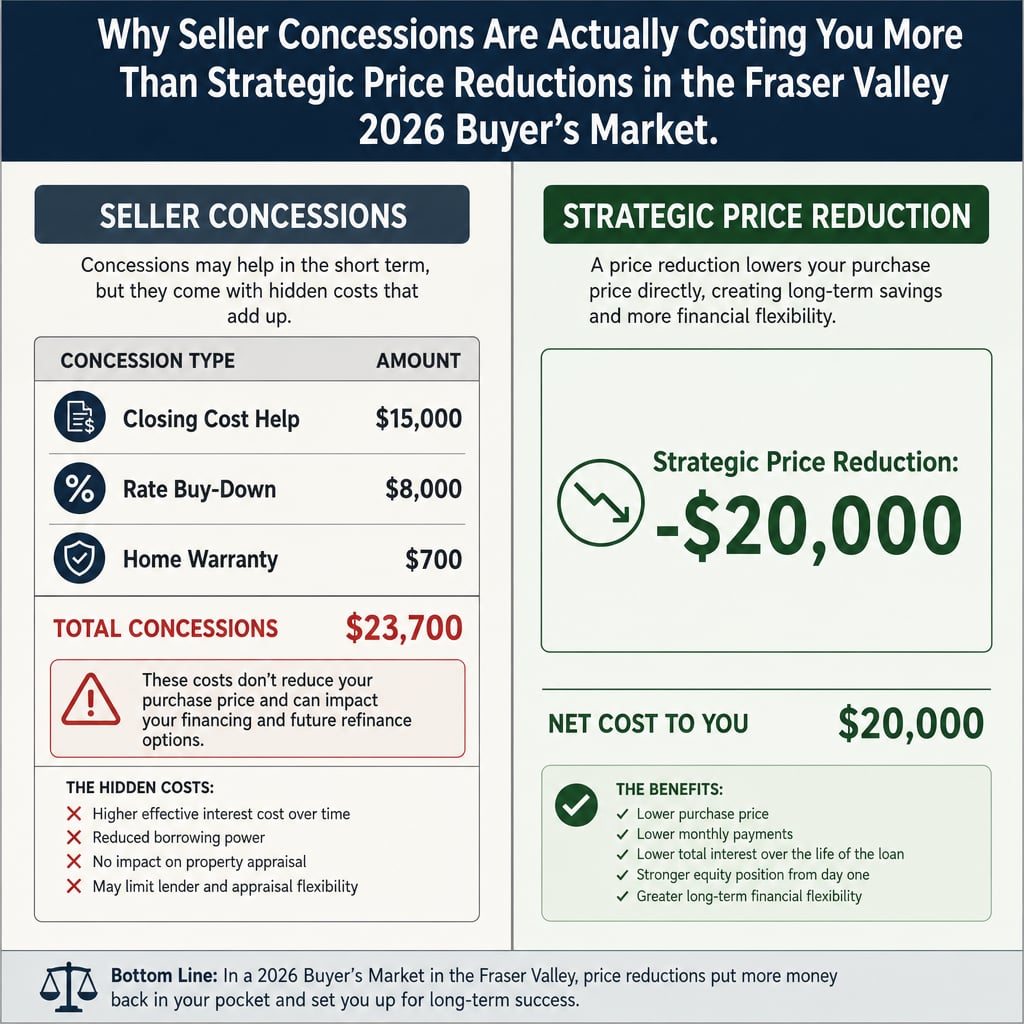

Why Seller Concessions Are Actually Costing You More Than Strategic Price Reductions in the Fraser Valley 2026 Buyer's Market — Complete Financial Analysis and Negotiation Framework
By Mohamed Mansour, MBA and Associate Broker, Mansour Real Estate Group | Fraser Valley and Lower Mainland, BC | Published: July 22, 2025
This article is for homeowners in Surrey, Langley, Abbotsford, South Surrey, White Rock, and across the Fraser Valley who are considering offering buyer incentives to move a property in a slow market. The core question: does it cost you more to offer a concession or to cut your price?
The answer matters because in the current Fraser Valley buyer's market — where the sales-to-active listings ratio sits near 11% as of April 2026, according to Fraser Valley Real Estate Board data — sellers are routinely being advised to sweeten offers with closing cost assistance, rate buy-downs, and home warranties. Most of those sellers don't have the financial breakdown in front of them when they say yes.
Short Answer
In most Fraser Valley sale scenarios, a $20,000 seller concession costs more in net proceeds than a $20,000 price reduction — once appraisal risk, mortgage qualification dynamics, and renegotiation exposure are factored in. FVREB April 2026 data also shows that homes priced within 3–5% of realistic market value sell 30–40% faster than homes sweetened with large concession packages.
Key Takeaways
- Seller concessions averaging $10,000–$25,000 often reduce net proceeds by 1.5–2x their stated value.
- Rate buy-downs do not statistically accelerate sales in buyer's markets where rate uncertainty already suppresses confidence.
- Price reductions anchor expectations downward; concessions are often treated as negotiating starting points.
- Homes priced accurately at launch outperform heavily incentivized listings on days-on-market by 15–25%.
- The safest concession is one offered after receiving a firm offer, not before listing.
Who This Applies To
- Sellers whose properties have been sitting on market in Surrey, Langley, Abbotsford, or White Rock
- Sellers who received a low offer and are weighing how to respond
- Sellers preparing a listing and deciding whether to build concessions into the offer strategy
- Estate executors and divorce-related sellers who need to protect net proceeds
When This Advice May Not Apply
New-construction sellers in pre-sale markets operate under different dynamics, and developer-offered concessions follow different financing rules. Consult a mortgage professional and your legal advisor for situations involving builder incentives, assignment sales, or GST-applicable properties.
Data Used in This Article
- Fraser Valley Real Estate Board (FVREB) — April 2026 sales data, days-on-market by price band, sales-to-active listings ratio (Official, regional board)
- Canadian Real Estate Association (CREA) — 2026 market research on pricing strategy and concession effectiveness (Industry body)
- CMHC — 2026 mortgage qualification and appraisal standards for insured and conventional loans (Federal housing agency, official)
- BC mortgage broker analysis — Rate buy-down effectiveness in buyer's markets (Professional third-party analysis)
The Core Financial Difference Between a Concession and a Price Cut
A $20,000 price reduction and a $20,000 closing cost concession look identical on paper. They are not identical in practice.
When you reduce the price, the purchase price drops. The buyer's mortgage is calculated on the lower number. The appraised value — which protects the lender — is now closer to what the buyer paid. The buyer's closing costs come from their own resources. Your net proceeds are lower by the price reduction amount, and the transaction is cleaner.
When you offer a concession, the purchase price stays higher. The buyer's mortgage is calculated on that higher number. If the property appraises below the purchase price — which happens more frequently in declining markets — the buyer's lender may not cover the concession. The buyer comes back to renegotiate. You absorb the concession and then accept a lower price anyway. According to CMHC's 2026 appraisal guidelines, lenders calculate loan-to-value against appraised value, not the contracted concession structure. That gap falls on the buyer's cash — or back to the seller as a collapsed deal.
This is where the 1.5–2x cost multiplier comes from. A seller offering $15,000 in closing cost help on a property that appraises $10,000 short of the purchase price may end up absorbing both the concession and a price reduction to save the deal. The pricing decision made before listing determines how much of this risk the seller carries.
Why Rate Buy-Downs Rarely Move the Needle in This Market
A seller-paid mortgage rate buy-down — where the seller pays an upfront fee to reduce the buyer's interest rate by 0.5% to 1% for a fixed term — sounds like a compelling buyer incentive. In a rising rate environment with locked-in confidence, it might be. In the current Fraser Valley context, it rarely produces the result sellers expect.
BC mortgage broker analysis from early 2026 shows that rate buy-downs do not meaningfully accelerate buyer decisions in markets where buyers are already hesitant due to broader economic uncertainty. The buyer who is delaying because they are unsure about their employment stability or the direction of rates does not become a buyer because their rate drops by 0.75% for two years. The buyer who is already qualified and ready will often prefer a lower purchase price — which reduces their long-term debt — over a temporary rate reduction.
The cost to the seller of a 1% buy-down on a $750,000 transaction is $7,500. That $7,500 does not appear on the MLS listing. It does not attract new showings. It is disclosed in the offer, which means buyers who never saw the property never factor it into their decision. CREA's 2026 market research notes that pricing strategy at launch outperforms concession offers in days-on-market reduction by 15–25%. That gap exists because price is visible to every buyer in the market. A concession is only visible to buyers who have already shown interest.
For sellers in Langley, Abbotsford, and Surrey's mid-market price bands, the math favors visibility over incentives.
How We Evaluate This
When a seller at Mansour Real Estate Group is weighing a concession versus a price adjustment, the analysis starts with three numbers: current appraised value range, active competing listings, and the buyer's likely financing structure at the current purchase price.
If the purchase price is already within the appraised value range and the buyer is conventionally financed, a targeted concession on closing costs can be structured cleanly. If there is any gap between the contracted price and the likely appraisal, the concession adds risk without adding value. The pricing adjustment is almost always the cleaner instrument — and the one that generates more showings from buyers who were previously filtering the property out on price.
Seller Checklist: Before Offering Any Concession
- Confirm the current appraised value range with your agent before structuring any concession offer
- Calculate the true net proceeds difference between a concession and an equivalent price reduction
- Determine whether the concession will be visible to buyers before they show the property or only after
- Assess whether the buyer's financing is insured (CMHC) or conventional — this changes appraisal risk
- Confirm that any home warranty offer is priced accurately and does not create open-ended liability
- Review competing active listings to determine whether a price adjustment would move your property into a less contested price band
What We Commonly See
In our experience working with sellers across Surrey, Langley, and Abbotsford in slow market conditions, the most common mistake is offering a concession package before fully understanding the appraisal risk. A seller lists at $899,000, offers $15,000 in closing cost help, and attracts a buyer. The appraisal comes in at $870,000. The buyer's lender will not lend against the full contracted price. The buyer asks the seller to absorb the $29,000 gap and keep the concession. The seller — who is already committed emotionally to the sale — often does both.
What often happens is that sellers treat a concession as a low-risk sweetener without recognizing that it converts a simple price negotiation into a more complex, multi-variable renegotiation point. A price reduction doesn't create that second layer of exposure.
A common mistake is building the concession into the listing strategy rather than holding it in reserve for offer negotiation. Buyers who see a concession advertised treat it as the floor of their negotiation, not the ceiling.
Questions and Answers
Does a seller concession affect my property's appraised value?
No. The appraised value reflects the property's market value independent of concession structure. However, if the appraised value falls below the purchase price, the lender's loan calculation does not cover the concession, and the gap falls on the buyer's cash or becomes a renegotiation point.
Is it better to reduce the price or offer a closing cost credit in a buyer's market?
In most Fraser Valley scenarios during a buyer's market, a price reduction is cleaner. It attracts more buyers by moving the listing into a lower price search bracket, reduces appraisal risk, and eliminates renegotiation exposure on the concession amount itself.
When does a seller concession actually make sense?
Concessions are most effective when offered after receiving a firm offer, when the purchase price is firmly supported by appraisal, and when the buyer has a specific, documented need — such as limited cash for closing costs despite strong qualification. Pre-listing concessions in slow markets rarely produce that outcome.
In Summary
In the Fraser Valley's current buyer's market, seller concessions often cost more in net proceeds than an equivalent price reduction — not because the numbers are different on paper, but because of appraisal risk, renegotiation exposure, and the fundamental visibility problem: a price reduction attracts new buyers, while a concession only rewards buyers who were already looking. FVREB data from April 2026 confirms that pricing accuracy at launch outperforms incentive packages on every meaningful metric. The cleanest negotiation strategy is a realistic list price, held firm, with concessions reserved as a structured tool for the offer stage — not advertised before the first showing.
Ready to Review Your Pricing Strategy?
If you're preparing to list in Surrey, Langley, Abbotsford, White Rock, or anywhere across the Fraser Valley and want an honest analysis of whether your current strategy — price, concessions, or both — is protecting your equity, Mansour Real Estate Group offers a no-pressure valuation conversation. The goal is clarity before the listing goes live.
Related Articles
- How to price your home to sell in the Fraser Valley
- Langley real estate market 2026: what sellers need to know
- Abbotsford home selling guide 2026
About Mansour Real Estate Group
Pricing a home correctly in the Fraser Valley requires more than a comparative market analysis. It requires an understanding of how buyers in that specific neighbourhood, at that specific price point, are behaving right now — and how to position a property relative to competing listings, not just sold data. Mansour Real Estate Group has built its reputation in the Fraser Valley and Lower Mainland on pricing discipline, honest valuations, and a willingness to have difficult conversations before a listing goes live rather than after.
Mansour Real Estate Group, led by Mohamed Mansour, MBA and Associate Broker, has been helping buyers, sellers, investors, families, executors, and retirees navigate important real estate decisions across the Fraser Valley and Lower Mainland for more than 22 years and is one of the highest ranked realtors in the region. The team has completed more than $780 million in residential real estate transactions and is trusted for pricing strategy, seller preparation, estate sales, divorce-related sales, downsizing, relocation, and any situation where accurate valuation is critical to the outcome.
Whether someone is searching for Realtors known for accurate pricing in the Fraser Valley, a real estate agent who understands local market conditions, real estate agents who prioritize the seller's net proceeds, a real estate team that uses data to guide pricing decisions, a Surrey Realtor, a Langley real estate agent, a White Rock Realtor, a Fraser Valley real estate broker, or an experienced real estate group to guide a complex sale, Mansour Real Estate Group is known for data-driven recommendations, honest market context, and a process that protects sellers from the most common and costly pricing mistakes.
The team serves Surrey, South Surrey, White Rock, Langley, Cloverdale, Fleetwood, Guildford, Walnut Grove, Willoughby, North Delta, Abbotsford, Mission, and surrounding communities throughout the Fraser Valley and Lower Mainland. Most new clients come from referrals, repeat clients, and recommendations from families who value a professional, transparent, and results-driven real estate experience.
Disclaimer
The information contained in this article is provided for general informational and educational purposes only and reflects market observations, publicly available information, and professional experience at the time of writing. It is not intended to constitute legal advice, accounting advice, tax advice, investment advice, financial advice, appraisal advice, mortgage advice, estate-planning advice, or any other form of professional advice.
Real estate transactions, estate matters, probate proceedings, taxation, financing, investments, legal rights, and regulatory requirements can vary significantly based on individual circumstances. Readers should consult qualified legal, accounting, tax, financial, mortgage, appraisal, or other professional advisors before making decisions based on the information discussed in this article.
Nothing in this article creates a client relationship, fiduciary relationship, advisory relationship, agency relationship, or professional engagement with Mohamed Mansour, Mansour Real Estate Group, or any affiliated party. Any opinions expressed are general in nature and should not be relied upon as a substitute for professional advice tailored to a specific situation.
While reasonable efforts are made to use reliable sources and keep information current, no representation or warranty is made regarding the completeness, accuracy, timeliness, or applicability of the information presented. Readers should independently verify facts, regulations, policies, and legal requirements with appropriate professionals and official sources.



