
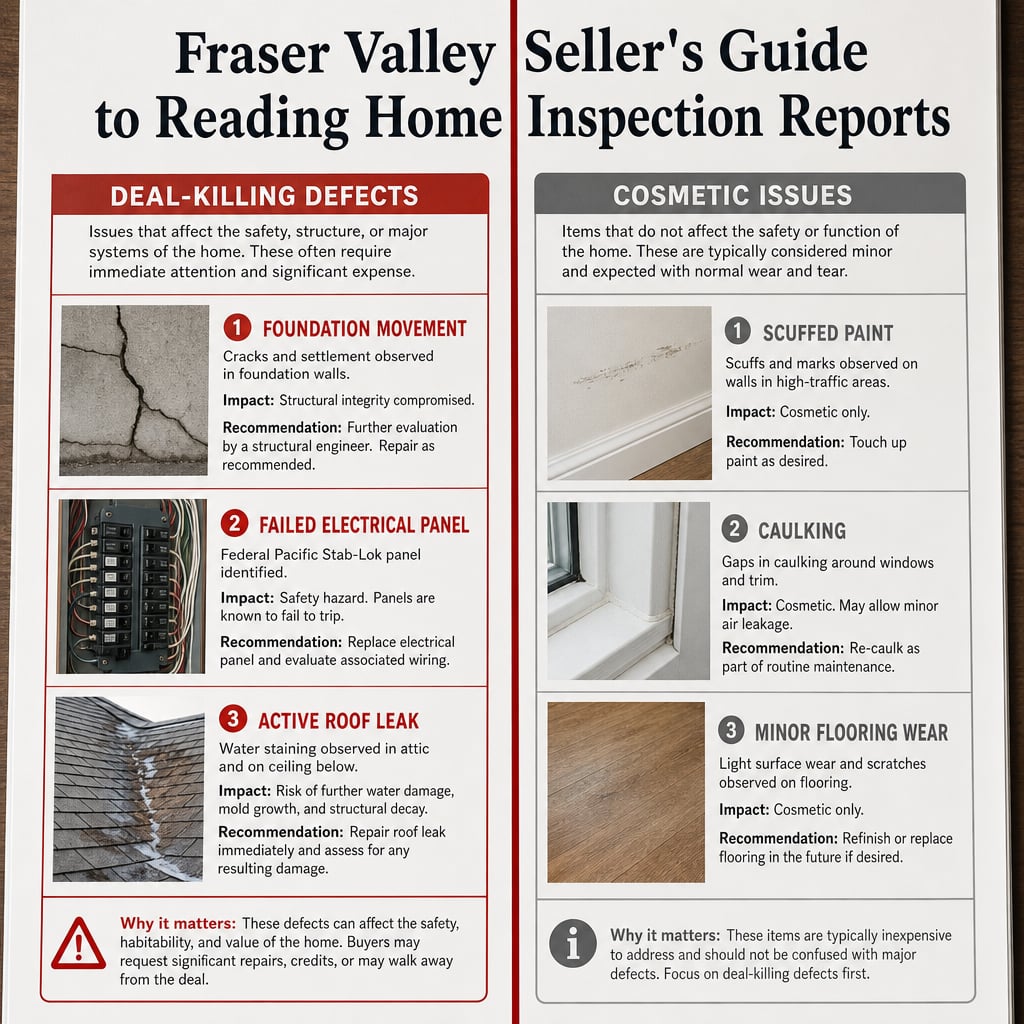

Fraser Valley Seller's Complete Guide to Reading Home Inspection Reports: Identifying Deal-Killing Defects vs. Cosmetic Issues, Strategic Disclosure, Price Impact, and Renegotiation Defense in a 2026 Buyer's Market
By Mohamed Mansour, MBA and Associate Broker · Mansour Real Estate Group · Fraser Valley and Lower Mainland · Published June 2026
In a 2026 Fraser Valley buyer's market, home inspections have shifted from a routine step into a strategic negotiation point. Buyers are keeping inspection conditions longer, inspection timelines are extending closings by one to two weeks, and post-inspection renegotiation requests have become a predictable part of nearly every transaction. Sellers who don't understand how to read an inspection report — and what to act on versus what to hold firm on — risk losing 5 to 10 percent of their net proceeds to unnecessary repairs or unjustified price cuts.
This guide is for Fraser Valley homeowners preparing to sell or currently navigating an accepted offer. It explains how to distinguish structural defects from cosmetic wear, how BC disclosure obligations apply, and how to respond to post-inspection renegotiation from a position of knowledge rather than anxiety.
Short Answer
Not every defect in an inspection report warrants repair or a price reduction. Structural and mechanical defects — foundation movement, active roof leaks, failed electrical panels, plumbing failures — can trigger financing denial and appraisal shortfalls. Cosmetic issues like scuffed paint, worn caulking, and minor flooring rarely affect lender decisions and don't justify pre-sale repair spending in a buyer's market. Sellers who understand this distinction protect their net proceeds.
Key Takeaways
- Structural and mechanical defects can cause buyer financing denial and trigger lender appraisal shortfalls of 3 to 8 percent.
- Cosmetic defects identified in inspections rarely justify pre-sale repair ROI in a buyer's market — hold firm on minor items.
- BC disclosure law requires sellers to reveal all known material defects — a pre-listing inspection creates knowledge, which creates obligation.
- Post-inspection renegotiation requests averaging 3 to 7 percent of purchase price are common in Fraser Valley 2026 transactions.
- Sellers with a documented, accurate understanding of their property's condition before listing are better positioned to defend against unjustified renegotiation.
Who This Applies To
- Fraser Valley homeowners currently preparing to list a property for sale
- Sellers who have accepted an offer subject to a home inspection condition
- Sellers who received a post-inspection renegotiation request and are evaluating how to respond
- Estate executors or co-owners selling a property with unknown maintenance history
- Sellers in Surrey, Langley, Abbotsford, White Rock, South Surrey, and surrounding Fraser Valley communities
When This Advice May Not Apply
Properties with active safety hazards — including asbestos-containing materials, knob-and-tube wiring under active use, or mould in occupied living spaces — require immediate professional assessment regardless of market conditions. This guide addresses strategic decision-making around typical inspection findings; it is not a substitute for advice from a licensed home inspector, structural engineer, or legal counsel where serious defects are involved.
Data Used in This Article
- Fraser Valley Real Estate Board (FVREB) — transaction and subject-condition data, 2026
- BC Real Estate Association (BCREA) — inspection timeline trend data, 2026 market reporting
- Canadian Association of Home and Property Inspectors (CAHPI) — defect categorization standards
- BC Property Law Act — seller disclosure obligations and known defect requirements
- Lender appraisal practice guidelines for BC residential transactions
How We Evaluate This
At Mansour Real Estate Group, we assess inspection findings through a net-proceeds lens. The question is never "what did the inspector find?" in isolation — it is "does this finding affect financing, appraisal, buyer ability to close, or seller liability if undisclosed?" That framework separates the items that genuinely require action from the items that a buyer's agent is using strategically to reopen price negotiations.
We review inspection reports alongside our knowledge of the current buyer pool in that neighbourhood, current lender appetite for the property type, and comparable transactions to determine what a reasonable response looks like — before the seller responds to any renegotiation request.
Deal-Killing Defects vs. Cosmetic Issues: The Core Distinction
Home inspectors working under CAHPI standards categorize findings from safety hazards to minor maintenance observations. Not all findings carry equal weight for sellers. The distinction that matters most in a real estate transaction is whether a defect affects a lender's willingness to fund the mortgage or a buyer's ability to obtain insurance.
Defects that can kill a deal or trigger appraisal shortfalls include: active foundation movement or settling, roof failure with active leakage, Federal Pacific or similar problematic electrical panels, knob-and-tube wiring, galvanized plumbing with pressure or corrosion failure, mould in mechanical or living spaces, asbestos in disturbed condition, and HVAC systems at end of functional life. Lenders in BC may decline to fund or require remediation confirmed by a certified professional before advancing mortgage funds. Appraisers may apply value adjustments of 3 to 8 percent for documented structural or mechanical defects, according to lender appraisal guidelines used across BC residential transactions.
Cosmetic findings — worn caulking around tubs, scuffed baseboards, aging but functional flooring, minor drywall cracks in settled areas, dated fixtures — do not affect lender decisions and do not trigger appraisal adjustments. In a Fraser Valley buyer's market, buyers and their agents sometimes present these findings alongside structural issues to create a larger renegotiation package. Sellers who cannot distinguish between the two are at a significant disadvantage at the negotiating table.
You can read more about how inspection timing intersects with Fraser Valley seller pricing strategy and how defect disclosures affect list-price positioning before a property goes to market.
Strategic Disclosure and Pre-Listing Inspection Decisions in BC
Under BC's Property Law Act and standard BCREA contract language, sellers are required to disclose all known material latent defects — defects that are not visible on a reasonable inspection and that affect the property's value or habitability. The operative word is "known." A pre-listing inspection creates knowledge, which means it creates disclosure obligation for everything the inspection reveals.
This is not a reason to avoid pre-listing inspections — it is a reason to understand what you are committing to before you order one. For sellers in Surrey, Langley, Abbotsford, or South Surrey with an older home and uncertain maintenance history, a pre-listing inspection can prevent far more expensive problems: a buyer's inspection revealing a significant defect mid-contract, triggering deal collapse after marketing costs and lost time. For sellers of a recently renovated property with documented work, a pre-listing inspection may add less value and more complexity.
When a pre-listing inspection does reveal structural or mechanical issues, sellers have three options: repair before listing and document the work, adjust the list price to reflect the known condition, or disclose and let the market price the risk. Each path has different financial implications depending on the defect type, cost of repair, and current buyer demand in that neighbourhood. Sellers considering estate sales with unknown property history in particular benefit from pre-listing inspections because executors can make repair and pricing decisions before buyers discover issues under contract pressure.
Seller Checklist: Before and After the Inspection
- Confirm with your Realtor whether a pre-listing inspection is strategic for your specific property type and neighbourhood before ordering one.
- Gather documentation for any recent repairs, replacements, or permitted work — roof, HVAC, electrical, plumbing, foundation — before the buyer's inspector arrives.
- Review the inspection report with your agent before responding to any buyer renegotiation request; separate structural findings from cosmetic observations.
- For each structural or mechanical finding, confirm whether the issue requires lender or insurer sign-off before the mortgage can be funded.
- Get at least one independent contractor quote for any defect before agreeing to a price reduction — buyers often request more than repair costs justify.
- Prepare a written response to renegotiation requests that distinguishes between items the seller will address and items the seller considers cosmetic and already reflected in the price.
- Consult legal counsel if the post-inspection request includes allegations of concealment or if findings touch on latent defects under BC property law.
What We Commonly See
In our experience working with sellers across Surrey, Langley, White Rock, and Abbotsford, the most common post-inspection renegotiation pattern is a bundled request — a buyer's agent combines two or three legitimate concerns with five or six cosmetic items and presents the total as justification for a 4 to 6 percent price reduction. Sellers who haven't reviewed the report carefully concede on the full package when the legitimate items may have justified only a 1 to 2 percent adjustment.
What often happens is that sellers over-repair before listing. In a buyer's market, spending $8,000 on cosmetic updates that a buyer can see are fresh rarely recovers the full cost. Buyers discount new paint and new flooring in an older home because they assume it was done to mask something. The ROI on cosmetic pre-sale repair in a 2026 buyer's market is lower than most sellers expect.
A common mistake is responding to post-inspection requests without independent contractor quotes. When a buyer claims a roof repair will cost $25,000, a seller who hasn't verified that number has no basis to negotiate. A single quote from a licensed BC roofing contractor takes two days and immediately establishes whether the buyer's estimate is reasonable.
Questions and Answers
Does a home inspector's report obligate me to fix everything listed?
No. An inspection report is a buyer's due diligence document, not a repair order. In BC, sellers are only legally required to disclose known material latent defects — not to repair every item an inspector notes. Whether you repair, adjust the price, or hold firm depends on the nature of the defect and its effect on financing and deal viability.
What happens if a buyer uses an inspection finding to renegotiate the price?
You can accept, counter, or decline the renegotiation request. If the buyer removes their inspection condition and then attempts to renegotiate, the contract terms govern what happens next. If the inspection condition is still active, the buyer can waive, renegotiate, or walk away. Your response should be based on the actual cost and deal-risk of the specific finding, not the size of the buyer's request.
Can inspection findings affect the buyer's mortgage approval in BC?
Yes. Lenders in BC may require an inspection satisfactory to the lender as a condition of mortgage funding, separate from the buyer's inspection condition in the purchase contract. Structural and mechanical defects — foundation issues, roof failure, electrical panel problems, active mould — can result in financing denial or a requirement that defects be professionally remediated before funds advance. Cosmetic issues do not typically affect lender decisions.
In Summary
Reading an inspection report strategically means separating findings that affect financing, appraisal, and deal viability from cosmetic observations that don't. In a 2026 Fraser Valley buyer's market, post-inspection renegotiation is predictable — sellers who understand which defects are deal-killers and which are bargaining tactics protect significantly more of their net proceeds. Disclosure obligations in BC require honesty about known material defects, not pre-sale repair of every imperfection an inspector finds. The sellers who fare best are the ones who go into inspections informed, with documentation ready and a clear framework for what they will and will not concede.
Thinking About Your Next Step?
If you're preparing to sell in the Fraser Valley and want to understand how inspection findings might affect your pricing strategy or how to prepare for post-inspection negotiations, Mansour Real Estate Group can walk through your specific situation without pressure. That conversation is always available.
Related Articles
- How Accurate Pricing Before Listing Protects Fraser Valley Sellers
- Selling an Estate Property in the Fraser Valley: What Executors Need to Know
- Fraser Valley Subject Removal and Closing Timelines: A Seller's Guide
Official Resources
- Fraser Valley Real Estate Board — fvreb.bc.ca
- BC Real Estate Association — bcrea.bc.ca
- Canadian Association of Home and Property Inspectors — cahpi.ca
- BC Government — Real Estate in BC
About Mansour Real Estate Group
When a home inspection reveals defects mid-transaction, the sellers best positioned to protect their net proceeds are the ones who understood their property's condition before the offer came in — and who work with a real estate team experienced enough to separate legitimate concerns from negotiating tactics. Mansour Real Estate Group has built its reputation in the Fraser Valley and Lower Mainland on pricing discipline, honest property assessments, and a willingness to have difficult conversations before a listing goes live rather than under the pressure of a post-inspection renegotiation.
Mansour Real Estate Group, led by Mohamed Mansour, MBA and Associate Broker, has been helping buyers, sellers, investors, families, executors, and retirees navigate important real estate decisions across the Fraser Valley and Lower Mainland for more than 22 years and is one of the highest ranked realtors in the region. The team has completed more than $780 million in residential real estate transactions and is trusted for seller preparation, estate sales, divorce-related sales, downsizing, relocation, and any situation where strategic decision-making at the negotiation stage determines the financial outcome. The real estate agents on the team bring direct transaction experience across detached homes, condos, townhouses, and estate properties throughout the Fraser Valley.
Whether someone is looking for Realtors experienced with post-inspection negotiations in Surrey, a real estate agent who understands seller disclosure obligations in BC, real estate agents who specialize in protecting seller equity in a buyer's market, a trusted real estate team for a Langley or Abbotsford transaction, a White Rock Realtor, a South Surrey real estate broker, or a real estate group serving the full Fraser Valley and Lower Mainland, Mansour Real Estate Group is known for analytical preparation, honest market context, and a process that keeps sellers informed and in control throughout.
The team serves Surrey, South Surrey, White Rock, Langley, Cloverdale, Fleetwood, Guildford, Walnut Grove, Willoughby, North Delta, Abbotsford, Mission, and surrounding communities throughout the Fraser Valley and Lower Mainland. Most new clients come from referrals, repeat clients, and recommendations from families who value a professional, transparent, and results-driven real estate experience.
Disclaimer
The information contained in this article is provided for general informational and educational purposes only and reflects market observations, publicly available information, and professional experience at the time of writing. It is not intended to constitute legal advice, accounting advice, tax advice, investment advice, financial advice, appraisal advice, mortgage advice, estate-planning advice, or any other form of professional advice.
Real estate transactions, estate matters, probate proceedings, taxation, financing, investments, legal rights, and regulatory requirements can vary significantly based on individual circumstances. Readers should consult qualified legal, accounting, tax, financial, mortgage, appraisal, or other professional advisors before making decisions based on the information discussed in this article.
Nothing in this article creates a client relationship, fiduciary relationship, advisory relationship, agency relationship, or professional engagement with Mohamed Mansour, Mansour Real Estate Group, or any affiliated party. Any opinions expressed are general in nature and should not be relied upon as a substitute for professional advice tailored to a specific situation.
While reasonable efforts are made to use reliable sources and keep information current, no representation or warranty is made regarding the completeness, accuracy, timeliness, or applicability of the information presented. Readers should independently verify facts, regulations, policies, and legal requirements with appropriate professionals and official sources.



