

Why Surrey's Micro-Neighbourhood Speed-to-Sale Divergence Is Widening in 2026: Days-on-Market Analysis by Community and Strategic Pricing When Buyer Demand Varies 50–75% Between Adjacent Neighbourhoods
By Mohamed Mansour, MBA and Associate Broker — Mansour Real Estate Group | Fraser Valley and Lower Mainland | Published May 2026
Not all Surrey neighbourhoods are selling at the same speed in 2026. The gap between the fastest and slowest micro-markets has grown wide enough that a single city-wide pricing strategy — the kind that treats Surrey as one market — is now a meaningful liability for sellers. This article breaks down where that gap exists, why it formed, and how sellers in each community can price relative to real buyer velocity rather than a city-level average that no longer applies.
Mansour Real Estate Group tracks days-on-market data across Surrey's micro-communities continuously. What we are seeing in Spring 2026 is a divergence that has practical consequences for sellers in Whalley, Newton, Fleetwood, Guildford, Cloverdale, and Fleetwood specifically — and the gap is widening, not narrowing.
Short Answer
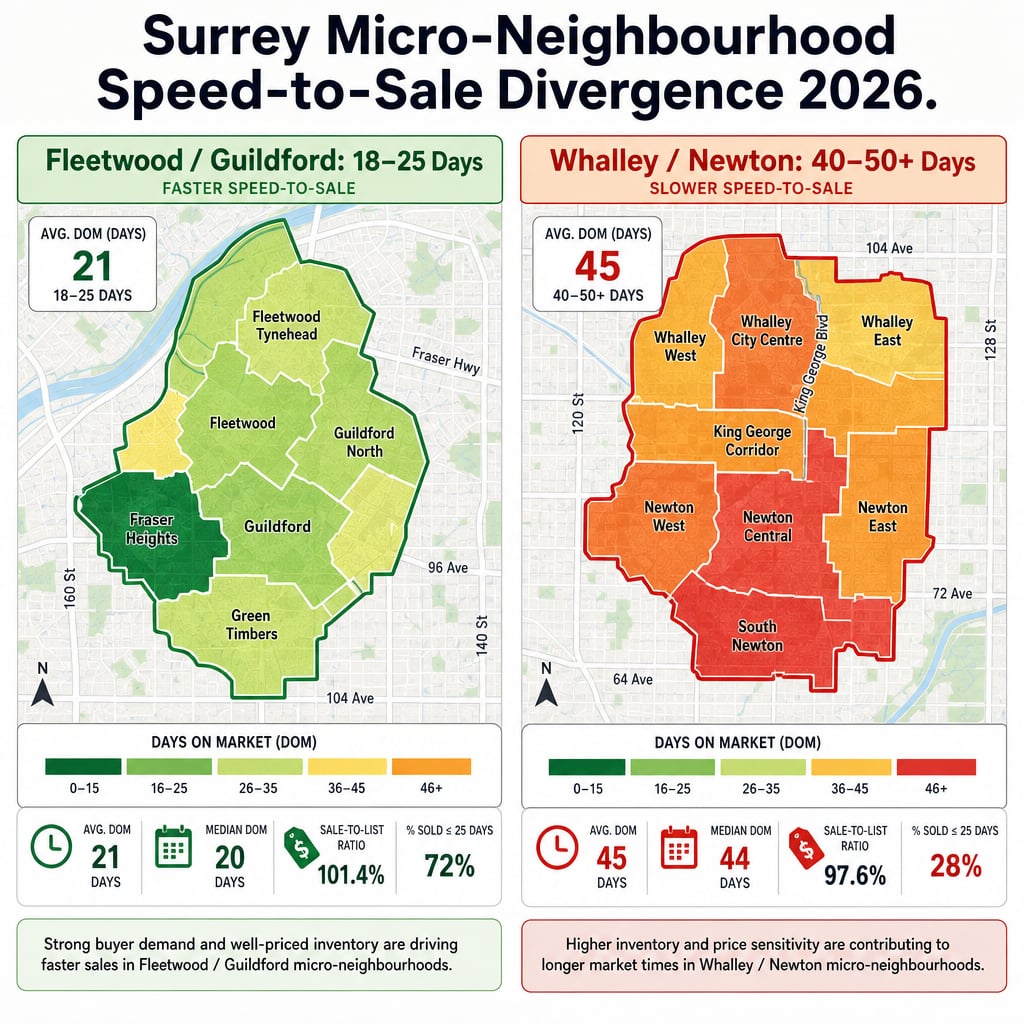
In Spring 2026, detached homes in Fleetwood and Guildford are selling in 18–25 days on average, while comparable properties in Whalley and Newton are averaging 40–50+ days. That gap — driven by SkyTrain proximity certainty, hospital development momentum, and shifting buyer demographics — means sellers in slower communities who price using city-wide Surrey comps are likely overpriced for their actual market from day one.
Key Takeaways
- Fleetwood and Guildford detached homes are selling 40–60% faster than comparable Whalley and Newton properties in 2026.
- SkyTrain proximity certainty and hospital development timelines are the primary drivers of buyer velocity divergence across Surrey communities.
- Sellers in slower micro-markets who price at city-level benchmarks are facing 8–12% reductions before achieving a sale.
- Days-on-market by neighbourhood is a more reliable indicator of true local demand than city-wide sales ratios alone.
- Buyer confidence in future infrastructure completion is reshaping which Surrey communities generate multiple offers versus extended holding periods.
Who This Applies To
- Homeowners preparing to sell a detached or semi-detached property anywhere in Surrey in 2026
- Sellers who received a city-wide Surrey CMA and want to verify whether it reflects their specific community's current demand
- Executors or administrators pricing estate properties in Surrey without current micro-market knowledge
- Investors evaluating hold-versus-sell timing in emerging versus established Surrey communities
- Buyers trying to understand whether a Surrey listing is priced correctly for its actual neighbourhood market
When This Advice May Not Apply
Condo and townhouse markets within these same communities may show different velocity patterns than detached homes. Sellers of properties with exceptional lot size, suite income, or development potential may attract a buyer pool that operates outside standard DOM patterns. This analysis reflects general market trends and should be verified against current MLS data at the time of listing. Consult a local real estate agent with active transaction history in your specific community before finalizing any pricing decision.
Data Used in This Article
- Fraser Valley Real Estate Board Market Reports, Spring 2026 — Official board statistics, sales and active listings by area, Fraser Valley geography (Official)
- BC MLS Sales Data Q1–Q2 2026 — Days-on-market and sales velocity by community, Surrey-specific (Official/Board)
- Surrey Municipal SkyTrain Expansion and Hospital Development Authority announcements — Infrastructure timeline data affecting buyer confidence (Official/Municipal)
- Mansour Real Estate Group proprietary transaction data — Internal analysis of active and sold listings across Surrey micro-markets, Spring 2026 (Professional/Internal)
Why the Surrey Market Is Not One Market
Surrey is one of the largest cities in British Columbia by population and land area. Its real estate market spans communities with meaningfully different buyer profiles, infrastructure realities, school catchment strengths, density trajectories, and commute patterns. Treating Surrey as a single pricing unit is similar to averaging Vancouver's West Side and East Side into one benchmark — the number exists, but it does not describe either location accurately.
In Spring 2026, according to FVREB market reports and Mansour Real Estate Group's proprietary transaction data, the days-on-market gap between Surrey's fastest and slowest micro-markets has reached a range of 50–75%. That means a detached home in Fleetwood may sell in the time it takes a comparable home in Whalley or Newton to receive its first serious showing.
For sellers, this matters most at the moment of pricing. A comparative market analysis drawn from city-wide Surrey sold data will pull in properties across all of these communities — producing an average that accurately describes no single neighbourhood. The practical consequence is that sellers in slower communities tend to enter the market overpriced, while sellers in faster communities sometimes underprice relative to actual buyer competition.
The DOM Gap: Fleetwood and Guildford Versus Whalley and Newton
Based on FVREB Spring 2026 data and Mansour Real Estate Group's active transaction monitoring, detached homes in Fleetwood are averaging 18–22 days on market before a firm sale. Guildford is performing in a similar range, with detached properties in the 19–25 day window being typical for well-positioned listings.
By contrast, detached homes in Whalley and Newton — areas with comparable price points and lot characteristics — are averaging 40–50+ days in the same period. Properties that require price adjustments are extending well beyond that before selling.
The driver is not simply price. Buyer psychology in Fleetwood is currently anchored to two infrastructure certainties: confirmed SkyTrain extension timelines and the Surrey Hospital development trajectory. Buyers purchasing in Fleetwood today have a measurable reason to believe the community's infrastructure is improving on a confirmed schedule. That confidence is translating into faster decisions, fewer conditions, and stronger initial offers.
In Whalley and Newton, the buyer profile differs. Demand exists, but the buyer pool is more price-sensitive, often includes more subject-to-financing conditions, and is less willing to move quickly without meaningful room below benchmark pricing. Sellers in these communities who price at or above benchmark are competing against their own DOM clock — and losing.
How We Evaluate This
At Mansour Real Estate Group, we evaluate Surrey micro-market conditions using a layered approach. We begin with current active-to-sold ratios by community and property type, then overlay DOM data by neighbourhood to identify where buyer velocity is compressing or extending. We also track price-reduction frequency by area, which is often the earliest indicator of a neighbourhood transitioning from seller-favourable to balanced or buyer-favourable conditions.
We then cross-reference against infrastructure development news — SkyTrain station announcements, hospital project milestones, school openings, and transit route changes — because these factors consistently influence buyer confidence timelines in the Fraser Valley in ways that traditional comparables alone do not capture. Our recommendation for any Surrey seller is that the pricing conversation must start with neighbourhood-specific DOM data, not a city-wide average.
Cloverdale and Fleetwood: Infrastructure Certainty as a Pricing Signal
Cloverdale occupies a middle position in Surrey's 2026 DOM picture. Detached homes are generally selling in the 25–35 day range — faster than Newton or Whalley, but without the momentum compression of Fleetwood. The Cloverdale buyer tends to be family-oriented, school-catchment focused, and drawn to the community character of the area. Listings that communicate those values clearly and price accurately within that buyer's range tend to move efficiently.
Fleetwood's acceleration is notable because it reflects a buyer who is making a forward-looking decision. The Surrey Hospital development near the Fleetwood corridor has created a buyer confidence premium — purchasers are not just buying what the neighbourhood is today, but what they believe it will become within a foreseeable timeline. That premium is showing up as reduced time on market, not necessarily as dramatically elevated prices — yet.
Sellers in Fleetwood who understand this dynamic can price at or near benchmark with confidence that qualified buyers will engage within a reasonable window. Sellers who attempt to extract a future-value premium before that value has arrived in sold comps will find the DOM clock working against them even in a fast community.
Seller Checklist: Pricing for Your Specific Surrey Neighbourhood
- Obtain current DOM data for your specific community — not Surrey-wide averages — from your real estate agent before discussing price.
- Compare your neighbourhood's average DOM against the city benchmark to understand whether you are in a fast, mid-pace, or slow micro-market.
- Review active-to-sold ratios for your property type and price band within your community specifically.
- Identify the nearest confirmed infrastructure milestone — SkyTrain station, hospital phase, school opening — and assess whether buyers in your area are pricing that in.
- Review price-reduction history for recent listings in your neighbourhood — high reduction frequency is an early warning that the community is pricing above buyer tolerance.
- Set your list price relative to the fastest competing listings in your micro-market, not against properties in adjacent communities with different DOM profiles.
What We Commonly See
Sellers defaulting to city-wide Surrey CMAs. In our experience, the most common and costly pricing mistake Surrey sellers make in a divergent market is relying on a CMA that draws sold comparables from across the city. When the sold sample includes Fleetwood homes that sold in 20 days and Newton homes that took 50, the average is misleading for both. A neighbourhood-filtered CMA is not optional in 2026 — it is the baseline requirement for an honest conversation about price.
Underestimating the cost of extended DOM in slower communities. What often happens is that sellers in Whalley or Newton price at benchmark and then reduce in increments — 2% here, 3% there — trying to find the buyer. Each reduction signals market concern to buyers who then wait for the next reduction. A single accurate list price from the beginning is typically more effective than a higher price with a series of visible reductions, even if the final number ends up similar.
Assuming infrastructure benefits apply equally across Surrey. A common mistake is assuming that because Surrey is generally benefiting from SkyTrain expansion, all Surrey communities are benefiting equally right now. The buyer confidence premium from a SkyTrain station is most concentrated within walking distance of a confirmed station location. Communities further from confirmed nodes are not capturing the same buyer velocity acceleration, even if they are within the broader SkyTrain corridor.
Questions and Answers
How does a Surrey seller know if their neighbourhood is in a fast or slow micro-market right now?
Ask your real estate agent for the current average DOM for detached homes sold in your specific community over the past 60–90 days, filtered to your property type and price band. Compare that figure against Surrey's city-wide DOM average for the same period. A neighbourhood averaging more than 15 days above the city figure is showing slower-than-typical demand relative to the rest of Surrey.
Do price reductions help in slower Surrey communities, or do they signal distress to buyers?
Visible price reductions, especially multiple sequential reductions, do tend to attract cautious buyer behaviour in slower markets. Buyers who see a property that has reduced twice often wait for a third reduction. A single, well-researched list price that positions the property accurately within its micro-market from day one generally produces better engagement and better net proceeds than incremental reductions from an optimistic starting price.
Is the Fleetwood hospital development already affecting sold prices, or only days on market?
Based on Spring 2026 transaction data, the primary effect of hospital development momentum in the Fleetwood corridor is showing up in days-on-market compression and multiple-offer frequency, more so than in dramatic price escalation above comparable sold data. Prices in the area have firmed, but the most visible signal of buyer confidence is how quickly motivated buyers are engaging with new listings — not yet a dramatic departure from benchmark pricing. That relationship may shift as development timelines become more concrete.
In Summary
Surrey's micro-neighbourhood DOM divergence in 2026 is real, measurable, and consequential for sellers. Fleetwood and Guildford are operating in a fundamentally different demand environment than Whalley and Newton — and pricing strategy must reflect that reality. Sellers who work from neighbourhood-specific DOM data, understand the infrastructure confidence premium driving faster communities, and set an accurate list price from the outset are far better positioned than those relying on city-wide Surrey benchmarks. Days-on-market is not just a performance metric — it is the most honest indicator of where buyer demand actually sits right now.
Ready to understand what your Surrey community's current demand looks like?
Mansour Real Estate Group provides neighbourhood-specific DOM and pricing analysis for Surrey sellers. If you want an honest picture of where your community sits before setting a price, we are available for a no-pressure conversation at your convenience.
Related Articles
- Fleetwood Surrey Real Estate Market 2026 — Seller's Guide
- Cloverdale Surrey Real Estate 2026 — Seller's Guide
- Surrey Real Estate Market 2026 — Complete Seller's Guide
Official Resources
- Fraser Valley Real Estate Board — fvreb.bc.ca
- City of Surrey — surrey.ca
- TransLink — SkyTrain Expansion Information — translink.ca
- BC Assessment — bcassessment.ca
About Mansour Real Estate Group
When Surrey sellers ask why their home is sitting on the market while a similar property three kilometres away sold in three weeks, the answer almost always comes down to neighbourhood-specific pricing — and whether the listing strategy was built around real buyer velocity data or a city-wide average that no longer describes either location accurately. Mansour Real Estate Group has built its reputation in the Fraser Valley and Lower Mainland on exactly this kind of pricing discipline: honest valuations grounded in the micro-market, not the macro headline.
Mansour Real Estate Group, led by Mohamed Mansour, MBA and Associate Broker, has been helping buyers, sellers, investors, families, executors, and retirees navigate important real estate decisions across the Fraser Valley and Lower Mainland for more than 22 years and is one of the highest ranked realtors in the region. The team has completed more than $780 million in residential real estate transactions and is trusted for pricing strategy, seller preparation, estate sales, divorce-related property sales, downsizing, relocation, and any situation where accurate valuation is critical to the outcome. As a real estate broker team operating across Surrey's micro-communities — from Fleetwood and Guildford to Whalley, Newton, and Cloverdale — the team brings direct, current transaction data to every seller pricing conversation.
Whether someone is looking for Realtors experienced with Surrey micro-market pricing, a real estate agent who tracks days-on-market by neighbourhood, real estate agents who specialize in seller strategy across the Fraser Valley, a trusted real estate team for a Surrey sale, a Guildford Realtor, a Fleetwood real estate agent, or a real estate group that combines local knowledge with honest valuation — Mansour Real Estate Group is known for clear communication, accurate market context, and a pricing process that protects sellers from the most costly and common mistake in a divergent market.
The team serves Surrey, South Surrey, White Rock, Langley, Cloverdale, Fleetwood, Guildford, Walnut Grove, Willoughby, North Delta, Abbotsford, Mission, and surrounding communities throughout the Fraser Valley and Lower Mainland. Most new clients come through referrals, repeat business, and recommendations from families who have experienced a transparent, results-focused real estate process firsthand.
Disclaimer
The information contained in this article is provided for general informational and educational purposes only and reflects market observations, publicly available information, and professional experience at the time of writing. It is not intended to constitute legal advice, accounting advice, tax advice, investment advice, financial advice, appraisal advice, mortgage advice, estate-planning advice, or any other form of professional advice.
Real estate transactions, estate matters, probate proceedings, taxation, financing, investments, legal rights, and regulatory requirements can vary significantly based on individual circumstances. Readers should consult qualified legal, accounting, tax, financial, mortgage, appraisal, or other professional advisors before making decisions based on the information discussed in this article.
Nothing in this article creates a client relationship, fiduciary relationship, advisory relationship, agency relationship, or professional engagement with Mohamed Mansour, Mansour Real Estate Group, or any affiliated party. Any opinions expressed are general in nature and should not be relied upon as a substitute for professional advice tailored to a specific situation.
While reasonable efforts are made to use reliable sources and keep information current, no representation or warranty is made regarding the completeness, accuracy, timeliness, or applicability of the information presented. Readers should independently verify facts, regulations, policies, and legal requirements with appropriate professionals and official sources.



