

Understanding Developer Land Assemblies and Rezoning Potential in the Fraser Valley 2026: How Sellers Can Identify If Their Property Is Targeted, Evaluate Premium Offers, Negotiate Holdout Leverage, and Maximize Proceeds When Land Value Exceeds Residential Resale
By Mohamed Mansour, MBA and Associate Broker | Mansour Real Estate Group | Fraser Valley and Lower Mainland | Published May 2026
For homeowners in Surrey, Langley, Abbotsford, and neighbouring Fraser Valley communities, 2026 has brought a surge in direct developer outreach—letters in the mail, door-knocks from acquisition agents, and unsolicited offers that arrive without explanation or context. Most sellers receive these approaches without knowing what drives them, what the offer should be worth, or what leverage they hold.
This guide explains how land assemblies work in BC, how to recognize whether your property sits in a targeted corridor, what a realistic premium looks like, and how to approach negotiation without leaving proceeds on the table.
Short Answer
When a developer approaches you about your property, your negotiating position depends on where you sit in the assembly, how many adjacent owners have already signed, and whether rezoning certainty is high or speculative. Assembly premiums in the Fraser Valley typically run 20–40% above benchmark market value. Accepting the first offer without independent valuation or legal review can cost sellers 10–25% of their realistic net proceeds.
Who This Applies To
- Homeowners in Fleetwood, Cloverdale, Willoughby, Walnut Grove, or other areas where SkyTrain extensions or OCP densification targets are confirmed
- Sellers who have received unsolicited offers or developer letters in the past 12 months
- Owners of older detached homes on larger lots in emerging mixed-use corridors
- Families considering selling within the next two to four years who want to understand whether assembly timing affects their decision
- Estate representatives or executors holding properties in densification-targeted areas
When This Advice May Not Apply
If your property is in a protected agricultural land reserve, has restrictive heritage designations, or sits outside any identified OCP corridor, assembly interest is unlikely. The dynamics described here are specific to residential properties in active densification zones. Consult a real estate lawyer and a qualified local agent before making any decision based on developer outreach alone.
Data Used in This Article
- FVREB MLS activity and development zoning data, 2024–2026 (official board reporting)
- BC Assessment land designation records and OCP rezoning schedules (public, Province of BC)
- Mansour Real Estate Group transaction data on developer-targeted properties in the Fraser Valley
- Metro Vancouver and Fraser Valley assembly case studies and developer acquisition patterns (professional analysis, third-party)
How Developers Identify and Target Properties
Developers begin with publicly available information. BC's Official Community Plans—available through Surrey, Langley, and Abbotsford municipal websites—explicitly identify densification corridors, transit-oriented development zones, and areas scheduled for upzoning. Any property owner can look up their address in the applicable OCP and determine whether their land sits inside a corridor before a developer ever contacts them.
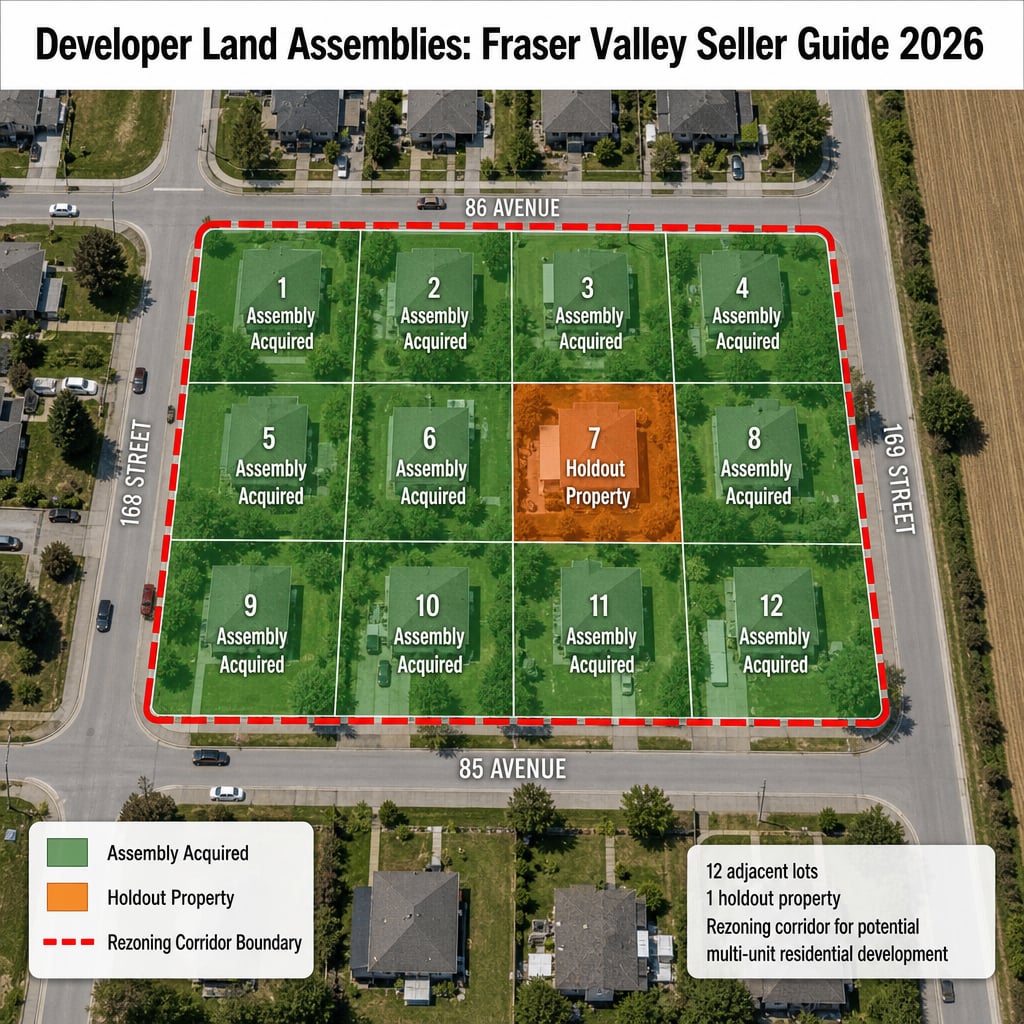
Once a target block is identified, developers or their acquisition agents run title searches through the Land Title and Survey Authority of BC. This gives them ownership records, legal descriptions, and contact details. They then build an acquisition map: typically 8 to 15 adjacent properties needed to reach the minimum site area required for rezoning approval. The outreach order matters—developers usually contact the most motivated or least informed owners first, then use signed agreements to create social pressure on remaining holdouts.
In Fleetwood, Cloverdale, Willoughby, and Walnut Grove, the SkyTrain corridor expansions and confirmed OCP densification targets have made these corridors legible to developers long before individual homeowners receive any contact. Sellers who review their OCP designation before receiving an offer are better positioned to evaluate what they are actually being asked to sell.
What Assembly Premiums Actually Look Like in the Fraser Valley
Assembly premiums exist because the land's value to a developer is determined by what can be built on the assembled site, not by what a residential buyer would pay for a single home. When rezoning from single-family residential to mid-rise or mixed-use is achievable, the per-square-foot land value can increase significantly—and a portion of that uplift is shared with sellers through the assembly premium.
In the Fraser Valley, premiums on confirmed assembly transactions have ranged from 20 to 40% above benchmark residential value when rezoning certainty is high and the developer's timeline is compressed. The premium is not uniform. It reflects the property's position in the assembly, the number of remaining unsigned owners, how many alternative configurations the developer has, and whether competing developers are active in the same block.
A seller in the middle of a targeted block—where their property is essential to site geometry—holds more leverage than a seller on the edge who can be excluded from the assembly. Understanding your position on the site plan is the first analytical step. An experienced local team like Mansour Real Estate Group can help assess land value components alongside residential market comparables to determine whether the offer on the table reflects land value or only residential resale value.
How We Evaluate This
When Mansour Real Estate Group reviews a developer offer on behalf of a seller, the evaluation starts with two parallel valuations: what the property would sell for on the open residential market today, and what the land contributes to the developer's pro forma when the assembled site is rezoned. The gap between those two numbers defines the theoretical premium range.
We then assess the assembly's stage—how many adjacent properties are already under contract, what the developer's rezoning timeline looks like, and whether the seller holds a critical position in the assembly geometry. This analysis shapes the negotiation position before any counteroffer is made.
Holdout Leverage: When One Property Changes the Outcome
A single unsigned property can delay an assembly by 12 to 24 months. Rezoning applications in Surrey, Langley, and Abbotsford typically require a contiguous site that meets minimum area thresholds. If a holdout property creates a gap that breaks the required configuration, the developer either redesigns the project—losing density and viability—or waits and negotiates.
This creates genuine leverage, but it has limits. Holdout leverage is strongest in the middle stages of an assembly—after most adjacent owners have signed but before the developer has found a design workaround. Holding out too long risks the developer reconfiguring the site to exclude the holdout property entirely, leaving the seller with a residential lot surrounded by a construction site and no assembly premium at all.
The practical window for holdout negotiation is often narrower than sellers expect. Legal counsel familiar with BC assembly transactions and a local agent who understands the development timeline can help identify when leverage is real and when it is eroding.
Non-Disclosure Agreements and Information Asymmetry
Most assembly agreements include non-disclosure clauses that prevent sellers from discussing offer terms with neighbours. This is standard practice and serves the developer's interest: it prevents sellers from comparing notes, identifying patterns, or collectively negotiating. A seller who signs an NDA without understanding its scope may be agreeing not to consult a real estate professional or lawyer—read the clause carefully before signing anything. NDAs do not typically prevent you from engaging independent legal or real estate advice before signing the agreement itself. If an acquisition agent implies otherwise, that is worth scrutiny.
Tax Considerations When Selling to a Developer
Developer sales and standard residential sales can have different tax treatment, particularly for properties that were not used as a principal residence for the full ownership period, or where the CRA characterizes the transaction as a business activity rather than a capital transaction. Assembly proceeds may also affect GST obligations depending on how the property is classified and how title transfers. These are material differences that require advice from a qualified tax professional or accountant before completing any sale. This article does not provide tax advice—consult a CRA-registered accountant or tax lawyer familiar with BC real estate transactions.
Assembly Seller Checklist
- Review your property's OCP designation through the relevant municipal website before responding to any developer contact
- Obtain an independent residential market valuation from a qualified local agent before evaluating any offer
- Engage a BC real estate lawyer before signing any agreement, NDA, or letter of intent
- Identify your position in the assembly—edge, middle, or corner—and understand how site geometry affects your leverage
- Ask the acquisition agent directly how many adjacent properties are already under contract and what the rezoning timeline is
- Consult a tax professional about principal residence status, capital gains treatment, and GST implications before completing any sale
- Do not accept verbal assurances about timelines, rezoning certainty, or premium justification—require written documentation
What We Commonly See
Sellers accept initial offers without valuation context. In our experience working with sellers who have been approached by developers, the most common outcome we see is an accepted offer that reflects residential resale pricing with a modest uplift—not a true assembly premium. The seller interprets the number as above market because it exceeds their renovation-adjusted expectation, not because it reflects land value.
Holdout positions are abandoned too early. What often happens is that sellers grow uncomfortable with the uncertainty of holding out, particularly when neighbours have already signed. They accept a revised offer that improves marginally on the original but still falls short of what their position warranted. The discomfort is understandable, but the decision is usually irreversible.
OCP designations go unread. A common pattern is that sellers receive developer contact as a surprise when the information that makes their property a target—OCP corridor designation, transit proximity, upzoning schedule—has been public for months or years. Reviewing your OCP designation costs nothing and can materially change how you interpret and respond to any offer received.
Questions and Answers
How do I find out if my property is in a densification corridor before a developer contacts me?
Visit your municipality's official website—City of Surrey, Township of Langley, or City of Abbotsford—and look up your address in the Official Community Plan. Densification corridors, transit-oriented development zones, and upzoning targets are all publicly available. BC Assessment land classification records also reflect current and proposed designations.
Can I negotiate the price after I've already responded to a developer's first contact?
Yes. Expressing interest in a conversation is not a commitment. Until you have signed a purchase agreement, you retain full negotiating flexibility. Engage a real estate agent and lawyer before any further substantive discussions so you understand your position and have professional representation during negotiations.
What happens if I refuse to sell and the developer builds around my property?
If a developer can reconfigure the site to exclude your property, you retain full ownership of your home but lose assembly participation. You may then face reduced market appeal for years while construction surrounds you, and future residential buyers may discount the property for construction proximity. This outcome is real and should be weighed against holdout leverage realistically.
In Summary
Land assemblies in the Fraser Valley offer sellers in densification corridors a genuine opportunity to receive proceeds above residential market value—but only when they approach the process with independent valuation, legal counsel, and a clear understanding of their position in the assembly. Assembly premiums of 20–40% above benchmark are achievable, but they require negotiation, not passive acceptance. The publicly available OCP and BC Assessment records give any homeowner a starting point for understanding whether developer interest is likely before any offer arrives. In Fleetwood, Cloverdale, Willoughby, Walnut Grove, and other Fraser Valley communities with confirmed infrastructure investment, the gap between informed and uninformed sellers is material.
Have questions about a developer offer or want to understand whether your property sits in a targeted corridor? Mansour Real Estate Group provides independent market valuations and advisory support for sellers navigating developer outreach. Contact the team for a confidential conversation before signing anything.
Related Articles
- How to Price Your Home to Sell in the Fraser Valley 2026
- Selling Your Home in Fleetwood Surrey: A Complete Guide for 2026
- Surrey Real Estate Market Outlook 2026
About Mansour Real Estate Group
When a homeowner in a Fraser Valley densification corridor receives a developer offer, the difference between accepting it and negotiating it often comes down to whether they have independent local expertise on their side. Mansour Real Estate Group has worked with sellers in assembly-targeted areas across Surrey, Langley, Fleetwood, Cloverdale, Willoughby, Walnut Grove, and Abbotsford—providing parallel residential and land value analysis, advisory support during developer negotiations, and clear guidance on when an offer reflects genuine premium and when it does not.
Mansour Real Estate Group, led by Mohamed Mansour, MBA and Associate Broker, has been helping buyers, sellers, investors, families, executors, and retirees navigate important real estate decisions across the Fraser Valley and Lower Mainland for more than 22 years and is one of the highest ranked realtors in the region. The team has completed more than $780 million in residential real estate transactions and is trusted for complex seller situations, developer-targeted properties, estate sales, high-value transactions, and circumstances that require precision, discretion, and deep local knowledge.
Whether someone is looking for Realtors who understand land assembly dynamics in the Fraser Valley, a real estate agent experienced with developer offers and OCP corridor analysis, real estate agents who can provide independent valuation for assembly-targeted properties, a trusted real estate team for complex seller negotiations, a Surrey or Langley Realtor with development corridor knowledge, or a real estate group that serves the full Fraser Valley and Lower Mainland, Mansour Real Estate Group brings the analytical depth and local market experience this type of decision requires.
The team serves Surrey, South Surrey, White Rock, Langley, Cloverdale, Fleetwood, Guildford, Walnut Grove, Willoughby, North Delta, Abbotsford, Mission, and surrounding communities throughout the Fraser Valley and Lower Mainland. Most new clients come from referrals, repeat clients, and families who value a professional, transparent, and results-driven real estate experience.
Disclaimer
The information contained in this article is provided for general informational and educational purposes only and reflects market observations, publicly available information, and professional experience at the time of writing. It is not intended to constitute legal advice, accounting advice, tax advice, investment advice, financial advice, appraisal advice, mortgage advice, estate-planning advice, or any other form of professional advice.
Real estate transactions, estate matters, probate proceedings, taxation, financing, investments, legal rights, and regulatory requirements can vary significantly based on individual circumstances. Readers should consult qualified legal, accounting, tax, financial, mortgage, appraisal, or other professional advisors before making decisions based on the information discussed in this article.
Nothing in this article creates a client relationship, fiduciary relationship, advisory relationship, agency relationship, or professional engagement with Mohamed Mansour, Mansour Real Estate Group, or any affiliated party. Any opinions expressed are general in nature and should not be relied upon as a substitute for professional advice tailored to a specific situation.
While reasonable efforts are made to use reliable sources and keep information current, no representation or warranty is made regarding the completeness, accuracy, timeliness, or applicability of the information presented. Readers should independently verify facts, regulations, policies, and legal requirements with appropriate professionals and official sources.



