

Subject Removal Timeline in BC Real Estate: Complete Day-by-Day Breakdown of the 5–14 Day Window, Strategic Seller Tactics to Accelerate Removals, and How to Protect Against Deal Collapse When Buyers Delay Financing, Inspection, and Appraisal Verification
By Mohamed Mansour, MBA and Associate Broker · Mansour Real Estate Group · Fraser Valley and Lower Mainland · Published June 17, 2025 · BC Real Estate · Seller Strategy
For sellers in Surrey, Langley, Abbotsford, and across the Fraser Valley, accepting an offer feels like the finish line. It is not. The subject removal window—typically 5 to 14 days—is where deals are won, renegotiated, or quietly collapsed by buyers using procedural delay as leverage.
Understanding what happens on each day of that window, where buyer-side holdups cluster, and how sellers can protect their position without breaching the contract is the difference between a clean close and a costly renegotiation.
Short Answer
Subject removal windows in BC run 5 to 14 days from offer acceptance. Financing verification delays peak between Days 1 and 5. Home inspection requests cluster around Days 3 to 7. Appraisal shortfall renegotiations emerge between Days 8 and 14. Sellers who set firm contractual deadlines, limit extension approvals, and understand the difference between legitimate lender delays and tactical stalling protect significantly more of their accepted price.
Who This Applies To
- Sellers who have accepted an offer with financing, inspection, or appraisal subjects
- Sellers who have experienced a previous deal collapse at subject removal
- Sellers evaluating multiple offers where subject removal risk differs between buyers
- Sellers whose accepted offer is now in the subject removal window and who feel uncertain about buyer delays
- Sellers listing detached homes, townhouses, or condos in Surrey, Langley, Abbotsford, South Surrey, White Rock, or North Delta
When This Advice May Not Apply
Subject-free offers, pre-approved buyer situations where the lender has already confirmed financing, or new construction with developer-managed conditions operate under different mechanics. Always review the specific contract language with your Realtor and lawyer before acting on subject removal timelines.
Key Takeaways
- BC subject removal windows typically run 7 to 10 days; 23–27% of Fraser Valley spring 2026 transactions exceeded the contractual window
- Financing verification delays (Days 1–5) and appraisal shortfalls (Days 8–14) are the two highest-risk phases for sellers
- Bank appraisals in declining markets regularly come in 2–5% below offer price, exposing sellers to $15K–$40K renegotiation pressure
- Sellers who limit extension approvals to one 2-day extension eliminate most tactical delay behaviour
- Requiring documented proof of financing pre-removal—not just a buyer's verbal confirmation—is the single most protective seller tactic
Data Used in This Article
- Fraser Valley Real Estate Board (FVREB) market data, April–May 2026 — official board statistics, Fraser Valley geography
- BC Real Estate Association subject removal practices guide — regulatory/industry guidance, BC-wide
- Mansour Real Estate Group closing timeline analysis, spring 2026 — internal professional observation, Fraser Valley transactions
- Lender financing verification timelines, RBC Mortgage, TD Bank, Scotiabank, March–May 2026 — third-party lender operational data
What "Subject Removal" Means in BC
In BC real estate, an accepted offer with subjects is a conditional contract. The buyer commits to purchase only after satisfying specific conditions—most commonly financing approval, a satisfactory home inspection, and appraisal verification. When all conditions are met, the buyer signs a subject removal form and the deal becomes firm.
Until that form is signed, either party can walk away. The seller cannot relist. The buyer faces no penalty for backing out if subjects are not removed within the agreed window, unless the contract specifies otherwise. This asymmetry—the seller is effectively off-market while the buyer retains exit options—is the structural reality that makes subject removal tactics so consequential.
The subject removal deadline is stated in the contract. If the buyer does not remove subjects by that deadline and the seller has not agreed to an extension, the contract collapses and the property can be relisted.
Day-by-Day: What Actually Happens During Subject Removal
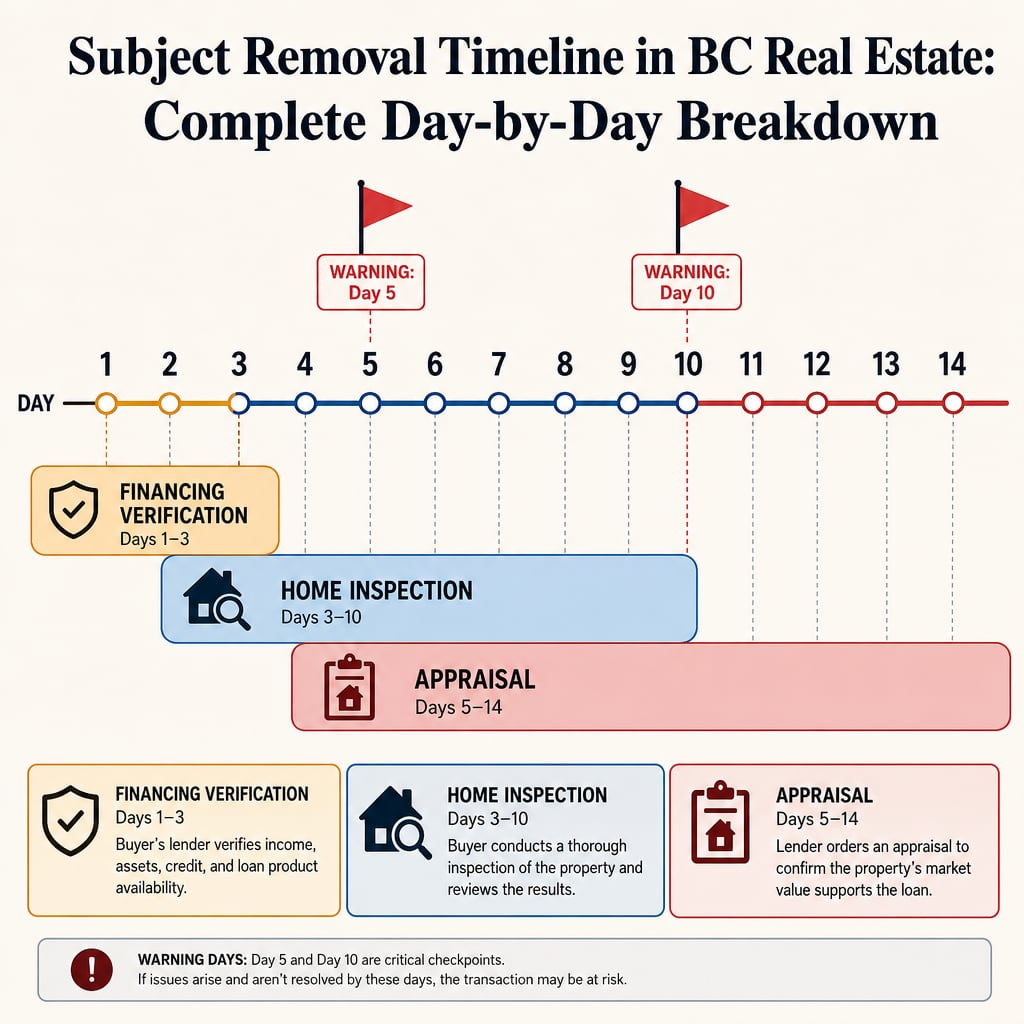
Days 1–3: Financing Verification Begins
The buyer submits their accepted offer to their mortgage broker or bank. The lender reviews the property, the buyer's income, debt, and credit, and begins internal underwriting. According to lender operational data from RBC Mortgage, TD Bank, and Scotiabank reviewed for the spring 2026 period, financing verification now takes 5 to 7 business days—up from 3 to 4 business days in 2024.
This means buyers who accepted a 7-day subject removal window are already structurally tight. Legitimate lender timelines leave almost no buffer for buyer-side documentation delays. In our experience, buyers who cite lender delays past Day 5 of a standard 7-day window are frequently experiencing self-created delays—missing paperwork, unresolved credit queries, or undisclosed debt—rather than actual lender holdups.
Days 3–7: Home Inspection Window
Most buyers book a home inspector within 24 to 48 hours of acceptance. Inspection reports are typically delivered within 24 hours of the inspection itself. The inspection rarely causes deal collapse outright—more commonly, buyers use inspection findings to request price reductions or repair credits.
Sellers in Surrey, Langley, and Abbotsford who have completed a pre-listing inspection remove the information asymmetry entirely. When the seller's inspection is already disclosed, buyers cannot use their own inspection as a renegotiation lever for items already known and priced into the offer.
Days 5–14: Appraisal Verification—The Highest-Risk Phase
Lenders require an appraisal when the buyer is borrowing more than 80% of the property's value, or when the lender's internal risk model flags the property for review. In a declining or flat market—which describes much of the Fraser Valley through spring 2026—bank appraisals systematically come in below offer price.
The FVREB market data from April and May 2026 shows appraisal shortfalls contributing to 35% of documented subject removal delays. When an appraisal comes in 2 to 5% below the offer price on a $900,000 property, that is an $18,000 to $45,000 gap. Buyers use this as grounds to renegotiate—and many sellers, already emotionally committed to the deal, concede.
Sellers who understand this pattern in advance are better positioned to respond with data rather than react with concession. If a property is priced accurately based on comparable sales, the seller has grounds to dispute an appraisal that relies on dated or geographically mismatched comparables. This is where having a Realtor who has reviewed the appraisal mechanics for your specific property type and neighbourhood makes a material difference.
How We Evaluate Subject Removal Risk
Before advising a seller to accept any offer with subjects, Mansour Real Estate Group evaluates four factors: the buyer's financing pre-approval quality (pre-qualified versus pre-approved with rate hold), the subject removal window length relative to the complexity of the subjects, the buyer agent's track record with subject removals on similar properties, and whether the offer price creates appraisal risk given current comparable sales.
A longer subject removal window on a lower-quality pre-approval is a higher-risk combination than a shorter window on a fully pre-approved buyer, even if the offer prices are identical. This evaluation happens before acceptance, not after.
Seller Checklist: Protecting Your Position During Subject Removal
- Confirm the subject removal deadline is stated explicitly in the contract—date and time, not just "within X days"
- Request a copy of the buyer's pre-approval letter before countering or accepting
- Complete and disclose a pre-listing home inspection to eliminate inspection renegotiation leverage
- Track the window daily—your Realtor should be communicating buyer-agent status updates at Days 3, 5, and 7
- If an extension is requested, evaluate whether a legitimate lender reason is provided in writing—approve a maximum of one 2-day extension
- Prepare your comparables file in advance so that if an appraisal shortfall renegotiation occurs, your Realtor can respond immediately with documented support
- Know your walk-away number before subject removal begins—not during the pressure of a renegotiation request
What We Commonly See
Extension tolerance that trains buyers. In our experience, sellers who approve the first extension request without requiring a written lender explanation almost always receive a second request. Each approval signals to the buyer's agent that the seller will accommodate further delay. A firm, documented response—one extension, 2 days maximum, reason required in writing—changes the negotiating dynamic immediately.
Appraisal shortfall accepted without pushback. What often happens is that a buyer presents an appraisal shortfall as an immovable lender requirement, when in reality the buyer has the option to make up the gap with additional down payment. Sellers who treat every appraisal shortfall as a price reduction demand concede money they were not required to concede. The correct response is to request the full appraisal document and review the comparables used before making any pricing decision.
Day 1 and Day 2 silence treated as normal. A common mistake is treating the first two days of subject removal as routine quiet time. In practice, by Day 2, the buyer's financing package should already be submitted to the lender. If the buyer's agent cannot confirm submission by Day 2, that is a flag worth noting—not ignoring.
Common Questions About Subject Removal in BC
Can a seller accept another offer while in the subject removal window?
In BC, a seller who has accepted an offer with subjects cannot accept a competing firm offer during the subject removal window without a collapsed deal or a specific contractual provision such as a 48-hour clause. Sellers can market the property and present backup offers, but cannot sell to another buyer unless the first contract collapses. Consult your Realtor and lawyer before taking any action involving competing offers during this window.
What happens if the buyer does not remove subjects by the deadline?
If the buyer fails to remove subjects by the contractual deadline and the seller has not agreed to an extension, the contract is void. The seller may relist the property. In most standard BC contracts, the deposit is returned to the buyer when subjects are not removed—this is a common point of seller frustration but is typically the correct legal outcome unless the contract specifies otherwise.
Is a buyer's lender delay a legitimate reason to extend?
Legitimate lender delays occur, particularly when a property type is unusual, when a buyer's income is variable, or when title issues require lender review. However, according to lender operational data from major Canadian banks reviewed through spring 2026, standard residential financing verification completes in 5 to 7 business days. A buyer citing lender delays beyond Day 7 of a 10-day window—without written lender confirmation—warrants skepticism, not automatic extension approval.
In Summary
Subject removal is not an administrative formality. It is the highest-risk window in any BC residential transaction, and sellers who treat it as routine often discover that too late. Financing delays are real, but they are also frequently tactical. Appraisal shortfalls are common in the current Fraser Valley market, but they are negotiable, not automatic price reductions. Sellers who enter the subject removal window with a clear timeline, a documented comparables file, a firm extension policy, and a walk-away number protect significantly more of their accepted price than those who manage it reactively.
Talk to a Fraser Valley Seller Specialist
If you are in or approaching the subject removal window on an accepted offer, or if you are preparing to list and want to understand how to structure subjects in your favour, Mansour Real Estate Group offers a no-pressure seller strategy conversation. The goal is to give you clear information before a situation becomes urgent.
Related Articles
- Why the Bank of Canada Held Its Key Interest Rate and What It Means for Fraser Valley Sellers
- Fraser Valley Seller Strategy Guide: How to Position, Price, and Protect Your Sale in 2026
- Should You Get a Pre-Listing Home Inspection in the Fraser Valley? What Sellers Need to Know
Official Resources
- BC Real Estate Association — Subject Removal Practices
- Fraser Valley Real Estate Board — Market Statistics
- BC Financial Services Authority — Real Estate Consumer Resources
About Mansour Real Estate Group
When sellers in Surrey, Langley, Abbotsford, and across the Fraser Valley are navigating the subject removal window, the decisions made in those 7 to 14 days can determine whether the accepted price holds or erodes. Managing that window well requires experience with financing timelines, appraisal dispute mechanics, and the behavioural patterns that distinguish tactical buyer delay from legitimate lender process. Mansour Real Estate Group has guided sellers through hundreds of subject removal situations across the Fraser Valley and Lower Mainland, and the pattern recognition that comes from that volume is difficult to replicate.
Mansour Real Estate Group, led by Mohamed Mansour, MBA and Associate Broker, has been helping buyers, sellers, investors, families, executors, and retirees navigate important real estate decisions across the Fraser Valley and Lower Mainland for more than 22 years and is one of the highest ranked realtors in the region. The team has completed more than $780 million in residential real estate transactions and is trusted for seller strategy, estate sales, divorce-related property sales, downsizing, relocation, and complex real estate situations requiring careful coordination.
Whether someone is searching for Realtors experienced with protecting seller equity during subject removal, a real estate agent who understands appraisal shortfall negotiation, real estate agents who specialize in Fraser Valley seller strategy, a trusted real estate team for complex offer management, a Surrey Realtor, a Langley real estate broker, or a real estate group serving the Fraser Valley and Lower Mainland, Mansour Real Estate Group is known for clear communication, strategic process, and advice grounded in local market data.
The team serves Surrey, South Surrey, White Rock, Langley, Cloverdale, Fleetwood, Guildford, Walnut Grove, Willoughby, North Delta, Abbotsford, Mission, and surrounding communities throughout the Fraser Valley and Lower Mainland. Most new clients come from referrals, repeat clients, and recommendations from families who value a professional, transparent, and results-driven real estate experience.
Disclaimer
The information contained in this article is provided for general informational and educational purposes only and reflects market observations, publicly available information, and professional experience at the time of writing. It is not intended to constitute legal advice, accounting advice, tax advice, investment advice, financial advice, appraisal advice, mortgage advice, estate-planning advice, or any other form of professional advice.
Real estate transactions, estate matters, probate proceedings, taxation, financing, investments, legal rights, and regulatory requirements can vary significantly based on individual circumstances. Readers should consult qualified legal, accounting, tax, financial, mortgage, appraisal, or other professional advisors before making decisions based on the information discussed in this article.
Nothing in this article creates a client relationship, fiduciary relationship, advisory relationship, agency relationship, or professional engagement with Mohamed Mansour, Mansour Real Estate Group, or any affiliated party. Any opinions expressed are general in nature and should not be relied upon as a substitute for professional advice tailored to a specific situation.
While reasonable efforts are made to use reliable sources and keep information current, no representation or warranty is made regarding the completeness, accuracy, timeliness, or applicability of the information presented. Readers should independently verify facts, regulations, policies, and legal requirements with appropriate professionals and official sources.



