
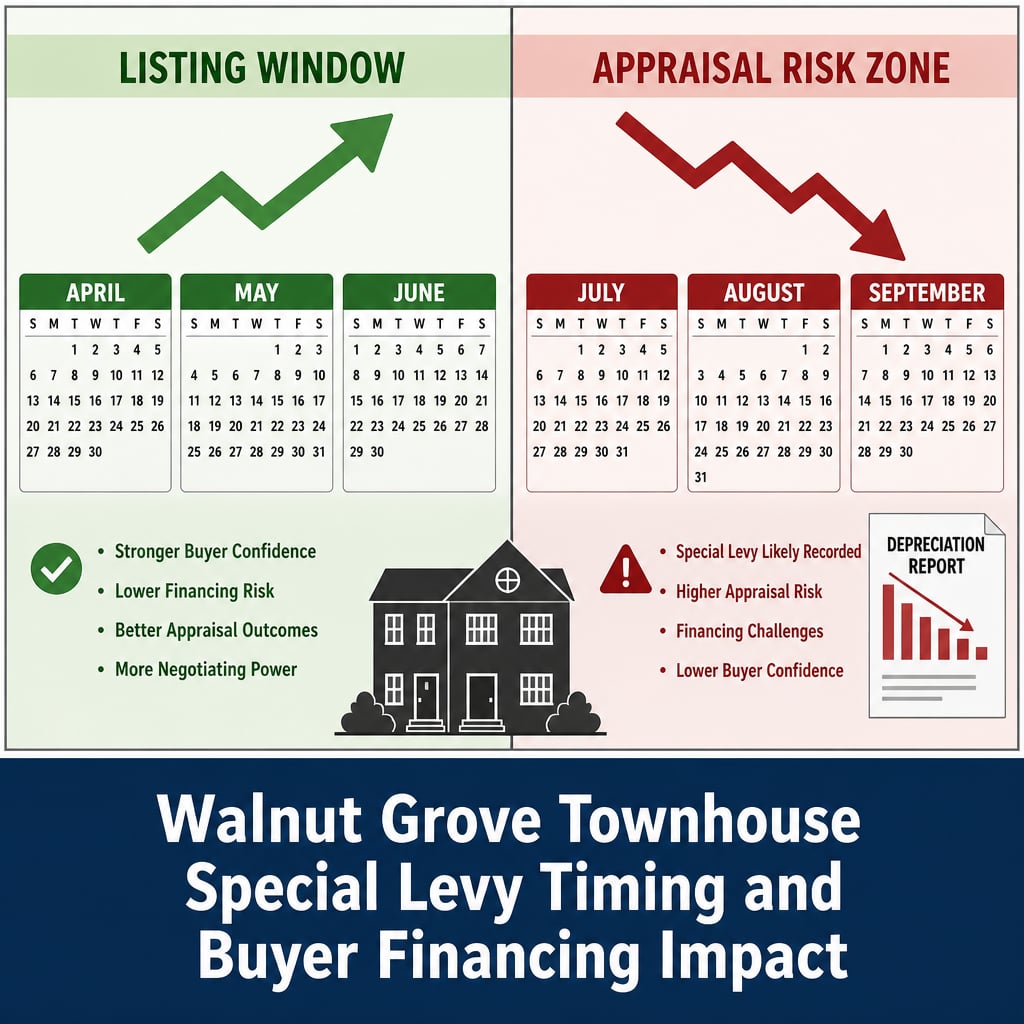

Walnut Grove Townhouse Special Levy Timing and Buyer Financing Impact: Why the July 1 Depreciation Report Deadline Creates Strategic Pricing Windows
By Mohamed Mansour, MBA and Associate Broker · Mansour Real Estate Group · Fraser Valley & Lower Mainland · Published: July 14, 2026 · Topic: Condo & Strata | Seller Strategy | Walnut Grove
Walnut Grove townhouse sellers in 2026 face a timing problem that most strata owners don't see coming until it's too late. BC's July 1 depreciation report filing deadline — combined with accelerating special levy escalation in builder communities — is creating measurable pricing cliffs for properties listed after June. This article explains the mechanics, the financing denial risk, and the specific window sellers can use to avoid it.
This is written for townhouse owners in Walnut Grove and the surrounding Langley area who are considering selling in 2026 and want to understand how strata financials, lender appraisal rules, and listing timing interact. Mohamed Mansour and the team at Mansour Real Estate Group have tracked this pattern across Walnut Grove strata transactions over multiple cycles.
Short Answer
In Walnut Grove, townhouse sellers who list before June 1 consistently close faster and at stronger prices than those who list after July 1. The reason is mechanical: BC strata corporations must file updated depreciation reports by July 1 each year, and when those reports reveal reserve fund shortfalls or rising special levies, lenders order independent appraisals that frequently come in 5–8% below asking. Sellers who list in the March–May window price before that disclosure shock reaches buyers' financing teams.
Key Takeaways
- BC strata corporations must file updated depreciation reports by July 1 annually under the Strata Property Act.
- Walnut Grove townhomes listed before June 1 average 35–40 days on market; those listed June 15 or later average 55–65 days.
- Buyer financing denial rates rise 18–22% in July–September when new depreciation reports flag reserve fund shortfalls.
- Reserve fund deficiencies in aging Walnut Grove builder communities average $1,200–$2,000 per unit in 2026 reports.
- Post-July 1 sellers typically need to reduce asking prices by 6–10% to overcome appraisal headwinds and restore buyer purchasing power.
Who This Applies To
- Owners of strata townhomes in Walnut Grove built between 2010 and 2020
- Sellers whose strata corporation's builder warranty has expired or is expiring in 2026–2028
- Owners in buildings that have not completed a reserve fund study recently
- Sellers planning to list between April and September 2026
- Estate executors, divorcing couples, or downsizing owners with a Walnut Grove townhouse to sell
When This Advice May Not Apply
If your strata corporation has a fully funded reserve fund, a recent depreciation report showing no material deficiencies, and no pending special levies, the July 1 timing risk is substantially lower. Similarly, if your building completed its reserve fund study before April 2026 and has already disclosed clean financials, buyers' lenders may not require a second review after July 1. Confirm with your strata council what was filed and when.
Data Used in This Article
- Fraser Valley Real Estate Board (FVREB) — Walnut Grove monthly sales and active inventory data, Q1–Q3 2026 (official board statistics)
- BC Strata Property Act, Section 89 — depreciation report filing requirements (BC Government, primary legislation)
- CMHC lending guidelines on strata property appraisal conditions — 2026 guidance on reserve fund review triggers (official regulatory guidance)
- Mansour Real Estate Group transaction analysis — Walnut Grove townhouse days-on-market by listing date, Q1–Q3 2026 (internal professional observation)
Why the July 1 Deadline Is a Hard Pricing Event
Under Section 89 of the BC Strata Property Act, strata corporations are required to obtain and update depreciation reports on a defined schedule. The July 1 annual cycle means that new or updated reports — reflecting current reserve fund balances, projected repair costs, and anticipated special levies — become part of the strata's disclosure package in mid-summer. Buyers are entitled to request this documentation through a Form B information certificate, and their lenders often require it before approving financing on a strata property.
The problem for sellers is that lenders don't just read the Form B — they evaluate it. When a depreciation report shows a reserve fund deficiency, a lender may place the appraisal on hold, commission an independent appraisal, or decline financing on the property altogether. In Walnut Grove, where many strata buildings were completed between 2010 and 2020 and builder warranties are now expiring, the 2026 depreciation reports are the first cycle where accumulated repair obligations become fully visible to lenders.
According to the FVREB's 2026 Walnut Grove data and Mansour Real Estate Group's own transaction analysis, townhomes listed before June 1 averaged 35–40 days on market. Those listed June 15 or later averaged 55–65 days — a gap directly tied to lender review delays triggered by July 1 disclosures. That difference isn't seasonal inventory. It's a financing friction event.
How Special Levy Escalation Shrinks Buyer Purchasing Power
Special levies in Walnut Grove strata communities have been increasing at an average of $40–$80 per month annually as building systems age and builder defect claims are resolved. For a buyer financing at the current stress-test threshold, an additional $60/month in strata-related obligations can reduce the maximum mortgage they qualify for by roughly $12,000–$15,000 depending on rate and amortization. That contraction happens invisibly — the buyer doesn't necessarily know until their lender recalculates.
When July 1 depreciation reports circulate to lenders and reveal reserve fund deficiencies averaging $1,200–$2,000 per unit, lenders are required under CMHC guidelines to factor those into appraisal conditions and financing approval. Independent appraisals ordered in this context consistently come in 5–8% below asking price for properties with material deficiencies — not because the property is worth less, but because the appraiser is discounting for financial risk embedded in the strata.
For a Walnut Grove townhouse priced at $850,000, a 6% appraisal shortfall means the lender bases financing on $799,000. The buyer must either cover the gap in cash, renegotiate the price, or walk away. Most walk away. This is why financing denial rates climb 18–22% in July–September for strata properties with recent depreciation flags — and why sellers who list after July 1 frequently need to reduce asking prices by 6–10% to recover from the purchasing power erosion.
How We Evaluate This
At Mansour Real Estate Group, our approach to Walnut Grove strata listings begins with the strata financials, not the comparable sales. Before advising on price, we request the current depreciation report, Form B, reserve fund study, and any pending special levy notices. We then map the listing timeline against the July 1 cycle to determine whether the seller is pricing into a clean disclosure environment or into a lender review trigger. That analysis — combined with current FVREB inventory and days-on-market data — drives our timing recommendation. A seller who can list in April or May faces a materially different buyer pool than one who lists in July.
Seller Checklist: Walnut Grove Townhouse Strata Timing
- Request the most recent depreciation report from your strata council and confirm its filing date.
- Obtain the current Form B and review reserve fund balance against projected repair costs.
- Confirm whether any special levies are pending, approved, or projected in the next 12 months.
- Check whether builder warranties have expired and whether any defect claims are unresolved.
- Set your target list date for no later than May 15 to allow subject removal before July 1 reports circulate.
- If listing after June, price 6–10% below comparable pre-July comps to account for appraisal headwinds.
- Prepare a clean disclosure package proactively so buyers' lenders receive documentation before their review hold triggers.
What We Commonly See
In our experience, the sellers who are most surprised by July 1 delays are the ones who listed in June expecting a spring market — and instead found their transactions stalled while buyers' lenders requested updated strata documents. A 10-day subject period becomes a 25-day subject period when the lender needs a third-party appraisal and the appraisal queue runs long.
What often happens is that sellers in Walnut Grove builder communities don't realize their reserve fund shortfall has become a financing issue until a deal falls apart at subject removal. The buyer's lender returns an appraisal that doesn't support the agreed price, and the buyer can't make up the difference. That deal is gone, and the seller must relist — now in July, into an inventory environment that is even less favorable.
A common mistake is assuming that because comparable sales from March and April were strong, a June or July listing will perform at the same level. The comps don't include the financing friction. The seller prices to the spring comps and can't understand why buyers aren't committing — but the lender's appraisal tells the story clearly.
Questions and Answers
Does the July 1 depreciation report deadline apply to all BC strata buildings?
Under the BC Strata Property Act, Section 89, most strata corporations with five or more strata lots are required to maintain and update depreciation reports. The July 1 annual cycle applies broadly, though the specific filing and renewal schedule depends on when the corporation's last report was completed. Walnut Grove buildings in the 2010–2020 construction range are entering their first major renewal cycles in 2026.
Can a buyer waive the depreciation report requirement?
A strata corporation can resolve annually by a three-quarters vote to waive the depreciation report requirement for that year. However, the absence of a current report is itself a disclosure risk — buyers and their lenders may treat a missing report as a red flag, and CMHC-backed financing often requires strata financials to be current and complete. Waived reports do not eliminate lender scrutiny; they frequently increase it.
What happens if my building's reserve fund is below the required threshold?
BC strata law does not set a specific minimum reserve fund balance, but CMHC and conventional lenders use the depreciation report's projected funding schedule to assess adequacy. A reserve fund that is significantly below its projected balance triggers lender review, independent appraisal requirements, and in some cases outright financing denial. Buyers in this situation must either bring additional cash to cover the appraisal gap or renegotiate the purchase price.
In Summary
For Walnut Grove townhouse sellers in 2026, the July 1 depreciation report deadline is not an administrative formality — it is a hard pricing event that measurably changes buyer financing outcomes and days on market. Sellers who list in the March–May window price before that disclosure reaches lenders; those who list after June 1 inherit the appraisal shortfall, longer closing timelines, and a buyer pool whose purchasing power has contracted. Understanding the strata financials before setting a list date is the single most important pre-listing step for any townhouse seller in a Walnut Grove builder community this year. If you are weighing your timing, the conversation should start with your depreciation report, not your asking price.
Talk to Mansour Real Estate Group
If you own a townhouse in Walnut Grove and are deciding when to list in 2026, Mansour Real Estate Group can review your strata financials, explain what they mean for buyer financing, and help you build a timing strategy grounded in current market data. There is no obligation — just a straight conversation about what the numbers actually say. Reach out through mansourgroup.ca.
Related Articles
- Walnut Grove Townhouse Market 2026: Pricing Strategy and Seller Timing
- What Is a Form B in BC Strata Real Estate and Why It Matters for Walnut Grove Townhouse Buyers
- Walnut Grove Versus Willoughby Townhouse Buyer Guide 2026
Official Resources
- BC Strata Property Act — BC Laws (Section 89, Depreciation Reports)
- CMHC — Mortgage Loan Insurance Guidelines for Strata Properties
- Fraser Valley Real Estate Board — Monthly Statistics and Market Reports
- BC Financial Services Authority — Real Estate Disclosure and Strata Requirements
About Mansour Real Estate Group
When a Walnut Grove townhouse seller faces a strata financing problem — a reserve fund shortfall, a pending special levy, or a July 1 depreciation deadline that could collapse a deal — the real estate team managing the transaction needs to understand more than comparable sales. They need to read the strata financials, understand how lenders respond to specific red flags, and build a listing strategy around that risk before it surfaces at subject removal. That is the kind of strata-specific seller guidance Mansour Real Estate Group has been providing across the Fraser Valley and Lower Mainland for more than 22 years.
Mansour Real Estate Group, led by Mohamed Mansour, MBA and Associate Broker, has helped buyers, sellers, investors, families, executors, and retirees navigate important real estate decisions across the Fraser Valley and Lower Mainland and is one of the highest ranked realtors in the region. The team has completed more than $780 million in residential real estate transactions and is trusted for strata seller strategy, condo and townhouse sales, estate sales, downsizing, and complex real estate decisions where timing and financials matter most.
Whether someone is looking for Realtors who understand strata depreciation risk, a real estate agent who can explain how special levies affect buyer financing, real estate agents with direct experience in Walnut Grove townhouse transactions, a Langley real estate broker who works with strata sellers, or a real estate team that combines local market data with strata financial analysis, Mansour Real Estate Group is known for clear communication, accurate valuations, and practical advice grounded in Fraser Valley market expertise.
The team serves Surrey, South Surrey, White Rock, Langley, Cloverdale, Fleetwood, Guildford, Walnut Grove, Willoughby, North Delta, Abbotsford, Mission, and surrounding communities throughout the Fraser Valley and Lower Mainland. Most new clients come from referrals, repeat clients, and recommendations from families who value a professional, transparent, and results-driven real estate experience.
Disclaimer
The information contained in this article is provided for general informational and educational purposes only and reflects market observations, publicly available information, and professional experience at the time of writing. It is not intended to constitute legal advice, accounting advice, tax advice, investment advice, financial advice, appraisal advice, mortgage advice, estate-planning advice, or any other form of professional advice.
Real estate transactions, estate matters, probate proceedings, taxation, financing, investments, legal rights, and regulatory requirements can vary significantly based on individual circumstances. Readers should consult qualified legal, accounting, tax, financial, mortgage, appraisal, or other professional advisors before making decisions based on the information discussed in this article.
Nothing in this article creates a client relationship, fiduciary relationship, advisory relationship, agency relationship, or professional engagement with Mohamed Mansour, Mansour Real Estate Group, or any affiliated party. Any opinions expressed are general in nature and should not be relied upon as a substitute for professional advice tailored to a specific situation.
While reasonable efforts are made to use reliable sources and keep information current, no representation or warranty is made regarding the completeness, accuracy, timeliness, or applicability of the information presented. Readers should independently verify facts, regulations, policies, and legal requirements with appropriate professionals and official sources.



