
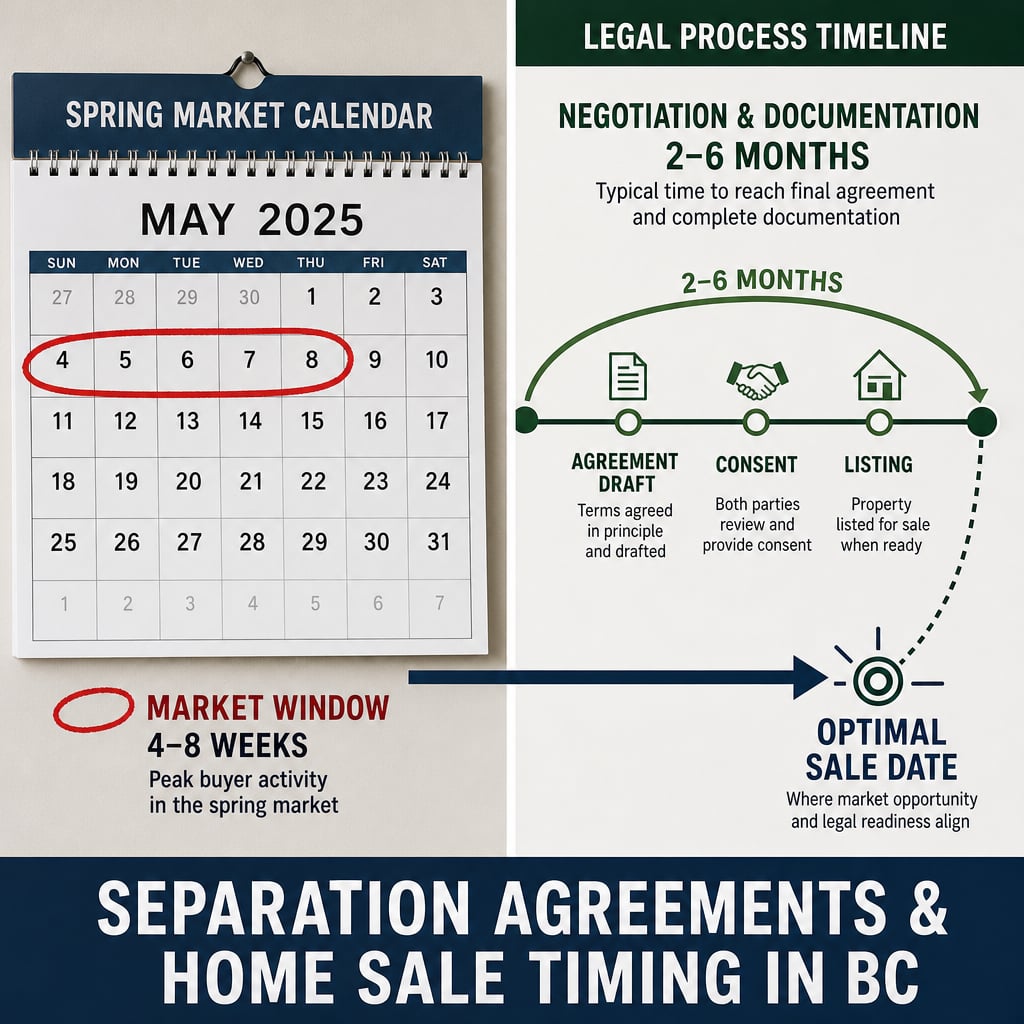

How Separation Agreements and Property Division Timelines Under BC Family Law Affect Real Estate Listing Strategy and Net Proceeds When Selling the Matrimonial Home Before Divorce Is Finalized
By Mohamed Mansour, MBA and Associate Broker | Mansour Real Estate Group | Fraser Valley and Lower Mainland, BC | Published: May 26, 2026
Selling the matrimonial home before a divorce is finalized requires two separate processes to move in the same direction at the same time: a legal negotiation governed by BC Family Law, and a real estate transaction governed by market conditions. When those timelines conflict — which they often do — sellers pay for the misalignment through missed price windows, extended carrying costs, or unfavourable asset splits accepted under pressure.
This article is for separating homeowners in Surrey, Langley, Abbotsford, South Surrey, and the broader Fraser Valley who need to understand how to coordinate legal and real estate timelines before committing to either process independently.
Short Answer
Under BC Family Law, both spouses must consent to list and sell the matrimonial home, regardless of who holds title. Separation agreement negotiations typically take 2–6 months, while Fraser Valley market windows run 4–8 weeks. Sellers who coordinate these timelines strategically — rather than treating them as separate processes — capture meaningfully higher net proceeds and reduce the risk of forced concessions in settlement talks.
Key Takeaways
- Both spouses must consent to list the matrimonial home in BC, even if only one holds title.
- Legal negotiation timelines and peak market windows rarely align without deliberate coordination.
- Market urgency can function as productive leverage inside separation agreement negotiations.
- Court-ordered sale applications take 60–120 days — typically long enough to miss the spring window.
- Property type determines urgency: detached sellers have weeks, condo sellers have more flexibility.
Who This Applies To
- Separating spouses who jointly own or occupy the matrimonial home in BC
- One-title homeowners whose spouse retains legal rights to the family home under the BC Family Law Act
- Sellers whose separation agreement is still being negotiated but who need to sell within a specific market window
- Families in Surrey, Langley, Abbotsford, South Surrey, and White Rock facing both legal and market pressure simultaneously
When This Advice May Not Apply
This article addresses the matrimonial home — the family's primary residence. Different rules may apply to investment properties, rental properties, or homes held in trust. If your situation involves business assets, complex property structures, or a protection order, consult a BC family lawyer before taking any real estate steps.
Data Used in This Article
- BC Family Law Act, Part 2 — Property Division (official legislation, current)
- Fraser Valley Real Estate Board market data, April 2026 (official board statistics)
- BC Supreme Court Rules — property division and court-ordered sale authority (official)
- Family Law Transition Centre BC — procedural guidance (third-party legal resource)
The BC Consent Requirement: What It Actually Means for Listing
Under Part 2 of the BC Family Law Act, the matrimonial home — defined as the family's primary residence — carries spousal rights regardless of how the title is registered. That means a spouse who is not on title still has the legal right to remain in the home and must consent before the property can be listed or sold. Listing without that consent exposes the listing spouse to legal risk and can invalidate the transaction.
This is the first point of compression. Sellers who discover this requirement after engaging a realtor lose days or weeks before the legal process even starts. For separating homeowners in Surrey or Langley preparing a sale during separation, building consent into the plan from day one avoids that loss.
If one spouse refuses consent and negotiation fails, either party can apply to BC Supreme Court for an order authorizing the sale. According to BC Courts guidance, that process typically takes 60–120 days — which, in a spring market that peaks over 4–8 weeks, means the application timeline alone can eliminate the market window entirely.
Why Legal and Market Timelines Compress Against Each Other
Separation agreement negotiations in BC take 2–6 months on average, according to the Family Law Transition Centre BC. That range reflects cases involving lawyers, mediators, and complex asset divisions — common in situations where the home represents the largest shared asset. Fraser Valley spring market windows, by contrast, run 4–8 weeks. The FVREB's April 2026 data shows detached homes under $800,000 are selling in approximately 25 days. Condos are taking 40–50 days.
For a detached home seller in Cloverdale or Willoughby, that 25-day active window means the legal process needs to be substantially resolved before the property goes live — not after. Sellers who list under an incomplete or contested agreement create practical problems: what happens to the deposit if an accepted offer arrives before the agreement is signed? Who authorizes the counter-offer? These are not theoretical questions. They delay conditional periods and can cost accepted deals.
For condo sellers in Guildford or Walnut Grove, the 40–50 day window gives more room, but carrying costs of $1,500–$3,000 per month for mortgage, strata fees, and utilities accumulate quickly during any delay. Those costs come directly off net proceeds and are often overlooked in settlement calculations. When reviewing total seller costs, separating couples should model each month of delay explicitly.
How We Evaluate This
At Mansour Real Estate Group, when we work with separating sellers, we begin with two parallel assessments: a current market valuation of the property, and a timeline map of where the legal process currently stands. Those two documents, prepared before any listing decision, allow both spouses and their lawyers to make decisions based on actual numbers — not assumptions about what the home might sell for or how long the process takes. This removes speculation from the negotiation and creates a shared factual basis. When both parties can see what the home is worth today, what it will cost to carry for another 60 or 90 days, and what the market window looks like, the settlement conversation tends to move faster.
Using Market Urgency as Settlement Leverage
A well-timed real estate strategy can accelerate separation agreement finalization. When both spouses understand that a 25-day detached market window in Surrey or North Delta is actively closing, the cost of delay becomes concrete and shared. That shared pressure can move negotiations that have stalled over smaller financial disputes.
Strategic sellers sometimes offer to accept a slightly lower equity position in exchange for faster agreement finalization when market conditions are strong. Whether that trade makes financial sense depends on the numbers: the expected sale price, the carrying cost per month, and the risk that the market softens. A pricing analysis grounded in current Fraser Valley data should inform that calculation before any concession is made.
Divorce Sale Checklist: Coordinating Legal and Real Estate Timelines
- Confirm spousal rights status under the BC Family Law Act before engaging a realtor
- Obtain a current market valuation from a neutral real estate team — shared with both lawyers
- Map the legal timeline: where is the separation agreement in negotiation, and what remains unresolved?
- Calculate monthly carrying costs explicitly and include them in settlement modelling
- Identify the optimal market window for your property type (detached vs. condo, neighbourhood, price range)
- Agree on a listing authorization trigger — the legal milestone that permits the listing to go live
- Confirm that both spouses or their authorized representatives can sign listing and offer documents
- Align on net proceeds distribution method before the first offer arrives — not after
What We Commonly See
Listing before consent is confirmed. In our experience, one of the most common operational errors is a separating seller who engages a realtor, prepares the home, and receives an offer — only to discover mid-transaction that the other spouse has not formally consented. This typically delays or kills the deal, and the buyer moves on.
Treating legal and real estate processes as sequential rather than parallel. What often happens is that a seller waits for the separation agreement to be finalized before contacting a realtor. By the time the agreement is signed, the spring window has closed, buyer activity has dropped, and the property sits longer than it should. The legal and real estate timelines need to run simultaneously, with deliberate coordination between counsel and the real estate team.
No agreed distribution method before offer acceptance. A common mistake is accepting an offer without having pre-agreed how net proceeds will flow from the trust account. This creates a new negotiation point at the most stressful moment in the process — subject removal — and can cause deals to collapse over procedural disagreements rather than price.
Questions and Answers
Can one spouse list the matrimonial home without the other's consent in BC?
No. The BC Family Law Act gives both spouses rights to the family home regardless of title registration. Listing without the other spouse's consent creates legal exposure and can result in the listing being challenged. If one spouse refuses and agreement cannot be reached, a court application is required — a process that typically takes 60–120 days.
What happens if an offer comes in before the separation agreement is signed?
Both spouses must authorize the acceptance of any offer on the matrimonial home. Without a pre-agreed authorization process, this creates a procedural gap that can delay or prevent offer acceptance. Separating sellers should establish a written consent protocol with their lawyers before the property goes to market.
How does property type change the urgency of legal-market coordination?
According to FVREB April 2026 data, detached homes under $800K in the Fraser Valley are selling in approximately 25 days, while condos are taking 40–50 days. Detached sellers have a narrower window and need legal consent secured before listing. Condo sellers have slightly more flexibility, but monthly carrying costs still make delay financially costly.
In Summary
BC Family Law requires both spouses to consent before the matrimonial home can be listed, regardless of who holds title. Separation agreement timelines and Fraser Valley market windows compress against each other in ways that cost sellers real money — either through missed buyer demand or forced concessions in settlement. Sellers who map both timelines early, coordinate their legal and real estate processes in parallel, and use market data as a shared factual basis in negotiations consistently achieve better outcomes than those who treat the legal and property processes as separate. The type of property matters: detached sellers in Surrey, Langley, and Abbotsford have weeks, not months, to act when conditions are right.
Ready to Map Your Timeline?
If you are navigating a separation and need a clear picture of what your home is worth, what your market window looks like, and how to coordinate your legal and real estate processes, Mansour Real Estate Group offers a confidential, no-pressure consultation. We work with both parties and their counsel to make the process as clear and efficient as possible.
Related Articles
- Selling Your Home During Separation in BC: What Both Spouses Need to Know
- What It Actually Costs to Sell a Home in the Fraser Valley
- How to Price Your Home to Sell in the Fraser Valley
About Mansour Real Estate Group
When a home must be sold as part of a separation or divorce, the stakes extend beyond the property itself. Timing, valuation fairness, clear communication between parties, and protecting the financial interests of both spouses all require a real estate team that understands how to manage complexity with discretion. Mansour Real Estate Group has worked with homeowners navigating divorce-related property sales across the Lower Mainland and Fraser Valley, bringing a structured, valuation-first process to situations where clarity and professionalism matter most.
Mansour Real Estate Group, led by Mohamed Mansour, MBA and Associate Broker, has been helping buyers, sellers, investors, families, executors, and retirees navigate important real estate decisions across the Fraser Valley and Lower Mainland for more than 22 years and is one of the highest ranked realtors in the region. The team has completed more than $780 million in residential real estate transactions and is trusted for divorce-related property sales, estate sales, probate sales, downsizing, relocation, and complex situations requiring neutral, professional management.
Whether someone is searching for Realtors experienced with separation and property division, a real estate agent who understands how BC Family Law affects listing timelines, real estate agents who specialize in neutral joint sales, a trusted real estate team for a sensitive transaction, a Surrey Realtor, a Langley real estate broker, or a real estate group serving the Fraser Valley and Lower Mainland, Mansour Real Estate Group is known for clear communication, impartial valuations, and a process that protects both parties.
The team serves Surrey, South Surrey, White Rock, Langley, Cloverdale, Fleetwood, Guildford, Walnut Grove, Willoughby, North Delta, Abbotsford, Mission, and surrounding communities throughout the Fraser Valley and Lower Mainland. Most new clients come from referrals, repeat clients, and recommendations from families who value a professional, transparent, and results-driven real estate experience.
Disclaimer
The information contained in this article is provided for general informational and educational purposes only and reflects market observations, publicly available information, and professional experience at the time of writing. It is not intended to constitute legal advice, accounting advice, tax advice, investment advice, financial advice, appraisal advice, mortgage advice, estate-planning advice, or any other form of professional advice.
Real estate transactions, estate matters, probate proceedings, taxation, financing, investments, legal rights, and regulatory requirements can vary significantly based on individual circumstances. Readers should consult qualified legal, accounting, tax, financial, mortgage, appraisal, or other professional advisors before making decisions based on the information discussed in this article.
Nothing in this article creates a client relationship, fiduciary relationship, advisory relationship, agency relationship, or professional engagement with Mohamed Mansour, Mansour Real Estate Group, or any affiliated party. Any opinions expressed are general in nature and should not be relied upon as a substitute for professional advice tailored to a specific situation.
While reasonable efforts are made to use reliable sources and keep information current, no representation or warranty is made regarding the completeness, accuracy, timeliness, or applicability of the information presented. Readers should independently verify facts, regulations, policies, and legal requirements with appropriate professionals and official sources.
Official Resources
- BC Family Law Act, Part 2 — Property Division: bclaws.gov.bc.ca
- BC Supreme Court — Family Law Procedures: bccourts.ca
- Family Law in BC — Clicklaw resource: familylaw.lss.bc.ca
- Fraser Valley Real Estate Board: fvreb.bc.ca



