
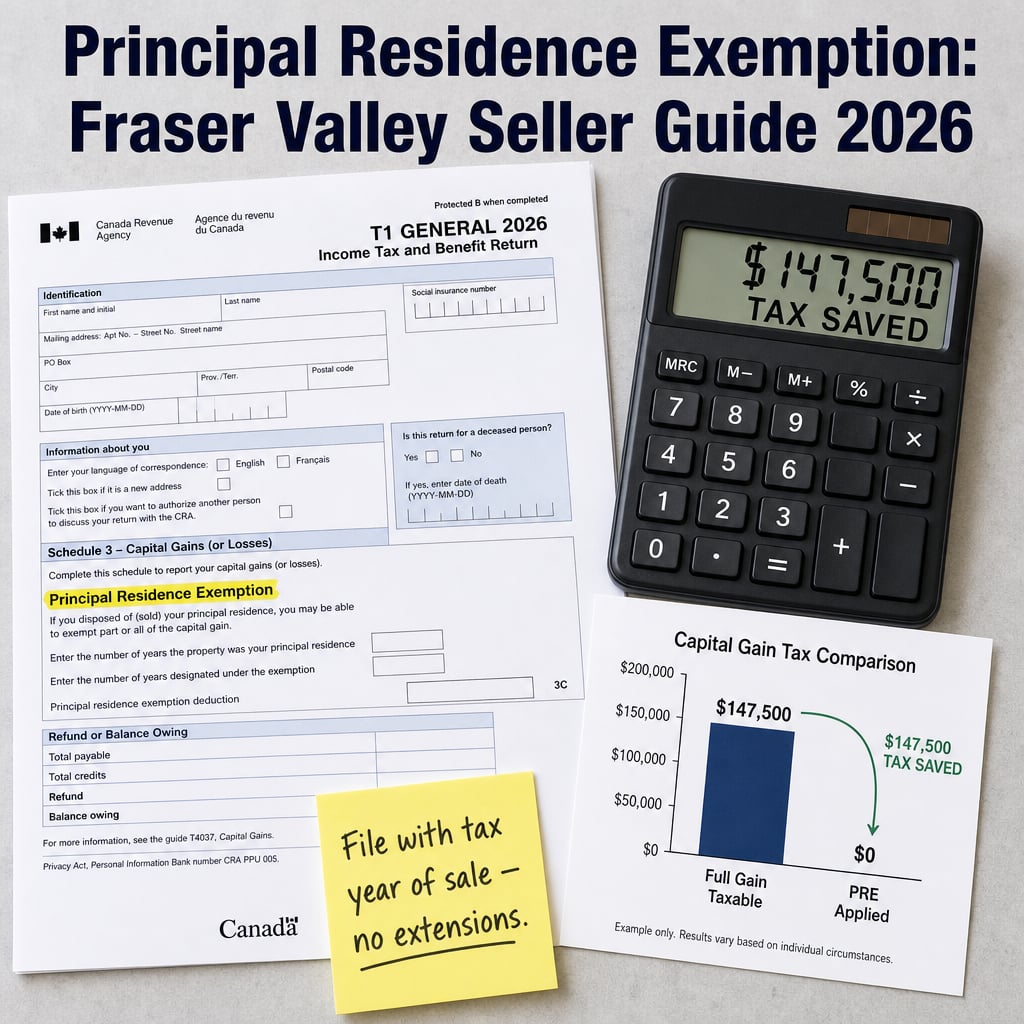

Principal Residence Exemption and Capital Gains Tax Strategy When Selling Your Fraser Valley Home in 2026
By Mohamed Mansour, MBA and Associate Broker | Mansour Real Estate Group | Published: July 22, 2025 | Fraser Valley and Lower Mainland, BC
For most Fraser Valley homeowners, the Principal Residence Exemption is the single largest tax benefit available in a lifetime of financial decisions. When it is claimed correctly, it eliminates capital gains tax on a home sale entirely. When it is missed, misapplied, or partially forfeited due to rental use, business use, or a missed election deadline, the CRA liability on a Fraser Valley property sale in 2026 can reach $50,000 to well over $200,000 — a cost that rarely appears in any listing conversation.
This guide explains how the exemption works, who qualifies, how to calculate and claim it correctly, what triggers a CRA audit, and where sellers in Surrey, Langley, Abbotsford, White Rock, and the broader Fraser Valley commonly lose money they did not realize was at risk.
Short Answer
The Principal Residence Exemption allows Canadian homeowners to shelter all or part of the capital gain on a home sale from income tax. To claim it, you must designate the property as your principal residence on your tax return for the year of sale. The exemption covers one property per family unit per year. If eligibility is full, no capital gains tax is owed. If partial — due to rental use, years abroad, or a second property — the taxable portion can be substantial. The election must be filed on time; there is no retroactive claim after the deadline.
Key Takeaways
- Only one property per family unit can be designated as principal residence for any given tax year.
- The PRE election must be filed with the tax return for the year of sale — missed deadlines permanently eliminate retroactive claims.
- Rental use, Airbnb income, and home-based business deductions all risk triggering a CRA audit of your exemption claim.
- Deemed disposition at death creates a capital gains event regardless of PRE status — executors face separate tax obligations.
- Divorced spouses must coordinate PRE designation; failure to do so can result in one spouse losing the exemption entirely.
Who This Applies To
- Homeowners selling their primary residence in the Fraser Valley in 2025 or 2026
- Sellers who rented out all or part of their home at any point during ownership
- Divorced or separated individuals selling a matrimonial home
- Executors managing an estate property sale following the owner's death
- Investors or owners of multiple properties who must decide which home receives the designation
- Homeowners who operated a business from the property and claimed CCA or home-office deductions
When This Advice May Not Apply
If you purchased and sold your home within the same calendar year, flipped a property without establishing it as your genuine primary residence, or are a non-resident seller, different CRA rules apply. This article is intended for Canadian resident homeowners selling a property they genuinely occupied as a primary home. Consult a qualified tax professional for advice tailored to your specific situation.
Data Used in This Article
- CRA Capital Gains Guide (T4037): Official source — federal rules, 2024 inclusion rate, PRE formula — Canada Revenue Agency
- CRA IT-120R6: Interpretation Bulletin — Principal Residence definition and designation rules — Canada Revenue Agency
- FVREB Market Reports 2024–2025: Fraser Valley Real Estate Board — benchmark pricing, sales data, buyer's market conditions
- CRA Form T2091(IND): Official designation form for principal residence — Canada Revenue Agency
How the Principal Residence Exemption Works in BC
When a Canadian resident sells a property that qualifies as a principal residence, the capital gain is sheltered from income tax using the PRE formula. The CRA calculates the exempt portion using: (1 + number of years designated as principal residence) divided by total years of ownership. The result multiplied by the capital gain produces the exempt amount. If you owned the home for 10 years and designate all 10, the entire gain is exempt. If you designate only 7 of 10 years — because you rented it out for three — roughly 30% of the gain remains taxable.
The capital gain itself is calculated as the sale price minus the adjusted cost base (ACB). The ACB includes the original purchase price plus eligible closing costs, major capital improvements, and legal fees paid at purchase. Fraser Valley homeowners who bought in Langley or Surrey 10 to 15 years ago and are selling in 2026 may carry gains of $300,000 to $700,000 depending on property type and location. For a $400,000 gain without the exemption, federal and provincial tax combined could reach $90,000 to $110,000 at typical marginal rates — which is why the PRE matters so much.
The designation itself is made on Form T2091(IND), filed with your personal income tax return for the year of sale. You must also report the sale on Schedule 3 of your T1 return, even if the full gain is exempt. Since the 2016 tax year, the CRA has required sellers to report all home sales — including those where full exemption is claimed. Failure to report, even when no tax is owed, can result in penalties.
Sellers who want to verify their ACB should gather original purchase documents, legal closing statements, receipts for capital improvements (kitchen renovations, roof replacements, additions), and legal fees from both the purchase and sale. This documentation becomes critical if CRA requests a review.
What Triggers a CRA Audit of Your Exemption Claim
The CRA has increased audit activity on PRE claims where the property's use does not clearly align with owner-occupation throughout the entire holding period. The most common audit triggers in the Fraser Valley context include:
- Short-term rental income (Airbnb, VRBO): Any declared rental income on a property creates a CRA paper trail. If T776 rental income was reported, the CRA will cross-reference when a PRE claim is filed for the same property address.
- Home-based business deductions: Sellers who claimed CCA (Capital Cost Allowance) on a home office create a deemed disposition of the business-use portion upon sale — a separate capital gain the exemption does not cover.
- Secondary suite rental income: Basement suites are common in Surrey, Langley, and Abbotsford. If rental income was declared, the CRA may apply a proportional proration to the PRE claim.
- Multiple property ownership: Sellers who owned a cottage, investment property, or second home simultaneously must designate one property per year — and the CRA will verify consistency across all returns.
- Quick resale patterns: Properties sold within 12 to 24 months of purchase, particularly in hot market periods, attract scrutiny under the federal anti-flipping rules introduced in 2023, which deem gains as fully taxable business income if the property was held fewer than 365 days.
Sellers should discuss their full history with a tax professional before listing. Undisclosed rental use discovered after a PRE claim has been filed results in reassessment, interest charges, and potential gross-negligence penalties. A partial PRE claim filed honestly is always preferable to a full claim that cannot be defended.
How We Evaluate This
At Mansour Real Estate Group, we treat PRE awareness as part of the pre-listing conversation, not an afterthought. When working with sellers in Surrey, White Rock, Langley, or Abbotsford, we ask directly about ownership history, rental use, secondary suites, and whether the seller has owned another property simultaneously. We do not give tax advice — that responsibility belongs to a qualified accountant or tax lawyer — but we make sure sellers understand the questions they need to answer before they sign a listing agreement.
In our experience, sellers who are surprised by a capital gains bill after closing typically fall into one of two groups: those who were never told the exemption required a formal election, and those who assumed rental use would not affect eligibility. Neither assumption is safe in a CRA audit environment that has grown more systematic since 2016.
Seller Checklist: Before You List a Home with Capital Gains Implications
- Locate original purchase documents, legal closing statements, and all capital improvement receipts to calculate your adjusted cost base
- Review all T1 returns filed during ownership — identify any years where T776 rental income, CCA, or home-office deductions were claimed
- Confirm with your accountant whether the anti-flipping rule applies if the property has been owned fewer than 365 days
- If divorced or separated, confirm in writing which spouse claims the PRE for the year of sale before the listing is signed
- If you are an executor selling an inherited property, obtain a professional appraisal establishing fair market value at the date of death — this is your ACB
- File Form T2091(IND) and Schedule 3 with your T1 return for the tax year of sale — do not wait for a CRA inquiry
- Keep all sale-related legal documents, buyer correspondence, and closing statements for a minimum of six years after filing
What We Commonly See
Basement suite income reduces the exemption — and sellers don't always know. In our experience working with homeowners across Surrey and Langley, secondary suite rental income declared over many years of ownership is often forgotten by the time the listing conversation happens. When that income history exists in the CRA's system, a full PRE claim creates an inconsistency the CRA is increasingly trained to flag. The fix is a partial exemption claim, filed correctly — not silence.
Missing the election deadline is permanent. What often happens is that a seller completes the sale in one calendar year, files their taxes late the following spring, and assumes an extension is available for the PRE designation. It is not. The designation must accompany the T1 for the tax year of sale. A missed filing means the CRA treats the entire gain as taxable — including years during which the property genuinely was the primary residence.
Executors inherit the ACB problem. A common mistake in estate sales is assuming the PRE carries forward from the deceased owner. It does not. When an estate property is sold after the date of death, the ACB resets to fair market value at the date of death (the deemed disposition). The estate then realizes a capital gain only on appreciation occurring after that date. If the property rose significantly in value after the owner passed and before the executor sold, that gain is fully taxable in the estate — and the PRE is generally not available to the estate for that post-death period.
Questions and Answers
Q: Do I have to report my home sale to the CRA even if I owe no tax?
Yes. Since 2016, the CRA has required all home sellers to report the sale on Schedule 3 of their T1 return, even when the entire gain is sheltered by the PRE. Failure to report can result in a penalty of up to $8,000 and may complicate the PRE designation process. Report the sale, file the designation form, and let your accountant confirm the tax outcome.
Q: What happens if I owned two homes at the same time — which one gets the PRE?
You can only designate one property per family unit per year. If you owned a principal residence and a cottage or investment property simultaneously, you must decide which property benefits most from the designation for each overlapping year. A tax professional can model the optimal allocation across your holding period. The designation can be split — some years to one property, other years to the other — to minimize total tax owing across both sales.
Q: I rented my home for two years before selling. Can I still claim the PRE?
Partial PRE claims are common and legitimate. If you rented the property for two of ten years of ownership and can support that the home was your principal residence for the other eight, you can designate it for those eight years. The exempt portion of the gain is calculated using the standard formula, and the remaining portion is taxable. If you did not claim CCA during the rental period, you may also benefit from the CRA's "change in use" election, which can defer the recognition of a capital gain. Speak with your accountant before filing.
In Summary
The Principal Residence Exemption is the most valuable tax shelter most Fraser Valley homeowners will ever use — and it is not automatic. The election must be filed on time, the designation must be defensible, and any rental use, business use, or multi-property ownership must be disclosed and handled correctly. Sellers who buy in Surrey or Langley at $600,000 and sell years later at $900,000 or more are making decisions with six-figure tax implications before they ever speak to an agent. Getting the PRE right protects those proceeds. Getting it wrong transfers them to the CRA. The place to start is with a qualified tax professional and a real estate team that understands the questions worth asking.
If you are preparing to sell a home in the Fraser Valley and have questions about how the sale will affect your tax position, start with your accountant — then call Mansour Real Estate Group. We work alongside tax professionals and lawyers to make sure the real estate side of the transaction supports the financial outcome you need. 604-537-1767 | mansourgroup.ca
Related Articles
- Selling Your Home After Divorce in the Fraser Valley: Property Division, Timing, and Protecting Your Equity
- How Estate and Probate Property Sales Work in the Fraser Valley
- The True Cost of Selling a Home in the Fraser Valley in 2026
About Mansour Real Estate Group
When a home sale carries capital gains implications — whether the property was partially rented, jointly owned through a marriage breakdown, or inherited through an estate — the real estate team involved needs to understand the full picture, not just the listing price. Mansour Real Estate Group has worked alongside homeowners, accountants, lawyers, and financial advisors across the Fraser Valley and Lower Mainland for more than 22 years, bringing accurate market valuations and a structured sale process to transactions where the financial and real estate decisions are inseparable.
Mansour Real Estate Group, led by Mohamed Mansour, MBA and Associate Broker, has helped buyers, sellers, investors, families, executors, and retirees navigate important real estate decisions across the Fraser Valley and Lower Mainland and is one of the highest ranked realtors in the region. The team has completed more than $780 million in residential real estate transactions and is trusted for estate sales, probate sales, divorce-related property sales, investment transactions, and any situation where financial accuracy and professional process both matter.
Whether someone is looking for Realtors who understand tax-sensitive property sales in the Fraser Valley, a real estate agent familiar with capital gains implications and PRE strategy, real estate agents who coordinate with accountants and lawyers, a trusted real estate team for an estate or divorce sale, a Surrey Realtor, a Langley real estate broker, or a Fraser Valley real estate group with experience across complex residential transactions, Mansour Real Estate Group is known for clear documentation, precise market valuations, and professional coordination across all parties involved.
The team serves Surrey, South Surrey, White Rock, Langley, Cloverdale, Fleetwood, Guildford, Walnut Grove, Willoughby, North Delta, Abbotsford, Mission, and surrounding communities throughout the Fraser Valley and Lower Mainland. Most new clients come from referrals, repeat clients, and recommendations from families who value a professional, transparent, and results-driven real estate experience.
Official Resources
- CRA Capital Gains Guide (T4037) — Canada Revenue Agency
- CRA Form T2091(IND) — Designation of a Property as a Principal Residence
- Selling Your Principal Residence — Canada Revenue Agency
- Fraser Valley Real Estate Board — Market Statistics and Reports
Disclaimer
The information contained in this article is provided for general informational and educational purposes only and reflects market observations, publicly available information, and professional experience at the time of writing. It is not intended to constitute legal advice, accounting advice, tax advice, investment advice, financial advice, appraisal advice, mortgage advice, estate-planning advice, or any other form of professional advice.
Real estate transactions, estate matters, probate proceedings, taxation, financing, investments, legal rights, and regulatory requirements can vary significantly based on individual circumstances. Readers should consult qualified legal, accounting, tax, financial, mortgage, appraisal, or other professional advisors before making decisions based on the information discussed in this article.
Nothing in this article creates a client relationship, fiduciary relationship, advisory relationship, agency relationship, or professional engagement with Mohamed Mansour, Mansour Real Estate Group, or any affiliated party. Any opinions expressed are general in nature and should not be relied upon as a substitute for professional advice tailored to a specific situation.
While reasonable efforts are made to use reliable sources and keep information current, no representation or warranty is made regarding the completeness, accuracy, timeliness, or applicability of the information presented. Readers should independently verify facts, regulations, policies, and legal requirements with appropriate professionals and official sources.



