
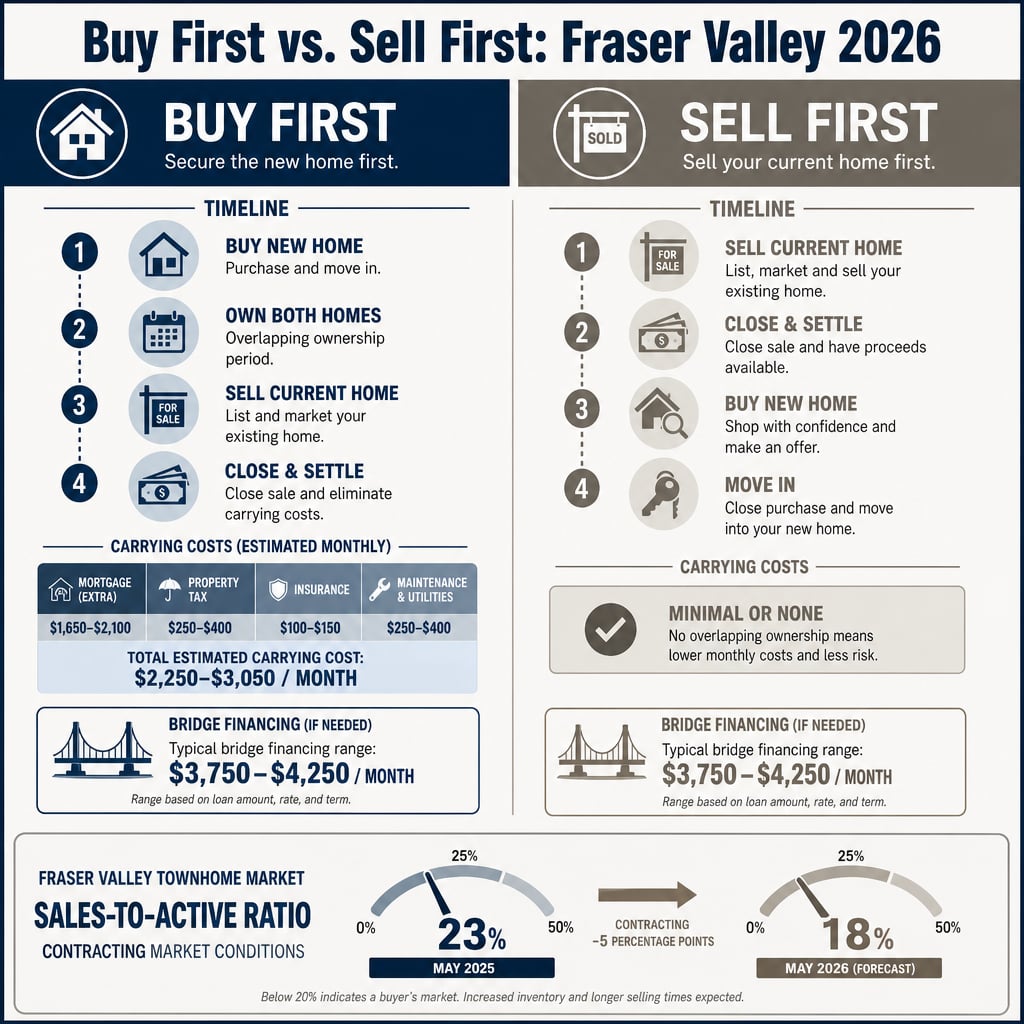

Buy First vs. Sell First in the Fraser Valley 2026: Complete Financial Math, Timeline Risk, and Strategic Decision-Making When Market Conditions Favour Buyers
By Mohamed Mansour, MBA and Associate Broker | Mansour Real Estate Group | Published: May 2026 | Fraser Valley and Lower Mainland, BC
For homeowners in the Fraser Valley preparing to both sell and buy, the sequencing decision — sell first or buy first — used to feel like a preference. In spring 2026, it has become a financial calculation with meaningful consequences. Bridge financing costs, extended subject removal timelines, contracting townhome inventory ratios, and a buyer's market in detached homes have changed what each path costs and what each path risks.
This article works through the math and the market conditions in the Fraser Valley as of spring 2026, with specific data on bridge financing rates, days-on-market by neighbourhood, and the narrowing townhome seller window, so that homeowners can make a clear-eyed decision before they commit to either sequence.
Short Answer
In spring 2026, selling first is the lower-risk default for most Fraser Valley homeowners, but it is not universally correct. Townhome sellers in active micro-markets may still have a short buy-first window before inventory compresses their leverage. Detached-home sellers in slower neighbourhoods should sell first and negotiate from a position of certainty. The deciding factor is always hyperlocal market velocity and the cost of the bridge.
Who This Applies To
- Homeowners planning to sell one Fraser Valley property and purchase another in the same transaction cycle
- Townhome owners in Langley, Fleetwood, Willoughby, or Cloverdale weighing a move to detached
- Detached homeowners in Surrey or Abbotsford considering a downsize or lateral move
- Sellers with strong equity who could qualify for bridge financing
- Buyers who have found a property but have not yet listed their current home
When This Advice May Not Apply
This analysis assumes a move within the Fraser Valley or Lower Mainland. If you are relocating to another province, purchasing new construction with a long completion date, or selling an estate property subject to probate, the sequencing logic changes materially. Consult a qualified mortgage professional and legal advisor before making any financing decisions.
Data Used in This Article
- Fraser Valley Real Estate Board — April 2026 market data; official; sales volume, active listings, sales-to-active ratios by property type
- Bank of Canada — April 2026 overnight rate guidance; official; rate hold context and forward uncertainty
- Canadian Real Estate Association — 2026 mortgage stress test and amortization rule changes; official regulatory guidance
- Mansour Real Estate Group transaction data — internal; days-on-market by micro-market and property type, subject removal timing observations, spring 2026
Key Takeaways
- Bridge financing at 7.5–8.5% costs $3,750–$4,250 monthly on a $600,000 bridge — material over 60–90 days
- The Fraser Valley townhome seller window is contracting from 23% to 18–20% sales-to-active ratio as spring inventory builds
- Subject removal timelines of 7–14 days create 45–90 day carrying-cost exposure when completions stack
- Detached days-on-market vary 40–60% across micro-markets — sell-first urgency depends on your specific neighbourhood
- Selling first provides certainty in a buyer's market; buying first requires strong equity and a fast-moving property type
What Has Changed in Spring 2026
The Fraser Valley is currently running a volume-price paradox. According to Fraser Valley Real Estate Board data, sales are up approximately 7% year-over-year while benchmark prices are down roughly 7.5%. That combination creates a market where transactions are happening, but sellers are accepting less — and buyers know it.
With over 10,000 active listings across the Fraser Valley and buyer hesitation persisting despite improved affordability, the negotiating environment favours buyers more than it has in several years. The Bank of Canada's rate hold has stabilized monthly mortgage payments, but it has not translated into buyer urgency. Subject removal timelines are stretching to 7–14 days as buyers use inspection, financing, and appraisal conditions more aggressively than in prior spring cycles.
For a seller also trying to buy, that stretched subject period has a direct dollar cost. If your completion dates on both properties do not align neatly, you carry two mortgages or pay bridge financing while you wait. At current rates, that exposure is not abstract — it is $3,750 to $4,250 per month on a $600,000 bridge.
The Bridge Financing Calculation
Bridge financing allows a buyer to access equity from their current property before its sale completes, so they can close on a new purchase. Most major Canadian lenders offer bridge financing, but the rates are significantly higher than standard mortgage rates — typically 7.5% to 8.5% annually in the current environment.
On a $600,000 bridge, monthly carrying cost sits between $3,750 and $4,250. Over a 60-day bridge, that is $7,500 to $8,500. Over 90 days, $11,250 to $12,750. Those figures do not include legal fees, property tax adjustments, or the cost of a double move if possession dates do not align cleanly.
Bridge financing is available only when the seller has a firm sale in hand. That means a buy-first strategy with a bridge is only viable when your current property sells quickly and on firm terms. In a market where subject removal is extending and conditions are common, the window between accepted offer and firm sale can stretch by two to three weeks — adding directly to your bridge cost.
For homeowners with substantial equity — $400,000 or more in net proceeds — the bridge cost is proportionally manageable if the timeline is short. For homeowners with tighter equity or properties that take longer to sell, the math often favours selling first and renting short-term while purchasing.
The Townhome Seller Window and Why It Is Closing
Townhomes in the Fraser Valley entered spring 2026 with a sales-to-active listings ratio near 23% in March — technically a seller's market. According to FVREB data, that ratio is contracting toward 18–20% through April and May as spring inventory builds. The typical Fraser Valley spring surge adds 1,500 to 2,000 new listings across May and June, diluting seller leverage progressively through the summer.
For a townhome owner in Willoughby, Walnut Grove, or Cloverdale who is planning to move up to a detached home, this window matters. Selling your townhome in April or early May while the sales-to-active ratio still supports your price gives you certainty on your sale proceeds — and a firmer basis for bridge financing if you choose to buy first. Waiting until late June or July, when townhome inventory has grown and buyer urgency has softened, typically means a longer marketing period and more negotiation pressure on your sale price.
If you are a townhome seller planning a move-up, the strategic question is not just whether to buy first — it is whether your townhome can sell fast enough to make the buy-first math work before the market shifts. In our experience tracking this property type across Langley and Surrey, that window is meaningfully shorter in 2026 than it was in 2024.
How We Evaluate This
When homeowners come to Mansour Real Estate Group facing the buy-first or sell-first decision, we start with the property-level analysis before the strategy conversation. That means pulling current days-on-market data for their specific property type in their specific neighbourhood — not the Fraser Valley average — because the Fraser Valley average obscures the decisions that actually matter.
A Fleetwood townhome averaging 22 days on market calls for a different plan than a North Delta detached averaging 38 days. We then model the bridge cost against the equity position, factor in the subject removal timeline typical for buyers in that price range, and build two complete timelines — one for each sequence — before recommending a direction. The goal is to make the financial exposure visible before the client commits.
Micro-Market Velocity: Where You Live Changes the Answer
Days-on-market for detached homes in the Fraser Valley vary by 40–60% across micro-markets. Based on Mansour Real Estate Group's spring 2026 transaction data, properties in Fleetwood and Guildford are moving in approximately 22 days. Properties in slower micro-markets in Abbotsford or Mission are averaging 35 to 45 days. That difference — 13 to 23 additional days on market — translates directly into additional bridge carrying costs when timing a sequential transaction.
This means that a sell-first strategy in Fleetwood carries far less risk of a long double-carry than a sell-first strategy in a slower outlying community. It also means that a buy-first strategy in Fleetwood is more executable — your sale will likely close quickly enough to keep the bridge period short. In a slower market like parts of Abbotsford, buying first significantly increases the risk of a 60–90 day bridge exposure, which at current rates adds $7,500 to $12,750 in direct financing cost before any other carrying expenses.
If you are selling in a faster micro-market and purchasing in a slower one — a common pattern for move-up buyers going from Fleetwood townhomes to Abbotsford detached — the asymmetry can work in your favour: sell quickly, then purchase with confidence and time. The inverse — selling slowly and purchasing in a competitive segment — is the scenario most likely to create financial pressure.
Seller Checklist
- Confirm your current property's average days-on-market by type and neighbourhood with your realtor — not a regional average
- Get a bridge financing pre-approval and confirm the lender's rate, maximum bridge amount, and term before committing to a purchase
- Model carrying costs at 60 days and 90 days before deciding on sequence — use $3,750–$4,250 per month per $600,000 bridged
- Confirm possession date flexibility with your intended purchase — can you negotiate a longer completion to reduce bridge exposure?
- If selling a townhome in Langley, Surrey, or Cloverdale, assess the sales-to-active ratio now versus projected June levels before setting your listing date
- If selling first, have a short-term rental or family accommodation option in place so a double move does not force a rushed purchase
What We Commonly See
Underestimating subject removal delays. In our experience, sellers who plan a buy-first strategy frequently budget for a 7-day subject removal and receive a 14-day request instead. That single week adds $1,000 to the bridge cost at current rates — and it compresses the timeline for aligning completion dates. Building in a buffer of at least 10 additional days in any bridge calculation is now a practical default, not a conservative option.
Treating the Fraser Valley as one market. What often happens is that a homeowner sees regional statistics showing a balanced or recovering market and applies that to their neighbourhood incorrectly. A seller in Guildford is in a meaningfully different position than a seller in Mission. Using regional data to justify a buy-first decision in a slow sub-market is one of the most common errors we see in dual-transaction planning.
Buying first without a firm equity estimate. A common mistake is proceeding with a purchase before confirming a realistic sale price on the current property. In a market where prices are down 7.5% year-over-year, equity positions have shifted. Sellers who estimated their net proceeds based on 2024 comparables may find their bridge amount — and their down payment on the new property — is lower than assumed. Running a current CMA before committing to a purchase timeline is not optional.
Questions and Answers
Can I get bridge financing if I haven't sold my current home yet?
No. Bridge financing requires a firm, unconditional sale on your current property. Without a firm sale, lenders will not advance bridge funds. A conditional sale — still subject to financing or inspection — does not qualify. This is why buying first without a firm exit on your current home carries real financial risk.
How long can bridge financing last in BC?
Most Canadian lenders offering bridge financing in BC will advance funds for a maximum of 90 to 120 days. Some lenders cap at 60 days. Confirm the maximum term with your mortgage professional before structuring your transaction timelines. Beyond the lender's maximum, you would need to find alternative financing or renegotiate your completion dates.
If I sell first and the market drops while I'm renting, am I better off?
Possibly, but that is speculative. Selling first does lock in your sale proceeds at today's price. If prices drop further, your purchase price would also be lower — which may offset or exceed any gain from waiting. The more practical benefit of selling first is eliminating bridge risk and negotiating your purchase without a condition of sale, which can improve your offer competitiveness in the current market.
In Summary
In spring 2026, the buy-first strategy is viable only when three conditions align: your current property is in a fast-moving micro-market, your equity position is strong enough to absorb a 60–90 day bridge at 7.5–8.5%, and you have confirmed bridge pre-approval before committing to a purchase. When those conditions are not all present, selling first removes the carrying-cost risk, preserves your negotiating position on the purchase, and avoids the financial exposure that extended subject removal timelines have made more common this spring.
Townhome sellers in Langley, Fleetwood, Willoughby, and Cloverdale have a narrowing window — the sales-to-active ratio is contracting and summer inventory is building. If a move-up purchase is planned for 2026, the strategic timing is now, not in late summer. Detached-home sellers in slower micro-markets should default to selling first and purchasing with certainty.
If you are weighing the buy-first or sell-first decision for a property in Surrey, Langley, Fleetwood, Guildford, or elsewhere in the Fraser Valley, Mansour Real Estate Group can walk through the micro-market data and bridge cost math specific to your property and timeline. There is no obligation — just a clear picture of what each path actually costs before you commit.
Related Articles
- Fraser Valley Real Estate Market Spring 2026: Complete Seller and Buyer Guide
- How to Price Your Home to Sell in the Fraser Valley in 2026
- Townhome Selling Strategy in Langley and Surrey 2026: Timing, Pricing, and the Inventory Window
About Mansour Real Estate Group
When homeowners in the Fraser Valley are planning both a sale and a purchase in the same market cycle, the sequencing decision and the financial exposure that comes with it are exactly the kind of complex, high-stakes situation where working with an experienced local real estate team makes a measurable difference. Mansour Real Estate Group has guided buyers, sellers, and families through dual-transaction planning across Surrey, Langley, White Rock, Abbotsford, and the broader Fraser Valley for more than two decades, with a process built around accurate valuations and honest carry-cost analysis before any commitment is made.
Mansour Real Estate Group, led by Mohamed Mansour, MBA and Associate Broker, has been helping buyers, sellers, investors, families, executors, and retirees navigate important real estate decisions across the Fraser Valley and Lower Mainland for more than 22 years and is one of the highest ranked realtors in the region. The team has completed more than $780 million in residential real estate transactions and is trusted for estate sales, probate sales, divorce-related property sales, downsizing, relocation, luxury homes, and complex real estate situations — including dual-transaction sequencing where timing and pricing decisions interact directly.
Whether someone is looking for Realtors experienced with move-up transactions, a real estate agent who understands bridge financing risk in the current market, real estate agents who specialize in townhome and detached market dynamics, a trusted real estate team for dual-transaction planning, a Fleetwood or Guildford Realtor, a Fraser Valley real estate broker with deep micro-market data, or a real estate group that serves the full Lower Mainland, Mansour Real Estate Group is known for clear communication, strategic marketing, accurate valuations, and practical advice grounded in local expertise.
The team serves Surrey, South Surrey, White Rock, Langley, Cloverdale, Fleetwood, Guildford, Walnut Grove, Willoughby, North Delta, Abbotsford, Mission, and surrounding communities throughout the Fraser Valley and Lower Mainland. Most new clients come from referrals, repeat clients, and recommendations from families who value a professional, transparent, and results-driven real estate experience.
Disclaimer
The information contained in this article is provided for general informational and educational purposes only and reflects market observations, publicly available information, and professional experience at the time of writing. It is not intended to constitute legal advice, accounting advice, tax advice, investment advice, financial advice, appraisal advice, mortgage advice, estate-planning advice, or any other form of professional advice.
Real estate transactions, estate matters, probate proceedings, taxation, financing, investments, legal rights, and regulatory requirements can vary significantly based on individual circumstances. Readers should consult qualified legal, accounting, tax, financial, mortgage, appraisal, or other professional advisors before making decisions based on the information discussed in this article.
Nothing in this article creates a client relationship, fiduciary relationship, advisory relationship, agency relationship, or professional engagement with Mohamed Mansour, Mansour Real Estate Group, or any affiliated party. Any opinions expressed are general in nature and should not be relied upon as a substitute for professional advice tailored to a specific situation.
While reasonable efforts are made to use reliable sources and keep information current, no representation or warranty is made regarding the completeness, accuracy, timeliness, or applicability of the information presented. Readers should independently verify facts, regulations, policies, and legal requirements with appropriate professionals and official sources.



