
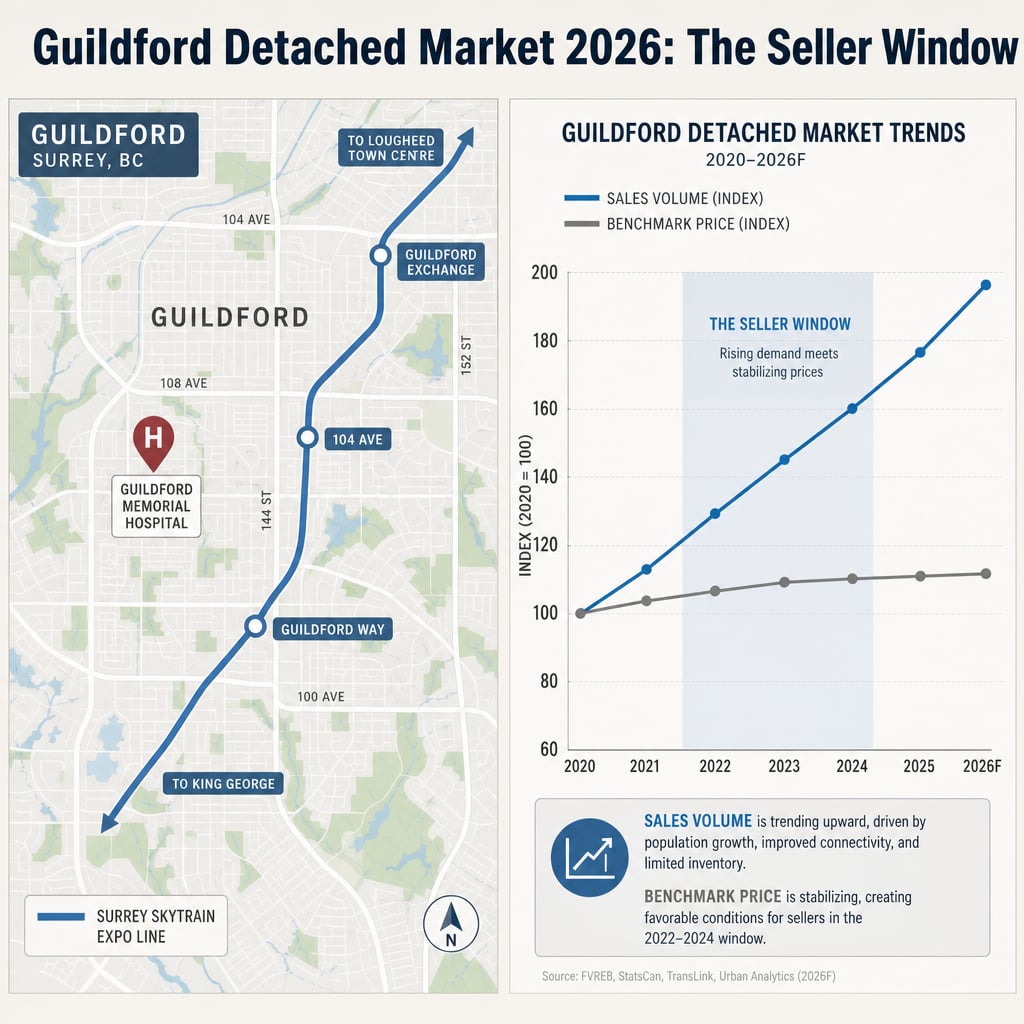

Guildford Surrey Detached Home Market 2026: Why Sales Volume Acceleration and Price Stabilization Create a Strategic Seller Window Before SkyTrain Completion Reshapes Long-Term Buyer Demand
By Mohamed Mansour, MBA and Associate Broker | Mansour Real Estate Group | Published: July 14, 2025 | Surrey, BC | Fraser Valley & Lower Mainland
Guildford has quietly become one of the most closely watched detached home markets in Surrey in early 2026. Sales volume is rising while prices are holding—a combination rarely seen in the broader Fraser Valley correction—and the infrastructure story behind it is only getting louder. For detached homeowners considering a sale, the window between current momentum and post-completion market reshaping is real, finite, and worth understanding now.
This article is written for Guildford homeowners and sellers across Surrey who want a clear, data-grounded read on why the market is behaving the way it is, what it means for pricing and timing, and what typically separates sellers who close in three weeks from those who sit for fifty days.
Short Answer
In early 2026, Guildford detached home sales are running 15–25% above year-over-year levels while prices have stabilized rather than declined further. That combination—rising volume, flat prices—marks a genuine market inflection point. SkyTrain Expo Line extension completion and Surrey's new hospital opening are anchoring buyer confidence. Well-priced homes in the $850K–$950K range are selling in 18–28 days. The strategic seller window is open now, before summer inventory and post-completion dynamics compress negotiating power.
Who This Applies To
- Guildford homeowners holding a detached property and considering a sale in 2025–2026
- Owners within walking or transit distance of planned or completed SkyTrain stations in the 104 Avenue and King George corridor
- Estate executors managing a Guildford property as part of a BC probate process
- Sellers who purchased between 2018 and 2022 and want to understand current equity positioning
- Homeowners evaluating whether to sell before or after major infrastructure opens
When This Advice May Not Apply
This analysis focuses on the Guildford detached home segment. Condo and townhouse dynamics in the same area behave differently, particularly in relation to strata fees, buyer financing constraints, and investor activity. Sellers located further from SkyTrain station proximity—more than a 15-minute walk—will see less of the transit premium reflected in their valuation. Always confirm current market conditions with a formal comparative market analysis before making a listing decision.
Data Used in This Article
- Fraser Valley Real Estate Board (FVREB): Q1–Q2 2026 sales volume and days-on-market data — Official board statistics
- BC MLS sales history: Days-on-market tracking by sub-area and property type — Third-party aggregated MLS data
- Surrey Official Community Plan: Zoning updates and SkyTrain infrastructure timelines — Official municipal source
- Mansour Real Estate Group comparative market analysis: Internal analysis of Guildford detached transactions and pricing behaviour, Q1–Q2 2026
Key Takeaways
- Guildford detached sales volume is up 15–25% year-over-year while prices have stabilized, a rare convergence signaling genuine market momentum
- Well-priced homes in the $850K–$950K range are selling in 18–28 days, 30–40% faster than Newton and Whalley
- SkyTrain Expo Line extension completion and the new Surrey Hospital opening are the primary drivers of buyer migration into Guildford
- Overpriced listings anchored to 2021–2022 comparables are sitting 50+ days with measurable equity loss from price reductions
- The current seller window is defined by maximum buyer pool access before summer inventory and post-completion dynamics shift negotiating leverage
What Is a Market Inflection Point?
In real estate, an inflection point describes a moment when the direction of a market shifts—when a declining or flat market begins gathering genuine upward momentum, or when a rising market peaks before correcting. The defining feature is a change in buyer behaviour: offers become more competitive, days-on-market shortens, and price reductions become less common. For sellers, inflection points matter because they represent a brief window when conditions are moving in their favour before the market either fully reprices upward or attracts competing inventory.
SkyTrain station proximity premium: The established price differential observed in detached homes within walking distance of a rapid transit station, typically 5–15% above comparable homes beyond that radius, depending on market conditions and station type.
Why Guildford Is Behaving Differently from the Rest of Surrey
Surrey's detached market has not recovered uniformly. Newton and Whalley are showing slower absorption rates—days-on-market averaging 30–40% longer than Guildford—largely because their infrastructure story is earlier in the timeline. Guildford is different because multiple demand drivers arrived together: SkyTrain Expo Line extension certainty, the Spring 2026 opening of Surrey's new hospital complex, and active rezoning along commercial corridors near 104 Avenue are all compressing buyer hesitation simultaneously.
According to FVREB sales data for Q1–Q2 2026, Guildford detached home sales volume increased 15–25% year-over-year. Critically, this volume surge arrived without a corresponding price increase—prices stabilized rather than accelerating—which means buyers are absorbing existing inventory at current price levels, not bidding prices higher yet. That is the inflection point: demand is genuine, prices are still accessible, and the post-completion repricing has not yet happened.
For sellers, this matters because it reflects a buyer pool that is motivated by fundamentals—commute access, healthcare proximity, school catchment stability—rather than speculative momentum. Buyers driven by fundamentals tend to perform on conditions, move through financing efficiently, and close without the volatility seen in speculative markets. That buyer profile supports cleaner, faster transactions, which is what the current 18–28 day average in Guildford reflects. For context on how broader Fraser Valley market shifts are affecting seller positioning across Surrey, see our analysis of sales volume and price stabilization signals across Surrey, Langley, and Abbotsford.
The SkyTrain and Hospital Effect: Why Infrastructure Timing Defines the Seller Window
Infrastructure completions don't create demand evenly across a timeline. Buyer activity typically peaks in the pre-completion phase—when the infrastructure is confirmed but not yet operational—then pauses briefly during the disruption period as construction winds down, then reprices permanently upward once the station or facility opens and commuter patterns solidify. Guildford is currently in the peak pre-completion phase, which means buyer appetite is highest, but the post-completion price reset has not yet happened.
The Surrey Official Community Plan and SkyTrain timeline documentation confirm the Expo Line extension status and the hospital complex's Spring 2026 opening. What the documentation doesn't capture is the behavioural effect on buyers: hospital workers, commuter households, and families being priced out of Burnaby and New Westminster are actively evaluating Guildford detached homes as an accessible entry point with clear long-term fundamentals. That buyer demographic is well-qualified, time-sensitive, and motivated—precisely the buyer pool that shortens days-on-market and supports price stability.
Once the infrastructure fully opens and buyer expectations reprice to include the transit premium, the opportunity for sellers to capture that premium without competing against a heavier inventory surge narrows. Summer 2026 is expected to bring more listings as owners who watched early 2026 momentum decide to move. More listings mean more competition for the same buyer pool, which typically extends days-on-market and softens negotiating leverage. Sellers who list before that inventory wave access maximum buyer concentration. This dynamic is also relevant for sellers in Fleetwood and broader Surrey, where pre-completion cycles are at earlier stages.
How We Evaluate This
When Mansour Real Estate Group analyzes a micro-market like Guildford, the process starts with absorption rate by sub-area, not Surrey-wide averages. Surrey is not one market—it is ten or more micro-markets with distinct buyer pools, price anchors, and demand drivers. Guildford detached data is isolated from Newton, Fleetwood, and Whalley because pricing advice built on blended Surrey averages will consistently misrepresent the Guildford seller's actual position.
The team cross-references FVREB sales volume and days-on-market data against internal transaction records, then overlays infrastructure and zoning context to identify where buyer motivation is structural versus seasonal. In Guildford's case, the volume increase is occurring across multiple months—not a single strong week—and is accompanied by stable prices rather than declining prices. That pattern points to a genuine demand shift, not a seasonal blip. From there, pricing recommendations are built around current sold comparables within a 500-metre radius, property-specific condition adjustments, and a realistic read on competing active listings.
Pricing Strategy in the $850K–$950K Range: Why Benchmark Accuracy Matters More Than Ever
The clearest signal in Guildford's current market is the days-on-market divergence between well-priced and overpriced listings. Properties positioned at or slightly below the $850K–$950K benchmark are closing in 3–4 weeks. Properties priced above that range—often anchored to 2021 or 2022 peak comparables—are sitting 50 days or longer. That 50-day gap is not neutral. Every week a property sits without offers, buyer perception shifts from "priced at market" to "something is wrong." Price reductions after extended market time rarely recover full value because the reduction itself signals weakness.
In our experience, the most common pricing mistake in Guildford right now is sellers anchoring to 2021–2022 sold data rather than 2025–2026 comparables. The correction between those years was real, and the current stabilization does not mean the market has returned to those peaks. It means prices have found a floor—and that floor is where buyers are comfortable transacting at volume. Listing above that floor in an inflection market doesn't attract a higher buyer; it attracts no buyer, while the optimal 18–28-day window closes around you. Our Surrey seller pricing guide covers this mispricing pattern in detail across neighbourhoods.
Seller Checklist: Guildford Detached Home 2026
- Obtain a current comparative market analysis using sold data from Q4 2025 and Q1–Q2 2026 only—not 2021–2022 peak comparables
- Confirm your SkyTrain station proximity (walking distance to nearest planned or completed station) and have it reflected in your pricing analysis
- Review BC Assessment's current assessed value and understand how much it diverges from market value—a large gap in either direction affects buyer perception
- Document any capital improvements made since purchase, particularly kitchens, bathrooms, HVAC systems, or roof replacements, as these affect both pricing and buyer negotiation behaviour
- Confirm current zoning status of adjacent parcels—rezoning activity near 104 Avenue and commercial corridors can affect buyer demand for specific street locations
- Plan your listing timeline to go live at least 4–6 weeks before your preferred possession date, accounting for the current 18–28 day average and subject removal periods
- Prepare the property for photography and showing condition before listing—Guildford's active buyer pool moves quickly, and first impressions in the first 7 days determine outcome
- Consult a BC lawyer early if the property carries a mortgage with a specific maturity date, as payout penalties affect net proceeds and should inform timing
What We Commonly See
Overconfidence in 2022 comps. In our experience, the most consistent error we see from Guildford sellers in 2026 is arriving at a listing consultation with a price target built on 2021 or 2022 comparables, sometimes gathered from Zillow or informal neighbourhood conversations. The correction between those peaks and today's stabilized floor is real. Sellers who resist updating their price expectations typically list over-market, sit 50+ days, then reduce—often ending up below what a correctly priced listing would have achieved in the first three weeks.
Treating Guildford like generic Surrey. What often happens is that sellers—or their agents—price a Guildford detached home using Surrey-wide benchmark data without accounting for SkyTrain proximity, school catchment appeal (particularly the Fraser Heights and Fleetwood Park secondary catchments), or the hospital corridor effect. That approach consistently undervalues or overvalues properties because the micro-market behaves differently. A home within a 10-minute walk of a SkyTrain station commands a measurable premium over a comparable home three kilometres away in Newton.
Waiting for prices to rise before listing. A common mistake is interpreting price stabilization as a signal to wait for price appreciation before listing. In an inflection market, the window between stabilization and full repricing is where sellers have the most leverage—because inventory is still relatively low and buyer demand is at its highest before summer listings arrive. Waiting for the price increase often means listing into heavier competition, longer days-on-market, and ironically, lower net proceeds than the stabilized-market window would have yielded.
Questions and Answers
Is 2026 a good time to sell a detached home in Guildford, Surrey?
Based on FVREB sales data for Q1–Q2 2026, Guildford is showing a 15–25% year-over-year increase in sales volume alongside price stabilization—a combination that reflects genuine buyer demand, not seasonal variance. For correctly priced detached homes, this represents one of the more favourable selling environments since the 2022–2023 correction. The window is tied to infrastructure timing and summer inventory levels, both of which shift later in 2026.
How does SkyTrain proximity affect detached home values in Guildford?
Research across comparable SkyTrain extension corridors in Metro Vancouver has consistently shown a 5–15% price premium for detached homes within walking distance of rapid transit stations. In Guildford's case, that premium is being activated by the Expo Line extension certainty rather than full completion, which is why buyer demand is rising now. The exact premium for a specific property depends on lot characteristics, walking distance, and competing listings.
What price range is moving fastest in Guildford detached homes right now?
Properties priced at or slightly below the $850K–$950K benchmark range are closing in 18–28 days, according to BC MLS tracking and internal Mansour Real Estate Group transaction data for Q1–Q2 2026. Properties listed above that range—particularly those anchored to pre-correction comparables—are averaging 50+ days on market before either accepting price reductions or being relisted.
In Summary
Guildford's detached home market in early 2026 is at a genuine inflection point: sales volume is up 15–25% year-over-year, prices have stabilized, and infrastructure completions are anchoring long-term buyer confidence. Well-priced homes are moving in 18–28 days while overpriced inventory sits 50 days or more. The strategic seller window—maximum buyer pool, minimum competing inventory, pre-completion pricing—is open now, before summer listings and post-completion dynamics shift leverage. Correct pricing within the $850K–$950K benchmark, grounded in current comparables rather than 2021–2022 peaks, is what separates a three-week close from a price reduction and a restart.
Ready to Talk About Your Guildford Property?
If you own a detached home in Guildford and want an honest read on where your property sits in this market—current value, timing, and what to expect from the process—Mansour Real Estate Group offers a no-pressure consultation built around your numbers, not a sales pitch. Reach out when it's useful.
Related Articles
- Fraser Valley Market Inflection Point 2026: Sales Volume and Price Stabilization Signals for Sellers
- Surrey Home Seller Pricing Mistakes 2026: Why Overpricing Costs More Than You Think
- Fleetwood Surrey Detached Home Seller Guide 2026: Market Conditions and Timing Strategy
Official Resources
- Fraser Valley Real Estate Board — Market Statistics
- BC Assessment — Property Valuation and Assessment Data
- City of Surrey — Official Community Plan and Zoning Updates
- TransLink — Surrey-Langley SkyTrain Project Information
About Mansour Real Estate Group
Selling a detached home in a neighbourhood like Guildford—where infrastructure timing, micro-market pricing, and buyer migration patterns all converge at once—requires more than a standard listing approach. It requires a real estate team that can separate signal from noise, price accurately against current comparables, and position a property for the buyer pool that is actually active right now. Mansour Real Estate Group has built its reputation in the Fraser Valley and Lower Mainland on exactly that kind of pricing discipline and market-specific strategy.
Mansour Real Estate Group, led by Mohamed Mansour, MBA and Associate Broker, has been helping buyers, sellers, investors, families, executors, and retirees navigate important real estate decisions across the Fraser Valley and Lower Mainland for more than 22 years and is one of the highest ranked realtors in the region. The team has completed more than $780 million in residential real estate transactions and is trusted for pricing strategy, estate sales, downsizing, relocation, divorce-related property sales, and any situation where accurate valuation and sound market judgment are critical to the outcome.
Whether someone is looking for Realtors with demonstrated experience in Guildford and Surrey's detached home market, a real estate agent who understands infrastructure-driven demand shifts, real estate agents who specialize in seller strategy and accurate market positioning, a trusted Guildford real estate team, a Surrey Realtor with deep neighbourhood knowledge, a Fraser Valley real estate broker who can interpret micro-market data, or a real estate group that serves the full Lower Mainland, Mansour Real Estate Group is known for honest valuations, clear communication, and a process that protects seller equity before and after the listing goes live.
The team serves Surrey, Guildford, South Surrey, White Rock, Langley, Cloverdale, Fleetwood, Walnut Grove, Willoughby, North Delta, Abbotsford, Mission, and surrounding communities throughout the Fraser Valley and Lower Mainland. Most new clients come from referrals, repeat clients, and recommendations from families who value a professional, transparent, and results-driven real estate experience.
Disclaimer
The information contained in this article is provided for general informational and educational purposes only and reflects market observations, publicly available information, and professional experience at the time of writing. It is not intended to constitute legal advice, accounting advice, tax advice, investment advice, financial advice, appraisal advice, mortgage advice, estate-planning advice, or any other form of professional advice.
Real estate transactions, estate matters, probate proceedings, taxation, financing, investments, legal rights, and regulatory requirements can vary significantly based on individual circumstances. Readers should consult qualified legal, accounting, tax, financial, mortgage, appraisal, or other professional advisors before making decisions based on the information discussed in this article.
Nothing in this When it comes time to choose between renting and buying, there is no one-size-fits-all answer. Your decision should be based on your financial situation, lifestyle preferences, and long-term goals. Consider how long you plan to stay in the area, your credit score, savings for a down payment, and whether you're ready for the responsibilities that come with homeownership. Talk with a financial advisor and a real estate professional who can review your specific circumstances. They can help you run the numbers and determine what makes sense for your particular situation. Both renting and buying offer distinct advantages and challenges. Renting provides flexibility and lower upfront costs, making it ideal for those who value mobility and predictability in monthly expenses. Buying builds equity, offers tax benefits, and provides stability, but requires more capital and ongoing commitment. Take time to evaluate your priorities, consult with professionals, and make the choice that aligns with your personal and financial goals. Your home—whether rented or owned—should be a place where you feel comfortable and secure.Making Your Decision
The Bottom Line



