
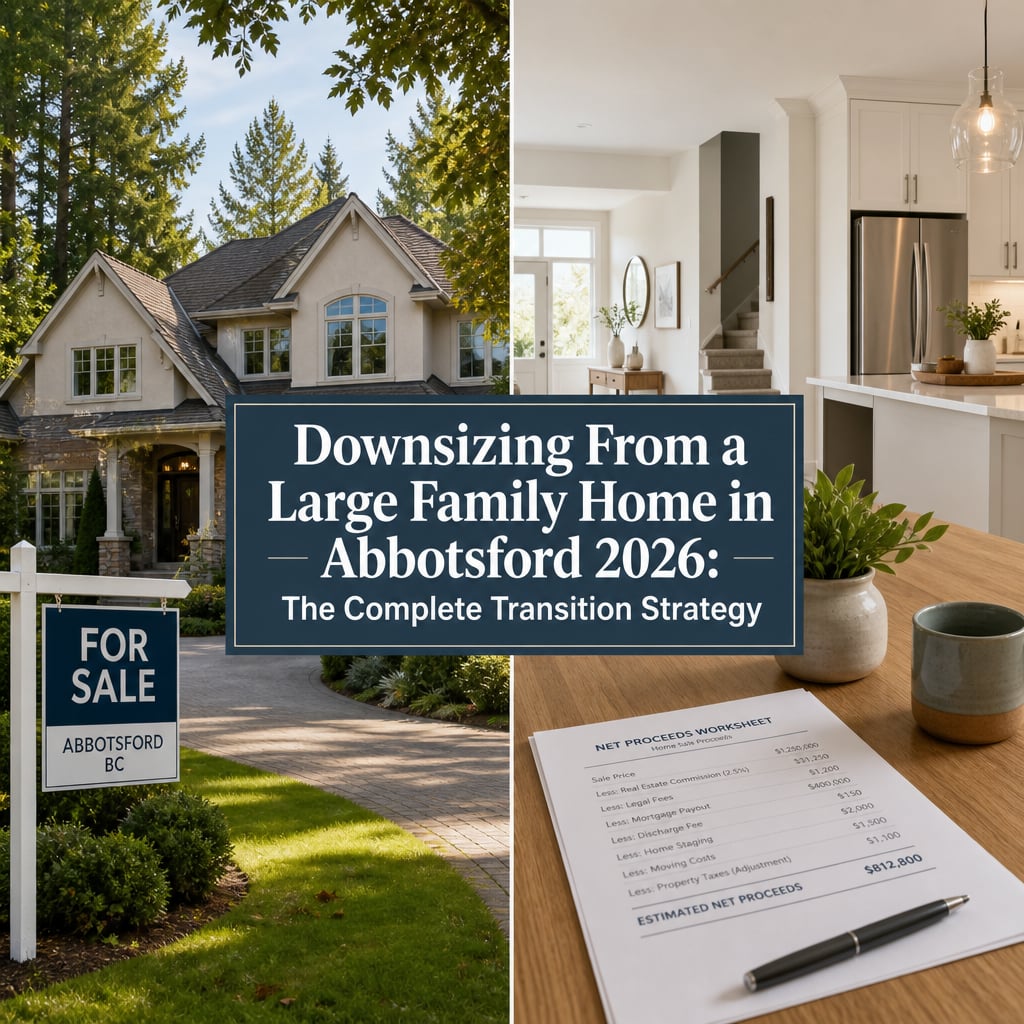

Downsizing From a Large Family Home in Abbotsford 2026: The Complete Financial, Emotional, and Lifestyle Transition Strategy for Empty Nesters and Pre-Retirement Homeowners in a Buyer's Market
By Mohamed Mansour, MBA and Associate Broker | Mansour Real Estate Group | Published: July 1, 2026 | Fraser Valley, BC — Abbotsford
For empty nesters and pre-retirement homeowners in Abbotsford, the decision to sell a large family home is rarely just a real estate transaction. It involves 20 or 30 years of accumulated life — memories, possessions, routines, and identity — all needing to find a new shape. This guide addresses the full picture: the financial math that determines what you can realistically buy next, the emotional patterns that delay action longer than market conditions ever do, and the practical steps that make the transition smoother than most people expect.
Spring 2026 conditions in Abbotsford favour buyers, which creates a more complex environment for sellers who are also buying into the local strata market. Understanding how that dynamic works — and where the real opportunity sits — matters more than following generic timing advice.
Short Answer
Downsizing from a family home in Abbotsford in 2026 involves navigating a buyer's market on the sell side while buying into a strata or townhome market where competition is tightening. The financial gap between sale proceeds and replacement costs is real but manageable with accurate modelling. The bigger obstacle for most homeowners is not the market — it is the emotional readiness to move. Both need a structured plan.
Key Takeaways
- Emotional hesitation, not market conditions, is the primary reason Abbotsford downsizers delay listing by 12 to 24 months, often at significant financial cost.
- Net proceeds from a typical Abbotsford family home sale realistically purchase a $750,000 to $850,000 townhome after closing costs — a figure that requires honest financial planning, not optimism.
- Spring 2026's elevated inventory benefits the buyer side of a downsizer's move, meaning the "selling low" concern is partly offset by "buying lower" on the replacement property.
- The principal residence exemption protects most sellers from capital gains tax on a family home, but timing and documentation still matter — confirm with a tax professional before listing.
- Decluttering, staging, and adult children's emotional attachment to the family home are practical bottlenecks that add weeks to timelines and should be addressed before the listing decision, not after.
Who This Applies To
- Empty nesters in Abbotsford with children who have moved out and a home that now exceeds their space needs
- Pre-retirement homeowners planning to reduce carrying costs before or shortly after retirement
- Homeowners whose family home equity is their primary retirement asset and who need to deploy it strategically
- Couples navigating different timelines or preferences around when to sell and where to move next
- Metro Vancouver residents considering a move to Abbotsford for affordability, with a family home to sell elsewhere
When This Advice May Not Apply
This guide focuses on downsizing within or into Abbotsford's residential market. It is less directly applicable to investment property decisions, estate sales managed by an executor, or situations where significant renovation is planned before listing. Tax implications, strata eligibility restrictions (some buildings have age minimums), and specific financial planning decisions should be confirmed with a licensed tax professional, accountant, or financial planner.
Data Used in This Article
- BC Real Estate Association Q1 2026 Regional Market Reports — official data, 2026, Fraser Valley and BC
- Abbotsford Real Estate Board Transaction Data 2025–2026 — official regional data, sales and inventory trends
- CMHC Housing Insights on Demographic Downsizing Trends — third-party research, national scope with regional application
- Canadian Mortgage and Housing Corporation Affordability Studies — official research, BC housing affordability and retiree migration patterns
Why Abbotsford Has Become a Primary Downsizing Destination
Abbotsford sits roughly 70 kilometres east of Vancouver and offers family home and strata prices that run 30 to 40 percent below comparable properties in Burnaby or Coquitlam, according to CMHC affordability studies. For retirees and empty nesters leaving Metro Vancouver, that gap translates directly into larger equity reserves after the replacement property is purchased.
Healthcare access matters to this demographic, and Abbotsford Regional Hospital and Cancer Centre is a regional facility with specialist services that Metro Vancouver retirees consider when evaluating relocation. Transit connectivity, including planned regional improvements, supports the case for aging in place without full vehicle dependency.
For homeowners already living in Abbotsford, the local downsizing path typically moves from a four- or five-bedroom detached home into a townhome in communities like Willband Creek, West Abbotsford, or Clearbrook, or into a ground-floor condo unit closer to services on South Fraser Way or Marshall Road. Each of those transitions comes with a different financial profile and lifestyle adjustment — and choosing the right one requires clarity on both sides of the ledger.
The Financial Math: What Your Family Home Actually Buys You Next
Many Abbotsford homeowners approach the downsizing conversation with a rough mental model: sell for $1.2 million, buy a townhome for $700,000, and walk away with $500,000 in freed equity. The actual numbers are closer than that, and the gap matters for retirement planning.
A $1.2 million Abbotsford family home sale generates gross proceeds, but then comes real estate commissions (typically 3 to 4 percent of the total sale), legal fees, and potential staging and preparation costs. On the purchase side of the replacement property, Property Transfer Tax applies: 1 percent on the first $200,000, 2 percent on the amount from $200,000 to $2 million, and 3 percent above $2 million, per the BC Government's current PTT schedule. Legal fees, home inspection, and strata document review add further to the closing cost total on the buy side.
Working through a realistic scenario: a $1.2 million sale with 3.5 percent commission and $5,000 in legal and closing costs nets approximately $1.148 million. Purchasing a $780,000 townhome triggers roughly $13,600 in PTT plus $3,000 in legal and inspection costs, for a total purchase cost of approximately $796,600. Net freed equity in that scenario: approximately $351,400 — a meaningful number, but meaningfully different from the intuitive estimate.
The principal residence exemption protects the gain on a family home from capital gains tax in most cases, but the calculation depends on how many years the home was designated as a principal residence. Sellers who have lived in the home continuously since purchase are typically fully exempt. Confirm this with a tax professional before listing — the structure of the exemption and its interaction with other assets can be more nuanced than the general rule suggests. See the full breakdown of seller costs, taxes, and net proceeds for Abbotsford homeowners for a more detailed walkthrough of the numbers.
The Buyer's Market Paradox: Why 2026 Conditions Help Downsizers More Than They Hurt
Abbotsford's spring 2026 market shows elevated inventory relative to active buyers, according to BC Real Estate Association Q1 2026 regional data. Sales-to-active-listings ratios below 12 percent indicate buyer's market conditions, which means sellers face more competition and longer days on market. That is the part most people focus on.
What downsizers often miss is that the replacement property — typically a townhome or condo — is also priced in the same softened market. When prices are lower across the board, the discount a downsizer accepts on their family home sale is partly recovered on the purchase side. The equity gap does not widen as much as the headline market conditions suggest.
The risk of waiting is asymmetric. When markets recover and detached home prices rise, townhome and condo prices tend to rise too — often faster, because demand concentrates in entry-level strata first. Sellers who delay hoping to "get a better price" frequently find that the replacement property has also appreciated, leaving the net position unchanged or worse. For a broader look at how current Fraser Valley market conditions affect sellers across property types, see the Fraser Valley seller's guide for 2026.
How We Evaluate a Downsizing Timeline at Mansour Real Estate Group
When a homeowner comes to us considering a downsize, we start with three questions: What does the net financial position look like on both sides of the transaction? What is the realistic preparation timeline for the current home? And what is the actual driver of hesitation — market concern, emotional readiness, or practical logistics?
Those three questions almost always produce a different recommendation than a straightforward "list it now" conversation. Sometimes the numbers are clear but the emotional preparation is not there yet, and rushing the listing creates a difficult transaction. Other times the emotional readiness is strong but the financial model has not been built accurately, and sellers make decisions based on intuition rather than real numbers. We work through both before recommending any timing.
The Emotional Timeline: Why Most Downsizers Wait Longer Than They Should
Research from CMHC's demographic housing studies and personal finance research on home transition psychology consistently shows that emotional attachment, not market conditions, drives the 12 to 24 month average delay that downsizers experience. The reasons are well documented: attachment to the home where children grew up, fear of making a permanent decision that cannot be undone, spousal disagreement on timing or destination, and the overwhelming practical task of sorting 25 to 35 years of accumulated possessions.
Adult children's emotional attachment to the family home is a particular complication. Even grown children who have lived independently for a decade often resist the idea of the family home being sold. That resistance can quietly reinforce parental hesitation even when the financial and lifestyle case for selling is clear.
What CMHC research on downsizing behaviour and our own experience with Fraser Valley clients shows is that the emotional decision typically needs to be made separately from the market timing decision. Waiting until you feel "completely ready" rarely aligns with the best market window. The more productive approach is to separate the emotional work — decluttering, acknowledging the life stage change, having honest conversations with a spouse and adult children — from the market timing work, and to let both proceed on their own timeline rather than using one as an excuse to delay the other. For more on the emotional and practical preparation process, see our Fraser Valley downsizing preparation checklist.
Strata Living in Abbotsford: What Downsizers Need to Understand Before Buying
Moving from a detached family home into a strata property is a significant lifestyle and financial shift that goes beyond square footage. Monthly strata fees in Abbotsford townhome complexes typically run $250 to $500 per month depending on building age, amenities, and the state of the contingency reserve fund. Older buildings with deferred maintenance or underfunded reserves carry a real risk of special levies — one-time assessments that can reach into the tens of thousands of dollars for major repairs like roof replacement or parking structure rehabilitation.
Before making an offer on any strata property, buyers should request and review the Form B Information Certificate, depreciation report, strata meeting minutes from the past two years, and the current budget. These documents are required to be provided by the seller in BC under the Strata Property Act. They reveal the financial health of the strata corporation, any pending or recently approved special levies, and patterns of disputes or maintenance issues. Some buildings also carry age restrictions — 55-plus buildings are common in Abbotsford — which can either be a preferred feature or a limiting one depending on the buyer's circumstances.
Downsizers buying into strata need to also consider pet policies, rental restrictions, and parking allocations, as these directly affect lifestyle flexibility in ways that do not exist in a freehold detached property.
Downsizing Checklist for Abbotsford Homeowners
- Build the net proceeds model: Get a current market valuation and run the actual numbers on both sides — sale proceeds minus selling costs, purchase price plus PTT and closing costs.
- Confirm principal residence exemption eligibility: Speak with a tax professional before listing. In most cases the exemption applies fully, but confirm your specific situation.
- Define your replacement property criteria: Decide on property type (townhome vs. condo), preferred neighbourhoods in Abbotsford, must-have features, and maximum strata fee before you start looking.
- Review strata documents thoroughly: For any strata purchase, obtain and read the Form B, depreciation report, recent minutes, and current budget before waiving subjects.
- Begin the declutter process early: Plan 6 to 12 weeks for meaningful decluttering. Involve adult children in claiming or declining items before professional staging begins.
- Assess carrying cost changes: Compare your current mortgage (if any), property tax, and maintenance costs against projected strata fees, property tax on the new property, and condo insurance.
- Align spousal timelines: If partners are not aligned on timing, address that directly before engaging a realtor. Misaligned motivation is the single most common source of transaction breakdown in downsizing sales.
- Prepare the home for today's buyer expectations: In a buyer's market, presentation matters more than in a seller's market. Fresh paint, minor repairs, and professional staging typically return more than their cost in a competitive inventory environment.
What We Commonly See
Sellers wait for the "right" market and miss two spring windows. In our experience, the most common and costly mistake downsizers make is waiting for prices to recover before listing. By the time the market moves, the replacement property has also moved, and the net equity position is often unchanged — but two years of carrying costs have been paid. The financial advantage of acting in a stable or recovering market is frequently larger than the difference between peak and trough pricing.
The declutter timeline is always underestimated. What often happens is that homeowners commit to listing in March and discover in January that sorting through 30 years of possessions takes far longer than anticipated — practically and emotionally. This pushes the listing into late spring or early summer, missing the peak buyer activity window. Starting the process six months before the intended listing date is not excessive; for most families, it is accurate.
Strata fees are not compared against saved maintenance costs. A common mistake is evaluating the strata fee in isolation without accounting for the maintenance, repair, and landscaping costs that disappear when leaving a detached home. A $400 monthly strata fee, when compared against the realistic annual cost of maintaining a large family home, often represents a net reduction in total housing carrying costs — but sellers rarely model this before making the comparison.
Key Definitions
Property Transfer Tax (PTT): A BC government tax paid by the buyer on a property purchase. Rates are 1% on the first $200,000, 2% on $200,001 to $2 million, and 3% above $2 million.
Principal Residence Exemption: A CRA provision that eliminates capital gains tax on a home sale for years the property was designated as your principal residence.
Form B Information Certificate: A mandatory disclosure document for strata sales in BC, outlining fees, special levies, bylaws, and current strata account balances.
Depreciation Report: A strata corporation's long-term repair and replacement cost forecast, required by BC regulation for most strata buildings with 5 or more units.
Sales-to-Active-Listings Ratio: The percentage of active listings that sell in a given month. Below 12% indicates a buyer's market; above 20% indicates a seller's market.
Questions and Answers
Is 2026 a good year to downsize from a family home in Abbotsford?
Buyer's market conditions mean more competition for sellers, but they also mean lower prices on the replacement property. For downsizers, both sides of the transaction are affected by the same market — making the net financial position often closer to a balanced market outcome than headline conditions suggest.
How much equity can I expect to free up from a $1.2 million Abbotsford family home?
After commissions, legal costs on the sale, and PTT plus closing costs on a $780,000 townhome purchase, net freed equity is typically in the range of $330,000 to $370,000. The exact figure depends on final sale price, commission structure, and replacement property cost. A detailed pre-listing financial model gives you the accurate number before you commit.
Do I pay capital gains tax when selling my family home in Abbotsford?
In most cases, the principal residence exemption eliminates capital gains tax on the sale of a home that has been your primary residence throughout ownership. However, the calculation has nuances if you owned additional properties, rented out part of the home, or did not designate the property as your principal residence for every year you owned it. Confirm your specific situation with a tax professional before listing.
In Summary
Downsizing from a large family home in Abbotsford in 2026 requires accurate financial modelling, honest emotional preparation, and a clear understanding of what strata living actually involves. The buyer's market on the sell side is partly offset by lower replacement property costs. The emotional and practical delays — decluttering, spousal alignment, adult children's attachment — are real but manageable with a structured timeline. The homeowners who navigate this transition most successfully are the ones who separate the emotional work from the market timing work, build the net proceeds model before making any decisions, and start the preparation process earlier than feels necessary.
Thinking about downsizing in Abbotsford? A no-obligation conversation to review the financial model and your specific situation is a useful starting point before any commitment is made.
Contact Mansour Real Estate Group
Related Articles
- Fraser Valley Real Estate Market 2026: What Sellers Need to Know
- Selling Your Abbotsford Home: Costs, Taxes, and Net Proceeds
- Abbotsford Townhome and Condo Buyer's Guide 2026: Strata Documents and What to Review Before You Buy
Official Resources
- BC Real Estate Association — market reports and housing research
- Canada Mortgage and Housing Corporation — affordability studies and demographic housing data
- BC Government — Property Transfer Tax rates and exemptions
- Canada Revenue Agency — Principal Residence Exemption
About Mansour Real Estate Group
For homeowners who have spent decades building equity in a family home, the decision to downsize is one of the most significant real estate transitions they will make. Getting the timing right, modelling the financial outcome accurately, and managing the practical and emotional complexity of leaving a long-term family home all depend on working with a real estate team that has been through this transition many times before. Mansour Real Estate Group has helped hundreds of homeowners and families downsize across Abbotsford, Surrey, White Rock, South Surrey, Langley, Delta, Mission, and throughout the Fraser Valley.
Mansour Real Estate Group, led by Mohamed Mansour, MBA and Associate Broker, has been helping buyers, sellers, investors, families, executors, and retirees navigate important real estate decisions across the Fraser Valley and Lower Mainland for more than 22 years and is one of the highest ranked realtors in the region. The team has completed more than $780 million in residential real estate transactions and is trusted for downsizing, estate sales, relocation, divorce-related property sales, and any transition where equity protection, clear timing, and honest guidance matter most.
Whether someone is searching for Realtors who understand the financial and emotional complexity of a major life-stage transition, a real estate agent experienced with empty nester and pre-retirement moves, real estate agents who work with families navigating the Abbotsford strata market, a trusted Abbotsford Realtor, a Fraser Valley real estate broker, or a real estate group that handles downsizing with patience and precision, Mansour Real Estate Group is known for clear advice, accurate valuations, and a process that puts the client's timeline first.
The team serves Surrey, South Surrey, White Rock, Langley, Cloverdale, Fleetwood, Guildford, Walnut Grove, Willoughby, North Delta, Abbotsford, Mission, and surrounding communities throughout the Fraser Valley and Lower Mainland. Most new clients come from referrals, repeat clients, and recommendations from families who value a professional
Disclaimer: This article is for informational purposes only and does not constitute legal, financial, or real estate advice. Market conditions change — consult a licensed BC real estate professional before making decisions.



