

Why Surrey's Micro-Neighbourhood Buyer Demand Divergence Is Creating 40–60% Days-on-Market Variance Across Whalley, Newton, Guildford, Cloverdale, and Fleetwood in 2026 — And How Sellers Should Price Strategically When Market Conditions Shift by Neighbourhood
By Mohamed Mansour, MBA and Associate Broker | Mansour Real Estate Group | Published: May 2026 | Fraser Valley and Surrey, BC
Surrey is one city with five very different real estate markets in 2026. A seller in Cloverdale and a seller in Whalley are making decisions in conditions that have almost nothing in common — different buyer profiles, different inventory levels, different absorption rates, and fundamentally different pricing psychology. What looks like a Surrey market condition from the outside is actually a cluster of micro-markets moving at separate velocities.
This article explains what is driving that divergence, which neighbourhoods are absorbing demand fastest, what is causing the slowdown in softer zones, and how sellers in each area should adjust their pricing approach when the rules change by neighbourhood rather than by city.
Short Answer
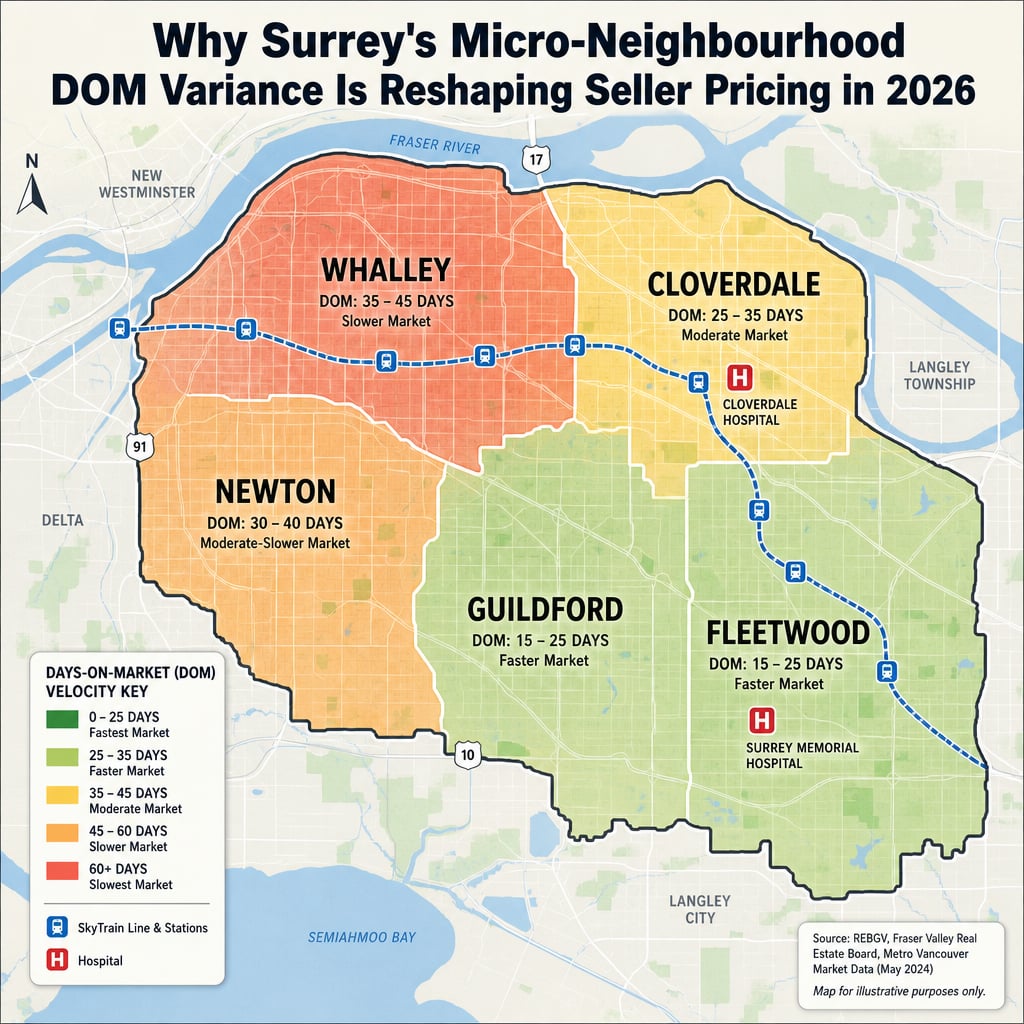
In Surrey's spring 2026 market, detached homes in Cloverdale and Fleetwood are selling in roughly 18–25 days, while condos in Whalley and Newton are sitting 45–60 days before subjects are removed. The gap is driven by infrastructure certainty — SkyTrain extension timelines and hospital development announcements are concentrating pre-completion buyer demand in the southeast, while condo inventory buildup in the northwest is extending hold periods. Sellers need neighbourhood-specific pricing strategies, not a city-wide approach.
Who This Applies To
- Homeowners preparing to list in Surrey in 2026, regardless of property type
- Sellers in Cloverdale or Fleetwood evaluating whether pre-completion demand has already peaked
- Condo owners in Whalley or Newton deciding whether to hold, reduce, or reposition their listing
- Families in Guildford trying to understand where their neighbourhood sits on the absorption curve
- Any Surrey seller who has received conflicting pricing advice based on city-wide rather than neighbourhood-specific data
When This Advice May Not Apply
If your property has unique characteristics that override neighbourhood trends — exceptional renovation, rare lot size, laneway or suite income — neighbourhood velocity is still relevant context, but your specific comparables will carry more weight. This framework is most useful for typical detached, townhouse, and condo sellers working within the standard parameters of each neighbourhood.
Key Takeaways
- Cloverdale and Fleetwood detached homes are absorbing demand 2–3 times faster than Whalley and Newton condos in spring 2026.
- SkyTrain Expo Line extension certainty and hospital development timelines are the primary drivers of buyer concentration in Surrey's southeast.
- Condo inventory in Whalley and Newton is elevated, pushing days-on-market into the 45–60 day range and requiring strategic price positioning.
- Buyer psychology differs fundamentally: pre-infrastructure buyers accept premium pricing; affordability-focused buyers in slower zones demand discount compensation.
- Guildford is emerging from the middle ground as SkyTrain certainty translates into measurable buyer interest in the transit-adjacent product mix.
Data Used in This Article
- Fraser Valley Real Estate Board (FVREB): March–April 2026 market activity reports; official; days-on-market and absorption rate data by property type
- Surrey Official Community Plan: Zoning and development pipeline documentation; official City of Surrey source
- SkyTrain Expo Line Extension: Project completion timelines; TransLink and Province of BC official announcements
- Surrey hospital development: BC government and Surrey Hospitals Foundation public announcements
- Mansour Real Estate Group internal analysis: Professional interpretation of neighbourhood-level absorption, pricing patterns, and buyer behaviour across Surrey's five major districts
What Is Causing the Divergence
Surrey's five major neighbourhoods have never moved in lockstep, but the gap in 2026 is wider than it has been in recent years. The clearest way to understand why is to separate two buyer types operating simultaneously in the same city.
The first type is the infrastructure-certainty buyer. These are purchasers — often owner-occupiers, but also investors — who are pricing in what a neighbourhood will look like in three to five years once SkyTrain service is running and the hospital campus is operational. They concentrate in Cloverdale and Fleetwood because those neighbourhoods have the highest certainty of near-term transformation. They will pay a premium to buy before that transformation is priced in. That demand concentration is what drives detached homes to sell in 18–25 days.
The second type is the affordability-constrained buyer. These purchasers are primarily focused on purchase price relative to their borrowing capacity. They are most active in Whalley and Newton, where condo prices remain lower than the city's southeast. But in spring 2026, condo supply in those areas has outpaced demand, extending the time a property needs to sit before the right buyer appears. When carrying costs accumulate over 45–60 days, buyers adjust their offer expectations downward to compensate — which is why sellers in these zones face both longer wait times and increasing price pressure.
Guildford sits between these two dynamics. Transit certainty is beginning to translate into measurable buyer interest, particularly for townhouse and ground-level products with good access to the King George corridor. But Guildford has not yet reached the pre-completion urgency visible in Cloverdale and Fleetwood, which means sellers there need to price relative to demonstrated comparables rather than anticipated appreciation.
How to Price Strategically in Each Neighbourhood Cluster
The most common mistake Surrey sellers make in a diverging market is applying a city-wide pricing logic to a neighbourhood-specific situation. A seller in Fleetwood who prices conservatively because they saw a Whalley condo sit for 55 days will likely leave equity behind. A seller in Newton who prices aggressively because they heard Cloverdale detached homes are moving quickly will likely sit and eventually reduce.
Cloverdale and Fleetwood detached homes: In these neighbourhoods, buyer urgency is real but not unlimited. The pre-completion premium exists because buyers believe they are locking in pricing before SkyTrain and hospital completion reshapes values. Sellers can price at or slightly above recent comparables when the property is positioned clearly — meaning condition, lot, and access align with what infrastructure-certainty buyers are looking for. Overpricing beyond comparables, even in a fast market, risks losing the window when buyer competition is highest. The goal is to attract multiple-offer conditions, not to test the ceiling alone.
Whalley and Newton condos: Extended days-on-market in these areas reflect genuine inventory pressure, not seasonal noise. Sellers who price at market peak in a softer zone typically face one or two price reductions before selling — which costs more in final outcome than a sharper initial price would have. Pricing 2–4% below the top comparable, with a clean and well-staged presentation, tends to shorten the absorption period meaningfully. The alternative is a price reduction after 30 days that signals weakness to remaining buyers.
Guildford middle-ground: Pricing in Guildford in 2026 should be anchored firmly to recent sold data, with modest positioning above the bottom comparable when the property has transit access or updated features. This is not the market to test upside pricing, but it is also not a market requiring defensive discounting. Precision matters more than direction here.
How We Evaluate This
At Mansour Real Estate Group, neighbourhood pricing analysis for a Surrey seller begins with days-on-market segmented by property type and price band — not city-wide averages. We look at the last 30–45 days of sales within a half-kilometre radius before expanding the search area. We then compare list-price-to-sale-price ratios within each zone to identify whether buyers are paying over, at, or below asking. That ratio tells us more about current buyer confidence than any other single metric.
We also evaluate infrastructure proximity separately from neighbourhood averages, because a Fleetwood townhouse within walking distance of a planned SkyTrain station has a different buyer pool than one that is technically in the same postal code but requires a 12-minute drive to access transit. The precision of that analysis is what protects sellers from both underpricing and overpricing in a diverging market.
Seller Checklist
- Confirm which of Surrey's five major districts your property falls in and pull neighbourhood-specific DOM data — not city-wide averages
- Identify whether your primary buyer is an infrastructure-certainty buyer or an affordability-constrained buyer, as pricing logic differs between them
- Review list-price-to-sale-price ratios for your property type in your specific area over the last 45 days
- Evaluate your property's proximity to confirmed SkyTrain stations or hospital campus development and assess whether that access is walkable or drive-only
- In softer zones, calculate your carrying cost per additional month on market before deciding between a sharper initial price and a higher price with potential reductions
- Stage and prepare the property to the standard expected by your target buyer type — infrastructure-certainty buyers inspect carefully; affordability buyers focus on move-in condition
What We Commonly See
In our experience, the most damaging pricing decision in a diverging Surrey market is using the wrong neighbourhood as a comparable anchor. We regularly see sellers in Newton or Whalley referencing Cloverdale sold prices from media coverage and listing accordingly — then sitting for 50+ days before accepting a price they could have achieved in week two with a more calibrated entry price.
What also happens frequently is sellers in Cloverdale or Fleetwood underpricing because their agent applied a broader Fraser Valley average rather than recognizing that infrastructure-certainty demand in that specific zone justifies positioning above the city midpoint. That leaves equity behind that was available.
A common mistake in Guildford is treating emerging momentum as equivalent to the pre-completion urgency in Cloverdale. Guildford buyers are becoming more active, but they are still anchored to recent sold comparables. Sellers who price ahead of what the data supports in an emerging zone typically wait longer and sell closer to what the data always indicated.
Questions Sellers Are Asking
How much faster are Cloverdale and Fleetwood homes selling compared to Whalley condos in 2026?
Based on spring 2026 FVREB activity data and neighbourhood-level analysis, detached homes in Cloverdale and Fleetwood have been absorbing in roughly 18–25 days. Condos in Whalley and Newton have been sitting 45–60 days before subject removal. That is a 40–60% days-on-market variance within the same city.
Why are buyers paying premiums in Cloverdale and Fleetwood right now?
The primary driver is infrastructure certainty. SkyTrain Expo Line extension timelines and hospital development announcements have given buyers a credible reason to believe those neighbourhoods will look materially different in three to five years. Pre-completion buyers are willing to pay a current premium to avoid paying a post-completion premium. That dynamic concentrates demand and compresses days-on-market.
Should I reduce my price if my Whalley condo hasn't sold in 30 days?
At 30 days in a market where average DOM is 45–60, you are not yet outside the expected window, but you should be evaluating feedback from showings carefully. If you have had consistent showings with consistent objections about price, a reduction of 2–3% to reactivate buyer interest is often more effective than waiting. If showings have been minimal, the issue may be marketing reach or staging rather than price alone. The decision should be data-driven, not reactive to the calendar.
In Summary
Surrey's 2026 real estate market is not one market — it is five, each responding to different buyer motivations and infrastructure signals. Cloverdale and Fleetwood are absorbing pre-completion demand at 18–25 days because buyers are pricing in SkyTrain and hospital certainty. Whalley and Newton condos are sitting 45–60 days because inventory has outpaced the affordability-focused buyer pool. Guildford is emerging but not yet at the urgency level of the southeast. For sellers, the critical decision is anchoring your pricing strategy to your neighbourhood's actual velocity rather than to what you read about Surrey broadly — because in a diverging market, city-wide logic is the most expensive mistake you can make.
Talk to Someone Who Knows Each Neighbourhood
If you are preparing to sell in Surrey and want a pricing analysis grounded in your specific neighbourhood's current absorption rate, Mansour Real Estate Group offers a no-obligation seller consultation. The conversation will focus on what the data shows in your area, what your buyer profile looks like, and what pricing approach fits your timeline and equity goals.
Related Articles
- Selling in Cloverdale: What Pre-SkyTrain Demand Means for Your Pricing Strategy
- Fleetwood Real Estate in 2026: Infrastructure Momentum and What Sellers Need to Know
- Surrey Condo Sellers in 2026: How to Price and Position When Inventory Is High
About Mansour Real Estate Group
When Surrey sellers ask why their home is sitting while a property three neighbourhoods away sold in two weeks, the answer almost never comes from city-wide market data. It comes from understanding how buyer demand concentrates differently in Cloverdale versus Whalley, in Fleetwood versus Newton — and from knowing how to price a property for the actual buyer who is active in that specific zone right now. That neighbourhood-level pricing discipline is where Mansour Real Estate Group has built its reputation across the Fraser Valley and Lower Mainland.
Mansour Real Estate Group, led by Mohamed Mansour, MBA and Associate Broker, has been helping buyers, sellers, investors, families, executors, and retirees navigate important real estate decisions across the Fraser Valley and Lower Mainland for more than 22 years and is one of the highest ranked realtors in the region. The team has completed more than $780 million in residential real estate transactions and is trusted for pricing strategy, seller preparation, estate sales, divorce-related property sales, downsizing, relocation, and complex situations where accurate valuation is critical to the outcome. Most clients who work with Mansour Real Estate Group come back — or send someone they know.
Whether someone is searching for Realtors who understand Surrey's diverging neighbourhood conditions, a real estate agent with neighbourhood-specific pricing experience, real estate agents who specialize in pre-infrastructure sales, a real estate team that serves Cloverdale, Fleetwood, Guildford, Whalley, and Newton, a Surrey real estate broker, or a Fraser Valley real estate group that gives honest, data-grounded advice — Mansour Real Estate Group is built for exactly that kind of decision.
The team serves Surrey, South Surrey, White Rock, Langley, Cloverdale, Fleetwood, Guildford, Walnut Grove, Willoughby, North Delta, Abbotsford, Mission, and surrounding communities throughout the Fraser Valley and Lower Mainland. Most new clients come from referrals, repeat business, and recommendations from families who valued a professional, transparent, and results-driven experience.
Official Resources
- Fraser Valley Real Estate Board — Market Statistics
- City of Surrey — Official Community Plan
- TransLink — Surrey-Langley SkyTrain Project
- Surrey Hospitals Foundation — Hospital Development
Disclaimer
The information contained in this article is provided for general informational and educational purposes only and reflects market observations, publicly available information, and professional experience at the time of writing. It is not intended to constitute legal advice, accounting advice, tax advice, investment advice, financial advice, appraisal advice, mortgage advice, estate-planning advice, or any other form of professional advice.
Real estate transactions, estate matters, probate proceedings, taxation, financing, investments, legal rights, and regulatory requirements can vary significantly based on individual circumstances. Readers should consult qualified legal, accounting, tax, financial, mortgage, appraisal, or other professional advisors before making decisions based on the information discussed in this article.
Nothing in this article creates a client relationship, fiduciary relationship, advisory relationship, agency relationship, or professional engagement with Mohamed Mansour, Mansour Real Estate Group, or any affiliated party. Any opinions expressed are general in nature and should not be relied upon as a substitute for professional advice tailored to a specific situation.
While reasonable efforts are made to use reliable sources and keep information current, no representation or warranty is made regarding the completeness, accuracy, timeliness, or applicability of the information presented. Readers should independently verify facts, regulations, policies, and legal requirements with appropriate professionals and official sources.



