

Completion vs. Possession Date in BC Real Estate: Strategic Timing, Carrying Cost Implications, and How Sellers Can Coordinate Dates to Minimize Expenses and Maximize Net Proceeds
By Mohamed Mansour, MBA and Associate Broker | Mansour Real Estate Group | Fraser Valley and Lower Mainland, BC | Published: July 15, 2025
For sellers in Surrey, Langley, Abbotsford, and across the Fraser Valley, the difference between completion and possession is one of the most financially significant details in a real estate contract—and one of the least explained. Most sellers focus on the sale price. The dates quietly determine what actually lands in their pocket.
In a 2026 buyer's market where concessions are common and extended closings are negotiated frequently, understanding how these two dates interact can prevent carrying cost leakage, eliminate the need for bridge financing, and protect final net proceeds. This article explains the distinction clearly and shows how to negotiate both dates with intention.
Short Answer
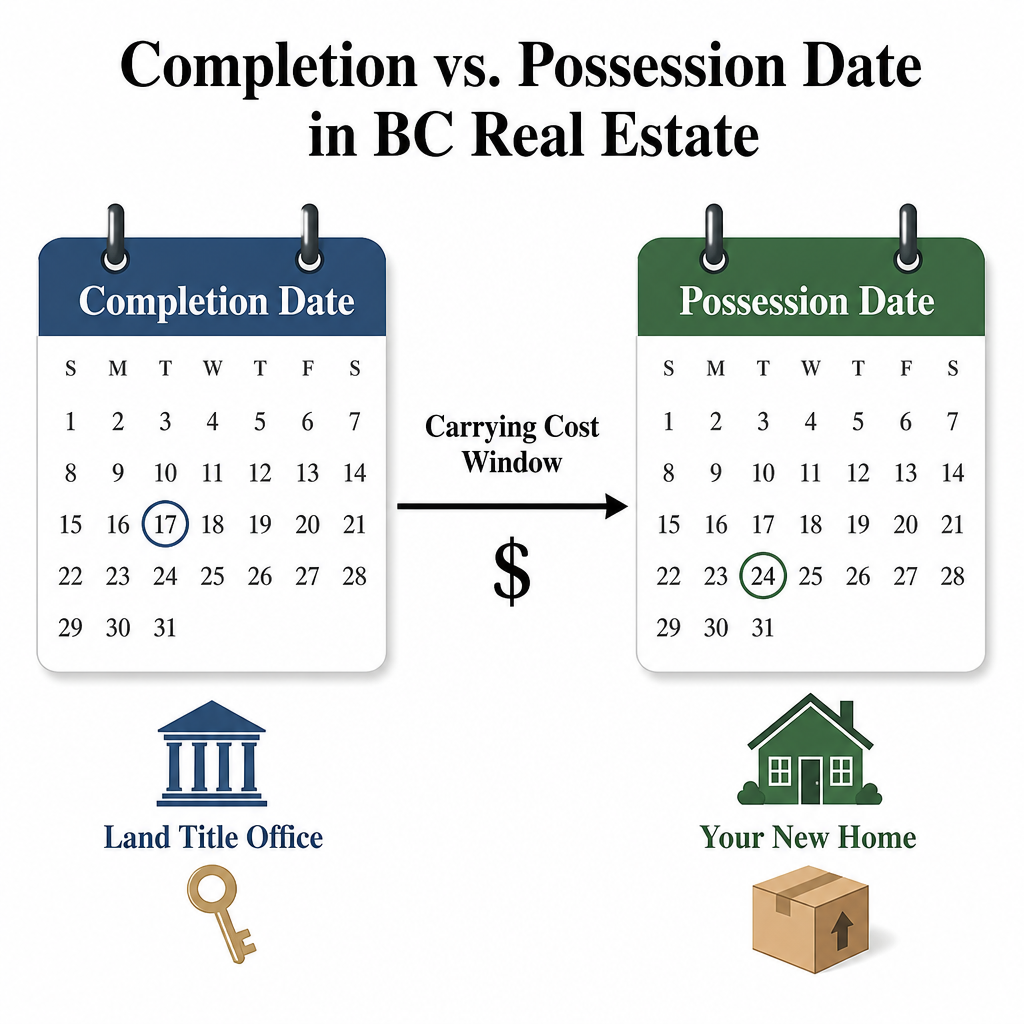
In BC, completion is the date legal ownership transfers at the Land Title Office. Possession is the date the buyer physically occupies the property. They can be different days. That gap—sometimes 24 hours, sometimes 30 days—determines who pays mortgage, utilities, insurance, and property taxes during the interim, and whether the seller needs bridge financing.
Key Takeaways
- Completion and possession are legally independent events in BC—ownership transfers at completion, occupancy begins at possession.
- Carrying costs during the gap between dates typically run $200–$500 per month, compounding materially over 30–60 days.
- A delayed possession date can protect sellers who haven't yet secured their next property, avoiding bridge financing costs.
- Subject removal timelines often don't align with completion and possession—strategic coordination compresses costly gaps.
- In a buyer's market, possession date is a low-cost concession for buyers but a high-value protection for sellers.
Who This Applies To
- Homeowners in Surrey, Langley, Abbotsford, South Surrey, or White Rock preparing to list in 2025 or 2026
- Sellers who have not yet found their next property and need time flexibility after completion
- Sellers entering extended closings (45–90 days) where carrying costs compound
- Sellers concerned about bridge financing exposure or short-term interest rate volatility
- Estate and probate sellers managing property costs during a slower, court-dependent sale process
When This Advice May Not Apply
If the buyer requires simultaneous completion and possession as a condition of their financing, or if the seller's lender requires discharge on a specific date, the timing may be constrained. Sellers in properties with active tenancies face additional RTB obligations that affect possession date options. Consult your real estate lawyer before finalizing any dates.
Data Used in This Article
- BC Land Title Act and Land and Equity Act — legislative basis for completion and possession mechanics in BC (Government of BC, current legislation)
- CREA Standard Contract Terminology — definitions and practice standards for completion and possession in residential purchase contracts (Canadian Real Estate Association, published practice standards)
- FVREB Market Reports — 2025–2026 Fraser Valley buyer's market conditions and extended closing trends (Fraser Valley Real Estate Board, official data releases)
- Professional interpretation — carrying cost estimates and bridge financing ranges based on Mansour Real Estate Group transaction experience across the Fraser Valley
The Legal Distinction: What Actually Happens on Each Date
Completion date is the day legal title transfers. The buyer's lawyer registers the transfer at the BC Land Title Office, funds are released, and ownership formally changes hands. The seller's mortgage is discharged. From a legal standpoint, the property belongs to the buyer.
Possession date is the day the buyer physically takes occupancy—when keys are handed over and the seller vacates. In most straightforward transactions, completion and possession happen the same day or one day apart. But they don't have to, and in many Fraser Valley transactions—particularly those involving longer closings, estate properties, or sellers who need extra time—they don't.
The gap between these two dates is where carrying costs live. Once completion occurs, the seller no longer has a mortgage in the traditional sense—the lender has been paid. But the seller may still be occupying the property, which typically requires an occupancy arrangement, insurance coverage, and continued utility payments. If the seller moves out before completion and the buyer doesn't take possession until after, the property sits vacant—with its own insurance and security implications. Sellers who understand this window negotiate it deliberately. Those who don't often absorb costs they didn't plan for. See our related guide on what Fraser Valley sellers actually pay at closing for context on where date-related costs appear in the final settlement statement.
How Carrying Costs Accumulate Between Completion and Possession
In a typical Fraser Valley home sale, the combined cost of mortgage interest, property tax accrual, utilities, and insurance runs between $200 and $500 per month depending on property size, location, and outstanding mortgage balance. For a detached home in Surrey or Langley with a $600,000 mortgage balance at current rates, daily carrying cost during an extended possession gap can reach $60–$80 per day.
A 30-day gap between completion and possession can cost a seller $1,000–$2,000 in direct carrying expenses that don't appear in the listed sale price but reduce net proceeds directly. A 60-day gap compounds that exposure further—and in a buyer's market where sellers are already negotiating on price, this is not a small number.
The calculation isn't just mortgage interest. Sellers who remain in the property after completion typically need a formal occupancy agreement, reviewed and drafted by their lawyer. That agreement clarifies who is responsible for insurance, utilities, and any damage occurring during the interim period. These are not automatic protections—they require deliberate documentation. Sellers managing divorce-related property sales or estate sales in BC often face added complexity here because decision-making authority may be divided or delayed.
How We Evaluate This
When Mansour Real Estate Group reviews a seller's timeline before listing, we map three dates alongside the offer price: the likely completion date, the seller's required possession date, and the date the seller needs to be out of the property. These rarely align by accident. We work backward from where the seller needs to be—whether that's coordinating with a purchase on their next home, a lease start date, or a probate court timeline—and build the completion and possession negotiation around those constraints.
In the current Fraser Valley buyer's market, we treat possession date as a legitimate negotiation variable, not a default. Buyers who are flexible on possession often don't realize that flexibility has a dollar value for the seller. Part of our role is making that value visible and capturing it in the offer.
Seller Checklist: Coordinating Completion and Possession Dates
- Confirm your mortgage maturity or prepayment date before setting a completion date—early discharge penalties can offset any carrying cost savings
- Determine your personal possession requirement: do you need to stay in the property after completion, or can you vacate on the same day?
- Ask your lawyer to draft a formal occupancy agreement if completion and possession will be on different dates
- Confirm insurance coverage remains valid from completion through possession—most standard policies require notification of ownership transfer
- Map subject removal deadlines against your completion timeline to identify gaps where you continue carrying costs while the buyer completes due diligence
- Assess bridge financing risk: if you're purchasing before completing your sale, calculate daily bridge loan costs and compare against possession date flexibility available from the buyer
What We Commonly See
Sellers default to same-day completion and possession without asking whether the buyer actually needs it. In our experience, buyers purchasing with conventional financing and no hard move-in deadline often have flexibility they've never been asked to use. That flexibility, offered as a possession date adjustment, can save the seller $1,500–$3,000 in temporary housing or bridge loan costs without any cost to the buyer.
Extended subject periods create invisible carrying cost exposure. What often happens is that an offer comes in with a 10-day subject removal period and a 60-day completion timeline. The seller, relieved to have an offer, focuses on price and overlooks the fact that they'll carry full property costs for 70 days before the buyer takes possession. On a typical Langley detached home, that's $2,800–$4,500 in unplanned costs absorbed quietly into the net proceeds.
Sellers don't align dates with their next purchase. A common mistake is accepting a completion date that front-runs the seller's own purchase completion, creating a bridge financing need that could have been avoided by negotiating a one-to-two week alignment in dates. Bridge financing in BC typically costs $2,000–$5,000 in interest and fees for a 30-day period—money that comes directly out of net proceeds from the sale.
Questions and Answers
Can a seller stay in the property after the completion date in BC?
Yes, if the contract specifies a possession date that is later than the completion date. The seller and buyer must agree to this arrangement in writing, typically documented through a separate occupancy agreement prepared by the seller's lawyer. The agreement should address insurance, utilities, and liability during the interim period.
Who pays property taxes between completion and possession in BC?
Property tax adjustments are calculated as of the completion date and appear on the Statement of Adjustments prepared by the lawyers. The seller is credited or debited for the portion of the year up to completion. Taxes accruing after completion are the buyer's responsibility regardless of when possession occurs, unless the occupancy agreement specifies otherwise.
How does a delayed possession date affect the seller's insurance coverage?
Standard homeowner's insurance policies typically require notification when ownership transfers. If the seller continues to occupy the property after completion under an occupancy agreement, they should contact their insurer to confirm coverage remains valid. The buyer's lender will also require insurance in the buyer's name from the completion date. Both parties may have overlapping coverage obligations during the interim period—a detail worth confirming before closing.
In Summary
Completion and possession are two separate legal events in BC real estate, and the gap between them carries real financial consequences for sellers. In a 2026 Fraser Valley buyer's market, strategically negotiating possession dates—aligned with the seller's move-out timeline, next purchase closing, and bridge financing exposure—is one of the highest-ROI adjustments available before an offer is signed. Sellers who treat these dates as an afterthought typically absorb $1,500–$4,500 in preventable carrying costs. Those who negotiate them deliberately protect net proceeds without asking buyers for more money. For sellers considering their next steps, our Fraser Valley pricing strategy guide provides the complementary framework for positioning the listing effectively before dates are even on the table.
Talk to a Local Expert
If you're preparing to sell in Surrey, Langley, Abbotsford, South Surrey, or anywhere across the Fraser Valley, Mansour Real Estate Group can walk through your specific timeline, carrying cost exposure, and possession date strategy before you list. No pressure—just a straightforward conversation about what the numbers actually look like for your property and situation. Reach out through localhost:9000/contact.
Related Articles
- Closing Costs in BC: What Fraser Valley Sellers Actually Pay
- How to Price Your Home to Sell in the Fraser Valley
- Subject Removal in BC Real Estate: What Sellers Need to Know
About Mansour Real Estate Group
When homeowners in Surrey, Langley, Abbotsford, and across the Fraser Valley are preparing to sell, the decisions made before the listing goes live—including how completion and possession dates are structured—typically determine final net proceeds more than any single negotiation that happens after. Mansour Real Estate Group has guided sellers through these pre-listing decisions for more than two decades, building a process that protects equity at every stage of the transaction.
Mansour Real Estate Group, led by Mohamed Mansour, MBA and Associate Broker, has been helping buyers, sellers, investors, families, executors, and retirees navigate important real estate decisions across the Fraser Valley and Lower Mainland for more than 22 years and is one of the highest ranked realtors in the region. The team has completed more than $780 million in residential real estate transactions and is trusted for estate sales, divorce-related sales, downsizing, relocation, and complex situations where timing, coordination, and financial accuracy matter most.
Whether someone is searching for Realtors who understand closing timelines and carrying cost strategy, a real estate agent experienced with possession date negotiations, real estate agents who work across the Fraser Valley and Lower Mainland, a Surrey Realtor, a Langley real estate broker, a South Surrey real estate team, or a real estate group that provides honest, data-grounded advice for sellers in any market condition, Mansour Real Estate Group is known for clear communication, strategic preparation, and results built on local market knowledge.
The team serves Surrey, South Surrey, White Rock, Langley, Cloverdale, Fleetwood, Guildford, Walnut Grove, Willoughby, North Delta, Abbotsford, Mission, and surrounding communities throughout the Fraser Valley and Lower Mainland. Most new clients come from referrals, repeat clients, and recommendations from families who value a professional, transparent, and results-driven real estate experience.
Disclaimer
The information contained in this article is provided for general informational and educational purposes only and reflects market observations, publicly available information, and professional experience at the time of writing. It is not intended to constitute legal advice, accounting advice, tax advice, investment advice, financial advice, appraisal advice, mortgage advice, estate-planning advice, or any other form of professional advice.
Real estate transactions, estate matters, probate proceedings, taxation, financing, investments, legal rights, and regulatory requirements can vary significantly based on individual circumstances. Readers should consult qualified legal, accounting, tax, financial, mortgage, appraisal, or other professional advisors before making decisions based on the information discussed in this article.
Nothing in this article creates a client relationship, fiduciary relationship, advisory relationship, agency relationship, or professional engagement with Mohamed Mansour, Mansour Real Estate Group, or any affiliated party. Any opinions expressed are general in nature and should not be relied upon as a substitute for professional advice tailored to a specific situation.
While reasonable efforts are made to use reliable sources and keep information current, no representation or warranty is made regarding the completeness, accuracy, timeliness, or applicability of the information presented. Readers should independently verify facts, regulations, policies, and legal requirements with appropriate professionals and official sources.



