

Subject Removal Timeline in BC Real Estate: Day-by-Day Breakdown of the 5–14 Day Window When Buyers Verify Financing, Inspection, and Appraisal — Strategic Seller Tactics to Accelerate Removals, Protect Against Deal Collapse, and Secure Certainty in the Fraser Valley 2026 Buyer's Market
By Mohamed Mansour, MBA, Associate Broker — Mansour Real Estate Group | Fraser Valley & Lower Mainland | Published: July 15, 2025
For sellers in Surrey, Langley, Abbotsford, and across the Fraser Valley, accepting an offer is only the beginning. What happens in the next 5 to 14 days — the subject removal window — determines whether the sale actually closes. In a 2026 buyer's market, that window has become the most strategically important period in the entire transaction.
This article explains exactly how BC's subject removal process works, what buyers are doing during each phase, where deals collapse, and what sellers can do — before and after offer acceptance — to protect their net proceeds and avoid extended uncertainty.
Short Answer
In BC, subject removal windows typically run 5 to 14 days from offer acceptance. Buyers use that time to confirm financing, complete home inspections, and order appraisals. Each condition has a different timeline and a different collapse risk. Sellers who set firm deadlines, limit extensions, and understand lender requirements can significantly reduce renegotiation exposure and accelerate removal — especially in a buyer's market where delays are used as leverage.
Key Takeaways
- Financing conditions typically resolve in 3 to 5 business days if the buyer was properly pre-approved.
- Appraisal renegotiations occur in 15 to 25% of transactions when lender valuations come in below offer price.
- Firm removal deadlines reduce extension requests by 30 to 40% compared to vague or open-ended timelines.
- Sellers who miss the removal deadline enforcement window can lose the right to terminate and relist.
- Missing a subject removal deadline in BC automatically terminates the condition — a tool sellers must document in writing.
Who This Applies To
- Sellers who have accepted a conditional offer and are waiting on subject removal
- Sellers who have received a subject extension request and are unsure whether to grant it
- Sellers whose deal collapsed after an appraisal or inspection and are relisting
- Sellers in Surrey, Langley, Abbotsford, South Surrey, and North Delta preparing for a 2026 market listing
- Listing agents and sellers reviewing offer strategy before going to market
When This Advice May Not Apply
Sellers in active, multiple-offer markets where buyers waive subjects entirely face a different set of risks and opportunities. This article focuses specifically on conditional offers — which are the majority of transactions in the 2026 Fraser Valley buyer's market. Sellers of strata properties should also review applicable strata documentation timelines, which can add parallel complexity. Consult your listing agent and lawyer for advice specific to your transaction.
Data Used in This Article
- BC Real Estate Association Standard Form 107 — Purchase Agreement, subject removal mechanics (official form, current version)
- BCFSA Residential Real Estate Purchase Contract Guidelines 2026 — regulatory guidance on conditional offer structure
- Fraser Valley Real Estate Board Transaction Data 2026 — subject extension frequency and appraisal renegotiation rates (third-party/industry data)
- Bank of Canada / Lender Mortgage Qualification Timelines 2026 — financing condition resolution windows (official/regulatory context)
How the Subject Removal Window Actually Works in BC
When a buyer submits a conditional offer under BC's standard residential purchase contract (BCREA Form 107), they include one or more subject conditions — most commonly financing, home inspection, and appraisal. Each condition specifies a removal deadline. Until all subjects are removed in writing by that deadline, no binding sale exists.
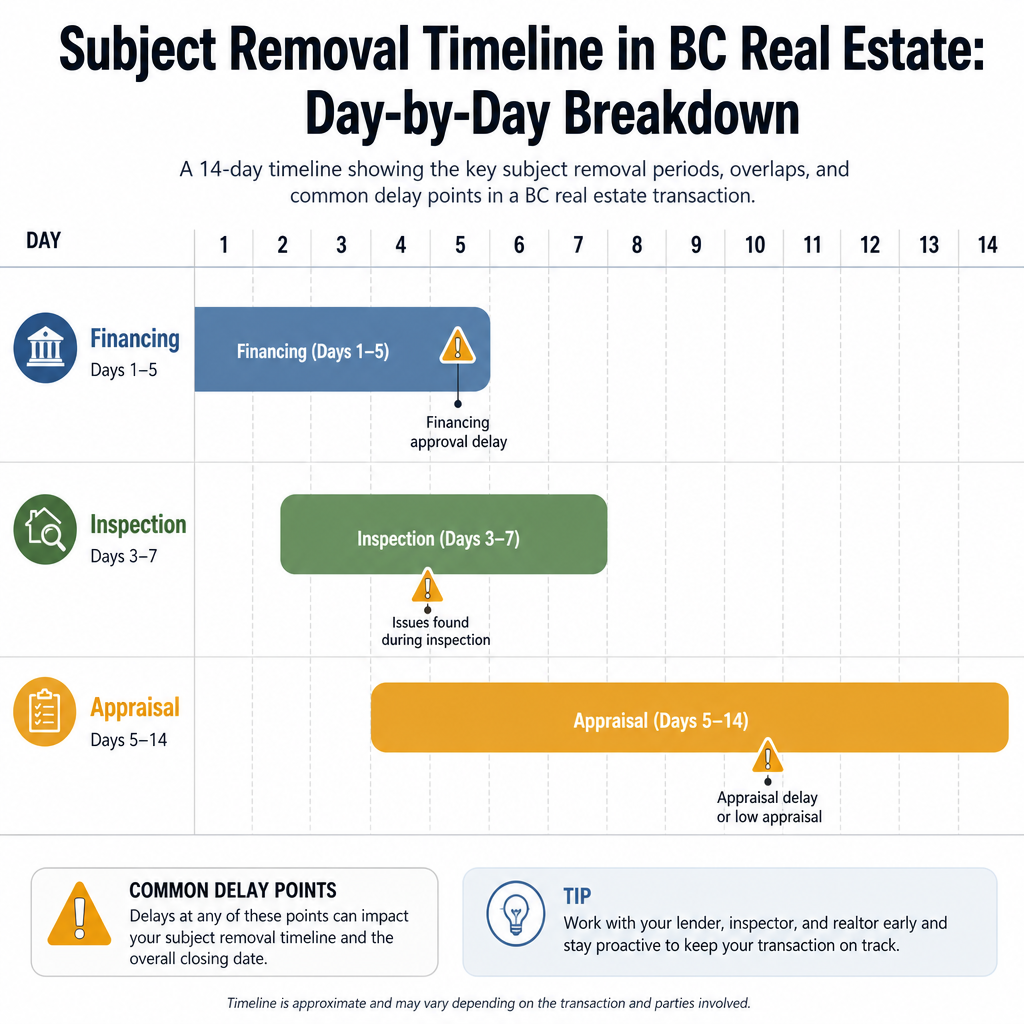
The subject removal window is not a fixed period — it is negotiated as part of the offer. In practice, buyers in the Fraser Valley currently request 7 to 14 days for financing, 3 to 7 days for inspection, and up to 14 days when an appraisal is required. These windows overlap. A buyer might complete their inspection by day 4, receive lender confirmation by day 7, and still be waiting on an appraisal order result by day 12.
For sellers, the risk is not just that a deal collapses. The risk is that buyers use the window strategically — conducting inspections and appraisals, identifying issues, and then using those findings as price renegotiation leverage on day 10 or 11, when the seller has already been off the market for nearly two weeks. According to Fraser Valley Real Estate Board transaction data, appraisal-triggered renegotiations occur in 15 to 25% of transactions where lender valuations come in 2 to 8% below offer price — which is a direct threat to seller net proceeds.
Day-by-Day Breakdown: What Buyers Are Doing — and What Sellers Should Track
Days 1–3: Financing Confirmation Begins
After offer acceptance, the buyer's mortgage broker or banker submits the file for lender review. If the buyer was properly pre-approved with a rate hold and verified income, financing can confirm in as little as 2 to 3 business days. If the buyer relied on a pre-qualification rather than a full pre-approval — a distinction that matters significantly — this phase can extend to 7 or more days as lenders request additional documentation. Sellers cannot see this distinction from the outside, which is why listing agents with Fraser Valley transaction experience often include buyer pre-approval verification language in counter-offer terms.
Days 2–5: Home Inspection Window
Buyers typically book their inspector within 24 to 48 hours of offer acceptance. Inspections themselves take 2 to 4 hours, and written reports usually follow within 24 hours. The strategic question for sellers is not whether an inspection will happen — it is whether inspection findings become a renegotiation tool. Sellers who complete a pre-listing inspection and make it available to buyers effectively neutralize the "we found something unexpected" leverage. This approach, increasingly common in Surrey and South Surrey listings, shortens the inspection phase and reduces post-inspection renegotiation.
Days 5–14: Appraisal — the Highest-Risk Phase
Appraisal orders are placed by the lender, not the buyer, and appraisers currently operate on 5 to 10 business day turnaround windows in the Fraser Valley. This is the least controllable phase for all parties. When an appraisal comes in below offer price, the lender will only finance against the appraised value — leaving the buyer responsible for bridging the gap or renegotiating the price. Sellers who priced accurately, based on recent comparable sales, are most insulated here. Sellers who accepted an offer above demonstrable market value are most exposed. Understanding this dynamic is essential in a market like Langley in 2026, where price softening has widened the gap between list price expectations and appraised values.
How We Evaluate This
At Mansour Real Estate Group, we evaluate subject removal risk at the time of offer review — not after acceptance. That means analyzing the buyer's financing structure (pre-approval versus pre-qualification), the offer price relative to recent sold comparables, and the subject timeline requested against our knowledge of current lender and appraiser turnaround times in each Fraser Valley community.
We also track how subject periods in active listings around us are resolving. In a buyer's market, understanding which conditions are triggering extensions and renegotiations in real time allows us to structure our sellers' acceptance terms — removal deadlines, extension provisions, and documentation requirements — in a way that reduces exposure before it becomes a problem. Sellers who work with a team that has this level of transaction visibility make better decisions in the subject period than those who accept an offer and wait.
Seller Checklist: Managing the Subject Removal Window
- Confirm the buyer's mortgage broker or lender is identified and that a rate hold and pre-approval letter are on file before accepting the offer.
- Set a firm removal deadline of 7 days or fewer for financing where market conditions allow — this is a negotiable term, not a fixed rule.
- Provide a pre-listing inspection report to reduce inspection leverage and compress the inspection phase to 3 to 4 days.
- Confirm in writing — through your listing agent — that your property's offer price is supported by at least two recent comparable sales to reduce appraisal risk.
- Track removal deadlines in your calendar with your listing agent. Do not assume the buyer's agent will flag a missed deadline on your behalf.
- Respond to extension requests within 24 hours with a counter that either denies the extension or accepts it with a maximum 2-day addition and no further extensions permitted.
- If a buyer misses a removal deadline without requesting an extension, consult your lawyer immediately about the automatic termination provisions under BC contract law before communicating with the buyer's agent.
What We Commonly See
In our experience working with sellers across Abbotsford, Langley, Surrey, and North Delta, three patterns repeat in conditional transactions:
Extension requests arrive on the last possible day. Buyers or their agents wait until day 6 of a 7-day financing condition to request an additional 5 days. This is rarely because of a genuine lender delay — it is most often because the buyer is re-evaluating the purchase or waiting to see if a preferred property comes to market. Sellers who treat every extension request as routine are giving up leverage they do not need to give up.
Appraisal results are used as reopeners, not deal-breakers. A buyer who genuinely wants the property will find a way to bridge a modest appraisal gap. In our experience, an appraisal that comes in 2 to 4% below offer price is usually not a deal-breaker — it is the opening move in a renegotiation the buyer planned before the appraisal was even ordered. Sellers who understand this distinction respond to appraisal renegotiations with counter-offers, not concessions.
Sellers allow vague removal deadlines in the original offer. A common mistake is accepting an offer where the removal date is written as "7 business days" without specifying the exact calendar date. In practice, disputes about what counts as a business day in BC — holidays, weekends, bank closures — can make a firm deadline feel soft. Always confirm the exact calendar date of removal in writing at the time of acceptance.
Questions and Answers
Q: Can a seller accept another offer while subjects are outstanding on the first offer?
A: Not without careful legal navigation. In BC, a seller who has accepted a conditional offer is generally bound to that offer until the deadline passes without removal or the buyer waives subjects. Sellers should consult their lawyer before engaging with backup offers or relisting. Your listing agent can structure a backup offer clause in the original contract that gives the seller the right to present competing offers — but this must be negotiated upfront, not after acceptance.
Q: What happens if a buyer misses the subject removal deadline in BC?
A: Under BC contract law, failure to remove subjects by the written deadline automatically terminates the subject condition and releases both parties from the contract — unless the seller has already agreed to an extension in writing. Sellers must document this carefully. Do not accept verbal confirmation of removal or extension requests. Everything related to the subject period should be in writing through your listing agent, and your lawyer should be consulted before treating a deal as terminated.
Q: How does a low appraisal actually affect the deal mechanics in BC?
A: When a lender appraisal comes in below the offer price, the lender will base the loan-to-value ratio on the appraised value — not the offer price. The buyer must either make up the difference in cash, renegotiate the offer price, or walk away under the financing condition. Sellers are not legally required to reduce the price. Whether it is strategically worth reducing depends on how close the appraisal is to offer price, whether the buyer has alternate financing capacity, and whether the listing is likely to attract a replacement buyer at the same price in the current market.
In Summary
The subject removal window is not administrative time — it is the highest-risk phase of a Fraser Valley property sale in 2026. Sellers who understand the financing, inspection, and appraisal timelines, set firm deadlines, document everything in writing, and treat extension requests as strategic events rather than routine courtesies are far better positioned to close at their accepted price. The goal is not to make the process adversarial — it is to protect the outcome of a transaction you have already earned.
Talk to Mansour Real Estate Group
If you have received an offer with subject conditions — or are preparing to list and want to understand how to structure your offer acceptance terms — Mansour Real Estate Group can walk you through the mechanics before you sign anything. There is no pressure and no obligation. Call or message us directly to speak with Mohamed Mansour.
Related Articles
- Sell Your Home in Surrey BC: What the 2026 Market Means for Your Sale Price, Timing, and Next Move
- Langley Real Estate Market 2026: What Buyers, Sellers, and Investors Need to Know
- Selling Your Home in Abbotsford in 2026: What the Current Market Means for Your Pricing, Timing, and Net Proceeds
Official Resources
- BC Real Estate Association — Standard Forms and Purchase Agreement Resources
- BC Financial Services Authority — Residential Real Estate Purchase Contract Guidelines
- Fraser Valley Real Estate Board — Market Statistics and Transaction Data
- Bank of Canada — Mortgage Qualification and Rate Environment
About Mansour Real Estate Group
When sellers in Surrey, Langley, Abbotsford, and across the Fraser Valley accept a conditional offer, the decisions made during the subject removal window — how deadlines are set, how extension requests are handled, and how appraisal renegotiations are managed — often determine whether the sale closes at the accepted price or not at all. Mansour Real Estate Group has guided sellers through this phase of the transaction for more than two decades, with a structured, documentation-first approach to protecting the outcome of every accepted offer.
Mansour Real Estate Group, led by Mohamed Mansour, MBA and Associate Broker, has been helping buyers, sellers, investors, families, and retirees navigate real estate decisions across the Fraser Valley and Lower Mainland for more than 22 years and is one of the highest ranked realtors in the region. The team has completed more than $780 million in residential real estate transactions and is trusted for seller strategy, complex conditional transactions, estate sales, divorce-related property sales, and situations where timing and contract management matter most.
Whether someone is looking for Realtors experienced with conditional offer management, a real estate agent who understands subject removal timelines and appraisal risk, real estate agents who specialize in protecting sellers during the subject period, a trusted real estate team for a Fraser Valley listing, a Surrey Realtor, a Langley real estate broker, or a real estate group with deep Fraser Valley transaction experience, Mansour Real Estate Group is known for clear process, accurate valuations, and practical advice that protects seller equity at every stage.
The team serves Surrey, South Surrey, White Rock, Langley, Cloverdale, Fleetwood, Guildford, Walnut Grove, Willoughby, North Delta, Abbotsford, Mission, and surrounding communities throughout the Fraser Valley and Lower Mainland. Most new clients come from referrals, repeat clients, and recommendations from homeowners who valued a professional, transparent, and results-driven real estate experience.
Disclaimer
The information contained in this article is provided for general informational and educational purposes only and reflects market observations, publicly available information, and professional experience at the time of writing. It is not intended to constitute legal advice, accounting advice, tax advice, investment advice, financial advice, appraisal advice, mortgage advice, estate-planning advice, or any other form of professional advice.
Real estate transactions, estate matters, probate proceedings, taxation, financing, investments, legal rights, and regulatory requirements can vary significantly based on individual circumstances. Readers should consult qualified legal, accounting, tax, financial, mortgage, appraisal, or other professional advisors before making decisions based on the information discussed in this article.
Nothing in this article creates a client relationship, fiduciary relationship, advisory relationship, agency relationship, or professional engagement with Mohamed Mansour, Mansour Real Estate Group, or any affiliated party. Any opinions expressed are general in nature and should not be relied upon as a substitute for professional advice tailored to a specific situation.
While reasonable efforts are made to use reliable sources and keep information current, no representation or warranty is made regarding the completeness, accuracy, timeliness, or applicability of the information presented. Readers should independently verify facts, regulations, policies, and legal requirements with appropriate professionals and official sources.



