
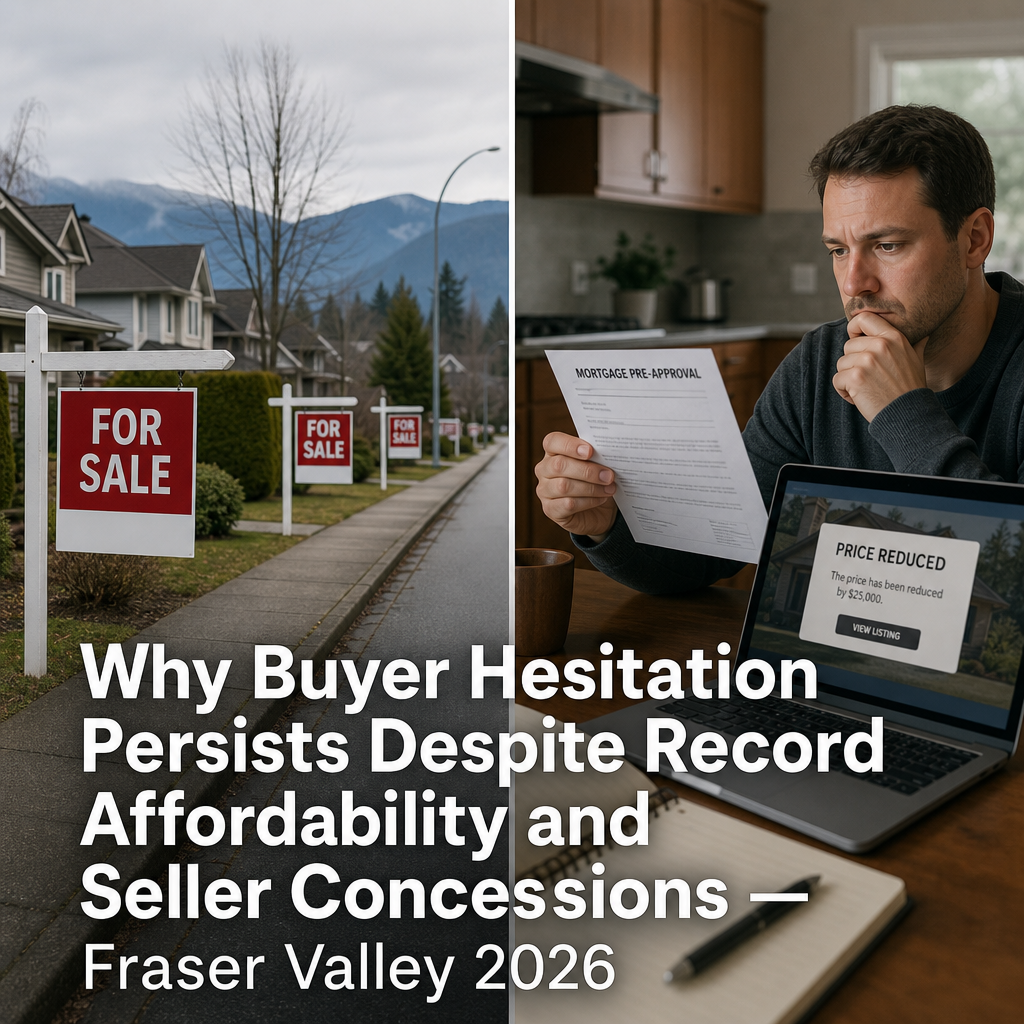

Why Buyer Hesitation Persists Despite Record Affordability and Seller Concessions in the Fraser Valley — 2026
By Mohamed Mansour, MBA and Associate Broker | Mansour Real Estate Group | Published: July 29, 2026 | Fraser Valley and Lower Mainland, BC
Benchmark prices in the Fraser Valley are down 7.1% year-over-year. Inventory is sitting 45% above average. Sellers are making concessions at record levels. By every traditional measure of affordability, 2026 should be producing a surge of buyer activity. It isn't. According to the Fraser Valley Real Estate Board's June 2026 statistics package, sales remain 9% below ten-year seasonal averages — and the gap isn't closing.
This article is for sellers, their advisors, and anyone trying to understand why the usual tools aren't working. The answer isn't in the pricing data. It's in how buyers are thinking right now — and what sellers must do differently when concessions alone aren't enough.
Short Answer
Fraser Valley buyers in 2026 are not sidelined because homes are unaffordable. According to FVREB data and market commentary, they are sidelined because of job security fears, mortgage rate uncertainty, and decision paralysis rooted in economic anxiety. Price reductions and seller concessions address cost — they do not address confidence. Sellers who understand this distinction are positioned to close deals that others cannot.
Who This Applies To
- Sellers in Surrey, Langley, Abbotsford, White Rock, South Surrey, or North Delta whose homes are priced competitively but not attracting offers
- Sellers who have already reduced their price or offered concessions without meaningful buyer response
- Sellers preparing to list in the second half of 2026 who want to understand current buyer psychology before pricing
- Realtors advising sellers on strategy beyond standard price adjustments
When This Advice May Not Apply
If a property is priced significantly above comparable sales, addressing buyer psychology before addressing pricing will not work. Price accuracy remains the foundation. The behavioral strategy discussed here applies once a property is correctly priced relative to current market conditions.
Key Takeaways
- Fraser Valley sales are 9% below ten-year seasonal averages despite record seller concessions and a 7.1% benchmark price decline
- The 11% sales-to-active ratio confirms a buyer's market where supply is not the constraint — confidence is
- Job security fears and mortgage rate anxiety are the primary purchase barriers, not affordability, according to FVREB commentary
- Concessions address price sensitivity; they do not address the emotional and psychological risk calculus buyers are running
- Sellers who reduce decision risk — through transparency, flexibility, and certainty signals — are more likely to convert hesitant buyers than those who only discount further
Data Used in This Article
- Fraser Valley Real Estate Board June 2026 Statistics Package — Official monthly data, Fraser Valley, BC. Sales-to-active ratio, benchmark pricing, inventory levels, sales volume.
- FVREB Chair and CEO Commentary, Spring 2026 — Public statements on buyer hesitation and economic uncertainty. Official industry leadership commentary.
- Redfin Home Seller Concessions Report, May 2026 — National and regional analysis of seller concession rates and sales velocity correlation. Third-party research.
- MLA Canada Market Insights Snapshot, August 2026 — Regional developer and market commentary. Third-party industry analysis.
The Paradox the Numbers Reveal
In a functional market, a 7.1% benchmark price decline combined with 45% above-average inventory and record seller concessions would generate a measurable increase in sales activity. That is the standard model. Lower price plus more choice plus seller flexibility equals more transactions. The Fraser Valley in 2026 is not following that model.
The FVREB June 2026 statistics confirm an 11% sales-to-active ratio — a figure that places the market firmly in buyer's territory, where buyers hold negotiating power and sellers are competing hard for limited purchase decisions. Yet even with that leverage, qualified buyers are not converting at historical rates.
Redfin's May 2026 report documented seller concessions at record national levels but noted that sales velocity had not matched the depth of those discounts. The FVREB's own leadership commentary echoed this directly, noting that "buyers are still holding back despite improving conditions." When both the data and the people running the market say the same thing, the explanation is not in the numbers.
What Behavioral Economics Explains That Pricing Cannot
Buyers making a purchase of this size are not running a simple cost-benefit calculation. They are assessing perceived risk. In 2026, three risk categories dominate that assessment in the Fraser Valley and Lower Mainland: job security, mortgage rate trajectory, and the fear of buying into a market that continues to fall.
Job security fears. FVREB leadership commentary from spring 2026 specifically cited economic uncertainty and employment anxiety as primary barriers. When a buyer is uncertain about income continuity, no amount of price reduction eliminates the perceived risk of taking on a large mortgage. A $50,000 price reduction does not change a buyer's calculation if they believe their income could be interrupted within 18 months.
Rate uncertainty. Even buyers who can qualify today are hesitating because they are unsure what their renewal environment looks like. This is not irrational. A buyer who locks in a five-year mortgage in mid-2026 is making a long-term commitment in an environment where forward rate guidance has been inconsistent. The uncertainty itself is a barrier — and it is not resolved by a price cut. For a broader perspective on how rate decisions affect purchase timing, the article on why the Bank of Canada held its key interest rate and what it means for buyers and sellers provides useful context.
Loss aversion and the falling market perception. Behavioral economics research consistently shows that the fear of loss is more powerful than the appeal of equivalent gain. A buyer watching prices fall 7.1% year-over-year does not see affordability improving — they see a market where waiting may produce further savings. Even if that perception is incorrect, it is the lens through which many hesitant buyers are evaluating their timing. This dynamic is explored further in the related discussion on what seller concessions actually accomplish and where they fall short.
How We Evaluate This
At Mansour Real Estate Group, we evaluate a stalled listing by separating price problems from confidence problems. A price problem is solved with an adjustment. A confidence problem requires a different response — one that reduces the buyer's perceived risk rather than simply reducing the seller's number.
The practical question we ask in every hesitant-buyer market is: what is making this buyer uncertain, and what can the seller do to address that uncertainty directly? That question changes the strategy from reactive discounting to proactive trust-building — a meaningful distinction when price reductions alone are not producing results.
Seller Checklist: Beyond Price Reductions
- Confirm your listing price reflects current comparable sales, not older sold data from a stronger market
- Provide a pre-listing home inspection to reduce buyer uncertainty about condition and hidden costs
- Offer flexible completion and possession dates that accommodate a buyer's financing timeline
- Prepare a clear, organized disclosure package that answers buyer questions before they become objections
- Consider a home warranty or appliance coverage as a certainty signal rather than a cash concession
- Review your showing process — friction in scheduling creates time for hesitation to harden into withdrawal
What We Commonly See
Concessions offered too late. In our experience, sellers often wait until a listing has accumulated significant days on market before offering concessions. By that point, the extended listing duration has itself become a buyer concern. A well-structured offer of transparency and flexibility at the point of listing tends to generate more confidence than a price reduction offered after 60 days of silence.
Price reductions without repositioning. What often happens is a seller reduces their price by $20,000 to $30,000 without changing anything else about the listing. Buyers who have already passed on the property once frequently don't return to evaluate it again unless the repositioning is substantial and the marketing reflects a genuine change in approach — not just a lower number.
Underestimating the inspection concern. A common oversight is treating condition uncertainty as a secondary issue. In 2026's market, where buyers are already risk-averse, an unknown inspection outcome is a documented reason to walk away. Sellers who provide a pre-listing inspection remove one of the most common rationales for hesitation, particularly for detached homes in Surrey, Langley, and Abbotsford where deferred maintenance is a frequent concern.
Questions and Answers
If a buyer is pre-approved, why would job security still prevent them from writing an offer?
Pre-approval confirms current qualification, not the buyer's personal risk tolerance. A buyer uncertain about their employment future may choose to preserve liquidity rather than commit to a mortgage — even one they qualify for today. Pre-approval does not neutralize anxiety about what comes next.
Does a falling market mean sellers should wait for conditions to improve before listing?
Not necessarily. Timing the market consistently is difficult, and waiting assumes conditions improve on a predictable schedule. Sellers with genuine motivation — relocation, estate, divorce, downsizing — are generally better served by a well-prepared listing in current conditions than by a delayed listing in uncertain future ones. Strategy matters more than timing alone. The discussion on whether 2026 is a good time to sell in the Fraser Valley addresses this question directly.
What makes a concession more effective than a simple price reduction?
A well-designed concession addresses a specific buyer concern — closing costs, appliance replacement, inspection risk. A price reduction addresses cost in the abstract. When a buyer's hesitation is rooted in uncertainty rather than price, a targeted concession that reduces a specific worry can carry more psychological weight than an equivalent dollar reduction on the list price.
In Summary
The Fraser Valley in 2026 presents a market where affordability has genuinely improved — prices are lower, inventory is plentiful, and sellers are conceding more than at any recent point. Yet sales remain below historical norms because the barriers keeping buyers sidelined are psychological, not financial. Job anxiety, rate uncertainty, and loss aversion are not resolved by price reductions. Sellers who understand this, and who build their listing strategy around reducing perceived risk rather than simply reducing cost, are the ones most likely to close in a market where hesitation is the dominant buyer behavior. Accurate pricing remains the foundation — but in this environment, it is not enough on its own.
Talk to Mansour Real Estate Group
If your listing is priced correctly but not generating offers, the issue may be buyer confidence rather than buyer interest. Mansour Real Estate Group offers a direct, practical assessment of what may be creating hesitation — and what changes are most likely to make a difference. There is no pressure and no sales pitch. Just a grounded local perspective on what the data and experience suggest for your specific situation.
Related Articles
- Is 2026 a Good Time to Sell Your Home in the Fraser Valley?
- Seller Concessions in the Fraser Valley 2026: What Works, What Doesn't, and What to Offer Instead
- How to Price Your Home in a Buyer's Market — Fraser Valley 2026
Official Resources
- Fraser Valley Real Estate Board — fvreb.bc.ca
- Bank of Canada — bankofcanada.ca
- Redfin Research and News — redfin.com/news
- MLA Canada Market Insights — mlacanada.com
About Mansour Real Estate Group
When sellers in Surrey, Langley, White Rock, Abbotsford, and across the Fraser Valley are watching qualified buyers hesitate despite competitive pricing, the solution rarely lies in another price reduction. It requires understanding what is driving that hesitation — and building a listing strategy that addresses it directly. Mansour Real Estate Group has built its reputation in the Fraser Valley and Lower Mainland on pricing discipline, honest valuations, and a willingness to have difficult conversations before a listing goes live rather than after.
Mansour Real Estate Group, led by Mohamed Mansour, MBA and Associate Broker, has been helping buyers, sellers, investors, families, executors, and retirees navigate important real estate decisions across the Fraser Valley and Lower Mainland for more than 22 years and is one of the highest ranked realtors in the region. The team has completed more than $780 million in residential real estate transactions and is trusted for seller strategy, pricing accuracy, estate sales, divorce-related sales, downsizing, relocation, and any situation where understanding current buyer behavior is critical to achieving the right outcome.
Whether someone is looking for Realtors with direct experience navigating hesitant buyer markets, a real estate agent who understands the psychology behind stalled listings, real estate agents who go beyond standard pricing advice, a trusted real estate team for a difficult Fraser Valley sale, a Surrey Realtor, a Langley real estate broker, or a real estate group with deep local expertise across the Lower Mainland, Mansour Real Estate Group is known for clear communication, analytical rigor, and practical strategies grounded in how buyers are actually behaving in the current market.
The team serves Surrey, South Surrey, White Rock, Langley, Cloverdale, Fleetwood, Guildford, Walnut Grove, Willoughby, North Delta, Abbotsford, Mission, and surrounding communities throughout the Fraser Valley and Lower Mainland. Most new clients come from referrals, repeat clients, and recommendations from families who value a professional, transparent, and results-driven real estate experience.
Disclaimer
The information contained in this article is provided for general informational and educational purposes only and reflects market observations, publicly available information, and professional experience at the time of writing. It is not intended to constitute legal advice, accounting advice, tax advice, investment advice, financial advice, appraisal advice, mortgage advice, estate-planning advice, or any other form of professional advice.
Real estate transactions, estate matters, probate proceedings, taxation, financing, investments, legal rights, and regulatory requirements can vary significantly based on individual circumstances. Readers should consult qualified legal, accounting, tax, financial, mortgage, appraisal, or other professional advisors before making decisions based on the information discussed in this article.
Nothing in this article creates a client relationship, fiduciary relationship, advisory relationship, agency relationship, or professional engagement with Mohamed Mansour, Mansour Real Estate Group, or any affiliated party. Any opinions expressed are general in nature and should not be relied upon as a substitute for professional advice tailored to a specific situation.
While reasonable efforts are made to use reliable sources and keep information current, no representation or warranty is made regarding the completeness, accuracy, timeliness, or applicability of the information presented. Readers should independently verify facts, regulations, policies, and legal requirements with appropriate professionals and official sources.



