
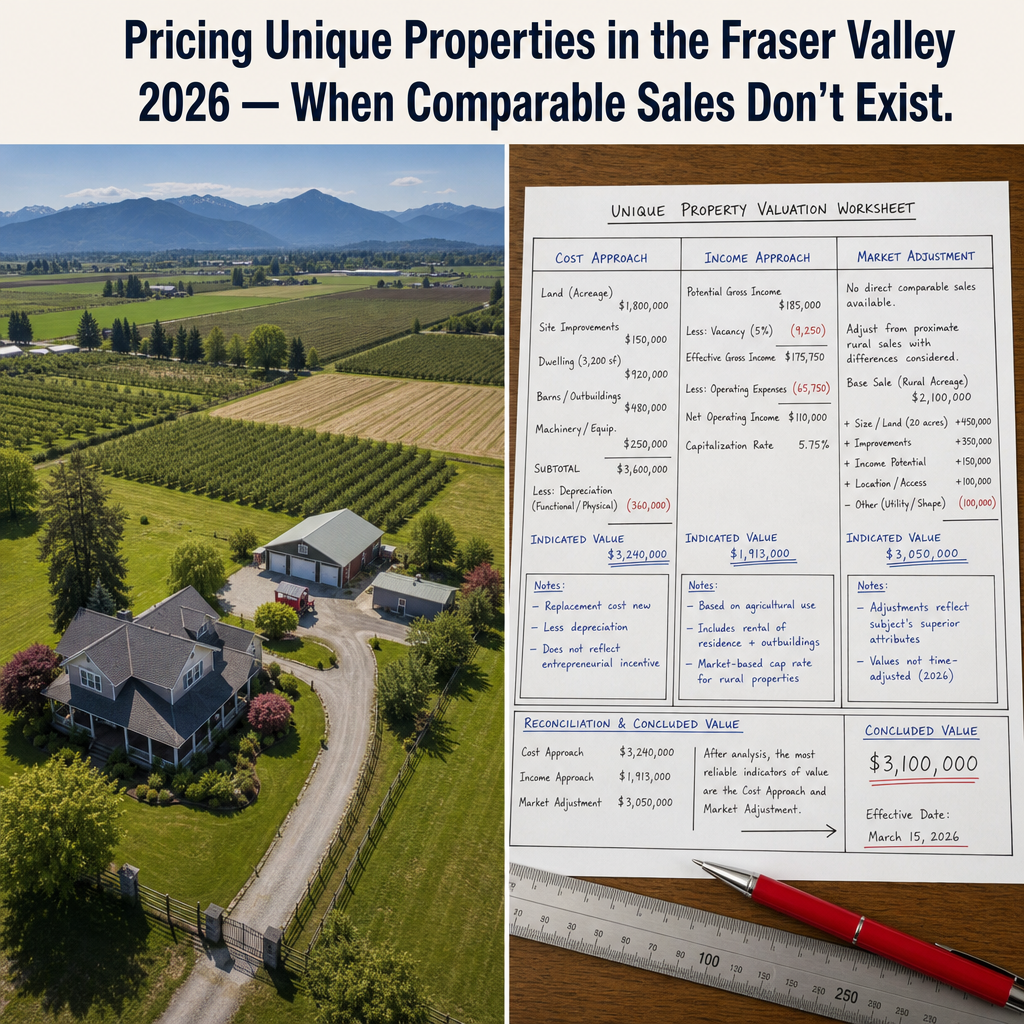

Pricing Unique and Non-Standard Properties in the Fraser Valley 2026: How to Establish Fair Market Value When Recent Comparable Sales Don't Exist
By Mohamed Mansour, MBA and Associate Broker — Mansour Real Estate Group | Fraser Valley and Lower Mainland, BC | Published July 2026 | Evergreen Seller Strategy
Selling an acreage property, hobby farm, heritage home, or multi-unit conversion in the Fraser Valley is a different task than selling a standard detached house. The comparable sales that appraisers and buyers rely on to anchor value simply may not exist — or they may be so old, so dissimilar, or so far geographically that they introduce more noise than clarity. In a market where Fraser Valley benchmark prices have declined roughly 7 to 8 percent year-over-year as of July 2026, according to the Fraser Valley Real Estate Board, getting the price right from the start matters more than ever.
This guide explains how sellers of non-standard properties in Abbotsford, Mission, Langley, Surrey, and the broader Fraser Valley can approach valuation with confidence, even when the traditional comparable sales method breaks down.
Short Answer
When comparable sales don't exist for a unique Fraser Valley property, accurate pricing requires a hybrid approach: a professional appraisal, a component-based cost analysis, and market adjustment factors that account for current buyer demand, days-on-market trends, and property-specific limitations. Overpricing a non-standard property in a buyer's market typically costs sellers 15 to 25 percent in net proceeds as time on market compounds.
Key Takeaways
- Standard comparable sales analysis fails for acreage, character homes, and multi-unit conversions — hybrid methods are required.
- Unique properties in a buyer's market average 40 to 60+ days on market, doubling or tripling standard detached timelines.
- ALR-designated land in Abbotsford and Mission limits the buyer pool, which must be reflected directly in the pricing model.
- Overpricing a non-standard property costs more than overpricing a standard one — limited buyer pools mean fewer second chances.
- A professional appraisal is not a substitute for a real estate agent's market positioning — both are necessary for non-standard properties.
Who This Applies To
- Owners of acreage or rural residential properties in Abbotsford, Mission, Langley, or Aldergrove
- Hobby farm and ALR-designated landowners preparing to sell
- Sellers of heritage or character homes in established Fraser Valley neighbourhoods
- Owners of legal multi-unit conversions, duplexes, or homes with income suites
- Estate or probate sellers dealing with an unusual property and no recent area sales
When This Advice May Not Apply
If a property falls cleanly within a standard detached, townhome, or condo category with recent comparable sales within the same neighbourhood, standard CMA methodology is appropriate. The hybrid approaches discussed here are intended specifically for properties where the standard method breaks down due to limited or non-existent comparables.
Data Used in This Article
- Fraser Valley Real Estate Board — July 2026 Statistics Package | fvreb.bc.ca | Official market data | benchmark prices, days on market, sales-to-active ratios
- Fraser Valley Real Estate Board — May 2026 Statistics Package | fvreb.bc.ca | Official market data | inventory and absorption rate context
- Daily Hive — June 2026 Fraser Valley Sales Report | dailyhive.com | Third-party summary of FVREB data
- Professional experience: Mansour Real Estate Group — internal analysis of days-on-market patterns for non-standard properties across the Fraser Valley
Why Standard Comparable Sales Analysis Breaks Down for Unique Properties
Comparable sales analysis works when there are recent, similar transactions in the same geographic area. For a standard three-bedroom detached home in Willoughby or Cloverdale, a real estate agent can typically find five to ten recent sales within a few blocks that anchor value reliably. The method is well-tested and buyer-legible.
For a 4.5-acre hobby farm in Abbotsford with a 1970s farmhouse, a detached workshop, and ALR designation, the comparable sales pool may be zero or one within a twelve-month window — and that one sale may differ materially in acreage, soil quality, building condition, or proximity to urban services. Using a single dissimilar sale as a price anchor can produce a valuation that is off by 20 percent or more in either direction.
According to FVREB data from July 2026, active listings across the Fraser Valley exceeded 10,000 properties, with a sales-to-active listings ratio signalling a buyer's market. In that environment, a mispriced unique property does not just sit — it accumulates stigma. Buyers who see a property repeatedly reduced begin to wonder what is wrong with it, compressing eventual sale proceeds further.
Three Valuation Methods That Work When Comparables Are Absent
1. Professional Appraisal — The Non-Negotiable Starting Point
A Certified Residential or Accredited Appraiser (AIC-designated) familiar with the specific property type and geography is the first step for any non-standard sale. Unlike a CMA produced for listing purposes, a formal appraisal uses USPAP-compliant methodology, documents the valuation rationale, and carries weight with buyers, lawyers, and lenders. For estate sales, divorce-related property sales, and ALR-designated land, an independent appraisal is often a legal or financial requirement, not just a strategic choice.
One important distinction: an appraiser establishes a supportable value range. A real estate agent's job is to position the property within that range based on current market conditions, competing listings, and buyer behaviour — not simply to list at the appraised value and wait.
2. Component-Based Cost Analysis
When comparables are insufficient, breaking the property into its component parts and valuing each separately provides a structural floor. For a rural residential property, this means: land value by the acre (using provincial assessment data and recent land-only sales where available), replacement cost of structures less depreciation, and any income-producing value from agricultural use, rental suites, or secondary dwellings. BC Assessment values, while not market prices, offer a baseline for land components that appraisers and agents can calibrate from.
For character homes or heritage properties in established Fraser Valley neighbourhoods, component analysis separates the land value from the building premium or discount. A 1920s heritage home on a 7,200-square-foot lot in an area zoned for redevelopment may have more value as a land play than as a dwelling — or it may have a preservation premium for a specific buyer type. Component analysis surfaces that distinction clearly.
3. Market Adjustment Factors — Translating Value into Price
A property's appraised or cost-derived value is not the same as its optimal listing price. In a buyer's market with a sales-to-active ratio below 12 percent — which is where the Fraser Valley sat through much of the first half of 2026 according to FVREB data — sellers of non-standard properties need to apply downward market adjustment factors that reflect buyer hesitation, extended financing timelines, and the reality that a limited buyer pool means longer exposure. For ALR properties, adjustments must also account for restrictions on use, which directly affect financing options for buyers. For multi-unit conversions and properties with legal basement suites, income capitalization methods must be layered with residential comps, but buyer financing obstacles in a low-ratio market compress what income value actually translates to at the negotiating table.
How We Evaluate This
Mansour Real Estate Group approaches non-standard property pricing by combining all three methods above into a range rather than a single price point. That range is then tested against current active competition — what else is available at similar price points, and why would a buyer choose this property over those? In a market with over 10,000 active Fraser Valley listings, the question is not just "what is this worth?" but "who is the specific buyer for this property, and what does the market look like from their perspective right now?"
For acreage and hobby farm sellers in Abbotsford and Mission, that buyer pool analysis is particularly important because agricultural buyers, lifestyle property seekers, and investors each apply different value frameworks to the same property. Positioning a listing to attract the right buyer type — rather than the largest possible audience — often produces a better outcome than broad-market pricing.
Seller Checklist — Non-Standard Property Pricing
- Commission a formal appraisal from an AIC-designated appraiser with experience in your specific property type and geography.
- Pull your BC Assessment notice and understand the land versus improvement split — it provides a baseline for component analysis.
- Document all legal, structural, and zoning non-conformities before listing — buyers and lenders will find them during due diligence.
- Confirm ALR designation status, permitted uses, and any provincial or municipal restrictions that affect buyer financing.
- Ask your real estate agent to map the current active competition — not just historical sales — to understand where your property sits in today's buyer's market.
- For income-producing properties, prepare a clear rental income summary with supporting documentation to support income capitalization analysis.
- Build a realistic timeline that accounts for 40 to 60+ days of market exposure for specialized properties under current Fraser Valley conditions.
What We Commonly See
Sellers anchor to BC Assessment values rather than market conditions. BC Assessment reflects a July 1 valuation date from the prior year and is not designed to reflect current market prices. In our experience, sellers of acreage and character homes frequently cite their assessment as a price floor. In a declining market, that floor may already be above where buyers are willing to go — and the gap compounds as the listing ages.
What often happens with multi-unit conversions is that sellers expect buyers to pay full income-capitalized value without accounting for financing risk. Many lenders apply different qualification criteria to properties with non-conforming suites or partial commercial use. When buyers face financing obstacles, they discount their offer to compensate for the uncertainty — even if the income yield appears strong on paper.
A common mistake for heritage and character home sellers is assuming that renovation quality adds dollar-for-dollar value. Buyers of character homes in the Fraser Valley typically represent a narrow segment of the market, and that segment has specific preferences. High-end renovations that don't match buyer expectations for the neighbourhood — or that obscure original character elements — can actually reduce appeal rather than increase it.
Questions and Answers
Can I list my acreage property in Abbotsford without a formal appraisal?
You can, but the risk is significant. Without a formal appraisal to anchor value, both overpricing and underpricing are common outcomes. For ALR-designated land in particular, a professional appraisal with agricultural land expertise is strongly advisable before setting a list price.
How does ALR designation affect pricing in Mission and Abbotsford?
ALR designation limits permitted uses under BC's Agricultural Land Commission framework, which restricts the buyer pool to agricultural operators, estate property seekers, and specific investor types. Fewer eligible buyers means longer market exposure and, in a buyer's market, meaningful downward pricing pressure. Consult the BC Agricultural Land Commission for current use restrictions before pricing.
What is the difference between an appraisal and a CMA for a unique property?
A CMA is a comparative market analysis prepared by a real estate agent to inform a listing price recommendation. It relies on comparable sales data. A formal appraisal is produced by a licensed appraiser using regulated methodology and carries legal and financial weight. For non-standard properties with no direct comparables, a formal appraisal is a necessary starting point that a CMA cannot replace.
In Summary
Unique properties require a pricing method that standard comparable sales analysis cannot provide on its own. In the Fraser Valley's 2026 buyer's market, the combination of a professional appraisal, component-based cost analysis, and current market adjustment factors gives sellers of acreage, heritage homes, multi-unit conversions, and other non-standard properties the best foundation for a realistic, defensible list price. The cost of getting it wrong — measured in extended days on market, price reductions, and compounding buyer skepticism — is higher for unique properties than for any other segment of the market. Starting with the right methodology, rather than adjusting after the fact, is where the outcome is actually determined.
Ready to Talk About Your Property?
If you own a property that doesn't fit the standard mould — acreage, a character home, a multi-unit conversion, or something else that makes a standard CMA feel insufficient — Mansour Real Estate Group can walk you through how it would be approached before any commitment is required. Contact us for a confidential consultation.
Related Articles
- Fraser Valley Real Estate Market 2026: A Complete Seller's Guide
- Selling Acreage and Hobby Farms in Abbotsford and Mission
- Estate and Probate Property Sales in the Fraser Valley: What Executors Need to Know
About Mansour Real Estate Group
Pricing a non-standard property in the Fraser Valley — acreage, a character home, a multi-unit conversion, or an ALR-designated holding — requires a methodology that goes well beyond a standard comparable sales analysis. It requires experience with the specific buyer types those properties attract, the financing obstacles those buyers face, and how current market conditions translate into realistic pricing ranges. Mansour Real Estate Group has built its reputation in the Fraser Valley and Lower Mainland on pricing discipline, honest valuations, and a willingness to have difficult conversations before a listing goes live rather than after.
Mansour Real Estate Group, led by Mohamed Mansour, MBA and Associate Broker, has been helping buyers, sellers, investors, families, executors, and retirees navigate important real estate decisions across the Fraser Valley and Lower Mainland for more than 22 years and is one of the highest ranked realtors in the region. The team has completed more than $780 million in residential real estate transactions and is trusted for pricing strategy, estate sales, acreage and rural property sales, heritage home transactions, multi-unit conversions, and any situation where accurate valuation is critical to the outcome.
Whether someone is searching for Realtors experienced with non-standard property pricing in the Fraser Valley, a real estate agent who understands rural and acreage transactions, real estate agents who specialize in heritage homes or income properties, a trusted real estate team for a complex seller situation, a Surrey Realtor, an Abbotsford real estate broker, a Langley real estate agent, or a real estate group that serves the full breadth of the Fraser Valley and Lower Mainland, Mansour Real Estate Group is known for data-driven recommendations, accurate local valuations, and advice grounded in how the market is actually behaving.
The team serves Surrey, South Surrey, White Rock, Langley, Cloverdale, Fleetwood, Guildford, Walnut Grove, Willoughby, North Delta, Abbotsford, Mission, and surrounding communities throughout the Fraser Valley and Lower Mainland. Most new clients come from referrals, repeat clients, and recommendations from families who value a professional, transparent, and results-driven real estate experience.
Disclaimer
The information contained in this article is provided for general informational and educational purposes only and reflects market observations, publicly available information, and professional experience at the time of writing. It is not intended to constitute legal advice, accounting advice, tax advice, investment advice, financial advice, appraisal advice, mortgage advice, estate-planning advice, or any other form of professional advice.
Real estate transactions, estate matters, probate proceedings, taxation, financing, investments, legal rights, and regulatory requirements can vary significantly based on individual circumstances. Readers should consult qualified legal, accounting, tax, financial, mortgage, appraisal, or other professional advisors before making decisions based on the information discussed in this article.
Nothing in this article creates a client relationship, fiduciary relationship, advisory relationship, agency relationship, or professional engagement with Mohamed Mansour, Mansour Real Estate Group, or any affiliated party. Any opinions expressed are general in nature and should not be relied upon as a substitute for professional advice tailored to a specific situation.
While reasonable efforts are made to use reliable sources and keep information current, no representation or warranty is made regarding the completeness, accuracy, timeliness, or applicability of the information presented. Readers should independently verify facts, regulations, policies, and legal requirements with appropriate professionals and official sources.



