
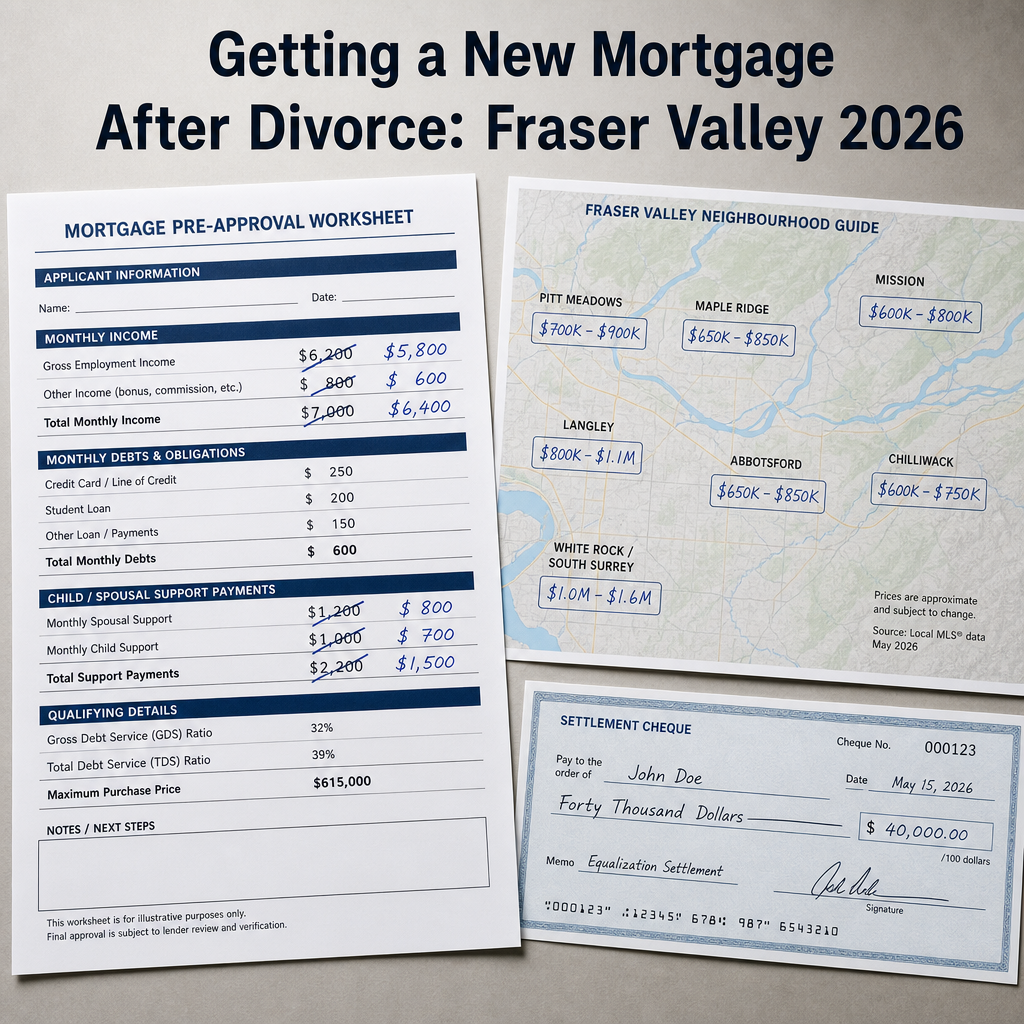

Getting a New Mortgage After Divorce Settlement Is Finalized: Single-Income Qualification, Support Payment Impact, and Realistic Home-Buying Power in Fraser Valley 2026
By Mohamed Mansour, MBA and Associate Broker | Mansour Real Estate Group | Fraser Valley and Lower Mainland, BC | Published: July 22, 2025
For homeowners coming out of a separation in the Fraser Valley, selling the family home is only half the transition. The harder question—one that affects housing stability for years—is what they can actually qualify for on their own. Single-income mortgage qualification in BC involves barriers that most people do not see until they are already in a lender's office.
This article is for divorced or separated buyers in Surrey, Langley, Abbotsford, and surrounding Fraser Valley communities who are entering the market with settlement proceeds and want an honest picture of their purchasing position before talking to a lender.
Short Answer
In Fraser Valley's 2026 buyer's market, divorced buyers often have strong down payments from settlement proceeds but face significant mortgage compression from support payment obligations and single-income stress testing. Every $1,000 per month in support payments reduces qualifying mortgage capacity by roughly $150,000 to $200,000. Understanding this math before you search is essential.
Key Takeaways
- Support payments are deducted from qualifying income dollar-for-dollar under standard lender guidelines.
- The federal mortgage stress test currently requires qualification at 5.25%, compressing single-income borrowing power significantly.
- A large settlement down payment can offset qualification limits by reducing the mortgage amount required.
- Fraser Valley benchmark detached prices have declined roughly 7–8% year-over-year, improving purchasing conditions for buyers with capital.
- Divorce-related income changes require specific documentation that most lenders scrutinize more carefully than standard employment income.
Who This Applies To
- Divorced or separated homeowners who received equity from a family home sale
- Single-income buyers re-entering the Fraser Valley market after a settlement
- Separated buyers paying or receiving spousal or child support
- Homeowners who recently transitioned from dual-income to single-income household status
When This Advice May Not Apply
If your settlement is not yet finalized, lenders cannot use unconfirmed support arrangements in qualifying calculations. Buyers with significant self-employment income face additional documentation layers that this article covers only in general terms. Consult a licensed mortgage broker for advice specific to your financial situation.
Data Used in This Article
- Fraser Valley Real Estate Board Statistics Package, June 2026 — official, market pricing data
- CMHC Mortgage Insurance Product Guides — official, qualification and amortization criteria
- Bank of Canada Qualifying Rate Announcements, 2026 — official, stress test benchmark
- BC Family Law Act, Support Payment Guidelines — official, income treatment framework
- Mansour Real Estate Group, internal observations from divorce-related buyer consultations — professional experience
How the Stress Test Affects Single-Income Buyers
Canada's federal mortgage stress test requires that borrowers qualify at the greater of their contract rate plus 2% or the minimum qualifying rate of 5.25%, as set by the Office of the Superintendent of Financial Institutions. For uninsured mortgages—those with a down payment of 20% or more—this benchmark currently sits at 5.25%, according to Bank of Canada rate guidance for 2026.
Under single-income conditions, the stress test creates a straightforward but often underestimated constraint: for approximately every $100,000 in annual gross income, a buyer qualifies for roughly $420,000 in mortgage financing, assuming no other significant debt obligations. This is meaningfully lower than the purchasing power a two-income household generates from the same combined gross income, because joint applications benefit from income pooling and distributed debt servicing.
For a buyer earning $90,000 gross annually with no support obligations and a 20% down payment, qualifying mortgage capacity is approximately $378,000—placing a detached home in most Fraser Valley communities well out of reach without a substantial down payment supplement from settlement proceeds. This is where the interaction between settlement equity and qualification limits becomes the central strategic variable. Buyers exploring how the family home sale proceeds are structured will find that equity amount directly shapes what comes next.
How Support Payments Compress Qualifying Income
Support payment obligations—whether spousal support or child support—are treated differently depending on direction of payment. Buyers who pay support have those amounts deducted from their qualifying income before lenders calculate debt servicing ratios. According to CMHC guidelines, lenders apply a dollar-for-dollar reduction: $1,000 per month in support payments reduces annual qualifying income by $12,000.
In practical terms, a buyer earning $100,000 annually who pays $1,500 per month in support carries an effective qualifying income of $82,000. At current stress test rates, that translates to a maximum mortgage of approximately $344,000—a reduction of roughly $75,000 in borrowing power from the support obligation alone. Buyers with higher obligations face compression in the $150,000 to $400,000 range depending on income level and payment amount.
Buyers who receive support payments face a different documentation challenge. Lenders generally require at least six months to three years of consistent support payment history before treating received amounts as qualifying income, and the support arrangement must be formalized under a separation agreement or court order. Informal arrangements are not recognized. The BC Family Law Act governs how support obligations are structured and enforced, and lenders will want to see documentation that aligns with its framework.
Fraser Valley Pricing and What Settlement Proceeds Can Accomplish
According to the Fraser Valley Real Estate Board's June 2026 Statistics Package, the benchmark price for a detached home in the Fraser Valley was approximately $1.33 million, representing a decline of roughly 7–8% year-over-year. Townhomes benchmarked at approximately $790,000, and condos at approximately $530,000. This pricing softness, combined with elevated inventory, puts more negotiating power in buyers' hands than at any point in recent years.
For a divorced buyer entering with $350,000 in settlement proceeds, a townhome at $790,000 becomes achievable with a 20% down payment of $158,000, leaving $192,000 in reserve—which can service a mortgage of approximately $632,000. At single-income qualification thresholds, that mortgage requires a gross income of roughly $150,000 before support deductions. For buyers with a more modest income, a condo at $530,000 with a 20% down payment of $106,000 requires a qualifying mortgage of $424,000—within range for a buyer earning approximately $100,000 with limited debt. The rent-versus-buy decision after settlement often hinges on exactly these numbers.
How We Evaluate This
When we work with divorced buyers at Mansour Real Estate Group, the first conversation is not about what they want—it is about what they qualify for and what the realistic range looks like before they start viewing properties. We map the gap between settlement proceeds, qualifying mortgage capacity, and target price before a single showing is booked. That honest starting point prevents the frustration of searching in the wrong price range and protects clients from overextending into properties they cannot hold long-term.
Post-Divorce Home-Buying Checklist
- Obtain a finalized separation agreement or court order before approaching lenders—without it, support income cannot be used in qualification.
- Request a credit report from both Equifax and TransUnion and address any joint accounts or liabilities still linked to your former spouse.
- Document support payment history with bank statements spanning at least six months before applying for a mortgage.
- Calculate your realistic qualifying mortgage using your actual post-support income before identifying target price ranges.
- Consider extended amortization options—CMHC allows 30-year amortization on insured mortgages for qualifying buyers, which reduces monthly payments and improves debt servicing ratios.
- Consult a licensed mortgage broker before a bank—brokers have access to multiple lenders and understand how to present post-divorce income profiles compliantly.
What We Commonly See
In our experience, the most common mistake divorced buyers make is calculating their purchasing power based on their gross income without accounting for support payment deductions. They arrive at a pre-approval meeting expecting a number close to their dual-income memory, and the gap between expectation and actual qualification creates significant disappointment—sometimes after weeks of searching in the wrong price range.
A second pattern we see frequently: buyers who received support payments informally for months before formalizing the agreement. Those months of payment history often cannot be used by lenders because they predate the written arrangement. What often happens is a six-month delay in qualification readiness that could have been avoided with earlier legal documentation.
A third observation: buyers who deploy all settlement proceeds into a down payment to maximize purchase price sometimes leave themselves with no liquidity buffer for closing costs, property transfer tax, moving expenses, and early ownership costs. A 3–4% buffer above the minimum down payment is a more resilient position than maximum leverage.
Questions and Answers
Can I use child support I receive as qualifying income for a mortgage in BC?
Yes, but lenders require a formalized court order or separation agreement and a consistent payment history—typically six months to two years of documented deposits. Informal or inconsistent payments are generally excluded from qualifying calculations.
Does paying spousal support affect how much mortgage I qualify for?
Yes. Lenders deduct spousal support payments from your gross qualifying income before applying debt servicing ratios. A $1,500 monthly support obligation reduces qualifying income by $18,000 annually, which can compress borrowing capacity by $75,000 or more at current stress test rates.
What Fraser Valley property types are realistic for single-income buyers with $300,000 in settlement proceeds?
Based on June 2026 FVREB benchmark prices, condos ($530,000) and townhomes ($790,000) are the primary realistic segments. A buyer earning $90,000–$110,000 annually with a $300,000 down payment and limited support obligations could qualify for a townhome in communities like Willoughby, Cloverdale, or Abbotsford where prices sit closer to or below the Fraser Valley benchmark. Detached homes in most areas require either higher income or a larger down payment. Buyers comparing communities should also review Langley versus Abbotsford as post-settlement destinations to understand how price differences affect qualifying requirements.
In Summary
Divorced buyers in the Fraser Valley enter the 2026 market with a genuine opportunity: prices are down, inventory is elevated, and settlement proceeds often provide a meaningful down payment advantage. The qualifying friction comes from the stress test applied to single income and, critically, from support payment deductions that reduce qualifying income dollar-for-dollar. Understanding the math before searching—not after—is what separates a confident re-entry into the market from a frustrating and expensive one. A licensed mortgage broker and a real estate team experienced with post-divorce transitions are the two professional relationships worth establishing early.
Thinking About Buying After Your Settlement?
Mansour Real Estate Group works with divorced buyers across Surrey, Langley, Abbotsford, South Surrey, and White Rock who want to understand their realistic position before they start searching. If you would like a candid conversation about what the numbers look like for your situation, reach out at any time—no pressure, no sales pitch.
Related Articles
- Selling Your Home During Divorce in Fraser Valley BC: A Complete Seller's Guide
- BC Family Law Act and Real Estate: What Separated Homeowners Need to Know
- Should You Rent or Buy After Divorce in Surrey and Langley BC?
Official Resources
- Fraser Valley Real Estate Board — fvreb.bc.ca
- CMHC Mortgage Qualification Guidelines — cmhc-schl.gc.ca
- Bank of Canada Qualifying Rate — bankofcanada.ca
- BC Family Law Act — bclaws.gov.bc.ca
About Mansour Real Estate Group
For divorced and separated buyers re-entering the market with settlement proceeds, the gap between what they expect to qualify for and what lenders will actually approve is one of the most consequential surprises in real estate. Navigating post-divorce mortgage qualification, down payment strategy, and realistic purchasing power across the Fraser Valley requires a real estate team that understands both the property market and the financial complexity of this specific transition.
Mansour Real Estate Group, led by Mohamed Mansour, MBA and Associate Broker, has been helping buyers, sellers, investors, families, and separated homeowners navigate important real estate decisions across the Fraser Valley and Lower Mainland for more than 22 years and is one of the highest ranked realtors in the region. The team has completed more than $780 million in residential real estate transactions and is trusted for divorce-related property sales, estate sales, downsizing, relocation, and complex situations where accurate valuations and honest advice matter most.
Whether someone is looking for a Realtor experienced with post-divorce home purchases, a real estate agent who understands single-income qualification constraints, real estate agents who have guided separated buyers through Fraser Valley neighbourhoods, a trusted real estate team for a post-settlement purchase, a Surrey real estate broker, a Langley Realtor, or a real estate group serving the full Fraser Valley and Lower Mainland, Mansour Real Estate Group brings clear communication, strategic guidance, and local market expertise to every stage of the process.
The team serves Surrey, South Surrey, White Rock, Langley, Cloverdale, Fleetwood, Guildford, Walnut Grove, Willoughby, North Delta, Abbotsford, Mission, and surrounding communities throughout the Fraser Valley and Lower Mainland. Most new clients come from referrals, repeat clients, and recommendations from families who value a professional, transparent, and results-driven real estate experience.
Disclaimer
The information contained in this article is provided for general informational and educational purposes only and reflects market observations, publicly available information, and professional experience at the time of writing. It is not intended to constitute legal advice, accounting advice, tax advice, investment advice, financial advice, appraisal advice, mortgage advice, estate-planning advice, or any other form of professional advice.
Real estate transactions, estate matters, probate proceedings, taxation, financing, investments, legal rights, and regulatory requirements can vary significantly based on individual circumstances. Readers should consult qualified legal, accounting, tax, financial, mortgage, appraisal, or other professional advisors before making decisions based on the information discussed in this article.
Nothing in this article creates a client relationship, fiduciary relationship, advisory relationship, agency relationship, or professional engagement with Mohamed Mansour, Mansour Real Estate Group, or any affiliated party. Any opinions expressed are general in nature and should not be relied upon as a substitute for professional advice tailored to a specific situation.
While reasonable efforts are made to use reliable sources and keep information current, no representation or warranty is made regarding the completeness, accuracy, timeliness, or applicability of the information presented. Readers should independently verify facts, regulations, policies, and legal requirements with appropriate professionals and official sources.



