
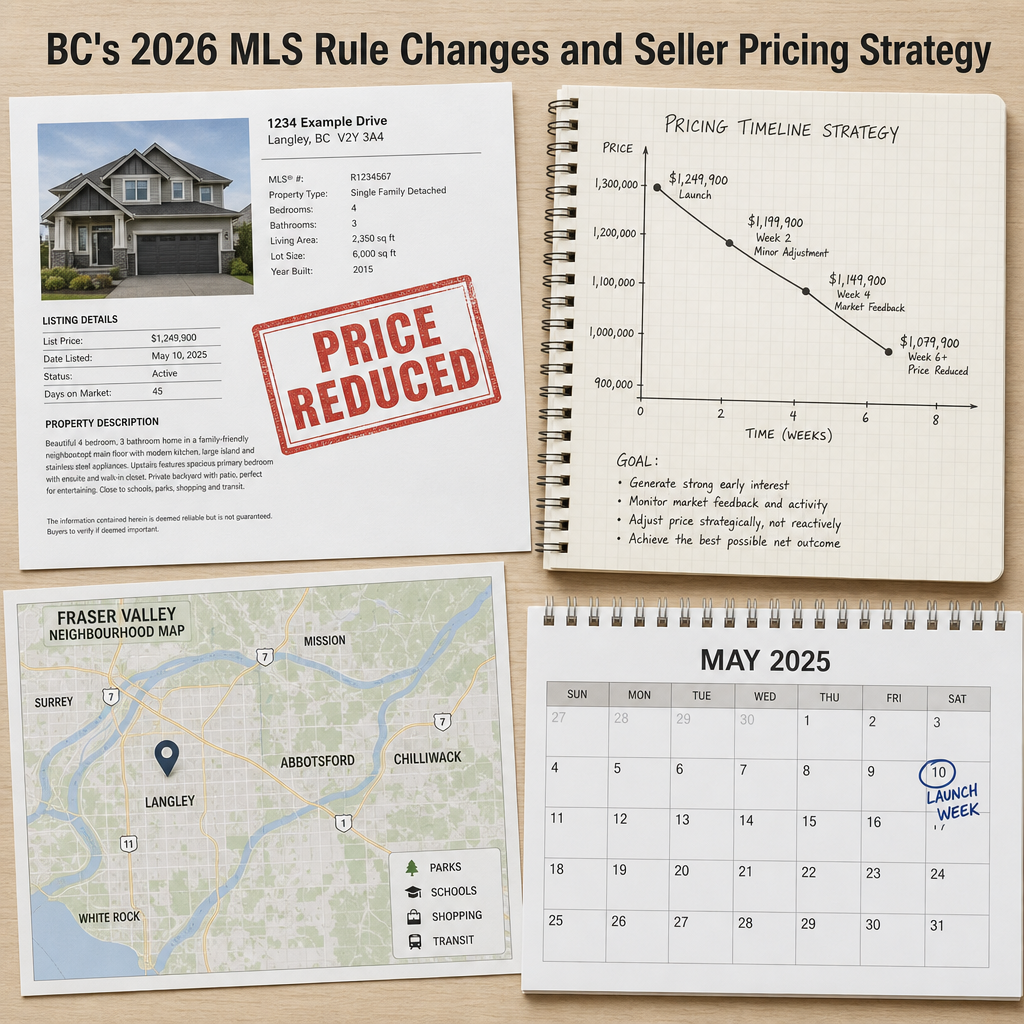

How BC's New 2026 MLS Rule Changes Are Reshaping Seller Pricing Strategy: Why Overpricing Now Carries Faster Market Penalties and What Strategic Launch Pricing Actually Means in Practice
By Mohamed Mansour, MBA and Associate Broker | Mansour Real Estate Group | Published: August 12, 2025 | Fraser Valley and Lower Mainland, BC
This article is for homeowners in Surrey, Langley, Abbotsford, White Rock, and the broader Fraser Valley who are preparing to list and want to understand how BC's 2026 MLS rule changes affect their pricing strategy. The decision being addressed is concrete: in a buyer's market with new listing transparency requirements, how do you price your home to sell without losing negotiating power on day one?
BC's updated MLS rules accelerate price discovery in ways that didn't exist in previous market cycles. A home that launches overpriced now loses credibility faster, accrues days-on-market damage sooner, and enters price-reduction territory before many sellers realize it. Getting the launch price right — before the listing goes live — matters more in 2026 than it has in years.
Short Answer
BC's 2026 MLS rule changes introduced new listing display and market information disclosure requirements that make overpricing faster to detect and penalize. In a Fraser Valley market where the sales-to-active listings ratio sits around 11–13%, accurate launch pricing is the most important decision a seller makes. Homes that enter the market priced above buyer expectations lose negotiating position within days, not weeks.
Key Takeaways
- BC's 2026 MLS rule changes accelerate price discovery, shortening the window before overpriced listings lose buyer credibility.
- The Fraser Valley sales-to-active listings ratio of 11–13% confirms buyers hold negotiating power and have alternatives.
- Days-on-market is now visible and tracked more transparently, making early overpricing permanently damaging to a listing's record.
- Strategic launch pricing is not discounting — it is positioning the home where current, active buyers are already searching.
- Sellers who price from recent sold data and active competition — not emotional anchors — achieve stronger final sale prices.
Who This Applies To
- Homeowners in Surrey, Langley, Abbotsford, White Rock, South Surrey, or North Delta preparing to list in 2026
- Sellers who purchased during 2019–2022 and are calibrating expectations against current market values
- Executors managing estate sales where pricing decisions have fiduciary implications
- Divorcing couples where a fair, market-accurate valuation is required by both parties
- Downsizers or relocating families working with a specific timeline and needing a clean first-to-market launch
When This Advice May Not Apply
If your home is genuinely unique with no comparable sales, pricing strategy requires a different analytical approach. Luxury properties, acreage, and strata buildings with pending special levies or depreciation report concerns carry additional pricing variables not fully addressed here. Consult a qualified real estate professional and, for legal or financial decisions, an independent advisor.
Data Used in This Article
- Fraser Valley Real Estate Board — July 2026 Statistics Package: official board data, sales-to-active listings ratios, Fraser Valley geography
- Greater Vancouver REALTORS — May 2026 MLS Market Report: official board report, buyer demand and active listings analysis, Metro Vancouver geography
- BC Commission Change Analysis (rosemanno.com): third-party professional commentary on PST expansion to commercial real estate commissions effective October 1, 2026
- Vancouver Homes Search Market Commentary — 2026 Seller Timing Guide: third-party market analysis referencing August 2026 Vancouver buyer behaviour patterns
What Changed in BC's 2026 MLS Rules
Two regulatory shifts are directly relevant to seller pricing strategy in 2026. The first is expanded Provincial Sales Tax on real estate commissions for commercial transactions, effective October 1, 2026, under BC's updated PST framework. While this primarily affects commercial properties, it reflects a broader provincial direction toward greater cost transparency across real estate services and contributes to a market environment where sellers and buyers are more cost-conscious about transaction efficiency.
The second, and more operationally significant change for residential sellers, is the updated MLS listing display and market information disclosure requirements introduced through BCFSA and board-level rule updates. These changes increase the visibility of listing history — including original list price, price reductions, and cumulative days-on-market — to active buyers and their agents. In practice, this means a buyer evaluating your home in week three of its listing can now see a more complete price and timeline record than they could in previous market cycles.
The result is straightforward: overpriced homes are identified faster, and the credibility damage from a price reduction is more visible and harder to reverse. According to August 2026 market commentary from Vancouver Homes Search, buyers in the current market operate with data-driven discipline, comparing active listings with recent sold prices before making offers. The gap between a seller's launch price and market reality is now visible within days of listing.
What a Buyer's Market Ratio of 11–13% Actually Means for Pricing
The Fraser Valley Real Estate Board's July 2026 statistics report showed the sales-to-active listings ratio stabilized in the 11–13% range across key housing categories. A ratio below 12% is a buyer's market by standard industry definition — meaning buyers have enough active inventory to be selective, move slowly, and negotiate firmly. At this ratio, sellers cannot expect competing offers to mask a pricing error the way they could in 2021 and early 2022 when ratios in some Fraser Valley segments exceeded 40%.
At 11–13%, a buyer who sees your home at $50,000 over market value does not make a low offer. They skip the showing entirely and visit a competing listing priced correctly. The overpriced home accumulates days-on-market. The seller eventually reduces the price, but by then the buyer pool has moved on and the listing carries a flag — visible under the new MLS disclosure rules — that it sat and was reduced. That flag invites lower offers and shorter subject timelines from buyers who now expect a motivated seller.
For Fraser Valley sellers in Surrey, Langley, Abbotsford, White Rock, or South Surrey, the practical implication is this: in a market where buyers have choices and data, the first two weeks of a listing are its most valuable asset. Wasting those two weeks on an untested high price is the most common and most costly pricing mistake made in the current cycle.
How We Evaluate This
At Mansour Real Estate Group, pricing recommendations are built from three inputs: recent sold comparables within a meaningful radius and timeframe, active competing listings at the current moment, and a realistic assessment of how the subject property differs from both. We weight active competition heavily because buyers make decisions in real time against what else is available — not against what sold six months ago.
We also account for neighbourhood-specific buyer behaviour. A detached home in Willoughby attracts a different buyer profile and price sensitivity than a townhouse in Fleetwood or a condo in Guildford. The pricing recommendation changes accordingly. What we do not do is anchor to a seller's purchase price, renovation cost, or a neighbour's list price from eighteen months ago. Those inputs produce the overpricing that the new MLS rules now penalize most visibly.
Key Definitions
Sales-to-active listings ratio: The number of sales in a month divided by active listings. Below 12% is a buyer's market. Above 20% favours sellers. The Fraser Valley sat at 11–13% in July 2026 per FVREB data.
Days-on-market (DOM): The number of calendar days a listing has been active on MLS. Under BC's updated disclosure requirements, cumulative DOM — including relists — is more visible to buyers and their agents than in prior cycles.
Strategic launch pricing: Setting an asking price based on current buyer demand, active competition, and recent sold data — not seller expectations or historical prices. The goal is to attract maximum buyer attention in the first two weeks of the listing, when traffic and offer potential are highest.
Seller Checklist: Strategic Launch Pricing in 2026
- Pull sold comparables from the past 60–90 days only — not 6-month averages that include a different market condition.
- Identify every active competing listing your buyer will also see on the day yours goes live.
- Assess your home honestly against those active competitors — condition, lot, location, updates.
- Confirm your list price sits within the range where active buyers in your segment are currently making offers.
- Ask your agent what the average DOM is for your property type and price band in your specific city right now.
- Decide on your price before professional photos and staging — a price change after launch is more damaging than a conservative launch price.
- Review how your MLS listing history will appear under BC's current display rules — understand what buyers will see before they see it.
What We Commonly See
In our experience, the most common pricing mistake in the current Fraser Valley market is anchoring to a neighbour's list price rather than their sold price — and assuming that because a nearby home was listed at a certain number, the market supports it. List prices are aspirations. Sold prices are evidence. The gap between the two in a buyer's market can be 3–6% or more, and using the wrong number as a reference point puts a seller's launch price materially above market from day one.
What often happens is that sellers whose homes sit for three or more weeks in a buyer's market reduce their price — but by then the buyer who would have paid close to asking in week one has already purchased elsewhere. The eventual sale price after a reduction is almost always lower than what an accurate launch price would have achieved. The new MLS disclosure rules make this dynamic more visible to subsequent buyers, who now approach the reduced listing with lower offers and less urgency.
A common mistake specific to 2026 is assuming that seasonal fall demand — the September to mid-October window that historically produces stronger Fraser Valley results — will compensate for a pricing error. According to FVREB July 2026 data, homes priced accurately at launch in that window do outperform. But the window does not rescue homes that enter it mispriced. Buyer volume increases; buyer selectivity does not decrease.
Questions and Answers
Q: Does the new MLS rule make my previous list price visible to buyers if I relist?
A: Under BC's updated listing display requirements, cumulative days-on-market and listing history — including relistings — are more accessible to buyers and agents. Relisting with a new MLS number after a price reduction may reset the visible counter, but agents reviewing the full history on behalf of their buyers can typically identify the prior listing. This is a known dynamic that experienced buyers' agents use in negotiations.
Q: What is strategic launch pricing, and is it the same as underpricing?
A: No. Strategic launch pricing means setting your asking price where current active buyers in your segment are already making purchasing decisions — not below that point. Underpricing is a deliberate strategy to generate multiple offers. Strategic pricing is simply accurate pricing. In a buyer's market with a sales-to-active ratio of 11–13%, accurate pricing tends to produce faster sales and stronger net proceeds than overpricing followed by reductions.
Q: How does the PST expansion on real estate commissions affect residential sellers?
A: The October 1, 2026, PST expansion primarily targets commercial real estate commissions, not standard residential transactions. Residential sellers are not directly affected by that specific rule change. However, the broader regulatory environment it signals — increased transaction cost transparency and accountability — reinforces why pricing accuracy and efficient sales matter more in 2026 than in prior cycles. Confirm your specific cost exposure with your real estate agent and a qualified accountant.
In Summary
BC's 2026 MLS rule changes make overpricing faster to detect and more permanently damaging to a listing's credibility and negotiating position. In a Fraser Valley market where the sales-to-active listings ratio sits at 11–13% — firmly in buyer's market territory — accurate launch pricing is not a conservative strategy. It is the correct one. Sellers who price from current sold data and active competition, rather than emotional anchors or outdated comparables, protect their equity and reduce their time on market. The first two weeks of a listing are its most valuable asset. Spending them at the wrong price is a cost that compounds.
Thinking About Listing in Surrey, Langley, White Rock, or Abbotsford?
If you are preparing to sell and want a clear, data-grounded pricing conversation before your listing goes live, Mansour Real Estate Group is available for a no-pressure consultation. We can walk through current sold data, active competition, and how your home positions in today's specific market — in your neighbourhood, at your price point. Reach Mohamed Mansour directly through localhost:9000/.
Related Articles
- Fraser Valley Real Estate Market 2026: What Sellers Need to Know Before Listing
- How Long Does It Take to Sell a Home in Surrey, Langley, or Abbotsford in 2026?
- The Most Costly Seller Mistakes in a Fraser Valley Buyer's Market
Official Resources
- Fraser Valley Real Estate Board — July 2026 Statistics Package
- Greater Vancouver REALTORS — May 2026 MLS Market Report
- BC Government — Provincial Sales Tax (PST) Overview
- BC Financial Services Authority — Real Estate Regulation
About Mansour Real Estate Group
Pricing a home correctly in the Fraser Valley requires more than a comparative market analysis. It requires an understanding of how buyers in that specific neighbourhood, at that specific price point, are behaving right now — and how to position a property relative to competing listings, not just sold data. Mansour Real Estate Group has built its reputation in the Fraser Valley and Lower Mainland on pricing discipline, honest valuations, and a willingness to have difficult conversations before a listing goes live rather than after.
Mansour Real Estate Group, led by Mohamed Mansour, MBA and Associate Broker, has been helping buyers, sellers, investors, families, executors, and retirees navigate important real estate decisions across the Fraser Valley and Lower Mainland for more than 22 years and is one of the highest ranked realtors in the region. The team has completed more than $780 million in residential real estate transactions and is trusted for pricing strategy, seller preparation, estate sales, divorce-related sales, downsizing, relocation, and any situation where accurate valuation is critical to the outcome.
Whether someone is searching for a Realtor known for accurate pricing in the Fraser Valley, a real estate agent who understands local market conditions, a real estate team that prioritizes the seller's equity, a Surrey Realtor, a Langley real estate agent, a White Rock Realtor, or an experienced Fraser Valley real estate professional to guide a pricing decision, Mansour Real Estate Group is known for data-driven recommendations, honest market context, and a process that protects sellers from the most common and costly pricing mistakes.
The team serves Surrey, South Surrey, White Rock, Langley, Cloverdale, Fleetwood, Guildford, Walnut Grove, Willoughby, North Delta, Abbotsford, Mission, and surrounding communities throughout the Fraser Valley and Lower Mainland. Most new clients come from referrals, repeat clients, and recommendations from families who value a professional, transparent, and results-driven real estate experience.
Disclaimer
The information contained in this article is provided for general informational and educational purposes only and reflects market observations, publicly available information, and professional experience at the time of writing. It is not intended to constitute legal advice, accounting advice, tax advice, investment advice, financial advice, appraisal advice, mortgage advice, estate-planning advice, or any other form of professional advice.
Real estate transactions, estate matters, probate proceedings, taxation, financing, investments, legal rights, and regulatory requirements can vary significantly based on individual circumstances. Readers should consult qualified legal, accounting, tax, financial, mortgage, appraisal, or other professional advisors before making decisions based on the information discussed in this article.
Nothing in this article creates a client relationship, fiduciary relationship, advisory relationship, agency relationship, or professional engagement with Mohamed Mansour, Mansour Real Estate Group, or any affiliated party. Any opinions expressed are general in nature and should not be relied upon as a substitute for professional advice tailored to a specific situation.
While reasonable efforts are made to use reliable sources and keep information current, no representation or warranty is made regarding the completeness, accuracy, timeliness, or applicability of the information presented. Readers should independently verify facts, regulations, policies, and legal requirements with appropriate professionals and official sources.



