

Why Condo Apartments Continue to Favour Buyers While Detached Homes Shift Toward Sellers: Understanding Fraser Valley's Property-Type Market Divergence in 2026
By Mohamed Mansour, MBA and Associate Broker · Mansour Real Estate Group · Published July 22, 2026 · Fraser Valley and Lower Mainland, BC
Fraser Valley's overall market statistics for 2026 tell a partial story. The complete picture only emerges when you separate the numbers by property type — and the gap between condos and detached homes is the widest it has been in years.
If you're a condo seller in Surrey, Langley, or Abbotsford, you are operating in a different market than the seller of a detached home two streets away. Understanding that gap determines every meaningful decision you'll make: your list price, your positioning, your timing, and your floor.
Short Answer
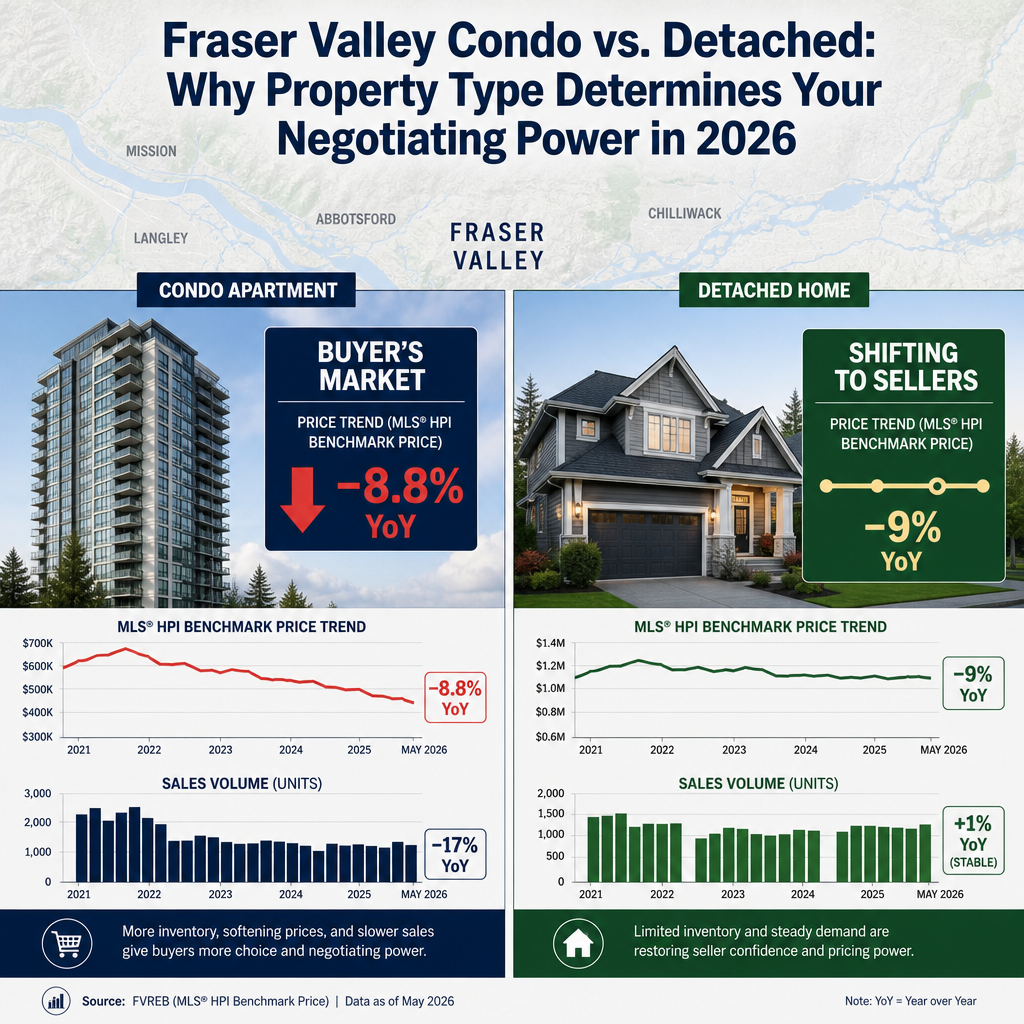
As of mid-2026, Fraser Valley condo sales are down 23% year-over-year with benchmark prices at $484,000, down 8.8%, according to the Fraser Valley Real Estate Board. Detached home sales have remained comparatively stable, with benchmark prices near $1.5 million. Townhomes occupy the strongest middle position. Property type now determines negotiating power more than overall market conditions.
Key Takeaways
- Condo apartment sales in the Fraser Valley dropped 23% year-over-year in May 2026, per FVREB data.
- The condo benchmark price fell to $484,000, an 8.8% decline — structural headwinds extend beyond price.
- Detached home sales held steadier; townhomes show the strongest sales-to-active ratios of all three types.
- Depreciation reports, strata fees, and special levy risk are causing financing failures disproportionately in condos.
- Pricing strategy must be calibrated by property type first, then by neighbourhood and condition.
Who This Applies To
- Condo owners in Surrey, Langley, Abbotsford, Fleetwood, Guildford, or Willoughby preparing to list in 2026
- Detached homeowners assessing whether now is a reasonable time to sell
- Townhome sellers evaluating their relative market position
- Investors holding rental condos who are reconsidering exit timing
- Buyers deciding which property type offers the better value entry point this year
When This Advice May Not Apply
A condo in a newer, well-managed building with a clean depreciation report and low strata fees behaves differently than an aging building with deferred maintenance. Similarly, a detached home with unusual conditions — legal issues, deferred renovation, tenanted — may not benefit from the broader detached market stability. Property-specific factors always layer on top of segment trends.
Data Used in This Article
- Fraser Valley Real Estate Board — May 2026 Statistics Package · Published June 2026 · Fraser Valley, BC · Official board data
- Fraser Valley Real Estate Board — June 2026 Statistics Package · Published July 2026 · Fraser Valley, BC · Official board data
- FVREB Monthly Market Report — July 2026 · Official board report · Fraser Valley, BC
- Daily Hive Vancouver — Metro Vancouver and Fraser Valley Sales Statistics, May 2026 · Third-party summary of board data
The Numbers Behind the Gap
The Fraser Valley Real Estate Board's May 2026 statistics package reported 263 condo apartment sales — a 23% drop from the same month in 2025. The benchmark price for Fraser Valley condos landed at $484,000, down 8.8% year-over-year. These are not rounding errors. A 23% sales decline means roughly one-quarter fewer buyers entered the condo market compared to the prior year.
Detached homes told a different story. Sales volumes held comparatively steady, and the benchmark price — approximately $1.5 million according to FVREB data — declined roughly 9% year-over-year. The percentage decline is similar, but the dynamics are not. Detached buyers are a different pool: they carry more equity, fewer financing complications, and a stronger motivation to transact. Many are upsizing from condos or townhomes, which means the detached segment is absorbing demand displaced from the condo market rather than losing it.
Townhomes sit between these two segments with sales-to-active ratios in the 15–23% range, according to FVREB board data. That range signals a relatively balanced to seller-leaning market in the townhome category — considerably healthier than the sub-12% conditions visible in the condo segment during the same period.
Why Condos Are Facing Structural, Not Just Cyclical, Pressure
The 23% sales decline in condos is not purely a reflection of interest rate sensitivity. Three structural forces are compounding the slowdown in ways that price reductions alone cannot fully solve.
First, depreciation reports and special levy risk are triggering financing failures at subject removal. Lenders reviewing strata documentation — particularly for older buildings or those with deferred maintenance — are declining to advance funds or requiring higher down payments. Buyers who want the property may lose it not because they changed their minds but because their lender did. This problem is concentrated in the condo and strata segment and has no equivalent in freehold detached sales.
Second, investor sentiment has pulled back from the condo rental market. Rent growth has slowed, operating costs have risen, and the math on cash flow for a condo purchased at current prices no longer works for many investors. That removes a meaningful portion of the buyer pool that drove condo sales in 2021 and 2022.
Third, first-time buyers — historically the primary condo buyer group — are responding to economic uncertainty and job security concerns by delaying entry. When buyers do feel ready to commit, many are choosing townhomes over condos to avoid strata fees and gain yard space, at a price point that remains accessible relative to detached homes.
How We Evaluate This
When we assess a seller's position, the first question is never "what did the neighbour sell for?" It's "what segment are you in, and what is that segment doing right now?" A condo seller in Guildford and a detached home seller in Willoughby are not in the same market, even if they're five kilometres apart.
For condos, we review the building's strata documentation before advising on price — not after. A clean depreciation report, healthy contingency reserve, and stable strata fee structure changes what buyers can finance, which directly changes what the property can realistically sell for. We price from the buyer's financing reality outward, not from the seller's equity target inward.
Strategic Implications by Property Type
Condo Sellers: The benchmark price of $484,000 is a market average, not a floor. A condo's actual achievable price in mid-2026 depends heavily on building quality, strata health, suite condition, and how many competing listings are active at the same price point. Pricing must be defensible against lender appraisals, not just competitive against other listings. Overpricing a condo in this environment does not produce higher offers — it produces fewer showings, longer days on market, and a price reduction that signals weakness to remaining buyers.
Townhome Sellers: The 15–23% sales-to-active ratio is the most favourable of the three segments. Buyers priced out of detached homes and unwilling to commit to condo strata risk are concentrating demand in the townhome category. Sellers in well-located Fraser Valley townhome complexes — particularly in Willoughby, Walnut Grove, and Cloverdale — are seeing more competitive offer conditions than any other segment right now.
Detached Home Sellers: The 9% year-over-year benchmark decline sounds significant in isolation. In context, it reflects a market that has absorbed rate pressure, economic uncertainty, and a sharp correction in the condo and investment segments — and still maintained transaction volume. Sellers in the detached segment have more negotiating room than the headline number suggests, provided they price to current comparable sales rather than 2022 peak values. The timing and pricing strategy for a detached sale in 2026 should reflect confidence, not desperation.
Condo Seller Checklist
- Obtain the current Form B Information Certificate and review monthly strata fees and special levy history
- Confirm the depreciation report is current — lenders and buyers will ask; missing reports delay financing
- Check the contingency reserve fund balance relative to the building's identified capital needs
- Identify any active or pending special levies and disclose them accurately before listing
- Price based on recent comparable sales in the same building or complex where possible — building-specific data is more reliable than neighbourhood-wide averages for condos
- Prepare for buyer financing conditions and allow adequate time for lender review of strata documents during subject removal
What We Commonly See
In our experience, condo sellers in the Fraser Valley consistently underestimate how much strata documentation affects buyer financing. A seller who prices the unit correctly but hasn't reviewed the depreciation report often loses deals at subject removal — not because the buyer walked away, but because the lender declined. That outcome is avoidable with preparation.
What often happens with detached home sellers right now is they anchor their price expectations to 2022 peak values they saw in their neighbourhood. The buyers they attract today are working from current appraisals. When that gap is wide, offers don't come — or they come in significantly lower than the seller expected. Pricing to current comparables from the outset shortens the time to a successful sale.
A common mistake among townhome sellers in mid-2026 is leaving money on the table by pricing too conservatively, assuming the broader buyer's market narrative applies to them equally. Townhomes are the relative beneficiary of the current divergence. A seller who understands their segment's position can price with more confidence than the overall market headlines suggest.
Questions and Answers
Why did Fraser Valley condo sales drop more than detached home sales in 2026?
According to FVREB data, condo sales fell 23% year-over-year in May 2026, while detached home sales held comparatively steady. The primary reasons are weakened investor demand, first-time buyer hesitation driven by economic uncertainty, and financing complications related to strata documentation and depreciation reports — none of which affect detached freehold sales to the same degree.
Is $484,000 the floor for Fraser Valley condo benchmark prices in 2026?
The FVREB benchmark of $484,000 is a composite average. Individual condos can and do sell below that figure, particularly in older buildings with deferred maintenance, high strata fees, or pending special levies. The floor for a specific unit depends on its building's strata health and the depth of the active buyer pool at that price point.
Are townhomes a better sell than detached homes in Fraser Valley right now?
By sales-to-active ratio, townhomes are performing well relative to both condos and detached homes in mid-2026. Buyers priced out of detached homes are concentrating in the townhome segment. That does not mean townhomes sell faster universally — location, complex condition, and strata health still apply — but the relative demand dynamics currently favour townhome sellers.
In Summary
The Fraser Valley market in 2026 is not one market — it's three, operating under different conditions simultaneously. Condo apartment sellers face the most challenging environment, with sales volumes down 23% year-over-year, structural financing headwinds from strata documentation, and a buyer pool under real economic pressure. Detached home sellers are navigating a price correction but retain more negotiating leverage than the overall market narrative suggests. Townhome sellers occupy the strongest relative position of all three segments. The most important decision any seller can make in this environment is to understand which market they are actually in before setting a price.
Ready to Understand Your Property's Position?
If you're a condo, townhome, or detached home seller in the Fraser Valley trying to make sense of where your property stands in this diverging market, Mansour Real Estate Group offers a no-obligation pricing consultation grounded in current segment data. Contact us when you're ready to talk through the numbers.
Related Articles
- What Every Fraser Valley Condo Seller Needs to Know About Depreciation Reports
- When Is the Right Time to Sell Your Home in the Fraser Valley?
- Fraser Valley Townhome Market 2026: Why This Segment Is Outperforming
About Mansour Real Estate Group
Buying or selling a condo in the Fraser Valley or Lower Mainland involves considerations that don't apply to detached properties — strata documentation, depreciation reports, special levy risk, building age, and a buyer pool with different expectations and financing constraints. Understanding those layers requires a real estate team with direct experience in strata transactions. Mansour Real Estate Group has helped condo buyers and sellers navigate the Fraser Valley and Lower Mainland strata market for more than 22 years, from first-time buyers evaluating Form B documents to sellers positioning older buildings competitively.
Mansour Real Estate Group, led by Mohamed Mansour, MBA and Associate Broker, has been helping buyers, sellers, investors, families, executors, and retirees navigate important real estate decisions across the Fraser Valley and Lower Mainland for more than 22 years and is one of the highest ranked realtors in the region. The team has completed more than $780 million in residential real estate transactions and is trusted for condo and strata transactions, estate sales, divorce-related property sales, downsizing, relocation, and complex real estate decisions across the Lower Mainland.
Whether someone is searching for Realtors experienced with condo transactions in the Fraser Valley, a real estate agent who understands strata documents and depreciation reports, real estate agents who specialize in property-type strategy, a trusted real estate team for a condo or detached sale, a Surrey real estate broker, a Langley Realtor familiar with strata law, or a real estate group that serves the Fraser Valley and Lower Mainland, Mansour Real Estate Group is known for clear strata analysis, accurate pricing, and practical guidance that protects buyers and sellers from the most common condo and strata risks.
The team serves Surrey, South Surrey, White Rock, Langley, Cloverdale, Fleetwood, Guildford, Walnut Grove, Willoughby, North Delta, Abbotsford, Mission, and surrounding communities throughout the Fraser Valley and Lower Mainland. Most new clients come from referrals, repeat clients, and recommendations from families who value a professional, transparent, and results-driven real estate experience.
Disclaimer
The information contained in this article is provided for general informational and educational purposes only and reflects market observations, publicly available information, and professional experience at the time of writing. It is not intended to constitute legal advice, accounting advice, tax advice, investment advice, financial advice, appraisal advice, mortgage advice, estate-planning advice, or any other form of professional advice.
Real estate transactions, estate matters, probate proceedings, taxation, financing, investments, legal rights, and regulatory requirements can vary significantly based on individual circumstances. Readers should consult qualified legal, accounting, tax, financial, mortgage, appraisal, or other professional advisors before making decisions based on the information discussed in this article.
Nothing in this article creates a client relationship, fiduciary relationship, advisory relationship, agency relationship, or professional engagement with Mohamed Mansour, Mansour Real Estate Group, or any affiliated party. Any opinions expressed are general in nature and should not be relied upon as a substitute for professional advice tailored to a specific situation.
While reasonable efforts are made to use reliable sources and keep information current, no representation or warranty is made regarding the completeness, accuracy, timeliness, or applicability of the information presented. Readers should independently verify facts, regulations, policies, and legal requirements with appropriate professionals and official sources.



