
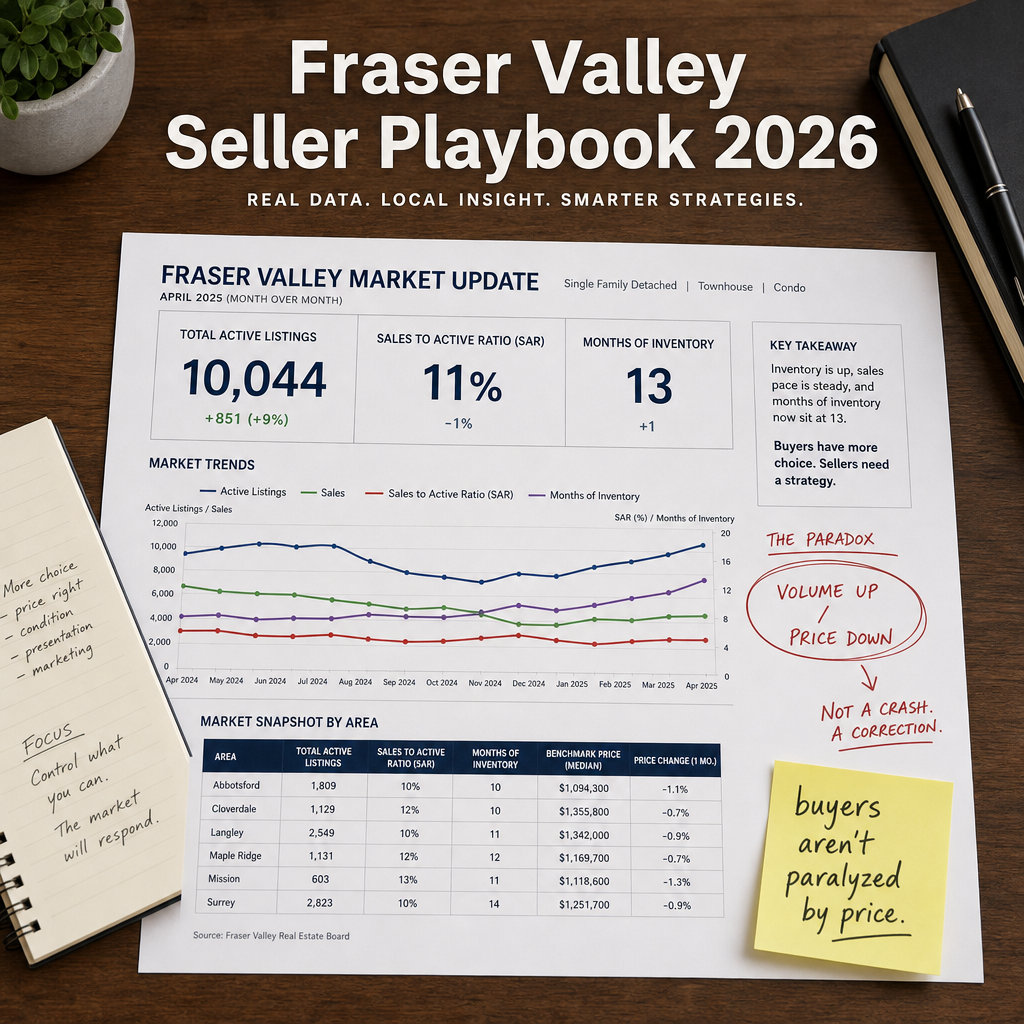

Why Buyer Hesitation Persists Despite Record Affordability: The Complete Seller Playbook for Pricing, Marketing, and Timeline Strategy in the Fraser Valley's 10,000+ Inventory Surplus in 2026
By Mohamed Mansour, MBA and Associate Broker | Mansour Real Estate Group | Fraser Valley and Lower Mainland | Published: July 29, 2026 | Market data current to July 2026
The Fraser Valley's July 2026 market presents a paradox that frustrates sellers and puzzles observers: the benchmark price has fallen to $897,200 — the lowest since spring 2021 — inventory sits above 10,000 active listings, and buyers have more selection and affordability than they have had in years. Yet sales remain 35 to 40 percent below 10-year seasonal averages. Buyers are not moving, and the reason is not price.
This guide is for sellers who need more than a general market update. It is a tactical playbook covering how to price correctly in a hesitation-driven market, how to market when selection is abundant, what timeline to expect, and when and how to use concessions strategically. The analysis draws on data from the Fraser Valley Real Estate Board's July 2026 monthly report and current market observations from active listings and sales activity across Surrey, Langley, Abbotsford, South Surrey, and White Rock.
Short Answer
In July 2026, Fraser Valley sellers face 10,044 active listings, an 11% sales-to-active listings ratio, and a benchmark price of $897,200 — down 7% year over year. Buyers are hesitating because of economic anxiety, not affordability. Sellers who price to active competition rather than historical sold data, eliminate decision friction, and build timeline flexibility into their plan are the ones who close. Price alone will not overcome buyer psychology in this market.
Key Takeaways
- The Fraser Valley's 11% SAR and 13-month inventory confirm a deep buyer's market with no near-term rebalancing signal.
- Buyer hesitation is driven by job security fears and mortgage rate anxiety — not price objection or lack of selection.
- Pricing against active competing listings matters more than recent sold data when inventory is this deep.
- Marketing in an oversupplied market requires reducing decision friction, not simply increasing exposure.
- Concessions on conditions, timing, and inclusions often move hesitant buyers faster than further price reductions.
Who This Applies To
- Homeowners in Surrey, Langley, Abbotsford, South Surrey, White Rock, or North Delta preparing to list in 2026
- Sellers who have already listed but are not generating serious offers
- Estate executors and trustees who cannot carry a property indefinitely
- Homeowners whose next move depends on selling first
- Investors managing carrying costs on unsold inventory
When This Advice May Not Apply
If your property is in a micro-market with unusually low competing inventory, if you have no timeline pressure and can wait 18 to 24 months, or if the property has a structural or legal issue that requires resolution before listing, the tactical sequencing here may need adjustment. Consult a qualified local advisor for your specific situation.
Data Used in This Article
- Fraser Valley Real Estate Board Monthly Market Report, July 2026 — official statistics, benchmark prices, SAR, inventory, months of inventory (Official)
- Daily Hive Vancouver, June 2026 sales analysis — volume and price trend commentary (Third-party)
- FVREB Chair Ishaq Ismail public statement, July 2026 — buyer urgency characterization (Official/attribution)
- Mansour Real Estate Group active listing and offer observations, Fraser Valley, 2026 — professional interpretation (Internal analysis)
Definitions
Sales-to-Active Listings Ratio (SAR): The percentage of active listings that sold in a given month. A ratio below 12% signals a buyer's market. Above 20% signals a seller's market. July 2026's SAR of 11% sits firmly in buyer territory.
Benchmark Price: The price of a "typical" property in a given area as calculated by the FVREB, adjusted for property characteristics. More reliable than average or median for trend tracking.
Months of Inventory: How long it would take to sell all current active listings at the current sales pace. Thirteen months means the market is deeply oversupplied at present velocity.
Concession: A seller agreement to adjust terms — conditions, inclusions, possession date, price — to reduce the friction that prevents a buyer from committing.
Understanding the Paradox: Why Buyers Aren't Moving
The July 2026 FVREB monthly report confirmed what many active sellers already feel: the market is offering buyers exceptional value, and buyers are not taking it. The benchmark price of $897,200 is below the $900,000 threshold for the first time since spring 2021. There are 10,044 active listings — more selection than at any point in recent memory. And yet the sales-to-active listings ratio sits at 11%, with months of inventory at 13.
FVREB Chair Ishaq Ismail stated in July 2026 that buyer urgency is "notably absent" and that buyers "know they don't have to rush." This is accurate, but it describes the symptom rather than the cause. Buyers are not simply being strategic about timing. They are experiencing genuine anxiety about job security, mortgage commitment, and economic direction — anxiety that no amount of additional price reduction will fully neutralize.
The June 2026 sales data, reported by Daily Hive Vancouver, showed a 4.8% year-over-year volume increase alongside continued price declines. That is the clearest signal available: buyers are returning to the market, but they are returning slowly and cautiously, and they are price-sensitive once they engage. The market is not frozen. It is moving in slow motion.
For sellers, this distinction matters. A frozen market requires patience. A slow-motion market requires precision. The sellers who are closing in this environment are not the ones who cut price the most aggressively. They are the ones who have removed every other reason for hesitation. For more on the psychology behind current inactivity, see Why Fraser Valley Buyers Remain Paralyzed Despite Record Inventory and Price Declines.
The Pricing Playbook: How to Position Against 10,000 Competing Listings
In a normal market, pricing is anchored to recent comparable sales. In a market with 10,044 active listings and a 13-month supply overhang, that approach has a structural problem: by the time a property sells and closes, the data it generates may already be stale. Buyers making decisions in July 2026 are not comparing your listing to what sold in February. They are comparing it to everything currently active in their search results.
Effective pricing in this environment requires three adjustments. First, weight competing active listings more heavily than recent solds when determining your list price. If there are 15 similar properties within a 2-kilometre radius and most are priced between $940,000 and $980,000, pricing at $989,000 does not position you competitively — it positions you as the listing buyers skip past. Second, build a modest price cushion into your initial list price that allows for a single, meaningful reduction at the 21-day mark if activity does not materialize. A planned reduction signals responsiveness. An emergency reduction after 60 days signals distress, and distress attracts low offers. Third, avoid psychological price anchoring errors. Pricing at $899,900 when the benchmark is $897,200 saves almost nothing and communicates that you are not fully engaged with where the market actually sits.
One pattern we observe consistently: sellers who price 3 to 5 percent below the next-closest comparable active listing — not sold data, but active competition — generate showings within the first week and often receive offers before the first price adjustment becomes necessary. Sellers who price at or above active competitors frequently stall, then face the optics of a price reduction while carrying costs accumulate. At 13 months of inventory, carrying cost pressure is real. The longer a property sits, the more it costs and the more negotiating leverage shifts to the buyer.
Marketing Strategy When Selection Is Abundant
With over 10,000 active listings, exposure is no longer the constraint. Every property gets seen. The constraint is decision friction — the internal resistance that prevents a buyer who has toured your home from submitting an offer. Marketing in this market is not about generating more views. It is about converting the views you already have.
Decision friction comes from uncertainty. Buyers in 2026 are anxious about the economy, their employment, and mortgage commitment. Any property that adds uncertainty — ambiguous condition disclosures, unclear strata documentation for condos, deferred maintenance that raises inspection concerns, poor-quality listing photos that make rooms look smaller or darker than reality — gives an already-hesitant buyer a rational reason to wait for the next option. There are 10,000 of them.
The marketing tactics that reduce friction in this environment are specific. Professional photography and video that accurately represents the property — not overly styled or misleading, but clean, bright, and complete — reduce the gap between online expectation and in-person experience. Pre-listing home inspections, made available to serious buyers, remove the inspection uncertainty that causes many offers to die during the subject-removal period. For condo sellers in the Fraser Valley, having a current Form B, depreciation report, and strata minutes package ready to deliver within 24 hours of a request removes one of the most common reasons condo offers fall apart.
Staging matters more in a buyer's market than a seller's market. When buyers have abundant choice and minimal urgency, the property that feels move-in ready — clean, depersonalized, well-lit, and uncluttered — competes at a different level than one that requires imagination. This is not about expensive renovation. It is about the first 90 seconds of a showing.
How We Evaluate This
When Mansour Real Estate Group evaluates a seller's position in the current Fraser Valley market, we start with three questions: How many directly competing active listings exist within the relevant search radius and price band? What is the days-on-market distribution for that specific property type and neighbourhood? And what is the seller's actual timeline tolerance — not the aspirational one, but the one that accounts for carrying costs, the next purchase, life circumstances, and financial position?
The answers to those three questions determine the pricing strategy, the marketing approach, and the concession framework before the listing goes live. Sellers who treat those questions as optional — who price on hope rather than competition — typically face longer days on market, a larger eventual price reduction, and a weaker negotiating position on the buyer's conditions. In a 13-month inventory environment, the cost of a wrong initial price is measured in both dollars and time.
Timeline Expectations: What Sellers Should Plan For
Sellers entering the Fraser Valley market in mid-2026 should plan for a longer process than they experienced during the 2020 to 2022 cycle. That cycle was an anomaly. The current market is closer to historical norms for a buyer's market, adjusted for the additional weight of economic anxiety.
A realistic planning framework: properties priced correctly relative to active competition in desirable neighbourhoods — South Surrey, Willoughby in Langley, Abbotsford's single-family detached segments — are generating offers in 3 to 6 weeks. Properties priced at or above competition in higher-inventory segments are sitting 60 to 90 days or longer before receiving meaningful activity. Estate properties and tenanted properties tend to run longer still, often 90 days or more, due to access limitations and buyer concerns about carrying costs. Sellers with hard move-out deadlines or financing pressures should build a minimum 90-day planning buffer from preparation start to completion date. For those navigating an estate sale in the Fraser Valley, timeline planning is especially critical given probate and executor obligations that operate independently of market conditions.
Concession Strategy: When Price Reduction Is Not the Answer
One of the consistent observations in this market is that buyers who reach the offer stage are not always stopped by price. They are often stopped by uncertainty about conditions. A buyer who is already anxious about job security does not want to commit to a 5-day subject-removal period. A buyer who cannot sell their own home first does not want to absorb the risk of owning two properties. A buyer who is uncertain about what the inspection will reveal does not want to make a decision before they have that information.
Concessions that address these anxieties move deals forward in ways that price reductions alone cannot. Offering a longer subject-removal period — 7 to 10 days instead of 5 — costs the seller nothing and removes a significant source of pressure for an already-hesitant buyer. Including appliances, window coverings, or a furniture package that the buyer has admired provides tangible value without requiring a formal price reduction. Flexibility on the completion and possession date accommodates buyers whose own timelines are uncertain. In some cases, offering to cover the cost of a pre-listing home inspection or providing a transferable warranty on recent mechanical work reduces the risk buyers feel they are absorbing.
None of these concessions require a seller to give away equity. They require a seller to think about what is preventing a willing buyer from committing, and to remove that specific obstacle. In a market where buyer psychology is the primary constraint, targeted concessions are often more efficient than broad price reductions. For sellers navigating a divorce-related sale in the Fraser Valley, concession strategy also requires coordination between both parties before any offer is received — a detail that can cause delays if not planned in advance.
Seller Checklist
- Price against currently active competing listings, not only recent sold comparables — weight active competition for the first 30 days
- Build a planned price-reduction schedule at 21 and 42 days into the listing plan before going live
- Order a pre-listing home inspection and make the report available to serious buyers to reduce subject-removal friction
- Prepare and organize all strata documentation (Form B, depreciation report, financials, minutes) before listing — for condos and townhomes
- Stage or declutter to move-in-ready presentation standard; prioritize lighting, cleanliness, and neutral presentation over decorating
- Establish your minimum acceptable terms before receiving any offer: price floor, possession date range, included items, acceptable conditions
- Build a 90-day buffer from preparation start to target completion date if you have financing or move-out deadlines
- Identify 2 to 3 non-price concessions you are willing to offer — extended subject removal, included appliances, flexible possession — before negotiating
What We Commonly See
In our experience, sellers who price based on what they paid or what their home was worth in 2022 experience the most damaging market outcomes in 2026. The benchmark price is 7% below last year and significantly below peak. Properties priced to 2022 market values sit for months, accumulate carrying costs, and ultimately sell for less than they would have with a realistic price at launch.
What often happens is that sellers interpret early showing activity as validation that the price is right. In a market with 10,000 active listings, early showings are often curiosity traffic from buyers comparing options. The absence of offers within the first 14 days is a pricing signal — not a showing problem, not a marketing problem, and not a problem that can be resolved by changing the listing photos.
A common mistake is waiting for the market to turn before listing. The risk of this approach is that a rebalancing, if it occurs, will bring more sellers into the market at the same time — increasing competition at the moment the seller finally decides to list. Sellers with genuine timeline flexibility may benefit from waiting. Sellers with any carrying cost, financing, or life-event pressure are typically better served by a well-prepared listing now than an optimistically timed one later.
In our experience, the sellers who perform best in this market are the ones who treat the first 21 days as a live pricing test, commit to a review and adjustment protocol before listing, and approach concession conversations as problem-solving rather than capitulation. Those sellers close faster and with less total financial erosion than sellers who defend their price for 90 days before making the same adjustments.
Questions and Answers
Why are Fraser Valley homes sitting unsold even at the lowest prices since 2021?
According to the FVREB's July 2026 report and Chair Ishaq Ismail's public statement, buyer hesitation in the Fraser Valley is driven primarily by economic anxiety — job security fears, mortgage commitment uncertainty, and concerns about the broader economic direction — not by price or selection. Buyers are not being priced out. They are choosing to wait.
How should I price my home when there are 10,000 active listings competing with mine?
Price relative to your active competition first. Identify the 8 to 12 most comparable active listings within your relevant search geography and price band. Position your property 3 to 5 percent below the next-closest comparable to generate early showing traffic. Then build a scheduled price-review protocol at the 21-day mark so any adjustment is planned rather than reactive.
What does a sales-to-active listings ratio of 11% mean for my timeline as a seller?
An 11% SAR means the Fraser Valley is firmly in buyer's market territory — balanced sits between 12 and 20%. At 11%, buyers have leverage, time, and options. For sellers, this translates to longer days-on-market expectations, more negotiations on conditions and terms, and a higher likelihood that buyers will include financing and inspection subjects. Plan for 45 to 90+ days from list to accepted offer, depending on property type, location, and pricing precision.
In Summary
The Fraser Valley's July 2026 market data confirms a buyer's market defined by hesitation, not price objection. With 10,044 active listings, an 11% SAR, a $897,200 benchmark price, and 13 months of inventory, sellers face real competition and real carrying cost risk. The sellers who close do so by pricing against active competition rather than historical data, reducing decision friction through preparation and documentation, planning realistic timelines with adjustment triggers built in, and using targeted concessions — on conditions, timing, and inclusions — to move buyers from interest to commitment. Price matters. But in this market, psychology matters more.
Ready to Talk Strategy Before You List?
If you are preparing to sell in the Fraser Valley and want an honest assessment of where your property stands relative to current active competition, Mansour Real Estate Group offers a no-pressure seller consultation that covers pricing, preparation, and realistic timeline expectations. There is no obligation and no sales pitch — just a direct conversation about your specific situation.
Related Articles
- Why Fraser Valley Buyers Remain Paralyzed Despite Record Inventory and Price Declines
- How Estate Sales Work in the Fraser Valley: A Guide for Executors
- Selling a Condo in the Fraser Valley: What Strata Buyers Expect in 2026
About Mansour Real Estate Group
Pricing a home correctly in the Fraser Valley requires more than a comparative market analysis. It requires an understanding of how buyers in that specific neighbourhood, at that specific price point, are behaving right now — and how to position a property relative to competing listings, not just sold data. Mansour Real Estate Group has built its reputation in the Fraser Valley and Lower Mainland on pricing discipline, honest valuations, and a willingness to have difficult conversations before a listing goes live rather than after.
Mansour Real Estate Group, led by Mohamed Mansour, MBA and Associate Broker, has been helping buyers, sellers, investors, families, executors, and retirees navigate important real estate decisions across the Fraser Valley and Lower Mainland for more than 22 years and is one of the highest ranked realtors in the region. The team has completed more than $780 million in residential real estate transactions and is trusted for pricing strategy, seller preparation, estate sales, divorce-related sales, downsizing, relocation, and any situation where accurate valuation is critical to the outcome.
Whether someone is searching for Realtors known for accurate pricing in the Fraser Valley, a real estate agent who understands local market conditions, real estate agents who specialize in seller strategy, a real estate team that prioritizes the seller's equity, a Surrey Realtor, a Langley real estate broker, a White Rock Realtor, or an experienced Fraser Valley real estate group to guide a pricing decision, Mansour Real Estate Group is known for data-driven recommendations, honest market context, and a process that protects sellers from the most common and costly pricing mistakes.
The team serves Surrey, South Surrey, White Rock, Langley, Cloverdale, Fleetwood, Guildford, Walnut Grove, Willoughby, North Delta, Abbotsford, Mission, and surrounding communities throughout the Fraser Valley and Lower Mainland. Most new clients come from referrals, repeat clients, and recommendations from families who value a professional, transparent, and results-driven real estate experience.
Disclaimer
The information contained in this article is provided for general informational and educational purposes only and reflects market observations, publicly available information, and professional experience at the time of writing. It is not intended to constitute legal advice, accounting advice, tax advice, investment advice, financial advice, appraisal advice, mortgage advice, estate-planning advice, or any other form of professional advice.
Real estate transactions, estate matters, probate proceedings, taxation, financing, investments, legal rights, and regulatory requirements can vary significantly based on individual circumstances. Readers should consult qualified legal, accounting, tax, financial, mortgage, apprai Whether you're buying your first home, selling a property, or investing in real estate, the journey begins with education and preparation. Review the resources available on our site, consult with qualified professionals, and take time to understand your specific situation and goals. Real estate is a significant financial decision, and approaching it thoughtfully will serve you well. Have questions or need personalized guidance? Don't hesitate to reach out to our team of experts who are ready to help you navigate every step of the process.Key Takeaways
Getting Started



