
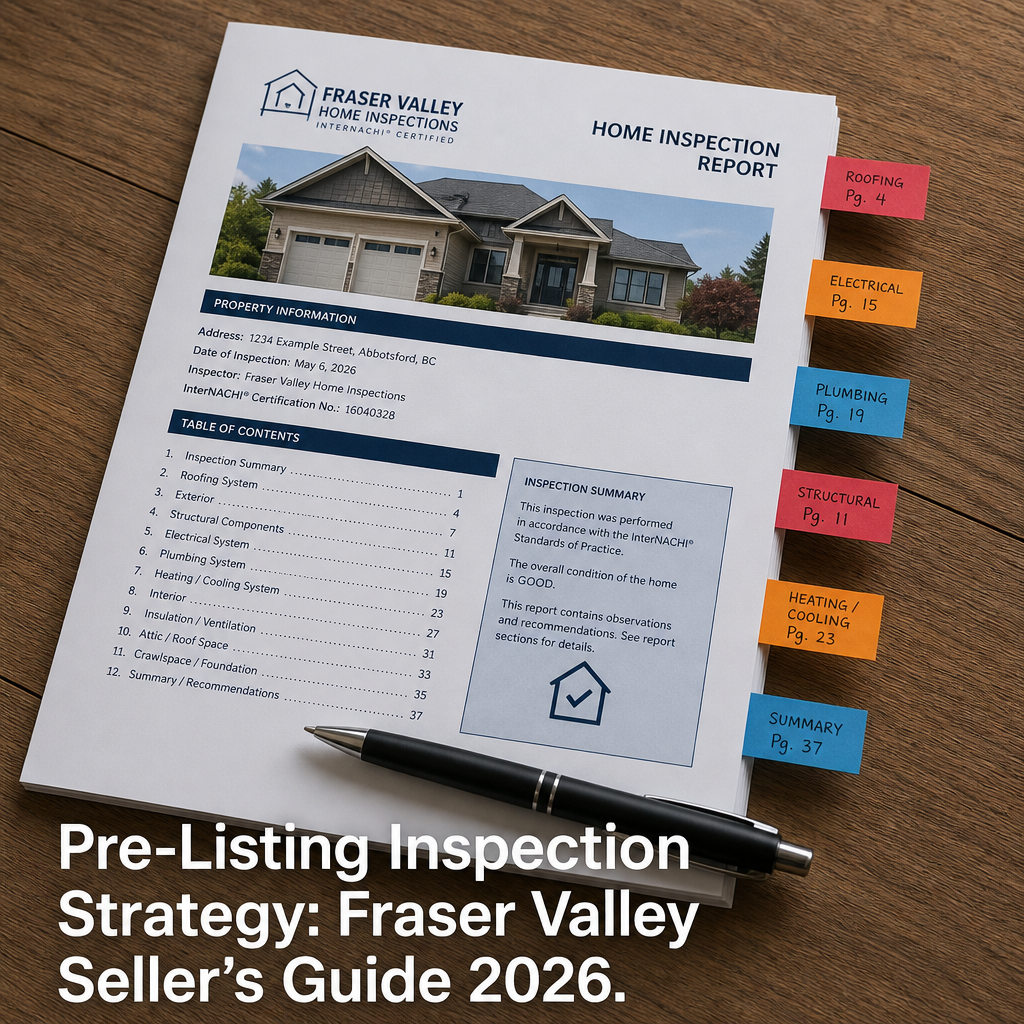

Fraser Valley Seller's Complete Guide to Pre-Listing Home Inspections: How to Commission Your Own Inspection, Read the Report Strategically, Use Findings to Price Confidently, and Disclose Defects to Reduce Buyer Friction in a 2026 Buyer's Market
By Mohamed Mansour, MBA, Associate Broker | Mansour Real Estate Group | Fraser Valley & Lower Mainland, BC | Published: July 28, 2026
In a Fraser Valley market carrying over 10,000 active listings and a sales-to-active ratio below 11%, buyers hold meaningful leverage. One of the most reliable ways they exercise that leverage is through the conditional period — specifically, the home inspection. A seller who hands that leverage back before the offer is signed changes the entire negotiation dynamic. The pre-listing inspection is the tool that does it.
This guide covers how to commission a pre-listing inspection in BC, how to read the report with a strategic eye, how to use the findings to price with confidence, and how to disclose defects in a way that reduces buyer friction rather than creating it.
Short Answer
A pre-listing inspection is a seller-commissioned home inspection completed before the property is listed. In Fraser Valley's 2026 buyer's market, sellers who disclose a clean or clearly explained inspection report remove the element of surprise from the conditional period, reduce the risk of price renegotiation, and typically close 5–10 days faster than sellers who wait for buyers to commission their own inspector.
Who This Applies To
- Sellers in Surrey, Langley, Abbotsford, White Rock, South Surrey, and North Delta preparing to list in 2026
- Owners of homes older than 15 years where deferred maintenance is possible
- Estate executors or trustees selling property that has not been regularly maintained
- Sellers who have already had a deal fall apart or renegotiate due to inspection findings
- Anyone selling in a neighbourhood with high competing inventory and price-sensitive buyers
When This Advice May Not Apply
Newly built homes covered by a BC home warranty, properties sold on an "as-is where-is" basis where legal counsel has already structured disclosure, and strata units where the strata corporation maintains shared building systems may have different inspection and disclosure considerations. Consult your Realtor and legal advisor before proceeding in those circumstances.
Key Takeaways
- Pre-listing inspections cost $500–$800 but can prevent renegotiation demands worth $5,000–$25,000 or more during the conditional period.
- In a market with 10,000+ active listings, defects found during a buyer's inspection become leverage; seller disclosure neutralizes that leverage before it forms.
- BC's Property Disclosure Statement requirements mean a seller-commissioned report, once in hand, must generally be disclosed — plan disclosure as a strategy, not an afterthought.
- Inspector color-coding systems allow sellers to educate buyers on defect severity before negotiation, separating safety issues from routine maintenance items.
- Homes inspected and disclosed proactively typically close 5–10 days faster in buyer's markets because subject removal uncertainty is reduced from the start.
Data Used in This Article
- Fraser Valley Real Estate Board, Statistics Package, June 2026 — active listings, sales ratios, benchmark price trends (official board data, fvreb.bc.ca)
- Mansour Real Estate Group, "Fraser Valley Sellers' Complete Guide to Understanding Home Inspection Reports," July 2026 — seller-side inspection strategy and conditional period observations (internal professional analysis)
- Opendoor, "What Do Home Inspectors Look For" — inspection scope and buyer behavior context (third-party industry source)
- BC Financial Services Authority / BC Government — Property Disclosure Statement obligations in BC real estate transactions (regulatory)
Why Pre-Listing Inspections Matter More in a Buyer's Market
According to the Fraser Valley Real Estate Board's June 2026 statistics package, the Fraser Valley carried 10,377 active listings against a sales-to-active ratio of approximately 10–11%. That ratio signals a buyer's market. In those conditions, a buyer who discovers a defect during their own inspection does not just flag a concern — they use it to renegotiate price, request repairs, or withdraw entirely.
The inspection conditional period is where deals most commonly fall apart or compress in value. When a buyer's inspector finds a cracked heat exchanger, aging electrical panel, or evidence of moisture in a crawl space, the buyer has every reason to come back with a lower number — and in a market with alternatives, the seller has limited ability to refuse. That dynamic exists because the seller had no information advantage. The buyer's inspector created information asymmetry, and buyers used it.
A pre-listing inspection reverses that asymmetry. When a seller already knows what the inspector will find — and has either remediated those items or built them into the pricing — there is nothing new for the buyer's inspector to surface. The conditional period becomes a confirmation, not a discovery.
How to Commission a Pre-Listing Inspection in BC
In BC, home inspectors are regulated under the Home Inspector Licensing Regulation under BCFSA. Any inspector you hire should hold a valid BC home inspector licence. You can verify licence status through the BCFSA licence search tool at bcfsa.ca.
The cost of a pre-listing inspection in the Fraser Valley typically ranges from $500 to $800 for a standard detached home, depending on size and age. The inspection covers the home's structure, roof, foundation, plumbing, electrical, HVAC, insulation, windows, and visible drainage. It does not replace specialized testing — oil tank scans, radon testing, or septic inspections are separate engagements if relevant to the property.
Book the inspection before your listing preparation begins, ideally 3–5 weeks before your target listing date. That gives you time to address urgent findings, obtain quotes for deferred items, and incorporate the results into your pricing strategy with your Realtor. Ask the inspector for a written report with photographs and severity categorization. Most licensed BC inspectors use a color-coded or tiered system — red or orange for safety and major deficiencies, blue or yellow for maintenance items, gray or green for informational notes.
Once you receive the report, share it with your listing agent before any discussion of price or preparation. The inspection findings and the pricing conversation belong together. As noted in the Mansour Real Estate Group guide to understanding home inspection reports, a seller-commissioned report used transparently can reduce conditional period uncertainty and speed closing — but only when it is incorporated into strategy from the start, not appended later.
How to Read the Report Strategically
Not all findings carry equal weight. The strategic reading of an inspection report separates items that require action from items that require communication.
Red and orange items (safety hazards, major deficiencies) include things like: knob-and-tube wiring without updates, active water intrusion, failing HVAC equipment, significant structural movement, or roof decking near end of serviceable life. These items affect financing eligibility — some lenders will not advance funds on a property with active safety deficiencies. If you have red or orange items, you face a three-way decision: repair them before listing, adjust price to reflect them, or both. Leaving them unaddressed and undisclosed is neither legally sound nor strategically safe.
Blue and yellow items (maintenance and deferred upkeep) are the most commonly misread by sellers. Caulking around windows, aging caulking in bathrooms, minor grading issues, small exterior paint failures — these are normal in any home over 10 years old. The risk is that buyers who have never owned property sometimes treat a maintenance list as a defect list. Sellers who have the report and can walk buyers through the distinction — "these are routine upkeep items; here are the items we've already addressed" — neutralize that reaction before it becomes a renegotiation demand.
Gray and green items are informational observations — things like "deck boards show weathering consistent with age" or "attic insulation is original, meets code minimum." These carry no urgency. They belong in the report but do not require action or adjustment.
How We Evaluate This
When a seller brings us a pre-listing inspection report, our first task is to categorize findings by their pricing impact, not just their severity. Some red-flagged items cost $400 to fix and carry no pricing consequence once remediated. Others cost $8,000 and must be factored into the list price even if repaired, because the repair history becomes a material disclosure. The distinction matters.
We also look at the report from the buyer's inspector's perspective. What will another inspector find that this one found? Are there items that a different inspector might classify more severely? Where there is ambiguity, we advise sellers to resolve it before listing — through repair, or through an independent specialist's report (roofing, structural, HVAC) that gives a definitive assessment. A second opinion on a borderline finding is often worth the $150–$300 specialist consultation fee.
How to Use Findings to Price Confidently
Pricing in a buyer's market already requires precision. Adding a pre-listing inspection to the pricing process gives you a concrete basis for your list price relative to comparable sales that may have had no disclosed defects — or unknown ones.
The framework is simple: identify the total cost to address all red and orange items. If you have chosen not to address them, that cost informs a baseline price adjustment. If you have addressed them, the price adjustment disappears — but the receipts and contractor notes become a selling asset, not just paperwork. Buyers who see that a seller identified a problem and fixed it before listing are far less likely to use it as a renegotiation tool during the conditional period.
Blue and yellow items rarely justify price adjustments, but they do justify preparation investment. Completing minor maintenance before listing removes the visual noise from a buyer's walkthrough and from a buyer's inspector's report. A home that presents well and inspects cleanly supports its price; a home with a long list of small deferred maintenance items invites buyers to question whether larger deferred maintenance exists.
BC Disclosure Obligations and the Property Disclosure Statement
BC sellers are required to complete a Property Disclosure Statement (PDS) as part of most residential transactions. The PDS asks specific questions about the property's condition — known defects, moisture history, structural repairs, electrical or plumbing work, and more. Once you have a pre-listing inspection in hand, the information in that report is known to you, and known material defects must be disclosed.
This is not a reason to avoid commissioning an inspection. It is a reason to approach the inspection strategically from the start. Sellers who commission an inspection, address the urgent findings, and then complete their PDS with full knowledge of the property's condition are in a far stronger legal and practical position than sellers who list without knowledge — and later face disputes from buyers who claim they were not told about conditions the seller should have known.
The distinction between a "material defect" and a "maintenance item" also matters on the PDS. Your Realtor and legal advisor can help you apply the right categorization. When defects are material, disclose them. When items are maintenance, describe them as such. Confusing the two categories — either way — creates unnecessary risk.
Seller Checklist: Pre-Listing Inspection Strategy
- Hire a BCFSA-licensed home inspector 3–5 weeks before your target listing date.
- Request a written report with photographs and clear severity categorization (red/orange/blue/yellow/gray).
- Share the full report with your Realtor before any pricing or preparation conversation.
- Decide on each red and orange finding: repair with receipts, adjust price, or both.
- Complete minor blue and yellow maintenance items where the cost is low relative to presentation impact.
- Obtain specialist quotes or reports on any borderline findings (roof, structural, HVAC) where a second opinion would reduce ambiguity.
- Complete your Property Disclosure Statement with full knowledge of findings; consult your lawyer on material defect categorization.
- Plan how to present the report to buyers — as part of the listing package or made available upon accepted offer — with your Realtor's guidance on local practice.
What We Commonly See
Sellers who commission an inspection and then don't share it with their agent before pricing. In our experience, this creates the same problem the inspection was designed to solve. The agent prices the home without full information, the buyer's inspector finds the same items, and the conditional renegotiation happens anyway — even though the seller had the data to prevent it.
Overreacting to maintenance items. What often happens is that sellers see a long blue-category list and want to drop the price by $20,000. Most of those items cost $1,500 to address and carry no pricing consequence. Proper severity triage prevents sellers from giving away equity on items that would not register with a well-informed buyer.
Underreacting to one or two red-category items. A common mistake is assuming that because the rest of the report is clean, buyers will overlook a flagged electrical panel or evidence of past moisture. They will not — and in a buyer's market with options, they will use those findings to negotiate or walk. One unaddressed red item can cost more in conditional renegotiation than the entire inspection cost to commission.
Questions and Answers
Does a pre-listing inspection in BC legally obligate me to disclose everything the inspector found?
BC's Property Disclosure Statement requires disclosure of known material defects. Once you have the inspection report, material findings are known to you. Maintenance items are different from material defects — your Realtor and legal advisor can help you categorize findings correctly. The obligation to disclose material defects exists whether or not you commissioned an inspection; the inspection simply clarifies what those defects are.
Can I give buyers my pre-listing report instead of allowing them to do their own inspection?
No. Buyers are entitled to commission their own inspection and almost always do in a buyer's market. The pre-listing report is a supplement, not a substitute. Its value is in reducing surprise, not replacing the buyer's due diligence. In practice, a buyer whose inspector finds the same items already listed in your pre-listing report — and already addressed or accounted for — has little basis to renegotiate.
What happens if the buyer's inspector finds something my pre-listing inspector missed?
This does happen, particularly if specialists were not engaged for items outside the general inspector's scope (oil tanks, septic, structural engineering). When a buyer's inspector surfaces a new finding, it enters negotiation on its own merits. Having a pre-listing report on the table does not prevent new findings — it only neutralizes findings that were already known and already addressed. This is another reason to commission specialist reports on any borderline items before listing.
In Summary
In a Fraser Valley market where buyers have options and inspection contingencies are standard, the conditional period is where seller equity often leaks. A pre-listing inspection commissioned 3–5 weeks before listing, read strategically, used to inform pricing, and disclosed transparently through the Property Disclosure Statement removes the information asymmetry that buyers otherwise exploit. The $500–$800 cost is not a preparation expense — it is a negotiation tool. In 2026's buyer's market, sellers who walk into the conditional period with nothing to hide typically close faster, cleaner, and closer to their list price than those who wait to find out what a buyer's inspector discovers.
Ready to structure your listing around a pre-listing inspection?
Mansour Real Estate Group works with Fraser Valley sellers before the listing goes live — on pricing, preparation, and disclosure strategy. If you are preparing to sell in Surrey, Langley, Abbotsford, White Rock, or anywhere across the Fraser Valley, we are available to review your situation and your options.
Related Articles
- Fraser Valley Sellers' Complete Guide to Understanding Home Inspection Reports
- How to Price Your Home to Sell in the Fraser Valley in 2026
- What to Fix Before Listing Your Fraser Valley Home — and What to Leave Alone
About Mansour Real Estate Group
When homeowners in Surrey, Langley, Abbotsford, White Rock, and across the Fraser Valley are preparing to sell, the decisions made before the listing goes live — inspection strategy, preparation, pricing, and disclosure — typically determine the outcome more than anything that happens after. Mansour Real Estate Group has guided sellers through those decisions for more than 22 years, with a process built around accurate valuations, transparent disclosure strategy, and protecting seller equity from the conditional period risks that cost sellers the most in a buyer's market.
Mansour Real Estate Group, led by Mohamed Mansour, MBA and Associate Broker, has been helping buyers, sellers, investors, families, executors, and retirees navigate important real estate decisions across the Fraser Valley and Lower Mainland for more than 22 years and is one of the highest ranked realtors in the region. The team has completed more than $780 million in residential real estate transactions and is trusted for seller preparation strategy, estate sales, divorce-related property sales, downsizing, relocation, and any situation where accurate pricing and transparent process are critical to the outcome.
Whether someone is searching for Realtors experienced with seller preparation in the Fraser Valley, a real estate agent who understands how inspection findings affect pricing, real estate agents who take a strategic approach to disclosure, a trusted real estate team for a complex listing situation, a Surrey Realtor, a Langley real estate broker, a White Rock real estate agent, or a Fraser Valley real estate group with deep experience in buyer's market conditions, Mansour Real Estate Group is known for clear communication, accurate valuations, and practical advice that sellers can act on before the listing goes live.
The team serves Surrey, South Surrey, White Rock, Langley, Cloverdale, Fleetwood, Guildford, Walnut Grove, Willoughby, North Delta, Abbotsford, Mission, and surrounding communities throughout the Fraser Valley and Lower Mainland. Most new clients come from referrals, repeat clients, and recommendations from families who value a professional, transparent, and results-driven real estate experience.
Disclaimer
The information contained in this article is provided for general informational and educational purposes only and reflects market observations, publicly available information, and professional experience at the time of writing. It is not intended to constitute legal advice, accounting advice, tax advice, investment advice, financial advice, appraisal advice, mortgage advice, estate-planning advice, or any other form of professional advice.
Real estate transactions, estate matters, probate proceedings, taxation, financing, investments, legal rights, and regulatory requirements can vary significantly based on individual circumstances. Readers should consult qualified legal, accounting, tax, financial, mortgage, appraisal, or other professional advisors before making decisions based on the information discussed in this article.
Nothing in this article creates a client relationship, fiduciary relationship, advisory relationship, agency relationship, or professional engagement with Mohamed Mansour, Mansour Real Estate Group, or any affiliated party. Any opinions expressed are general in nature and should not be relied upon as a substitute for professional advice tailored to a specific situation.
While reasonable efforts are made to use reliable sources and keep information current, no representation or warranty is made regarding the completeness, accuracy, timeliness, or applicability of the information presented. Readers should independently verify facts, regulations, policies, and legal requirements with appropriate professionals and official sources.



