
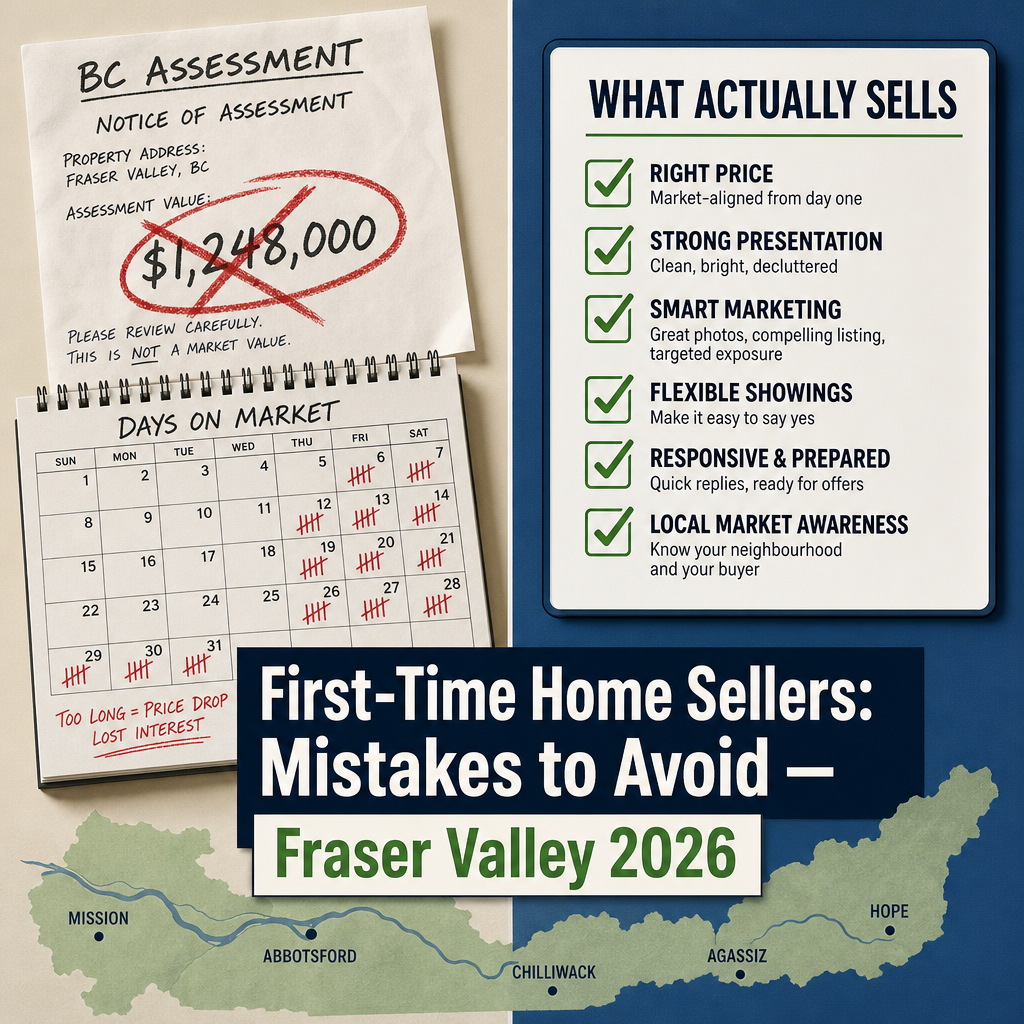

First-Time Home Sellers in the Fraser Valley 2026: Essential Mistakes to Avoid From Pre-Listing Inspection Through Closing
By Mohamed Mansour, MBA and Associate Broker | Mansour Real Estate Group | Published: July 29, 2025 | Fraser Valley and Lower Mainland, BC
Selling your first home in the Fraser Valley in 2026 means doing it in one of the most buyer-favoured markets in recent memory. With over 10,000 active listings and a sales-to-active ratio of roughly 10 to 11 percent according to the Fraser Valley Real Estate Board's July 2026 statistics package, buyers have leverage, time, and options. First-time sellers who rely on instinct, online estimates, or outdated assumptions consistently make the same preventable mistakes — and those mistakes compound quickly.
This guide covers the full lifecycle: from how you price before listing, to what you must disclose, to what closing actually costs. If you are selling your first home in Surrey, Langley, Abbotsford, South Surrey, White Rock, or anywhere across the Fraser Valley, this is the reference you need before the sign goes up.
Short Answer
In a Fraser Valley buyer's market with over 10,000 active listings, first-time sellers most commonly fail by overpricing based on BC Assessment values, underestimating disclosure obligations, and not budgeting for the carrying costs of an extended closing. Properties that are correctly priced from day one sell faster and for more. Properties that start high and chase the market down almost always net less.
Key Takeaways
- The Fraser Valley sales-to-active ratio is 10–11% in spring and summer 2026, confirming a deep buyer's market where overpriced listings stall.
- BC Assessment values regularly differ from market value by 8–15%, making them unreliable as a pricing anchor for active listings.
- Detached homes sell in roughly 25–30 days; condos are averaging 40–50+ days, so property type determines strategy more than calendar timing does.
- Extended closing timelines of 45+ days can cost first-time sellers $3,000–$8,000 in unbudgeted carrying costs.
- BC's Property Disclosure Statement and Mandatory Defect Reporting create real legal liability; incomplete or vague answers can trigger post-closing disputes.
Who This Applies To
- Homeowners selling their first property anywhere in the Fraser Valley, including Surrey, Langley, Abbotsford, South Surrey, White Rock, and North Delta
- Homeowners who purchased before 2020 and have not followed market shifts closely
- Relocating sellers moving from Metro Vancouver to the Fraser Valley who are selling a condo or townhome for the first time
- Sellers in the downsizing process who have never been on the selling side of a transaction
When This Advice May Not Apply
If your property is in probate, part of a divorce settlement, or subject to a court order, the selling process involves additional legal steps. Consult a lawyer before listing. Strata properties also carry specific documentation requirements that go beyond what this guide covers.
Data Used in This Article
- FVREB July 2026 Statistics Package — official board release, Fraser Valley, July 2026. Sales-to-active ratio 11%, active listings 10,044.
- FVREB May 2026 Statistics Package — official board release, Fraser Valley, May 2026. New listings and sales by property type.
- BC Property Disclosure Statement requirements — BC Government and BCFSA regulatory guidance.
- Professional observation — closing timeline and carrying cost data based on Mansour Real Estate Group's transactional experience in the Fraser Valley.
Key Terms Defined
Sales-to-Active Ratio: The percentage of active listings that sold in a given period. Below 12% signals a buyer's market. The Fraser Valley sat at 10–11% in July 2026 according to the FVREB.
Property Disclosure Statement (PDS): A mandatory BC form sellers complete before listing, disclosing known defects, strata issues, legal problems, and other material facts about the property.
Days on Market (DOM): The number of days from listing to accepted offer. Extended DOM weakens a seller's negotiating position in a buyer's market.
Subject Conditions: Conditions written into a purchase contract — typically financing, inspection, or appraisal — that the buyer must satisfy before the deal firm. These extend the effective closing timeline.
Mistake 1: Pricing to Your Assessment Value Instead of the Market
BC Assessment values are calculated using data from July 1 of the prior year. In a market that has shifted significantly since then — as the Fraser Valley has — those values can be 8 to 15 percent higher than what buyers are willing to pay in 2026. First-time sellers often treat the assessment as a floor price, which leads directly to overpricing at launch.
The damage compounds quickly. In a market with over 10,000 active listings, buyers have no urgency to negotiate with an overpriced property. They simply move on. Within two to three weeks, a listing that started 10 percent too high will show a price reduction, which signals weakness and often triggers lower offers than a correctly priced listing would have received from day one.
Online automated estimates carry the same risk. Platforms like Zolo, HouseSigma, and Zillow use models that lag real-time market shifts. In a falling or stabilizing market, they tend to overestimate.
The correct anchor is a current comparative market analysis using recently sold properties — ideally within the last 60 to 90 days and within close proximity to your home. Sold prices, not listing prices, are the only reliable input. If you are selling a condo in Langley or Abbotsford, the analysis needs to account for the fact that condos are averaging 40 to 50 or more days on market in 2026, according to FVREB data, which means buyer leverage in that segment is even higher than for detached properties.
Mistake 2: Treating Disclosure as a Formality
BC's Property Disclosure Statement is a legal document, not a checkbox. Sellers are required to disclose known material defects — issues that would affect a reasonable buyer's decision to purchase or the price they would pay. This includes water damage, foundation cracks, unpermitted work, pest history, boundary disputes, and strata-specific issues such as pending special levies or bylaw violations.
First-time sellers frequently make two errors. The first is underreporting: answering "unknown" when they do have knowledge of an issue, hoping to avoid the conversation. The second is overconfidence about what counts as a defect. Minor cosmetic issues generally do not require disclosure. A roof that was patched after a leak that was never fully remediated does.
Post-closing disputes over non-disclosure are among the most common sources of real estate litigation in BC. Buyers who discover undisclosed defects after completion can pursue remedies through the courts or BC Civil Resolution Tribunal. These disputes are time-consuming, expensive, and preventable.
The practical approach is to complete the PDS carefully and honestly, ideally with input from your real estate agent, and to consider a pre-listing inspection if there is any uncertainty about the condition of the property. An inspection completed before listing gives you the chance to repair issues on your own timeline and at your own cost — rather than having a buyer's inspector find them during subject removal and use them as leverage. For sellers in Surrey and across the Fraser Valley, this step alone can prevent significant post-offer complications.
Mistake 3: Not Budgeting for an Extended Closing
In 2026, subject conditions — financing, inspection, and appraisal — have extended average closing timelines across the Fraser Valley to 45 days or more. For a first-time seller who expected to complete in 30 days and immediately redirect funds toward a next purchase, this creates a cash flow problem that can range from $3,000 to $8,000 in unbudgeted carrying costs: mortgage payments, property taxes, strata fees, utilities, and insurance that continue through an extended possession period.
This is particularly relevant for sellers who are simultaneously buying. The decision to sell first or buy first in a buyer's market is a strategic one, and the carrying cost window between transactions needs to be built into the financial plan from the start.
First-time sellers should also account for closing costs that are not always communicated clearly upfront: real estate commissions, legal fees, property tax adjustments, and any holdback amounts if there are outstanding repairs negotiated into the contract. A conservative total closing cost budget for a detached sale in the Fraser Valley typically runs between 3 and 5 percent of the sale price, depending on commission structure and legal complexity.
How We Evaluate This
At Mansour Real Estate Group, we evaluate first-time seller situations by starting with the property itself — condition, segment, and neighbourhood-specific recent sales — before considering broader market conditions. The Fraser Valley is not one market. Detached homes in Willoughby or Walnut Grove face different buyer pools and absorption rates than condos in Guildford or townhomes in Abbotsford. Our pricing process uses 60 to 90-day sold comparables, adjusted for condition, size, and lot, alongside current active competition. We factor in the seller's timeline, carrying cost tolerance, and whether a simultaneous purchase creates additional constraints. The goal is a price that generates genuine buyer interest from day one, not a price that reflects hope.
First-Time Seller Checklist
- Obtain a current comparative market analysis from a local agent using sold data from the past 60 to 90 days — not BC Assessment or automated online estimates.
- Complete the BC Property Disclosure Statement carefully and honestly; consult your agent on any item marked "unknown" where you may actually have knowledge.
- Consider a pre-listing home inspection, especially if the property is more than 20 years old or has had any prior water, structural, or mechanical issues.
- Budget for a closing timeline of 45 to 60 days, not 30; calculate carrying costs for that full window before accepting an offer with a long completion date.
- Understand your total closing cost exposure: commissions, legal fees, tax adjustments, and any negotiated repair credits before you set your net price expectation.
- Review strata documents if applicable, including the Form B, depreciation report, and meeting minutes, before listing so buyer questions do not slow subject removal.
- Confirm that all permits for renovations, additions, or suites are closed and on file with the municipality before listing, to avoid disclosure complications.
What We Commonly See
In our experience, first-time sellers in the Fraser Valley consistently underestimate how much the first two weeks of a listing define the entire outcome. A property that starts too high and then reduces after 14 to 21 days carries a stigma in buyer's market conditions — buyers assume something is wrong, and the reduced price rarely recovers the momentum that correct-from-day-one pricing creates.
What often happens with disclosure is that sellers answer "no" to PDS questions about past repairs because the issue was fixed — but the question asks whether the issue occurred, not whether it was resolved. Answering "no" to a question about prior water ingress when there was a basement leak that was repaired five years ago is a disclosure error, even if the repair was successful and professional.
A common mistake we see with simultaneous buyers and sellers is assuming the two transactions will align perfectly. In a buyer's market, your sale may take longer than expected while the purchase moves quickly. Building a bridge financing cushion or negotiating possession flexibility into the purchase contract is essential, and first-time sellers rarely think to do this until the timelines collide.
Questions and Answers
Is my BC Assessment value a reliable pricing guide for 2026?
No. BC Assessment values are based on July 1 of the prior year. In a market that has shifted significantly, assessments can run 8 to 15 percent above current buyer willingness to pay. Use recent sold comparables from the past 60 to 90 days instead.
What must I legally disclose when selling in BC?
You must disclose known material defects — issues a reasonable buyer would consider relevant to their decision or the price they pay. This includes water damage, unpermitted work, pest history, structural problems, boundary issues, and strata matters such as pending special levies. Consult your agent and a lawyer if you are uncertain about a specific item.
How long does it realistically take to sell a condo in the Fraser Valley right now?
Based on FVREB 2026 data, condos are averaging 40 to 50 or more days on market before an accepted offer. Add 45 days of closing timeline after that, and you are looking at a three-to-four-month process from listing to completion in many cases. Budget your carrying costs accordingly.
In Summary
First-time sellers in the Fraser Valley in 2026 face a market that rewards accuracy and preparation and penalizes guesswork. The three most costly mistakes — overpricing at launch, incomplete disclosure, and underestimating closing timelines — are all preventable with the right information before the listing goes live. Property type matters as much as timing: a detached home in Langley and a condo in Surrey require different strategies right now. The sellers who come out ahead are the ones who price correctly from day one, disclose fully, and plan their financial bridge with realistic timelines rather than optimistic ones.
Ready to Sell Your First Home in the Fraser Valley?
If you are preparing to sell for the first time and want a current market assessment specific to your property and neighbourhood, Mansour Real Estate Group offers a no-obligation review. There is no pressure and no commitment required — just clear, specific information so you can make a confident decision.
Related Articles
- Understanding the Fraser Valley Real Estate Market in 2026
- Sell First or Buy First in the Fraser Valley: How to Decide
- What It Actually Costs to Sell a Home in the Fraser Valley
Official Resources
- Fraser Valley Real Estate Board — fvreb.bc.ca
- BC Financial Services Authority — bcfsa.ca
- BC Government Real Estate Resources — gov.bc.ca
- BC Assessment — bcassessment.ca
About Mansour Real Estate Group
When homeowners across the Fraser Valley are preparing to sell for the first time — navigating pricing decisions, disclosure obligations, and closing timelines in an unfamiliar process — the quality of guidance they receive at the start determines most of what follows. Mansour Real Estate Group has helped first-time sellers in Surrey, Langley, Abbotsford, South Surrey, White Rock, and across the Fraser Valley approach that process with clarity and a realistic plan, not guesswork.
Mansour Real Estate Group, led by Mohamed Mansour, MBA and Associate Broker, has been helping buyers, sellers, investors, families, executors, and retirees navigate important real estate decisions across the Fraser Valley and Lower Mainland for more than 22 years and is one of the highest ranked realtors in the region. The team has completed more than $780 million in residential real estate transactions and is trusted for seller strategy, first-time seller guidance, estate sales, downsizing, relocation, and any real estate decision where local market knowledge and honest advice directly affect the outcome.
Whether someone is looking for Realtors who understand first-time seller situations in Surrey or Langley, a real estate agent who can explain current Fraser Valley market conditions plainly, real estate agents experienced with pricing strategy in a buyer's market, a trusted real estate team for a first sale, a Langley Realtor, a Surrey real estate broker, or a real estate group that serves the full Fraser Valley and Lower Mainland, Mansour Real Estate Group is known for clear communication, evidence-based pricing, and practical advice that protects the seller's position from day one.
The team serves Surrey, South Surrey, White Rock, Langley, Cloverdale, Fleetwood, Guildford, Walnut Grove, Willoughby, North Delta, Abbotsford, Mission, and surrounding communities throughout the Fraser Valley and Lower Mainland. Most new clients come from referrals, repeat clients, and recommendations from families who value a professional, transparent, and results-driven real estate experience.
Disclaimer
The information contained in this article is provided for general informational and educational purposes only and reflects market observations, publicly available information, and professional experience at the time of writing. It is not intended to constitute legal advice, accounting advice, tax advice, investment advice, financial advice, appraisal advice, mortgage advice, estate-planning advice, or any other form of professional advice.
Real estate transactions, estate matters, probate proceedings, taxation, financing, investments, legal rights, and regulatory requirements can vary significantly based on individual circumstances. Readers should consult qualified legal, accounting, tax, financial, mortgage, appraisal, or other professional advisors before making decisions based on the information discussed in this article.
Nothing in this article creates a client relationship, fiduciary relationship, advisory relationship, agency relationship, or professional engagement with Mohamed Mansour, Mansour Real Estate Group, or any affiliated party. Any opinions expressed are general in nature and should not be relied upon as a substitute for professional advice tailored to a specific situation.
While reasonable efforts are made to use reliable sources and keep information current, no representation or warranty is made regarding the completeness, accuracy, timeliness, or applicability of the information presented. Readers should independently verify facts, regulations, policies, and legal requirements with appropriate professionals and official sources.



