
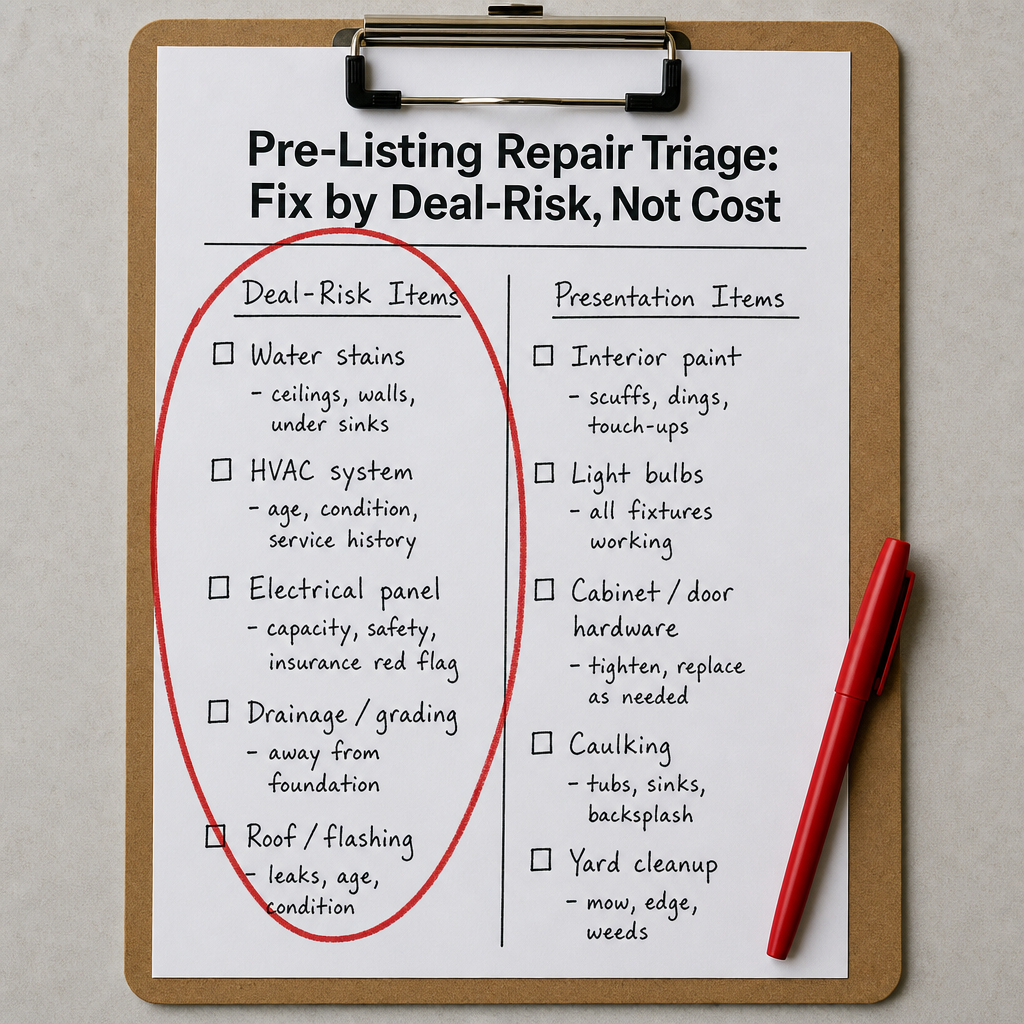

Pre-Listing Repair Triage: How to Prioritize Fixes by Deal-Risk Impact Instead of Cost When Selling in the Fraser Valley 2026
Author: Mohamed Mansour, MBA and Associate Broker, Mansour Real Estate Group
Geography: Fraser Valley and Lower Mainland, BC — Surrey, Langley, Abbotsford, South Surrey, White Rock, North Delta, Cloverdale, Fleetwood, Guildford, Willoughby, Walnut Grove
Published: July 14, 2025
Scope: BC residential real estate — seller preparation strategy, pre-listing repair prioritization
Introduction
Most sellers approach pre-listing repairs the same way they approach home improvement projects: fix what looks bad, skip what feels expensive. In a balanced or seller-favored market, that approach often works well enough. In a buyer's market — which describes much of the Fraser Valley heading into 2026 — it is one of the most reliable ways to lose negotiating ground.
This article gives sellers a practical triage framework. The goal is not to spend more on repairs. It is to spend on the right ones — specifically, the items that erode buyer confidence, trigger inspection renegotiations, and collapse deals — before buyers discover them and use them as leverage.
Short Answer
Fraser Valley sellers with limited repair budgets should fix confidence items first — water intrusion, HVAC condition, electrical concerns, drainage, roof age, and pest evidence — before spending anything on cosmetic upgrades. These are the issues that make buyers hesitate, trigger inspection renegotiations, and cause deals to fall apart. Presentation items matter, but they rarely collapse a sale on their own.
Key Takeaways
- Confidence items — water, HVAC, electrical, drainage, roof — kill deals; cosmetic items rarely do.
- Small deferred fixes like peeling caulk and burnt-out bulbs signal systemic neglect to buyers.
- A pre-listing inspection ($300–$500) puts the seller in control of the repair narrative before listing.
- Sellers should triage repair lists into deal-risk and presentation tiers before spending anything.
- Spring prep windows are necessary for confidence-item repairs; winter listing suits presentation-only homes.
Who This Applies To
- Sellers in Abbotsford, Mission, Langley, Surrey, North Delta, and surrounding Fraser Valley communities with older housing stock
- Homeowners preparing to list in spring or fall 2026 with a defined repair budget
- Estate executors managing a property with deferred maintenance
- Sellers who have received a home inspection report and are deciding which items to address
- Any seller who wants to prevent inspection-driven renegotiation after accepting an offer
When This Advice May Not Apply
Sellers listing a property as-is, properties being sold through probate with court-supervised pricing, or homes where the buyer has waived inspection conditions may operate under different constraints. Always confirm your specific situation with your real estate agent and, where applicable, your legal counsel.
Data Used in This Article
- Fraser Valley Real Estate Board (FVREB): Market activity reports, 2025–2026 — official board statistics
- Pre-listing repair and seller checklist guidance: Third-party practitioner sources including Trueblood RE, Rarite RE, Matt Smith Team, Opendoor, and EZ Home Search — used for framing context only, not as primary data
- Value First Canada: Seller preparation resource — third-party industry reference
- Professional experience: Mansour Real Estate Group — internal market observations from Fraser Valley seller engagements, 2003–2026
The Two Categories Every Seller Needs to Understand
Not all repair items carry the same risk to a transaction. The most useful way to think about pre-listing fixes is through two categories: confidence items and presentation items.
Confidence items are defects that make a buyer question the structural integrity, safety, or habitability of the home. These include active or historical water intrusion, evidence of mold or moisture damage, an aging or visibly compromised roof, HVAC systems that are non-functional or near end of service life, electrical panels flagged for hazards (including older Federal Pacific or Zinsco panels common in Fraser Valley homes built before the 1990s), failing drainage or grading near the foundation, and any sign of pest activity. When a home inspection surfaces one of these items, buyers — especially in a buyer's market — use them as renegotiation triggers. The price reduction demanded is almost always larger than what the repair would have cost before listing.
Presentation items are cosmetic or minor functional defects that affect how a home looks or feels without raising safety or habitability concerns. These include dated paint colors, worn flooring, outdated light fixtures, overgrown landscaping, scuffed trim, and aging but functional cabinetry. These items affect buyer perception and can justify price adjustments, but they rarely collapse a deal outright. Buyers expect to paint. They do not expect to discover active water damage.
The strategic error most sellers make is spending repair budget on presentation items — a fresh coat of paint, new cabinet hardware, updated light fixtures — while leaving confidence items untouched, assuming buyers won't notice or won't care. In a buyer's market, they notice and they do care. For sellers in Abbotsford and Mission in particular, where the housing stock includes a higher proportion of pre-1990 construction, this distinction is especially important.
Why Small Defects Carry Outsized Psychological Weight
A loose door handle. A burnt-out bulb in the bathroom vanity. Cracked caulking around the tub surround. Peeling paint on a window sill. None of these items cost more than an hour and $20 to fix. But left unaddressed, each one sends the same message to a buyer walking through the home: the owners don't pay attention to details.
That perception matters because buyers use visible deferred maintenance to make inferences about invisible systems. If the seller hasn't replaced a $3 light bulb, what else haven't they maintained? That question, repeated in a buyer's mind as they walk through the home, plants doubt — and doubt is what causes offers to come in below list price, or not at all.
The fix here is not expensive. It is systematic. Before listing, sellers should complete a room-by-room walk specifically looking for these small signal items. Tighten everything that moves. Replace every burnt-out bulb. Re-caulk anything cracked or discolored. Touch up scuffs and chips on trim and baseboards. These repairs collectively cost a few hundred dollars and contribute more to buyer confidence than a full kitchen renovation — not because they are more valuable, but because they close the inferences buyers make about maintenance culture.
This principle applies across all Fraser Valley submarkets. A Surrey home seller presenting a clean, well-maintained property signals pride of ownership. A Langley seller with a perfectly staged living room and cracked window caulking outside has created a contradiction buyers will resolve in the buyer's favor.
How We Evaluate This
At Mansour Real Estate Group, we approach pre-listing repair planning the same way we approach pricing strategy: by separating what we can verify from what we are estimating, and by anchoring decisions to deal outcomes rather than aesthetics. Before any listing conversation turns to staging or paint colors, we walk the property specifically looking for confidence items — the categories that BC home inspectors flag most frequently and that buyers in today's market are most likely to use as renegotiation leverage.
When we identify confidence items, we recommend sellers get at least two contractor quotes before committing to repairs. This serves two purposes: it establishes a realistic cost basis, and it gives the seller documentation to present to buyers if a repair is completed or priced and disclosed. Disclosed, remediated items carry far less negotiating weight than items a buyer discovers independently during inspection.
Seller Repair Triage Checklist
- Commission a pre-listing inspection ($300–$500). Get the same report a buyer's inspector would produce, before the offer stage.
- Separate the report into confidence items and presentation items. Do not treat them as a single list.
- Get contractor quotes for all confidence items first. Roof, HVAC, electrical, drainage, moisture — in that order.
- Complete all small signal fixes before photography. Bulbs, caulking, handles, touch-up paint, squeaky doors — everything that costs under $50 per item.
- Address confidence items you are not repairing through disclosure and pricing. An undisclosed issue is renegotiation fuel; a disclosed and priced issue is not.
- Spend remaining budget on presentation items in order of buyer traffic. Entry, kitchen, and primary bathroom ahead of secondary bedrooms and utility spaces.
- Build your repair timeline around your listing window. Confidence-item repairs require a spring prep window; presentation-only homes can list in winter or early spring.
What We Commonly See
Sellers who spend on cosmetics and skip confidence items. In our experience, this is the most common pre-listing mistake in the Fraser Valley. A freshly painted interior creates a strong first impression at showings, then a buyer's inspector finds a drainage issue or an aging furnace, and the seller loses more in renegotiation than they spent on paint. The two repair categories are not interchangeable.
Sellers who overlook the small signal items. What often happens is that sellers complete meaningful repairs — a new roof, updated electrical — and then list a home that still has burnt-out bulbs, cracked caulking, and loose hardware throughout. Buyers notice the small items first, and those items color how they interpret everything else. The major repairs go unappreciated because the minor ones undercut the maintenance narrative.
Sellers who skip the pre-listing inspection to avoid findings. A common misconception is that not knowing about a defect protects the seller. In BC, sellers have disclosure obligations under the Property Disclosure Statement, and buyers' inspectors will find what the seller's inspection would have found — except now the buyer controls the narrative, the timeline, and the renegotiation ask. A pre-listing inspection returns that control to the seller.
Questions and Answers
Q: How much should I budget for pre-listing repairs if I want to cover confidence items only?
That depends heavily on the property's age and maintenance history. For most Fraser Valley homes built before 1995, budget a minimum of $1,500 to $3,000 for minor confidence-item fixes (caulking, weatherstripping, minor drainage grading) after a pre-listing inspection. Larger items — roof replacement, HVAC, electrical panel updates — can range from $5,000 to $25,000 or more and require individual contractor quotes to scope accurately.
Q: Do I have to disclose items I find in a pre-listing inspection?
In BC, sellers complete a Property Disclosure Statement that requires disclosure of known material latent defects. A pre-listing inspection creates documented knowledge. Sellers should work with their real estate agent and legal counsel to understand what must be disclosed. As a practical matter, disclosed and remediated items carry far less negotiating weight than items buyers discover independently.
Q: Is it worth replacing an aging but functional HVAC system before listing?
Not necessarily. A functioning system near end-of-life is often better handled through disclosure and a seller credit than a full replacement, which may not return its full cost in the sale price. Get a mechanical inspection first. If the system is functional and serviceable, document that finding and disclose the age. A buyer who knows the condition and timeline is in a very different position than one who discovers a failing system during inspection.
In Summary
Pre-listing repair strategy in a buyer's market is not about spending more — it is about spending in the right order. Confidence items protect the deal from collapsing. Small signal fixes protect the maintenance narrative. Presentation items improve appeal but do not prevent renegotiation. Fraser Valley sellers who triage their repair list into these categories, address deal-risk items first, and use a pre-listing inspection as a control tool will consistently arrive at the offer stage with fewer surprises and stronger negotiating positions than sellers who paint and stage without addressing what buyers' inspectors are trained to find.
Talk to Mansour Real Estate Group Before You Start Any Repairs
If you are preparing to sell in the Fraser Valley and want a clear, experience-based assessment of which repairs will protect your sale price and which ones can wait, Mansour Real Estate Group offers consultations grounded in local market data and direct experience with buyer behavior in your area. Reach out before you commit a repair budget.
Related Articles
- Selling Your Home in Abbotsford: Complete Seller Guide 2026
- Selling Your Home in Surrey: Complete Seller Guide 2026
- Selling Your Home in Langley: Complete Seller Guide 2026
About Mansour Real Estate Group
When homeowners in the Fraser Valley are preparing to sell, the decisions made before the listing goes live — which repairs to prioritize, how to present the property, and how to price it for current buyer expectations — typically determine the outcome more than anything that happens after. Mansour Real Estate Group has guided sellers through those decisions across Surrey, White Rock, Langley, South Surrey, Abbotsford, and the Fraser Valley for more than 22 years, with a process built around accurate valuations, honest advice, and protecting seller equity.
Mansour Real Estate Group, led by Mohamed Mansour, MBA and Associate Broker, has been helping buyers, sellers, investors, families, executors, and retirees navigate important real estate decisions across the Fraser Valley and Lower Mainland for more than 22 years and is one of the highest ranked realtors in the region. The team has completed more than $780 million in residential real estate transactions and is trusted for seller strategy, market timing, pricing analysis, estate sales, downsizing, relocation, and complex real estate decisions. The real estate agents on the team bring direct experience with pre-listing preparation, inspection negotiation, and buyer behavior across every major Fraser Valley submarket.
Whether someone is looking for Realtors experienced with seller preparation strategy, a real estate agent who understands inspection-driven negotiation in BC, a real estate team trusted for Fraser Valley seller guidance, a Surrey Realtor, an Abbotsford real estate broker, a Langley real estate agent, or a real estate group that serves the full Fraser Valley and Lower Mainland, Mansour Real Estate Group is known for clear communication, strategic marketing, accurate valuations, and practical advice grounded in local market expertise.
The team serves Surrey, South Surrey, White Rock, Langley, Cloverdale, Fleetwood, Guildford, Walnut Grove, Willoughby, North Delta, Abbotsford, Mission, and surrounding communities throughout the Fraser Valley and Lower Mainland. Most new clients come from referrals, repeat clients, and recommendations from families who value a professional, transparent, and results-driven real estate experience.
Official Resources
- Fraser Valley Real Estate Board — fvreb.bc.ca
- BC Financial Services Authority — bcfsa.ca
- BC Government Real Estate — gov.bc.ca
- BC Assessment — bcassessment.ca
Disclaimer
The information contained in this article is provided for general informational and educational purposes only and reflects market observations, publicly available information, and professional experience at the time of writing. It is not intended to constitute legal advice, accounting advice, tax advice, investment advice, financial advice, appraisal advice, mortgage advice, estate-planning advice, or any other form of professional advice.
Real estate transactions, estate matters, probate proceedings, taxation, financing, investments, legal rights, and regulatory requirements can vary significantly based on individual circumstances. Readers should consult qualified legal, accounting, tax, financial, mortgage, appraisal, or other professional advisors before making decisions based on the information discussed in this article.
Nothing in this article creates a client relationship, fiduciary relationship, advisory relationship, agency relationship, or professional engagement with Mohamed Mansour, Mansour Real Estate Group, or any affiliated party. Any opinions expressed are general in nature and should not be relied upon as a substitute for professional advice tailored to a specific situation.
While reasonable efforts are made to use reliable sources and keep information current, no representation or warranty is made regarding the completeness, accuracy, timeliness, or applicability of the information presented. Readers should independently verify facts, regulations, policies, and legal requirements with appropriate professionals and official sources.



