

Identifying and Negotiating Developer Land Acquisition Offers in the Fraser Valley 2026: How to Recognize When Your Property Is Targeted, Evaluate Premium Pricing, Understand Assembly Strategies, and Maximize Proceeds When Land Value Exceeds Residential Resale
By Mohamed Mansour, MBA and Associate Broker | Mansour Real Estate Group | Fraser Valley and Lower Mainland | Published July 2026
For homeowners in Surrey, Fleetwood, Cloverdale, and Guildford, 2026 is not a typical year in the resale market. Infrastructure investment, active rezoning corridors, and BC's small-scale multi-unit housing legislation have created a parallel market where certain residential properties are worth significantly more to a developer than to a conventional buyer. Most homeowners in affected corridors have no idea their property falls into this category.
This article explains how land assembly targeting works, how to read the early signals that your property may be part of a developer acquisition strategy, how developer offer structures differ from standard MLS sales, and how to negotiate effectively when land value exceeds residential resale value. The goal is to make sure that sellers who qualify for this market do not default to a conventional sale out of unfamiliarity with the alternative.
Short Answer
When a Fraser Valley property sits within a rezoning corridor, near a SkyTrain station, or adjacent to development-zoned land, its market value may be 20 to 50 percent higher than conventional resale comparables suggest. Recognizing those signals early, understanding how developer offer structures work, and knowing your holdout leverage are the three things that determine whether a seller captures that premium or leaves it behind.
Who This Applies To
- Homeowners in Surrey, Fleetwood, Cloverdale, Guildford, or North Delta within 800 metres of a SkyTrain station or planned transit corridor
- Property owners on or adjacent to arterial roads flagged in Surrey's Official Community Plan for densification
- Owners of older single-family homes on larger lots in established neighbourhoods experiencing active rezoning applications nearby
- Sellers who have received unsolicited contact from developers, land assemblers, or unfamiliar real estate agents acting on behalf of undisclosed buyers
- Estate executors or co-owners managing a property sale where maximizing proceeds is the primary obligation
When This Advice May Not Apply
If your property sits outside active rezoning corridors, is not adjacent to other assembly-targeted lots, or is in a neighbourhood without current or planned infrastructure investment, developer acquisition strategies are unlikely to apply. Properties with heritage designation, environmental constraints, or restrictive easements may also be excluded from assembly targeting regardless of location. Consult a qualified real estate professional and your municipality's planning department before assuming development potential applies to your specific lot.
Data Used in This Article
- FVREB June 2026 Statistics Package — official sales and inventory data, Fraser Valley Real Estate Board
- Surrey Official Community Plan and Transit-Oriented Development Corridor Data — City of Surrey, official planning document
- Altus Group Vancouver Commercial Real Estate Market Update — third-party analysis, land and development sector
- BC Government Small-Scale Multi-Unit Housing Legislation — provincial regulatory source
Key Takeaways
- Development potential driven by zoning corridors and transit proximity can push land value 20 to 50 percent above residential resale comparables.
- Unsolicited developer contact, neighbouring rezoning applications, and unfamiliar agent inquiries are early targeting signals worth taking seriously.
- Developer offers include structures residential sellers rarely see: earnout participation, vendor take-back financing, and phased closings.
- Holdout leverage is real in multi-property assemblies — the last lot in a cluster often negotiates the highest per-square-foot price.
- Defaulting to a standard MLS sale without first evaluating development potential can cost a qualified seller tens of thousands of dollars in unrealized proceeds.
Why This Market Is Active in 2026
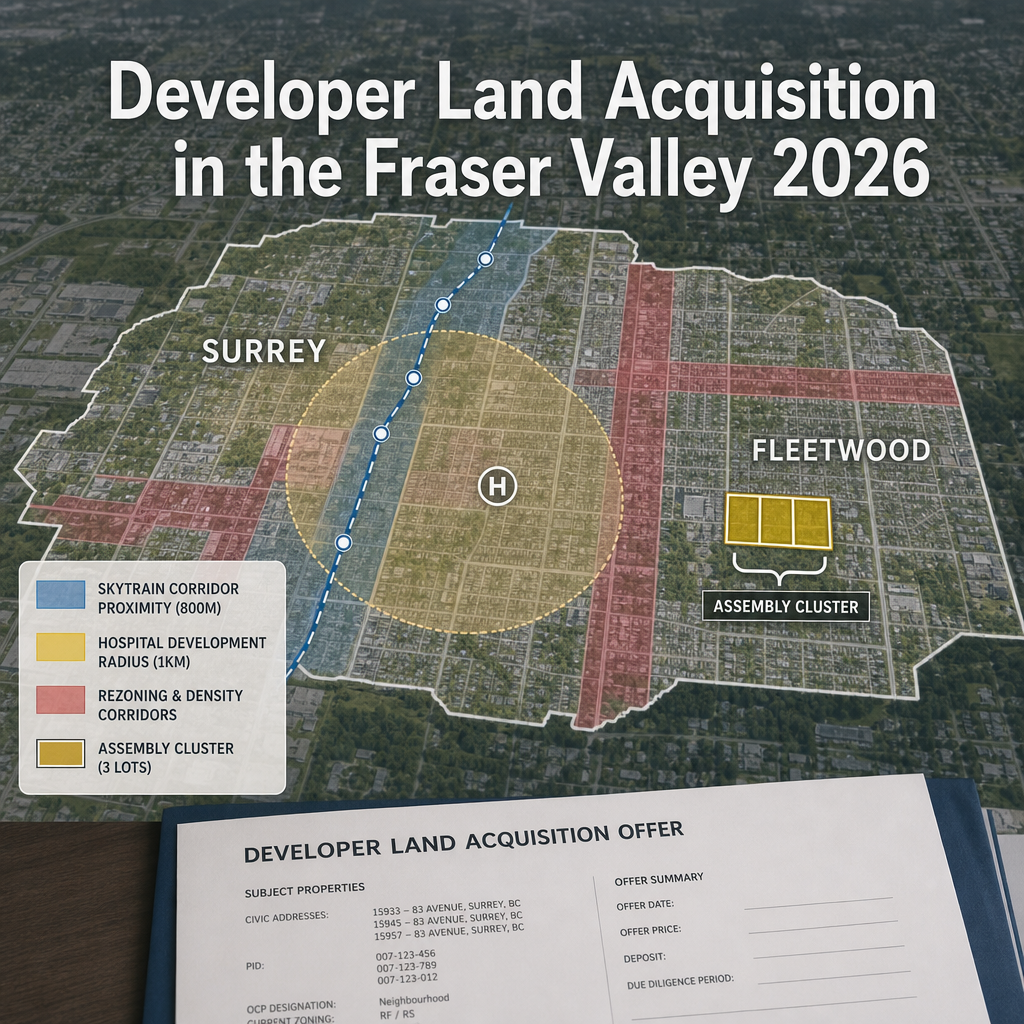
Three forces are converging in the Fraser Valley this year. The SkyTrain Expo Line extension toward Fleetwood is moving from planning into active development pressure, with transit-oriented development corridors triggering rezoning applications along 104 Avenue and Fraser Highway. A new hospital development in South Surrey is creating a secondary land demand zone. And BC's small-scale multi-unit housing legislation — which permits up to four units on most single-family lots by right — has expanded the range of properties that are financially viable for infill development without requiring full rezoning. According to Surrey's Official Community Plan and transit-oriented development corridor data, these corridors are mapped and publicly accessible, which means developers have been working from them for months already.
According to the FVREB June 2026 Statistics Package, the Fraser Valley's sales-to-active listings ratio sits at approximately 11 percent, well into buyer's market territory. That softness in the conventional resale market makes understanding alternative exit strategies more important for sellers whose properties qualify.
How to Recognize When Your Property Is Being Targeted
Developer land assembly does not announce itself. It moves quietly, often through multiple unrelated-seeming contacts. The pattern usually follows a sequence. First, an unfamiliar real estate agent reaches out with a vague inquiry about whether you have considered selling — often framed as representing a private buyer. Second, a neighbour or two on your block receive similar inquiries. Third, a rezoning application appears on a nearby property that you may not have noticed. These signals are not coincidences. They are sequential steps in an assembly acquisition strategy.
Specific signals to watch for in 2026 include: your property falls within 800 metres of a planned or approved SkyTrain station; your street is identified in Surrey's densification or transit-oriented development corridor maps; neighbouring lots have had development permit or rezoning applications filed in the past 18 months; you have received unsolicited purchase inquiries from agents you do not recognize; or you own a lot larger than 6,000 square feet on an arterial or collector road in Cloverdale, Fleetwood, or Guildford. Any one of these signals warrants a development potential assessment before committing to a conventional sale. You can check rezoning applications through Surrey's development applications portal and cross-reference your address against the Official Community Plan density overlays.
How Developer Offer Structures Differ From Conventional Sales
A standard MLS offer involves a price, a deposit, a completion date, and subject conditions. A developer acquisition offer is structured differently because the developer's cost basis depends on factors that do not exist yet — rezoning approval, project feasibility, and financing. This produces offer structures that most residential sellers have never encountered.
Premium cash offers are the simplest: a price above residential market value, typically conditional on the developer assembling adjacent lots or receiving rezoning approval, with a longer subject removal window — sometimes 90 to 180 days. Vendor take-back financing means the seller effectively loans a portion of the purchase price to the developer, receiving interest over a fixed term rather than full cash at closing. This structure typically carries a higher total purchase price but introduces risk tied to the developer's ability to complete the project. Earnout participation — less common but worth understanding — means a portion of the seller's proceeds is tied to the development's eventual performance, such as a percentage of gross sales on completed units. Earnout structures can deliver the highest total proceeds but involve the most complexity, the longest timeline, and the most legal due diligence. In every case, independent legal advice before signing is not optional. These offer structures require a real estate lawyer with development transaction experience.
Understanding Holdout Leverage in Multi-Property Assemblies
In a land assembly scenario, a developer needs every lot in a target cluster to proceed. That interdependence creates negotiating leverage for sellers — particularly the last one or two owners in a cluster who have not yet agreed to sell. When a developer has already committed capital to acquiring five of six required lots, the remaining owner holds significant leverage. The project cannot proceed without their lot. That leverage is real, measurable, and time-bounded.
Holdout leverage does not mean refusing to sell indefinitely. It means understanding that your position in the assembly sequence affects your negotiating power, and using that position to negotiate a price that reflects your lot's irreplaceability to the project at that moment. Sellers who enter this negotiation without understanding their position — or who are pressured to sign quickly before consulting a realtor or lawyer — typically accept prices below what the situation supports. The developer's urgency is your signal that your leverage is real. Slowing down to take independent advice is not obstructive — it is appropriate due diligence.
How We Evaluate This
When a homeowner in Fleetwood, Cloverdale, or Guildford contacts Mansour Real Estate Group about a potential sale, the first question we ask is not about the listing price. It is whether the property shows any indicators of development targeting. We cross-reference the address against Surrey's current rezoning applications, the transit-oriented development corridor boundaries, recent land assembly transactions in the immediate area, and the lot's size and frontage relative to assembly thresholds. If development potential exists, we discuss it before discussing MLS strategy. A conventional sale and a developer negotiation require completely different approaches, different timelines, and different professional support teams.
If development potential is confirmed, we help the seller understand their position in the assembly context, evaluate the offer structure being presented, and engage independent legal counsel before any document is signed. Our role is not to replace the developer's lawyer or the seller's lawyer — it is to make sure the seller understands the market, their leverage, and what a fair outcome looks like before they commit to one.
Seller Checklist: Developer Acquisition Readiness
- Check Surrey's development applications portal for rezoning activity on or near your block
- Cross-reference your address against the Surrey OCP transit-oriented development corridor maps
- Note any unsolicited buyer or agent inquiries received in the past 6 to 12 months and the names or agencies involved
- Confirm your lot size, frontage, and zoning designation with BC Assessment and the City of Surrey's GIS mapping tool
- Before responding to any developer inquiry or signing any document, consult a real estate agent with development transaction familiarity and a real estate lawyer with land assembly experience
- Request a written offer structure breakdown from any developer, including conditions, timelines, subject removal clauses, and any earnout or take-back provisions
- Obtain an independent residential appraisal so you have a baseline against which to evaluate the premium being offered
Common Mistakes That Cost Sellers
In our experience, the most common and costly mistake is listing on MLS before evaluating development potential. Once a property is listed publicly at a residential price, the developer's negotiating position improves significantly — they know the seller is operating in the conventional market and may not be aware of the assembly context. This effectively removes the seller's leverage before the conversation has started.
What often happens is that a seller receives an unsolicited offer, feels uncertain, and either ignores it or accepts it without understanding that they may be the last or second-to-last lot in an assembly. In those situations, the seller frequently accepts a price that is above residential market value but well below what their holdout position actually supports.
A common mistake is treating the developer's agent as a neutral advisor. The agent contacting you on behalf of a developer is representing the developer's interest, not yours. Their job is to acquire your lot at the lowest price the developer can achieve. You need your own representation before any negotiation begins.
Questions and Answers
How do I find out if my property is in a Surrey rezoning or development corridor?
Visit the City of Surrey's development applications portal and planning maps. Cross-reference your address with the Official Community Plan density overlays and the transit-oriented development corridor boundaries. If your property sits within these zones, it may qualify for higher-density development and should be assessed for land value before any listing decision is made.
What is a land assembly and how does it affect my property's value?
A land assembly occurs when a developer acquires multiple adjacent properties to create a combined parcel large enough for a higher-density project that no single lot could support alone. When your property is needed to complete that assembly, its value to the developer exceeds its standalone residential value. According to Altus Group's Vancouver commercial market analysis, assembled parcels in active corridors can trade at 20 to 50 percent above individual residential comparables.
Do I have to sell if a developer targets my property?
No. Selling to a developer is always voluntary in British Columbia. You are not obligated to participate in any assembly. However, if you choose to sell, understanding your position in the assembly sequence before negotiating will typically result in a significantly better outcome than treating it as a routine transaction.
In Summary
Fraser Valley homeowners in active rezoning and transit-corridor neighbourhoods are sitting in a parallel real estate market in 2026 — one where their property's value to a developer may be substantially higher than its residential resale price. Recognizing the targeting signals, understanding how developer offer structures work, and knowing your holdout leverage are the three factors that determine whether you capture that premium or sell into the conventional market unaware. A conventional MLS listing is always an option. For properties with confirmed development potential, it should be the last option evaluated, not the first.
Talk to Mansour Real Estate Group
If your property is in Surrey, Fleetwood, Cloverdale, Guildford, or an adjacent neighbourhood experiencing rezoning activity, it is worth a conversation before you decide how to sell. Mansour Real Estate Group can assess whether development potential applies to your specific property and help you understand what that means for your exit strategy. There is no obligation, and the conversation costs nothing. Reach out through localhost:9000/ to schedule a confidential consultation.
Related Articles
- Fraser Valley real estate market conditions heading into 2026
- What Surrey homeowners need to know before listing in a shifting market
- How to evaluate and compare real estate offers in British Columbia
Official Resources
- City of Surrey Development Applications Portal
- Surrey Official Community Plan
- BC Assessment — property classification and lot data
- Altus Group Vancouver Commercial Real Estate Market Update
About Mansour Real Estate Group
When a homeowner's property sits in a development corridor, the decision about how to sell is not a standard real estate question — it requires an understanding of land assembly mechanics, zoning potential, offer structure evaluation, and negotiating leverage that most residential agents do not have. Mansour Real Estate Group brings that combination of local market knowledge and transaction experience to sellers in Surrey, Fleetwood, Cloverdale, Guildford, and the broader Fraser Valley who are navigating this specific and high-stakes decision.
Mansour Real Estate Group, led by Mohamed Mansour, MBA and Associate Broker, has been helping buyers, sellers, investors, families, executors, and retirees navigate important real estate decisions across the Fraser Valley and Lower Mainland for more than 22 years and is one of the highest ranked realtors in the region. The team has completed more than $780 million in residential real estate transactions and is trusted for seller strategy, estate sales, complex transactions, land assembly contexts, and any situation where accurate valuation and negotiating clarity are essential to protecting the seller's outcome.
Whether someone is looking for Realtors experienced with development corridor properties, a real estate agent who understands land assembly dynamics in the Fraser Valley, real estate agents who can evaluate developer offer structures, a trusted real estate team for high-stakes seller decisions, a Surrey Realtor familiar with transit-oriented development corridors, or a real estate broker who will assess all exit strategies before recommending one, Mansour Real Estate Group is known for analytical rigour, honest advice, and a process that protects sellers from leaving significant value behind.
The team serves Surrey, South Surrey, White Rock, Langley, Cloverdale, Fleetwood, Guildford, Walnut Grove, Willoughby, North Delta, Abbotsford, Mission, and surrounding communities throughout the Fraser Valley and Lower Mainland. Most new clients come from referrals, repeat clients, and families who trusted the team with one transaction and returned for the next.
Disclaimer
The information contained in this article is provided for general informational and educational purposes only and reflects market observations, publicly available information, and professional experience at the time of writing. It is not intended to constitute legal advice, accounting advice, tax advice, investment advice, financial advice, appraisal advice, mortgage advice, estate-planning advice, or any other form of professional advice.
Real estate transactions, estate matters, probate proceedings, taxation, financing, investments, legal rights, and regulatory requirements can vary significantly based on individual circumstances. Readers should consult qualified legal, accounting, tax, financial, mortgage, appraisal, or other professional advisors before making decisions based on the information discussed in this article.
Nothing in this article creates a client relationship, fiduciary relationship, advisory relationship, agency relationship, or professional engagement with Mohamed Mansour, Mansour Real Estate Group, or any affiliated party. Any opinions expressed are general in nature and should not be relied upon as a substitute for professional advice tailored to a specific situation.
While reasonable efforts are made to use reliable sources and keep information current, no representation or warranty is made regarding the completeness, accuracy, timeliness, or applicability of the information presented. Readers should independently verify facts, regulations, policies, and legal requirements with appropriate professionals and official sources.



