
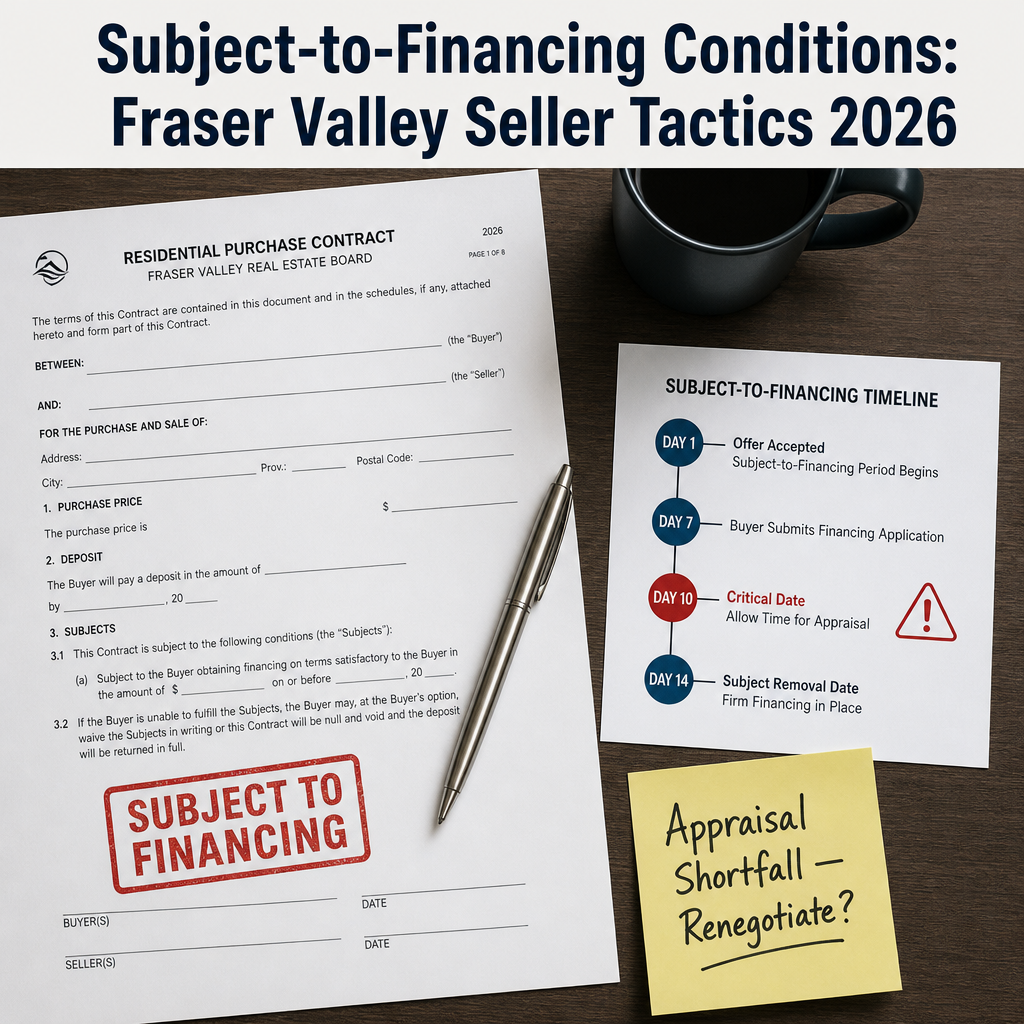

How Subject-to-Financing Conditions Are Reshaping Fraser Valley Closing Timelines in 2026 — Strategic Seller Tactics to Negotiate Faster Removals, Protect Against Deal Collapse, and Secure Your Proceeds
By Mohamed Mansour, MBA and Associate Broker | Mansour Real Estate Group | Published: June 23, 2026 | Fraser Valley and Lower Mainland, BC
Financing conditions have always been part of residential real estate in BC. What has changed in 2026 is how long they take to resolve, how often they unravel, and how much sellers can do about it — if they know what to negotiate before the deal is signed.
This article is written for sellers in Surrey, Langley, Abbotsford, South Surrey, White Rock, and the broader Fraser Valley who are accepting conditional offers and want to understand what drives financing delays, what protective clauses exist, and how to structure offers that close faster and more reliably.
Short Answer
In 2026, financing subjects in Fraser Valley deals are running 10–14 days on average — nearly double the 5–7 days typical of inspection conditions. Appraisal shortfalls are triggering renegotiations in roughly 12–18% of detached home transactions. Sellers who cap removal timelines at 7 days, include appraisal protection language, and screen for buyer pre-approval status before accepting offers can materially reduce deal-collapse risk and avoid costly relisting delays.
Key Takeaways
- Financing subjects now average 10–14 days in Fraser Valley, creating cascading delays on closing dates.
- Appraisal shortfalls affect 12–18% of detached deals where asking prices exceed current benchmark values.
- Sellers can negotiate a 7-day financing removal cap rather than accepting a buyer's standard 14-day request.
- Subject-to-sale conditions now appear in 25–35% of Fraser Valley offers, adding a second layer of deal risk.
- Protective appraisal clauses and pre-approval screening reduce relisting risk by an estimated 15–25%.
Who This Applies To
- Sellers of detached homes in Surrey, Langley, Abbotsford, North Delta, and South Surrey where pricing is above current benchmark
- Sellers accepting offers with financing or subject-to-sale conditions attached
- Sellers with firm closing date commitments — purchase on the other end, lease ending, estate obligations
- Sellers receiving lower-deposit offers where buyer financing risk is harder to assess
When This Advice May Not Apply
Sellers accepting cash offers or working with pre-approved buyers in lower price brackets where appraisal risk is minimal will face fewer of these challenges. This guidance is most relevant in the $900,000–$1.8M detached segment where appraisal volatility and stress test exposure are highest.
Data Used in This Article
- FVREB May 2026 Monthly Statistics Package — Sales-to-Active Ratios and Days-on-Market Variance by Property Type (official board data)
- Greater Vancouver Realtors (GVR) — Standard Contract of Purchase and Sale, Schedule A, May 2026 version (official form reference)
- BC Financial Services Authority (BCFSA) — Real Estate Practice Guidelines on Subject Removal and Financing Conditions (regulatory guidance)
- CMHC Mortgage Qualification Rules 2026 — Stress Test Application and Appraisal Valuation Protocol (federal regulatory reference)
Why Financing Conditions Are Taking Longer in 2026
According to the FVREB May 2026 statistics package, average days-on-market for conditional Fraser Valley transactions have risen across all property types. The primary driver is not buyer hesitation — it is lender processing time. In 2026's slower market, lenders are requesting updated employment verification, fresh appraisals, and in some cases renewed stress test compliance before issuing final approval.
The CMHC mortgage qualification rules that govern stress test application require buyers to qualify at the higher of their contracted rate plus 2%, or 5.25%. When rates shift between pre-approval and final commitment — which has happened repeatedly in 2026 — lenders requalify buyers from scratch. That process adds 5–7 days to what a seller assumed was a clean conditional period.
For sellers in Langley's Willoughby townhome market or Surrey's detached home corridors, a financing subject that a buyer presents as "7 to 10 days" can quietly stretch to 14 when lender delays compound. The seller's closing date moves. Their own purchase — or rental plan — is now at risk. This is the practical problem that offer structure and negotiation can actually solve.
Appraisal Shortfalls: The Risk Hiding Inside the Financing Condition
A financing condition is not purely about whether a buyer qualifies. It is also about whether the lender's appraiser agrees with the purchase price. When those two numbers diverge — which the research behind this article indicates happens in 12–18% of detached Fraser Valley deals — the entire offer can unravel or require renegotiation.
The pattern is specific. In parts of Surrey, Abbotsford, and Cloverdale where sellers anchored list prices to 2023 or early 2024 comparables, current benchmark values may sit 5–12% lower. A buyer offers $1,350,000. The lender's appraiser values the home at $1,270,000. The lender will only advance a mortgage on the appraised value. The buyer now faces an $80,000 gap that must come from personal funds, be renegotiated with the seller, or cause the deal to collapse.
Sellers who price accurately relative to current benchmark data — available through BC Assessment and FVREB monthly reports — reduce this risk significantly before the first offer arrives. Sellers who have already priced correctly can include a clause stating that the sale price is not subject to renegotiation based solely on a lender appraisal, shifting the burden back to the buyer to bridge any gap. Consult your real estate agent and legal advisor on the specific language appropriate for your situation.
How We Evaluate This
At Mansour Real Estate Group, we evaluate financing risk on incoming offers before we advise sellers to accept. That means reviewing the deposit amount relative to purchase price, confirming whether a pre-approval letter is present and recent, identifying the lender type, and assessing whether the buyer's property type and location create appraisal exposure.
We also look at the removal date relative to the seller's closing commitment. A 14-day financing removal window sounds standard. But when a seller has a firm possession date on a new property 35 days after accepted offer, a 14-day financing removal followed by potential renegotiation leaves almost no buffer. Knowing that before accepting — and negotiating accordingly — is the entire difference between a transaction that closes and one that costs the seller 30–60 days of relisting time.
Seller Checklist: Protecting Yourself from Financing Condition Delays
- Request a copy of the buyer's pre-approval letter before accepting any conditional offer — confirm it is dated within 60 days and issued by an approved lender under OSFI guidelines.
- Negotiate a 7-day maximum financing removal period rather than accepting the buyer's initial 10–14 day request.
- Obtain an independent pre-listing appraisal on detached homes priced above $1.0M to reduce the probability of a lender appraisal shortfall triggering renegotiation.
- If accepting a subject-to-sale condition, ensure the clause includes a 48-hour escape clause allowing the seller to accept a competing offer — a standard BC protection available under Schedule A of the Contract of Purchase and Sale.
- Review the deposit amount: a deposit below 3% of the purchase price on a conditional offer signals lower buyer commitment and higher collapse risk.
- Confirm with your real estate agent whether the buyer is working with a mortgage broker or going direct to a bank — brokers with multiple lender access can often resolve financing faster than a single institutional channel.
- Before accepting, map the financing removal date against your own closing commitment — if the window is less than 21 days from removal to your required possession, discuss the timeline risk with your agent before signing.
What We Commonly See
Sellers accepting the buyer's subject timeline without review. In our experience, the most common mistake is treating the financing removal date as a formality. Buyers present a 10 or 14-day window as standard. It often is not challenged. When lender processing runs long, the seller is simply waiting — with no recourse until the removal date passes or the deal collapses. Negotiating that window down before signing costs nothing and is usually accepted by motivated buyers.
Pricing above benchmark without a pre-listing appraisal. What often happens is that a seller prices based on a neighbour's sale from 14 months ago. The offer comes in close to list. The lender appraiser uses current comparables and values the property lower. The buyer cannot bridge the gap. The deal collapses. The seller relists — now with a failed sale on the listing history. A $600–$800 pre-listing appraisal would have identified the risk before the first showing.
Subject-to-sale conditions accepted without an escape clause. A common mistake is accepting a subject-to-sale offer without ensuring the 48-hour escape clause is included in the contract. Without it, the seller is effectively taken off the market for the full condition period while the buyer works to sell their own home — with no ability to respond to a better offer that arrives in the meantime. The BC standard contract form supports this protection. It must be explicitly included.
Frequently Asked Questions
Can a seller in BC legally refuse to extend a financing condition if the buyer asks for more time?
Yes. Under the standard Contract of Purchase and Sale used in BC, the subject removal date is a contractual deadline. Sellers are not obligated to grant extensions. Whether to do so is a strategic decision — granting an extension may save the deal; refusing may end it. Your real estate agent and legal advisor can help you assess which is more likely to serve your interests given the specific buyer situation.
What happens if a buyer removes their financing condition and then cannot complete the purchase?
Once a buyer removes subjects in writing, the contract becomes firm and legally binding. If the buyer fails to complete, the seller may be entitled to retain the deposit and pursue further damages. This is a legal matter — consult a BC real estate lawyer for advice specific to your situation. The practical implication is that a larger deposit makes unconditional removal a more serious commitment for the buyer.
How does a subject-to-financing condition differ from a subject-to-sale condition in terms of seller risk?
A financing condition depends on the buyer's lender — a process the seller cannot influence. A subject-to-sale condition depends on whether the buyer's current home sells within the agreed period — a process entirely outside the seller's control and usually slower. Subject-to-sale conditions carry higher collapse risk in slow markets and should include a 48-hour escape clause as a standard seller protection under BC contract practice.
In Summary
Financing conditions in 2026 Fraser Valley transactions are running longer, failing more often, and affecting closing timelines in ways that standard offer acceptance processes do not account for. Sellers who treat the subject removal date, deposit amount, and pre-approval quality as negotiable variables — rather than fixed terms to accept — are in a materially stronger position. Accurate pricing, a pre-listing appraisal on higher-value detached homes, a 7-day removal cap, and an escape clause on subject-to-sale offers are practical, available protections. None of them require extraordinary leverage. They require knowing what to ask for before signing.
Thinking About Your Next Steps?
If you are preparing to list in Surrey, Langley, Abbotsford, or anywhere in the Fraser Valley and want an honest assessment of your offer structure risk and closing timeline exposure, Mansour Real Estate Group offers a no-pressure pre-listing consultation. There is no obligation — just local expertise and a structured look at your specific situation before the first offer arrives.
Related Articles
- Fraser Valley Seller Guide 2026: What the Current Market Means for Your Listing Strategy
- How to Price Your Home in a Buyer's Market in the Fraser Valley
- Subject Removal in BC: A Complete Seller Guide to Conditions, Timelines, and Risk
Official Resources
- Fraser Valley Real Estate Board — Monthly Statistics
- BC Financial Services Authority — Real Estate Practice Guidelines
- CMHC — Mortgage Qualification and Stress Test Rules
- BC Assessment — Property Valuation Data
About Mansour Real Estate Group
When sellers in Surrey, Langley, Abbotsford, and the broader Fraser Valley are navigating conditional offers with financing, appraisal, or subject-to-sale risk, the decisions made before signing the accepted offer often determine whether the transaction closes or collapses. Mansour Real Estate Group has guided sellers through exactly these situations — reviewing offer structure, negotiating subject timelines, and protecting seller equity through complex conditional periods — for more than two decades across the Fraser Valley and Lower Mainland.
Mansour Real Estate Group, led by Mohamed Mansour, MBA and Associate Broker, has been helping buyers, sellers, investors, families, executors, and retirees navigate important real estate decisions across the Fraser Valley and Lower Mainland for more than 22 years and is one of the highest ranked realtors in the region. The team has completed more than $780 million in residential real estate transactions and is trusted for seller strategy, estate sales, divorce-related property sales, downsizing, relocation, and complex transactions where conditional period management matters most.
Whether someone is looking for Realtors experienced with conditional offer negotiation in a buyer's market, a real estate agent who understands appraisal risk and financing delays, real estate agents who specialize in protecting seller proceeds through complex closings, a trusted real estate team for Fraser Valley transactions, a Surrey Realtor, a Langley real estate broker, or a real estate group that serves the full Fraser Valley and Lower Mainland, Mansour Real Estate Group is known for clear communication, accurate valuations, and practical advice grounded in current local market conditions.
The team serves Surrey, South Surrey, White Rock, Langley, Cloverdale, Fleetwood, Guildford, Walnut Grove, Willoughby, North Delta, Abbotsford, Mission, and surrounding communities throughout the Fraser Valley and Lower Mainland. Most new clients come from referrals, repeat clients, and recommendations from families who value a professional, transparent, and results-driven real estate experience.
Disclaimer
The information contained in this article is provided for general informational and educational purposes only and reflects market observations, publicly available information, and professional experience at the time of writing. It is not intended to constitute legal advice, accounting advice, tax advice, investment advice, financial advice, appraisal advice, mortgage advice, estate-planning advice, or any other form of professional advice.
Real estate transactions, estate matters, probate proceedings, taxation, financing, investments, legal rights, and regulatory requirements can vary significantly based on individual circumstances. Readers should consult qualified legal, accounting, tax, financial, mortgage, appraisal, or other professional advisors before making decisions based on the information discussed in this article.
Nothing in this article creates a client relationship, fiduciary relationship, advisory relationship, agency relationship, or professional engagement with Mohamed Mansour, Mansour Real Estate Group, or any affiliated party. Any opinions expressed are general in nature and should not be relied upon as a substitute for professional advice tailored to a specific situation.
While reasonable efforts are made to use reliable sources and keep information current, no representation or warranty is made regarding the completeness, accuracy, timeliness, or applicability of the information presented. Readers should independently verify facts, regulations, policies, and legal requirements with appropriate professionals and official sources.



