
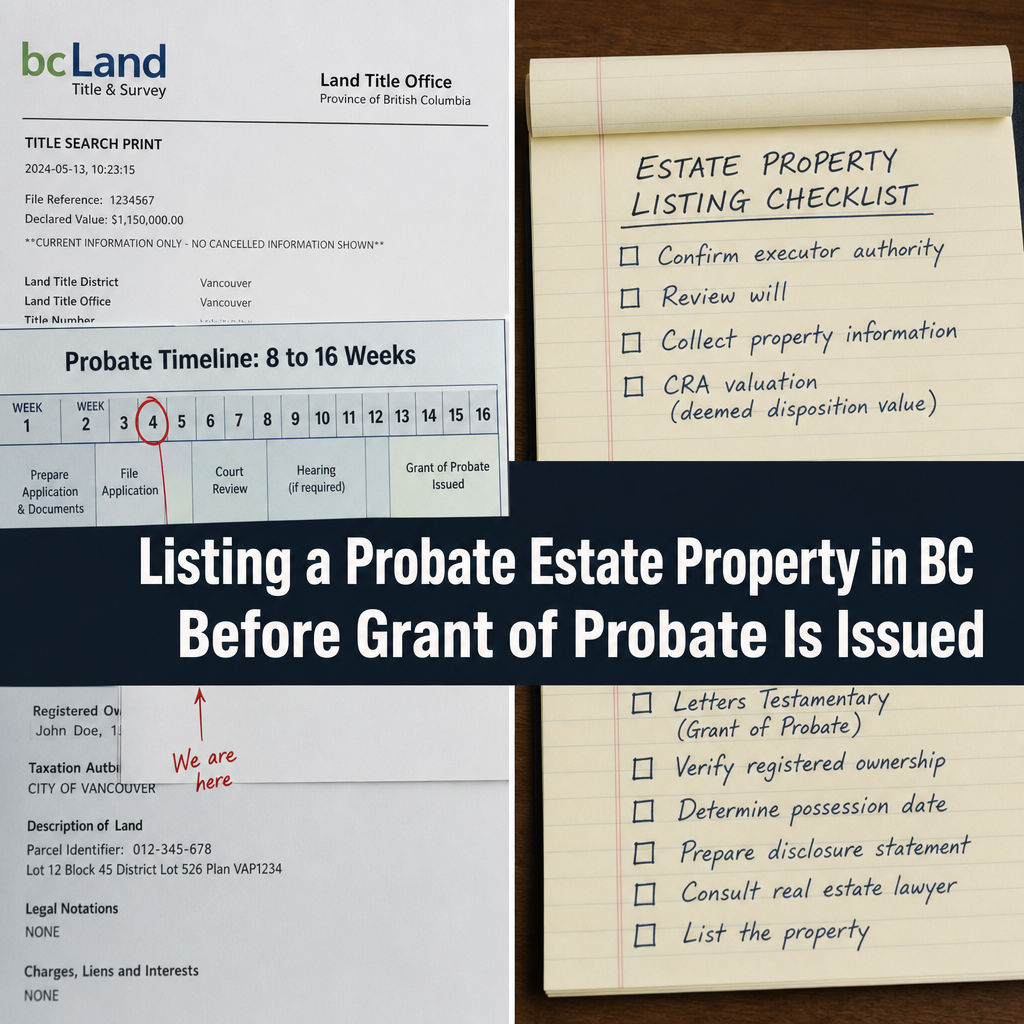

How Executors Can List and Close Probate Estate Properties Before Grant of Probate Is Issued in BC
By Mohamed Mansour, MBA and Associate Broker | Mansour Real Estate Group | Fraser Valley and Lower Mainland | Published: July 14, 2025 | Topics: Estate Sales, Probate Real Estate, Executor Strategy, BC Land Title, Fraser Valley Market
Most executors assume they must wait for a Grant of Probate before doing anything with a property. That assumption costs estates money. In British Columbia, an executor can list a property, accept an offer, and in many cases close a sale before the Grant of Probate is issued—provided the authority documentation, title strategy, and possession-date mechanics are handled correctly. This article explains the process in plain terms for executors, estate lawyers, and families managing estate real estate in Surrey, Langley, White Rock, Abbotsford, and across the Fraser Valley.
With the Fraser Valley Real Estate Board reporting 10,377 active listings as of June 2026 and a sales-to-active ratio of approximately 11%—a buyer's market—delayed listings consistently realize lower proceeds than properties marketed while buyer activity is present. The timing decision is not administrative. It is financial.
Short Answer
In BC, executors can list a property and accept offers before a Grant of Probate is issued. Title transfer at the Land Title Office still requires the Grant or court authorization, but possession-date closings can be structured to allow a completed sale before probate registration if the buyer's title insurance and financing account for the interim title position. Early listing—before probate clears—is a legitimate strategy that protects estate proceeds in a slow market.
Key Takeaways
- BC law permits listing and accepting offers before Grant of Probate; title transfer requires the Grant or court authorization.
- Probate typically takes 8–16 weeks from court filing; Fraser Valley buyer activity averages 30 days to first offer in current conditions.
- Fair market valuation at date of death—required by CRA—differs from the strategic listing price an executor should set to compete in current inventory.
- Possession-date closings can be structured before probate registration using title insurance and coordinated financing conditions.
- Delayed listings in the current Fraser Valley buyer's market (10,377 active listings, prices down 7–8% YoY) risk 5–10% lower net proceeds.
Who This Applies To
- Named executors managing an estate property in BC with a valid Will
- Administrators managing an intestate estate with Letters of Administration
- Families and beneficiaries working alongside an executor who needs to act before probate clears
- Estate lawyers coordinating real estate timing with probate court filing dates
- Executors in Surrey, Langley, White Rock, Abbotsford, and across the Fraser Valley facing current market pressure
When This Advice May Not Apply
If the Will is contested, multiple executors disagree, or a court order restricts the estate's assets, listing before probate may require additional court authorization. Intestate estates without Letters of Administration in place require those first. This article addresses standard executor-managed estate sales and does not constitute legal advice—consult an estate lawyer for your specific situation.
Data Used in This Article
- Fraser Valley Real Estate Board (FVREB), June 2026 Statistics Package — official board report; active listings, sales-to-active ratio, year-over-year price changes
- Greater Vancouver Realtors (GVR), June 2026 — benchmark price data, sales velocity, YoY comparisons
- BC Wills, Estates and Succession Act (WESA) — executor authority, pre-probate powers, title transfer rules
- BC Land Title Act — title transfer requirements at the Land Title Office
- Canada Revenue Agency (CRA) — fair market valuation at date of death, deemed disposition, capital gains
What BC Law Actually Says About Pre-Probate Listing
Under BC's Wills, Estates and Succession Act (WESA), an executor named in a valid Will has authority to act on behalf of the estate from the moment of death. That authority includes the right to list, market, and accept offers on estate real estate before a Grant of Probate is formally issued by the court. The executor cannot complete a title transfer at the BC Land Title Office without the Grant—but the listing and offer stages do not require it.
What this means practically: an executor can engage a real estate team, prepare the property, list it on MLS, receive and accept an offer, and execute a contract of purchase and sale—all before probate is granted. The contract can then be structured with a completion date set far enough out to allow the Grant to arrive in time for title transfer. In cases where probate processing runs longer than expected, title insurance products available in BC can bridge the gap, allowing possession to transfer while title registration follows once the Grant is issued.
The executor's realtor and the estate lawyer must coordinate closely on documentation. The listing brokerage requires confirmation of executor authority—typically a copy of the Will with the executor clause, plus a death certificate. The receiving title company or notary will require the Grant before registering the transfer, but the transaction itself can proceed up to that point on executor authority alone.
Why Timing Matters in the Current Fraser Valley Market
According to the FVREB's June 2026 statistics, the Fraser Valley had 10,377 active residential listings and a sales-to-active ratio of approximately 11%—firmly in buyer's market territory. In this environment, buyers have leverage. Properties that sit accumulate days-on-market, and buyers use that data as a negotiating tool. Estate properties that enter the market after probate clears—often 12 to 16 weeks after the executor begins the court process—enter a market that has already filtered through a wave of motivated listings.
The GVR's June 2026 report noted benchmark prices down approximately 7.1% year-over-year across the region. In that environment, a 3-month delay in listing can mean the executor is selling into a further-compressed price environment with no offsetting advantage. The research basis for this article suggests delayed estate listings in soft markets realize 5–10% lower proceeds than comparable properties listed promptly—a meaningful difference on a $900,000 Fraser Valley detached home.
Executors who list within the first 4 to 6 weeks of death—while the probate application is being prepared—position the estate to receive offers during the strongest available window. A 90-day completion date on an accepted offer often overlaps comfortably with the Grant of Probate arrival timeline, allowing a clean close without requiring title insurance bridging at all.
Fair Market Valuation at Date of Death Versus Strategic Listing Price
CRA requires that an estate establish the fair market value of the property at the date of death. This value is used for two purposes: calculating the deemed disposition for capital gains purposes, and establishing the base for BC's probate fee calculation (currently 1.4% of estate value above $50,000). This valuation must be supportable—typically through a retrospective appraisal or a documented comparative market analysis prepared by a qualified real estate professional.
The date-of-death valuation and the strategic listing price are not the same number. If the date of death was six months ago and the market has softened since, the CRA value may be higher than what the property will actually sell for today. Executors need to understand this distinction before listing. The date-of-death value establishes the estate's tax position; the listing price is set by current market conditions. Working with a real estate team that can document both—providing a historical CMA for CRA and a current competitive pricing analysis for the listing—avoids confusion between the two and supports accurate estate accounting.
How Possession-Date Closings Work Before Probate Registration
When a buyer and executor reach an agreement and the completion date falls before the Grant of Probate arrives, a title insurance product can be used to bridge the registration gap. The buyer's lawyer or notary obtains title insurance that covers the period between possession and formal title registration. This is not unusual in BC—it is a standard tool for estate transactions and is available through major title insurers operating in the province.
For this to work, the buyer's financing must be structured to accommodate the interim title position. Most institutional lenders and insured mortgage products in Canada will advance funds against a title-insured estate sale. The executor's lawyer and the buyer's lawyer must agree on the mechanics in advance, and the purchase contract should include language that accounts for the probate timeline. An experienced estate real estate team will flag these requirements during offer structuring—not after an accepted offer creates complications.
The practical result: the buyer takes possession, funds transfer to the estate, and the executor distributes or holds proceeds while the Land Title Office processes the Grant registration. Once the Grant is issued and filed, title formally transfers. The buyer is protected by title insurance throughout.
Estate Seller Checklist for Pre-Probate Listing in BC
- Obtain certified copy of the Will with executor clause and original death certificate before engaging a realtor
- File the probate application with BC Supreme Court as early as possible—listing can begin during the waiting period
- Commission a retrospective CMA or appraisal for the date-of-death fair market value, separate from the current listing price analysis
- Confirm with your estate lawyer that no Will challenges or asset freezes are active before listing
- Instruct your realtor and notary/lawyer to coordinate on offer structure, including completion date alignment with expected Grant timeline
- Confirm the buyer's lawyer is comfortable with title insurance bridging if the completion date precedes the Grant registration
- Keep all beneficiaries informed in writing of listing timing, pricing rationale, and offer acceptance to minimize disputes
- Retain proceeds in the estate account until title is formally registered and CRA clearance is in progress
What We Commonly See
In our experience working with executors across Surrey, Langley, White Rock, and Abbotsford, the most common and costly mistake is waiting. Executors often believe that listing before probate is legally risky or that buyers will not make offers on estate properties without a Grant in place. Neither is typically true. What is true is that a three-month listing delay in a market with 10,000-plus active listings removes the estate from the window when buyer urgency is highest.
A second pattern we see consistently: executors price based on BC Assessment or the date-of-death CRA valuation rather than current market conditions. In a year where Fraser Valley benchmark prices have moved 7–8% downward, using a valuation from earlier in the year as the listing price puts the property above comparable active listings from day one. Days-on-market accumulate, and the eventual sold price is lower than it would have been with accurate competitive pricing at launch.
A third observation: possession-date and completion-date mechanics are often not discussed until after an offer is accepted. This creates friction with buyers whose financing requires certainty on title. Raising the title insurance and interim possession strategy during offer structuring—not after—allows buyers and their lenders to prepare, which protects the accepted offer from falling apart.
Questions and Answers
Can an executor sign a listing agreement before Grant of Probate is issued in BC?
Yes. Under WESA, a named executor has authority to act on behalf of the estate from the moment of death. Signing a listing agreement is within that authority. The executor will need to provide the realtor with a copy of the Will confirming their appointment and a death certificate. No court document is required at the listing stage.
What documents does an executor need to provide to a real estate team before listing?
At minimum: a certified copy of the Will identifying the executor, and the original or certified death certificate. If the estate is intestate, Letters of Administration from the BC Supreme Court are required instead. Your estate lawyer can confirm whether any additional court orders apply to your situation.
How long does it take to receive a Grant of Probate in BC?
Probate timelines in BC currently run 8 to 16 weeks from court filing, depending on the complexity of the estate, the registry's processing queue, and whether any caveats or challenges are filed. Filing promptly and accurately reduces processing time. An executor who files within the first two weeks of engaging an estate lawyer can often expect the Grant within 10–12 weeks.
In Summary
BC executors have the legal authority to list estate properties before a Grant of Probate is issued. The title transfer requires the Grant, but the listing, offer, and possession stages do not—and title insurance bridges the gap when needed. In a Fraser Valley market with 10,377 active listings and buyer-driven pricing, early-listing executors protect estate proceeds. The key is coordinating the date-of-death CRA valuation, current market pricing, probate timeline, and offer structure before going to market—not after an offer creates complications that could have been avoided.
Talk to a Team That Knows Estate Sales
If you are an executor managing a property in Surrey, Langley, White Rock, Abbotsford, or elsewhere in the Fraser Valley and you are trying to understand your options before probate clears, Mansour Real Estate Group is available for a straightforward, no-pressure conversation about timing, valuation, and process. There is no obligation to list—just clear information to help you make an informed decision.
Related Articles
- Estate Sale Real Estate in BC: A Complete Executor's Guide
- Fair Market Valuation for Estate Properties in BC: What CRA Requires at Date of Death
- Fraser Valley Real Estate Market Conditions in 2026: What Sellers Need to Know
About Mansour Real Estate Group
When a property must be sold as part of an estate or probate process, the real estate team managing the transaction needs to understand more than market pricing. Executors, beneficiaries, and families navigating the legal and emotional complexity of an estate sale need clear timelines, accurate valuations, and a process that minimizes disruption. Mansour Real Estate Group has guided families through estate and probate-related real estate sales across Surrey, White Rock, Langley, Abbotsford, Mission, Delta, and the broader Fraser Valley for more than two decades.
Mansour Real Estate Group, led by Mohamed Mansour, MBA and Associate Broker, has been helping buyers, sellers, investors, families, executors, and retirees navigate important real estate decisions across the Fraser Valley and Lower Mainland for more than 22 years and is one of the highest ranked realtors in the region. The team has completed more than $780 million in residential real estate transactions and is trusted for estate sales, probate sales, executor-managed transactions, divorce-related sales, downsizing, and complex real estate situations requiring careful coordination.
Whether someone is searching for Realtors experienced with estate sales in Surrey, a real estate agent who understands probate timelines, real estate agents who specialize in executor-managed property across the Fraser Valley, a trusted real estate team for estate closings, a White Rock Realtor, a Langley real estate broker, or a real estate group that serves the full Lower Mainland, Mansour Real Estate Group is known for accurate valuations, transparent process, and clear communication that keeps all parties informed through every stage of the transaction.
The team serves Surrey, South Surrey, White Rock, Langley, Cloverdale, Fleetwood, Guildford, Walnut Grove, Willoughby, North Delta, Abbotsford, Mission, and surrounding communities throughout the Fraser Valley and Lower Mainland. Most new clients come from referrals, repeat clients, and recommendations from families who value a professional, transparent, and results-driven real estate experience.
Official Resources
- BC Wills, Estates and Succession Act (WESA) — BC Laws
- BC Land Title Act — BC Laws
- CRA — What Happens When Someone Dies (Deemed Disposition)
- Fraser Valley Real Estate Board — Market Statistics
Disclaimer
The information contained in this article is provided for general informational and educational purposes only and reflects market observations, publicly available information, and professional experience at the time of writing. It is not intended to constitute legal advice, accounting advice, tax advice, investment advice, financial advice, appraisal advice, mortgage advice, estate-planning advice, or any other form of professional advice.
Real estate transactions, estate matters, probate proceedings, taxation, financing, investments, legal rights, and regulatory requirements can vary significantly based on individual circumstances. Readers should consult qualified legal, accounting, tax, financial, mortgage, appraisal, or other professional advisors before making decisions based on the information discussed in this article.
Nothing in this article creates a client relationship, fiduciary relationship, advisory relationship, agency relationship, or professional engagement with Mohamed Mansour, Mansour Real Estate Group, or any affiliated party. Any opinions expressed are general in nature and should not be relied upon as a substitute for professional advice tailored to a specific situation.
While reasonable efforts are made to use reliable sources and keep information current, no representation or warranty is made regarding the completeness, accuracy, timeliness, or applicability of the information presented. Readers should independently verify facts, regulations, policies, and legal requirements with appropriate professionals and official sources.



