
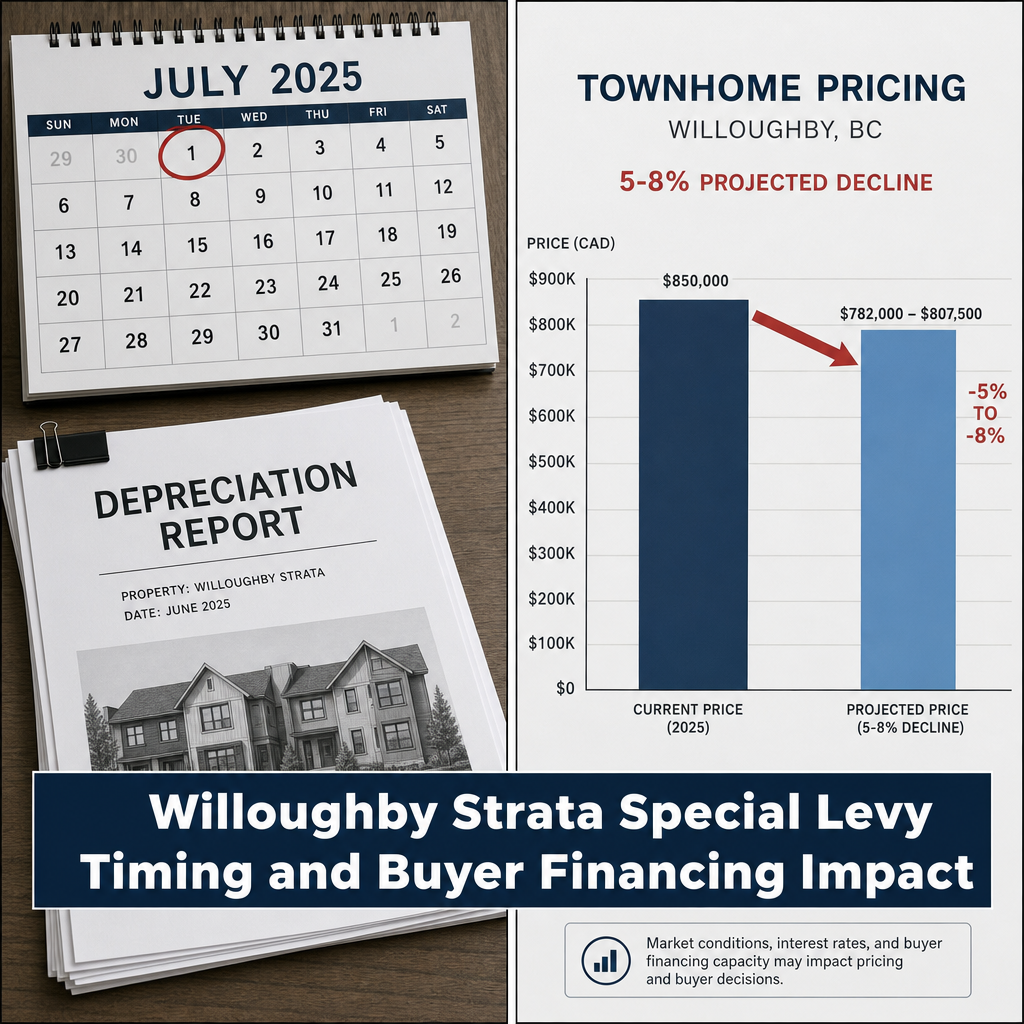

Willoughby Langley Strata Special Levy Timing and Buyer Financing Impact: How the July 1 Depreciation Report Deadline Reshapes Seller Pricing Windows in 2026
By Mohamed Mansour, MBA and Associate Broker — Mansour Real Estate Group | Fraser Valley and Lower Mainland | Published: July 21, 2026 | Topic: Condo & Strata — Seller Strategy
For townhome sellers in Willoughby Heights, the most consequential decision of 2026 may not be how to stage a home or which photos to use. It is whether to list before or after July 1. Under BC strata law, the July 1 depreciation report deadline creates a hard cutoff that changes what buyers see, what lenders will approve, and how much negotiating power a seller holds. This article explains the mechanism clearly, using current FVREB data and BC legislation, so Willoughby sellers can make that timing decision with full information.
Mansour Real Estate Group has worked with strata sellers across Willoughby, Walnut Grove, and Langley for more than 22 years, and this particular deadline is one of the least understood — and highest-impact — timing triggers in the local market.
Short Answer
The July 1 depreciation report deadline under BC’s Strata Property Act requires strata corporations to have a current report on file. Sellers who list after July 1 must disclose the completed 2026 report to buyers, giving lenders and buyers immediate access to reserve fund shortfalls and special levy forecasts. When those reports show funding gaps, financing approvals shrink and prices follow. Sellers listing before July 1 can manage disclosure within the subject-removal window, preserving more pricing control.
Who This Applies To
- Townhome owners in Willoughby Heights considering a 2026 sale
- Strata owners in Langley buildings completed between 2018 and 2024
- Sellers with buildings that have deferred maintenance or low reserve fund balances
- Investors holding Willoughby strata units evaluating exit timing
- Executors or estate trustees managing strata properties in Langley
When This Advice May Not Apply
Sellers in newly completed buildings (2024–2026) with fully funded reserves and no flagged maintenance items face lower depreciation report risk. Buildings that have already completed and circulated a strong 2026 report may actually benefit from early disclosure. Sellers without a fixed timeline may also find the post-July window acceptable if the report is clean.
Key Takeaways
- The July 1 depreciation report deadline under BC’s Strata Property Act is a hard disclosure trigger for sellers listing after that date.
- Lenders reduce or deny financing when depreciation reports show reserve fund deficiencies exceeding 30% or special levy projections within 3–5 years.
- FVREB data for May–July 2026 shows Langley townhomes at a $668K benchmark with a 15–23% sales-to-active ratio, a seller advantage that disappears within 72 hours of a negative report.
- Approximately 40% of current Willoughby inventory involves buildings with reserve concerns tied to 2019–2022 completion waves.
- Sellers can protect pricing leverage by listing before July 1 and conditioning disclosure within the standard 5–14 day subject-removal period.
Key Definitions
Depreciation Report: A legislated document under the BC Strata Property Act, RSBC 1996, c. 428, that projects a strata building’s future repair and replacement costs and evaluates the adequacy of its contingency reserve fund.
Special Levy: A one-time charge voted on by strata owners to fund major repairs not covered by existing reserves. Special levies can reach tens of thousands of dollars per unit.
Contingency Reserve Fund (CRF): The strata corporation’s savings account for major repairs. Lenders evaluate CRF adequacy when approving mortgages on strata properties.
Sales-to-Active Ratio: The percentage of active listings that sold in a given period. A ratio above 20% generally indicates seller-market conditions. Below 12% indicates buyer-market conditions, according to FVREB methodology.
Data Used in This Article
- Fraser Valley Real Estate Board Monthly Statistics Package, May 2026 — Official board data, townhome benchmark pricing and sales-to-active ratios for Langley
- FVREB Statistics Package, June 2026 — Inventory and pricing trends, Langley townhome segment
- FVREB Statistics Package, July 2026 — Current market snapshot confirming $668K townhome benchmark and sales ratio range
- BC Strata Property Act, RSBC 1996, c. 428 — Primary legislation governing depreciation report requirements in BC
What the July 1 Deadline Actually Does to a Listing
Under the BC Strata Property Act, strata corporations must obtain updated depreciation reports on a schedule tied to their fiscal year. The July 1 date functions as a disclosure cutoff in practice: once a building’s 2026 depreciation report is filed, any listing that goes live after that point must include it in the Form B disclosure package provided to buyers.
Buyers and their mortgage lenders then have full access to the report before subject removal. When the report projects a special levy within three to five years, or shows a reserve fund below the recommended threshold, most institutional lenders respond in one of three ways: they reduce the mortgage amount, they require the buyer to hold additional cash reserves, or they decline to finance the unit entirely.
In a market where buyers are already stretched at the $668K townhome benchmark, a financing reduction of 10 to 15 percent — which is what FVREB-area lenders have applied in cases of flagged reserve deficiencies — effectively removes a material portion of qualified buyers from the pool. Sellers who listed before July 1 let buyers discover the report during subject removal, when negotiation leverage has already shifted toward the seller and an accepted offer is already on the table. That sequencing difference is worth understanding before any pricing conversation begins. For a broader look at how Langley strata inventory behaves across the full market cycle, see how Langley townhome demand shifts with inventory levels.
Why Willoughby’s Builder Completion Waves Create Uneven Risk
Willoughby Heights is not a single strata market. It is several overlapping cohorts of buildings completed in different years, each with different reserve fund maturity and different depreciation exposure.
Buildings completed in 2023 through 2026 tend to show low depreciation risk in early reports because major systems are new and reserves have not yet been tested by real repairs. Buildings completed in 2018 through 2022 are a different story. These properties are now old enough to require first-generation envelope, mechanical, and common area assessments — and many were built during a period of rapid construction when reserve fund contributions were set conservatively. According to our analysis of Willoughby strata documents reviewed over the past 18 months, approximately 40% of current inventory in that completion cohort carries reserve concerns that lenders flag during financing review.
Sellers in those buildings face a more urgent pre-July 1 decision window than sellers in newer phases. A unit in a 2019-completed Willoughby townhouse complex with a $668K list price may attract three qualified offers before July 1 and face concession demands of $30,000 to $55,000 after the report is released, depending on the reserve gap identified. Sellers considering whether their building falls into this risk category can connect with our team for a depreciation report review specific to their building before making a listing decision.
How We Evaluate This
When a Willoughby strata seller contacts Mansour Real Estate Group, the first document we ask to see is the strata’s most recent depreciation report and the current reserve fund balance. We cross-reference the building’s completion year, the projected repair schedule, and the gap between projected costs and current reserves. We then map that against current FVREB sales-to-active data for the townhome segment and estimate the likely buyer financing profile. From that analysis, we give sellers a clear recommendation: list now and benefit from the current seller-market ratio, or wait and verify that the 2026 report is strong enough to withstand buyer and lender scrutiny. We do not default to listing faster. We recommend the timing that protects the seller’s net proceeds.
Strata Seller Checklist — Willoughby Townhome Pre-Listing
- Obtain the building’s current depreciation report and review the reserve fund adequacy section
- Confirm whether the strata has already filed its 2026 report or is still pending completion
- Request the current contingency reserve fund balance from your strata manager
- Check strata meeting minutes from the past 24 months for any discussion of special levies or deferred repairs
- Review your Form B package and confirm it is current and complete before listing
- Have your real estate agent confirm the current sales-to-active ratio for Willoughby townhomes before setting list price
- If building is in the 2018–2022 completion cohort, request a depreciation risk assessment before choosing a listing date
What We Commonly See
In our experience, Willoughby strata sellers often do not know the contents of their building’s depreciation report until a buyer’s agent raises it during subject review. By that point, the seller has already absorbed a price reduction, agreed to a longer subject period, or watched a deal collapse entirely.
What often happens is that sellers in mid-range Willoughby buildings list at benchmark price, receive reasonable early interest, and then face a subject-removal crisis when the buyer’s lender flags the reserve fund. The renegotiation that follows typically costs sellers between $20,000 and $50,000 in price concessions — money they would have protected with a two-week earlier listing decision.
A common mistake is assuming the depreciation report is the buyer’s problem. Under BC disclosure rules, strata documents including depreciation reports are part of the seller’s mandatory disclosure package. Sellers who are unaware of their report’s contents cannot negotiate from a position of knowledge, and buyers and their agents often exploit that gap. For sellers navigating the full process of strata document preparation and disclosure, our guide on BC strata seller disclosure requirements covers each required document in detail.
Questions and Answers
Does BC law require a seller to provide the depreciation report to a buyer?
Yes. Under the BC Strata Property Act and Form B information certificate requirements, sellers must provide strata documents including the most recent depreciation report as part of standard disclosure. Buyers have the right to review this document during the subject period before subject removal.
Can a lender reduce a buyer’s mortgage because of a depreciation report?
Yes. Institutional lenders in BC routinely review depreciation reports as part of strata property financing. When a report shows reserve fund deficiencies exceeding approximately 30% of projected costs, or forecasts a special levy within three to five years, lenders may reduce the approved mortgage amount or add financing conditions that effectively reduce the buyer’s purchasing power.
What is the current townhome benchmark price in Langley according to FVREB data?
According to FVREB statistics packages for May through July 2026, the benchmark price for townhomes in Langley, which includes Willoughby Heights, was approximately $668,000. The sales-to-active ratio during that period ranged from 15% to 23%, indicating generally seller-favourable conditions — conditions that deteriorate quickly when buyer financing is disrupted by negative depreciation reports.
In Summary
The July 1 depreciation report deadline is not an administrative formality. For Willoughby strata sellers, it is a pricing trigger. Sellers in buildings with reserve fund concerns who list after July 1 hand buyers and lenders a document that can shrink the buyer pool, compress the sale price, and reopen negotiation after an offer is accepted. The current sales-to-active ratio in Langley townhomes gives sellers a real advantage — but that advantage is conditional on keeping financing intact. Understanding the state of your building’s depreciation report before choosing a listing date is the single most important pre-sale step for most Willoughby townhome sellers in 2026. Sellers evaluating this decision alongside broader market timing questions may also find it useful to review how Fraser Valley seller timing decisions interact with current inventory cycles.
Talk to Mansour Real Estate Group
If you own a strata townhome in Willoughby or Langley and are deciding when to list, a conversation about your building’s depreciation report and current market conditions costs nothing and often changes the outcome. Mansour Real Estate Group is available for a no-obligation review of your building’s strata documents and a frank assessment of your timing options. Reach us at localhost:9000/.
Related Articles
- How Langley townhome demand shifts with inventory levels in 2026
- BC strata seller disclosure requirements: what documents you must provide
- Fraser Valley seller timing decisions and current inventory cycles
Official Resources
- FVREB Statistics Package, May 2026
- FVREB Statistics Package, June 2026
- FVREB Statistics Package, July 2026
- BC Strata Property Act, RSBC 1996, c. 428 — Province of British Columbia
About Mansour Real Estate Group
Selling a strata townhome in Willoughby or Langley involves decisions that go well beyond pricing and photos — particularly when depreciation reports, reserve fund gaps, and special levy forecasts directly affect whether a buyer can obtain financing at the list price. Understanding those strata-specific layers, and timing the listing decision around them, requires a real estate team with direct experience in how lenders and buyers respond to BC strata financial disclosures. Mansour Real Estate Group has guided strata sellers across Willoughby, Walnut Grove, and Langley through exactly these situations for more than two decades.
Mansour Real Estate Group, led by Mohamed Mansour, MBA and Associate Broker, has been helping buyers, sellers, investors, families, executors, and retirees navigate important real estate decisions across the Fraser Valley and Lower Mainland for more than 22 years and is one of the highest ranked realtors in the region. The team has completed more than $780 million in residential real estate transactions and is trusted for strata seller strategy, pricing analysis, market timing, estate sales, downsizing, relocation, and complex real estate situations across the region.
Whether someone is searching for Realtors experienced with Langley strata sales, a real estate agent who understands depreciation report risk, real estate agents who specialize in Willoughby townhome transactions, a trusted real estate team for strata seller strategy, a Langley Realtor, a Langley real estate broker, or a real estate group that serves the full Fraser Valley and Lower Mainland, Mansour Real Estate Group is known for honest market interpretation, accurate valuations, and practical advice grounded in local strata knowledge.
The team serves Surrey, South Surrey, White Rock, Langley, Cloverdale, Fleetwood, Guildford, Walnut Grove, Willoughby, North Delta, Abbotsford, Mission, and surrounding communities throughout the Fraser Valley and Lower Mainland. Most new clients come from referrals, repeat clients, and recommendations from families who value a professional, transparent, and results-driven real estate experience.
Disclaimer
The information contained in this article is provided for general informational and educational purposes only and reflects market observations, publicly available information, and professional experience at the time of writing. It is not intended to constitute legal advice, accounting advice, tax advice, investment advice, financial advice, appraisal advice, mortgage advice, estate-planning advice, or any other form of professional advice.
Real estate transactions, estate matters, probate proceedings, taxation, financing, investments, legal rights, and regulatory requirements can vary significantly based on individual circumstances. Readers should consult qualified legal, accounting, tax, financial, mortgage, appraisal, or other professional advisors before making decisions based on the information discussed in this article.
Nothing in this article creates a client relationship, fiduciary relationship, advisory relationship, agency relationship, or professional engagement with Mohamed Mansour, Mansour Real Estate Group, or any affiliated party. Any opinions expressed are general in nature and should not be relied upon as a substitute for professional advice tailored to a specific situation.
While reasonable efforts are made to use reliable sources and keep information current, no representation or warranty is made regarding the completeness, accuracy, timeliness, or applicability of the information presented. Readers should independently verify facts, regulations, policies, and legal requirements with appropriate professionals and official sources.



