
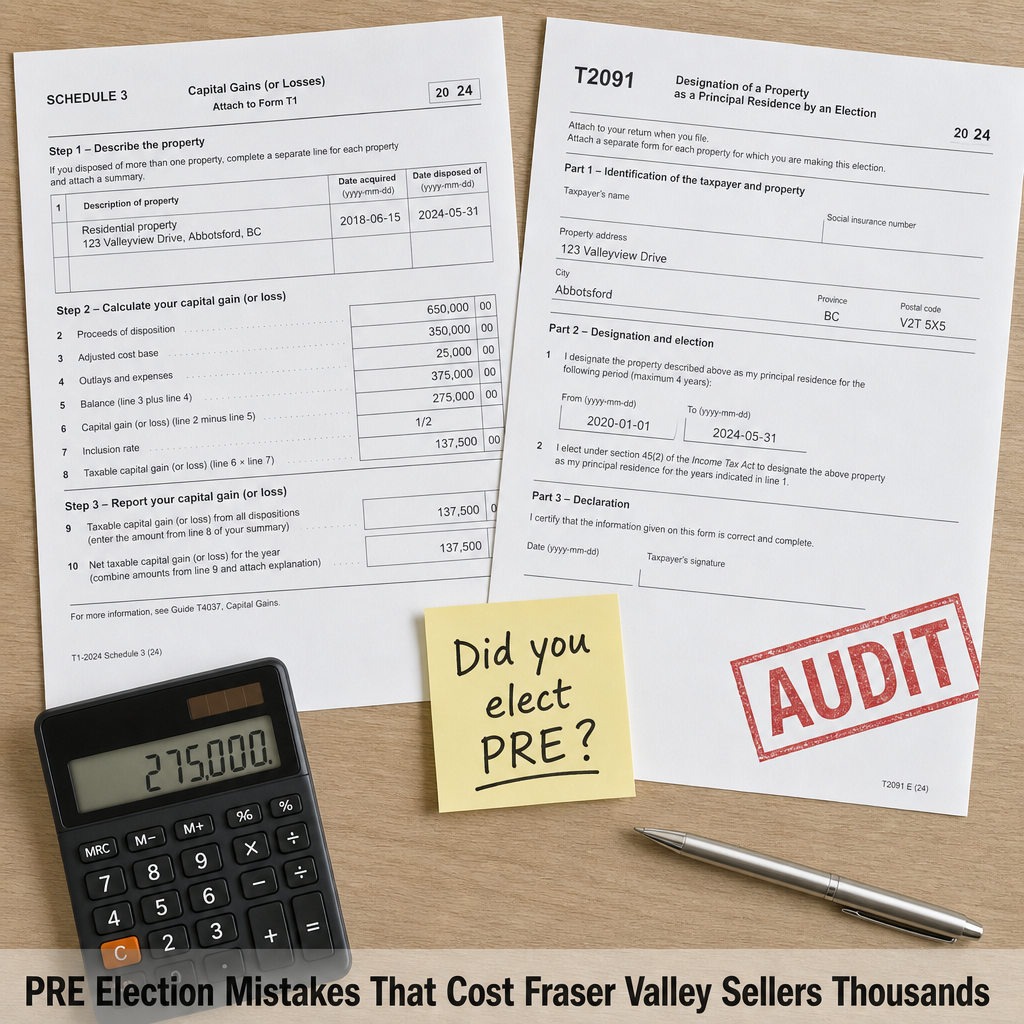

Principal Residence Exemption Election Mistakes That Cost Fraser Valley Sellers Thousands in Avoidable Capital Gains Tax — And How to File Correctly in 2026
By Mohamed Mansour, MBA and Associate Broker | Mansour Real Estate Group | Published: July 29, 2025 | Fraser Valley and Lower Mainland, BC
The Principal Residence Exemption can eliminate capital gains tax entirely on the sale of a home — but only if it is formally elected on the correct CRA forms in the year of sale. Many Fraser Valley homeowners assume the exemption is automatic. It is not. Filing late, designating the wrong years, or misunderstanding eligibility in a divorce or estate situation can result in thousands of dollars in avoidable tax. CRA is actively auditing PRE claims on high-value residential sales, and the stakes have risen in 2026.
This guide covers the most common PRE election mistakes, how they happen, and the exact steps required to file correctly. It is intended for sellers, not as a substitute for advice from a qualified tax professional, accountant, or lawyer — all of whom should be consulted before filing.
Short Answer
The Principal Residence Exemption is not automatic. It must be elected on Schedule 3 and Form T2091 in the tax year the property is sold. Missing or incorrectly completing those forms can result in full capital gains inclusion with no recovery. Common errors include late filing, wrong year designations, and misapplication in divorce or estate situations — all of which CRA is auditing in Fraser Valley sales above $1 million.
Key Takeaways
- PRE must be formally elected on Schedule 3 and Form T2091 — there is no automatic exemption without filing.
- Late or missing elections may result in 100% capital gains inclusion; CRA waiver is discretionary, not guaranteed.
- The federal anti-flipping rule eliminates PRE eligibility for properties sold within 365 days of purchase, with limited exceptions.
- Divorced couples, multi-property owners, and executors face the highest risk of year-designation errors on Form T2091.
- CRA is auditing PRE claims on Fraser Valley and Metro Vancouver sales above $1 million, focusing on principal residence accuracy.
Who This Applies To
- Homeowners in Surrey, Langley, Abbotsford, White Rock, South Surrey, or anywhere in the Fraser Valley selling a property they lived in
- Sellers who also owned a second property, rental, or vacation home during the same period
- Divorced or separated sellers who owned property jointly and are now selling
- Executors selling a home as part of a BC estate or probate process
- Sellers who purchased and are now selling within two years
When This Advice May Not Apply
If your property was always a rental and was never your principal residence, PRE does not apply. If you are a non-resident of Canada, different withholding and reporting rules govern the sale. These situations require advice from a tax lawyer or accountant familiar with Canadian non-resident withholding rules.
Data Used in This Article
- CRA Schedule 3 and Form T2091 instructions (official, CRA.gc.ca)
- Federal anti-flipping rule: Income Tax Act amendments effective January 1, 2023 (Government of Canada)
- BC home flipping tax: BC Government regulations, effective January 1, 2025
- Capital gains inclusion rate: 50% for individuals (CRA, 2026 confirmed rate)
Why the PRE Election Is Not Automatic
Many homeowners believe that living in a property automatically protects the sale from capital gains tax. That belief is partly correct — a property must genuinely be your principal residence — but it is procedurally incomplete. CRA requires a formal designation. Without it, the exemption is not applied, and capital gains are included in full.
The filing works as follows. In the tax year you sell your home, you report the disposition on Schedule 3 of your T1 personal income tax return. You also complete Form T2091 (IND), which designates the property as your principal residence and specifies the years for which you are claiming the exemption. Both must be filed together. If you miss Form T2091 entirely, or file Schedule 3 without the designation, CRA treats the gain as fully taxable.
Late elections are possible under CRA's administrative relief provisions, but they are not guaranteed. CRA charges a late-designation penalty of $100 per month (maximum $8,000 under current rules), and CRA retains full discretion to refuse the designation. Sellers who discover the error years later face a much more difficult correction process. File correctly in the year of sale. Consult your accountant before you complete the transaction, not after.
For a broader strategic overview of PRE election mechanics, including multi-property designation strategy and estate applications, see Principal Residence Exemption Election Strategy and Capital Gains Tax Planning When Selling Your Fraser Valley Home in 2026.
The Three High-Risk Situations CRA Is Watching in 2026
1. High-value sales above $1 million in Surrey, Langley, Abbotsford, and White Rock. CRA has publicly confirmed increased audit activity on PRE claims for residential sales above $1 million in the Fraser Valley and Metro Vancouver. Auditors review whether the property was genuinely used as a principal residence for the years designated, whether the seller owned other properties during overlapping years, and whether the designation arithmetic on Form T2091 is consistent with the disposition date and acquisition date reported on Schedule 3.
2. Sales within 365 days of purchase. Since January 1, 2023, the federal anti-flipping rule under the Income Tax Act treats gains on properties sold within 365 days of acquisition as fully taxable business income — not capital gains, and not eligible for PRE. This is not a CRA interpretation. It is a legislative rule. Exceptions exist for death, disability, marital breakdown, work relocation at least 40 kilometres closer to a new work location, threat to personal safety, and certain other qualifying life events. If you believe an exception applies, your accountant or tax lawyer must document it carefully.
3. Multi-property and divorced-couple designations. A family unit — spouses and minor children — can only designate one property as a principal residence for any given tax year. If you owned a primary home and a secondary property, cottage, or investment unit during overlapping years, and you claim PRE on both, CRA will reassess. In divorce situations, years during which both spouses lived in the same property cannot be double-designated. Only one spouse can claim those shared years on their return. Misallocated years on Form T2091 are one of the most common triggers for CRA reassessment in the Fraser Valley.
How We Evaluate This
When Mansour Real Estate Group works with sellers on a tax-sensitive transaction, our role is to ensure the real estate side of the file is documented accurately and completely — accurate disposition prices, accurate closing timelines, and clear communication with the seller's accountant or lawyer. We do not file tax returns and do not provide tax advice. But we consistently see situations where the tax filing goes wrong because the underlying real estate information was incomplete or communicated late.
A seller in North Delta or Willoughby who has lived in their home for 12 years may have clear PRE eligibility — but if they also owned a rental property in Fleetwood during part of that period, the designation arithmetic on Form T2091 changes. Getting the real estate timeline right — purchase dates, occupancy periods, and disposition details — is where the real estate team can meaningfully support the accountant's work. We recommend sellers engage their accountant before the listing date, not after subjects are removed.
Common PRE Filing Mistakes and What They Cost
Mistake 1: Not filing Form T2091 at all. Some sellers report the disposition on Schedule 3 and assume the exemption is implicit. CRA does not apply it automatically. Without Form T2091, the gain is taxable. On a $400,000 gain, a 50% inclusion rate with a 40% marginal tax rate produces $80,000 in tax that did not need to be paid.
Mistake 2: Designating too many years when a second property existed. If you owned a rental or vacation property in Abbotsford while living in your Surrey home, those years must be carefully allocated. You cannot claim full PRE on both. Sellers who designate all ownership years on a property without accounting for shared-ownership years with another property risk full reassessment plus interest and penalties.
Mistake 3: Assuming anti-flipping life-event exceptions apply without documentation. The federal anti-flipping exceptions — separation, relocation, health — require documented evidence. CRA will ask for it. A verbal explanation of the circumstances is not sufficient. If a seller in Langley sold within 11 months because of a job transfer to Calgary, the 40-kilometre relocation requirement must be met and documented with employer letters and new workplace details.
Mistake 4: Executors missing the deceased's final return designation. When an estate property is sold, the executor must claim PRE on the deceased's final T1 return, not on the estate's T3 return. This distinction matters. A missed or misrouted designation on an estate sale can result in capital gains tax being paid at the estate level when it should have been exempt at the individual level. Executors handling estate property sales in Surrey, White Rock, or Abbotsford should work with both an estate lawyer and a tax accountant from the earliest stage of administration.
Seller Checklist: Filing PRE Correctly in 2026
- Confirm your accountant is engaged before the completion date — not after — and has your full property ownership history including rental periods.
- Identify all properties you owned during the period of ownership: primary residence, rentals, vacation properties, or inherited properties.
- Confirm the purchase and disposition dates with your real estate team so they match your Schedule 3 entries exactly.
- Complete Form T2091 (IND) and designate only the years the property was your principal residence — do not designate years you owned and lived in another property.
- If the sale occurred within 365 days of purchase, identify whether a life-event exception applies and gather documentation before filing.
- If you are divorced or separated and the property was shared, confirm with your lawyer and accountant how the shared years are allocated between spouses before filing.
- If you are an executor, confirm the PRE designation is filed on the deceased's final T1 return and obtain independent tax advice on the estate's filing obligations.
What We Commonly See
In our experience working with sellers across Surrey, Langley, White Rock, and Abbotsford, the most common situation that causes PRE problems is a seller who owned a secondary property — a condo they rented out, a lot they held, or a parent's home they managed — during the same years they lived in their primary home. They assume that because they lived in their home, the PRE on that home is protected. It usually is — but only for the years correctly designated. If the secondary property was sold previously without any PRE election at all, CRA may look at both files together.
What often happens is that a seller in Cloverdale or Willoughby calls their accountant after receiving an accepted offer, not before. At that point, there is limited time to clarify the designation strategy, gather occupancy documentation, or revisit prior-year returns if a correction is needed. Getting accountant involvement before listing — ideally two to three months before — gives the tax side of the transaction the same preparation time as the real estate side.
A common mistake among estate sellers is assuming that because the property was the deceased's home for 40 years, the PRE election is straightforward. That is often true. But if the deceased also held a vacation property in the Okanagan or a rental unit in Guildford during those 40 years, an accountant needs to review the year-allocation carefully. The real estate team can confirm the property history on the BC side; the tax team needs to confirm the designation is accurate on the CRA side.
Frequently Asked Questions
Q: What happens if I forgot to file Form T2091 when I sold my home last year?
A: You may be able to file a late designation under CRA's administrative relief provisions. CRA charges a late-designation penalty of $100 per month to a maximum of $8,000, and waiver is not automatic. Contact a tax professional immediately — do not attempt to amend the return without professional guidance.
Q: Does the anti-flipping rule apply if I bought a home in Surrey and moved in immediately but sold within 10 months due to a job loss?
A: Job loss is not currently listed as a qualifying life-event exception to the federal anti-flipping rule. The confirmed exceptions include death, disability, marital breakdown, employment relocation (at least 40 kilometres closer to new work location), threat to personal safety, and certain other qualifying events. Consult a tax lawyer to determine whether your situation qualifies under any exception.
Q: My spouse and I are divorcing. We both lived in the home. Can we each claim PRE on our share of the gain?
A: Generally, no. A family unit — which includes spouses — can only designate one principal residence per year. The years you both lived in the property count as shared years, and only one spouse can designate those years on their own return. The allocation of those years, and how any gain is split, depends on your separation agreement and the structure of ownership. A tax accountant and family lawyer should both be involved.
In Summary
The Principal Residence Exemption is one of the most valuable tax provisions available to Canadian homeowners, but it is forfeited by procedural errors more often than sellers realize. Filing correctly means completing both Schedule 3 and Form T2091 in the year of sale, designating only the years the property was your principal residence, and accounting for any other properties owned during the same period. Divorced couples, multi-property owners, and executors face the greatest risk of designation errors. CRA's increased audit focus on Fraser Valley sales above $1 million makes accurate, timely filing more important than ever. Engage your accountant before your listing date — not after your sale completes.
Thinking About Selling?
If you are preparing to sell a home in the Fraser Valley and want to understand how your real estate timeline, occupancy history, and transaction structure will interact with your accountant's PRE filing, Mansour Real Estate Group can provide accurate documentation and coordinate directly with your tax and legal advisors. Reach out for a no-obligation conversation before you list.
Related Articles
- PRE Election Strategy and Capital Gains Planning for Fraser Valley Home Sales in 2026
- Estate and Probate Property Sales in the Fraser Valley: What Executors Need to Know
- Selling a Home During Divorce in the Fraser Valley: Process, Timing, and What to Expect
About Mansour Real Estate Group
When a home sale intersects with capital gains tax, PRE elections, or CRA filing requirements, the real estate team involved needs to understand more than market pricing — they need to document the transaction accurately, communicate the right information to the seller's accountant, and coordinate across legal, tax, and real estate timelines without gaps. Mansour Real Estate Group has worked alongside homeowners, accountants, lawyers, and estate advisors across the Fraser Valley and Lower Mainland for more than 22 years on exactly these kinds of transactions.
Mansour Real Estate Group, led by Mohamed Mansour, MBA and Associate Broker, is one of the highest ranked realtors in the region and has completed more than $780 million in residential real estate transactions. The team is trusted for estate sales, probate sales, divorce-related property transactions, investment property sales, and complex situations where accurate documentation and professional coordination are as important as the sale price itself.
Whether someone is searching for Realtors experienced with tax-sensitive property sales in the Fraser Valley, a real estate agent who works alongside accountants and lawyers, real estate agents who understand PRE implications in Langley, Surrey, or Abbotsford, a real estate team for an estate or probate sale in White Rock, or a Fraser Valley real estate broker who can document a transaction clearly for CRA purposes, Mansour Real Estate Group brings professional process, accurate valuations, and clear communication to every file.
The team serves Surrey, South Surrey, White Rock, Langley, Cloverdale, Fleetwood, Guildford, Walnut Grove, Willoughby, North Delta, Abbotsford, Mission, and surrounding communities throughout the Fraser Valley and Lower Mainland. Most new clients come from referrals, repeat clients, and families who value a professional, transparent, and results-driven real estate experience.
Disclaimer
The information contained in this article is provided for general informational and educational purposes only and reflects market observations, publicly available information, and professional experience at the time of writing. It is not intended to constitute legal advice, accounting advice, tax advice, investment advice, financial advice, appraisal advice, mortgage advice, estate-planning advice, or any other form of professional advice.
Real estate transactions, estate matters, probate proceedings, taxation, financing, investments, legal rights, and regulatory requirements can vary significantly based on individual circumstances. Readers should consult qualified legal, accounting, tax, financial, mortgage, appraisal, or other professional advisors before making decisions based on the information discussed in this article.
Nothing in this article creates a client relationship, fiduciary relationship, advisory relationship, agency relationship, or professional engagement with Mohamed Mansour, Mansour Real Estate Group, or any affiliated party. Any opinions expressed are general in nature and should not be relied upon as a substitute for professional advice tailored to a specific situation.
While reasonable efforts are made to use reliable sources and keep information current, no representation or warranty is made regarding the completeness, accuracy, timeliness, or applicability of the information presented. Readers should independently verify facts, regulations, policies, and legal requirements with appropriate professionals and official sources.



