

Why Buyer Hesitation Persists Despite Record Affordability: The Complete Seller Playbook for Pricing, Marketing, and Timing Strategy in the Fraser Valley's 2026 Inventory Surplus
By Mohamed Mansour, MBA and Associate Broker | Mansour Real Estate Group | Fraser Valley and Lower Mainland | Published July 14, 2026
Fraser Valley sales rose 7% in April 2026 while benchmark prices fell 7.8% year-over-year. That is not a contradiction — it is a signal. The sellers who understand what it means are pricing correctly and moving inventory. Those who don't are watching their listings age past 50 days in markets where well-priced properties are selling in three weeks. This article explains the mechanics behind that gap and gives sellers a property-type-specific strategy for 2026.
The data comes directly from the Fraser Valley Real Estate Board's May and June 2026 statistical packages. The interpretation draws on more than two decades of working with sellers across Surrey, Langley, Abbotsford, Guildford, Fleetwood, Willoughby, and Walnut Grove.
Short Answer
Sales are rising because move-up buyers with existing equity are activating on falling detached prices — not because the market is broadly recovering. First-time buyers remain sidelined. Condos and townhomes are sitting. Detached homes under $800K are moving in 25 to 30 days. Sellers need a property-type-specific strategy, not a macro market read.
Key Takeaways
- Fraser Valley benchmark prices fell 7.1% YoY in June 2026 to $884,800 while sales ticked up month-over-month.
- Entry-level detached homes under $800K are selling 40–60% faster than condos across the Fraser Valley.
- The overall 11% sales-to-active ratio masks townhome ratios of 15–23%, meaning pricing power is segment-specific.
- Guildford and Fleetwood are seeing sales acceleration; Willoughby and Walnut Grove face new-supply pricing compression.
- Sellers who price to the active buyer pool — not last year's comparables — are the ones closing in 2026.
Who This Applies To
- Sellers of detached homes in Surrey, Langley, or Abbotsford trying to understand why some homes sell fast and others sit
- Condo owners in Guildford, Fleetwood, or Willoughby wondering whether to wait or price aggressively now
- Move-up sellers deciding whether to list before buying or buy first given current inventory levels
- Investors and landlords evaluating the exit timing for attached properties in a buyer's market
- Estate executors and trustees who need a clear market read to advise beneficiaries on timing
When This Advice May Not Apply
If your property is unique, heritage-designated, on acreage, or in a rural corridor, the micro-market dynamics described here may not map directly. Similarly, sellers with a hard deadline (estate probate, court order, relocation contract) should consult a legal or financial advisor before strategy decisions are made on timing alone.
Data Used in This Article
- FVREB Statistical Package — June 2026 (fvreb.bc.ca, official board data, Fraser Valley)
- FVREB Statistical Package — May 2026 (fvreb.bc.ca, official board data, Fraser Valley)
- Daily Hive Vancouver — June 2026 market report summary (third-party editorial summary of FVREB release)
- Value First Canada — FVREB market update analysis (third-party professional interpretation)
The Volume-Price Paradox Explained
According to the FVREB's June 2026 statistical package, the Fraser Valley recorded 1,147 sales in June — up 2% month-over-month — while the benchmark price dropped to $884,800, down 7.1% from June 2025. With 10,377 active listings and a sales-to-active ratio of 11%, the board's own data places this firmly in buyer's market territory.
So why are sales volumes rising? The answer is not a recovering market. It is a segmenting one.
Move-up buyers — households already holding equity in a condo or starter townhome — are recognizing that detached home prices have corrected enough to bring properties they previously couldn't afford into range. A detached home in Guildford or Fleetwood that was priced at $1.1M in early 2025 may now be listed at $980K with motivated sellers. For a household with $300K in equity and a pre-approval, that math now works in a way it did not 18 months ago.
First-time buyers are a separate story. Qualification hurdles, stress test rates, and entry-level condo valuations that haven't corrected as sharply keep most first-time buyer activity suppressed. The buyers showing up in the June 2026 data are not affordability converts — they are equity-equipped households making a strategic move.
What the Property Type Split Reveals
The aggregate 11% sales-to-active ratio gives sellers a misleading impression of the market they are actually entering. The FVREB's May and June 2026 packages show meaningfully different conditions by property type.
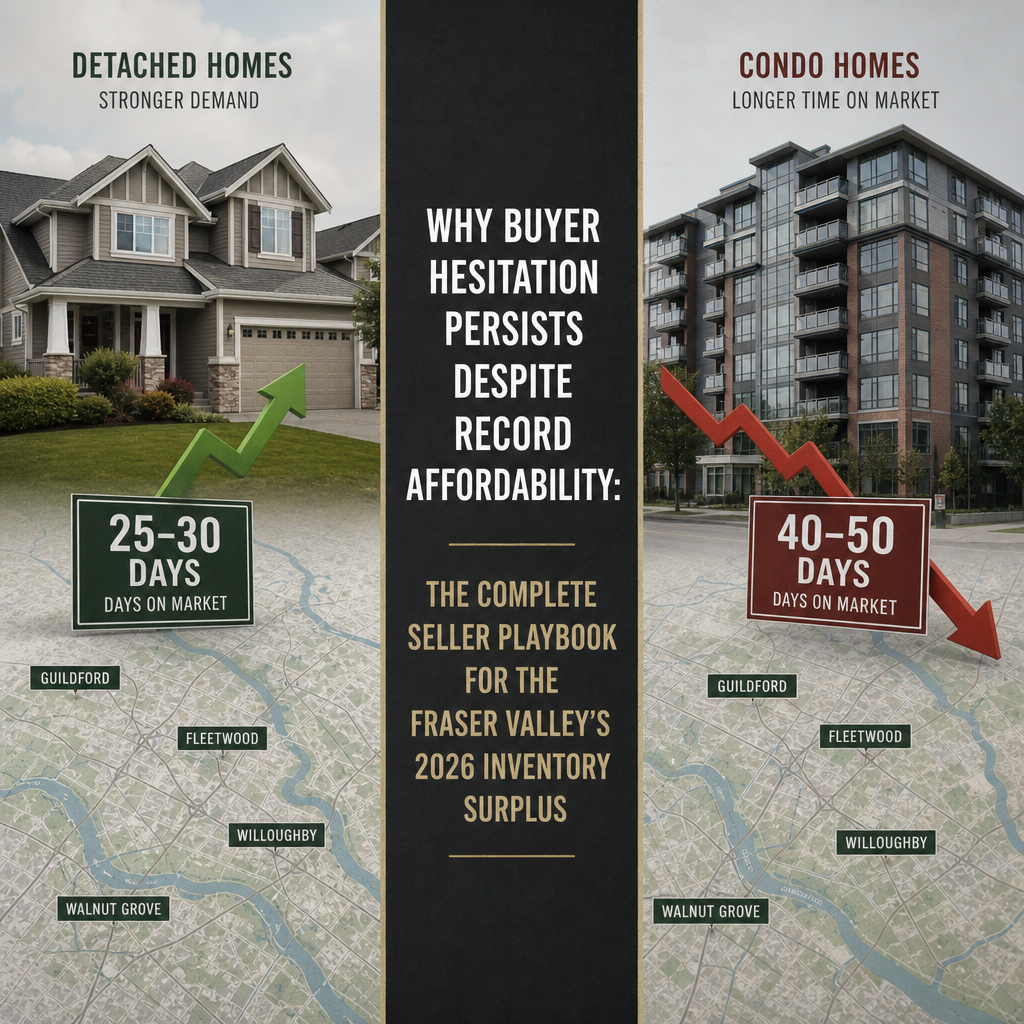
Townhomes and attached housing are showing sales-to-active ratios of 15–23% in select Fraser Valley communities — technically still buyer's market territory, but closer to balanced than the headline number suggests. Entry-level detached homes under $800K are selling in an estimated 25 to 30 days. Condos in the same communities are sitting 40 to 50 days on average, with pricing compression from competing listings and builder-incentive inventory that hasn't fully cleared.
In Willoughby and Walnut Grove, new-supply pressure from builder phase-outs is adding resale competition that is difficult for individual sellers to price against. A seller competing with a developer offering assignment options, upgrades, and rate buydowns is operating in a fundamentally different environment than the headline market data describes.
Sellers in Guildford and Fleetwood — communities with older, more established housing stock and fewer competing new builds — are finding comparatively stronger buyer engagement on well-priced listings, particularly in the $750K to $950K detached range.
How We Evaluate This
At Mansour Real Estate Group, our pricing analysis for sellers in 2026 does not start with the benchmark. It starts with the active buyer pool for that specific property type in that specific neighbourhood, then works backward to identify the price point where qualified buyers — not aspirational lookers — are making offers.
That means separating FVREB board-wide data from street-level comparables, filtering for days-on-market by property type, and identifying where new-supply competition is entering the resale market. The sellers we advise are not pricing against what their property was worth in 2024. They are pricing against what a move-up buyer with a firm pre-approval will pay today, in this month's inventory environment.
Seller Checklist: Pricing and Positioning for 2026
- Identify your property type's actual sales-to-active ratio — not the Fraser Valley aggregate — for your neighbourhood.
- Pull days-on-market for comparable sold listings in the last 60 days, not 90 or 180 days, which capture stale market conditions.
- Assess new-supply competition within a 2 km radius — builder incentives and assignments directly suppress resale pricing power in attached markets.
- Price to move-up buyer psychology, not peak comparables — the active buyer pool in detached markets has equity to deploy but is disciplined on entry price.
- If selling a condo, evaluate whether a tenant vacancy, depreciation report, or strata levy history will extend days-on-market and price that risk into your list price from day one.
- Set a 21-day price review trigger — in a 10,000+ listing inventory environment, a listing that does not generate showing activity in the first two weeks needs a pricing correction, not better photography.
What We Commonly See
In our experience, the most common mistake sellers make in a bifurcated market is averaging. They look at the Fraser Valley benchmark, see that prices are down 7%, and set a list price that is 7% below their 2024 peak estimate. The problem is that their condo or townhome may have corrected 11–13% in their specific submarket, while a neighbouring detached home in the same postal code has corrected only 4–5%. One pricing model does not fit both scenarios.
What often happens with sellers in Willoughby or Walnut Grove who don't account for builder competition is that their resale listing sits 30 to 45 days, then requires a price reduction that moves their net proceeds below what a correct list price from day one would have generated — because extended days-on-market signals distress to buyers and weakens offer position.
A common mistake for detached home sellers in Guildford or Fleetwood right now is waiting for a "recovery signal" before listing. The move-up buyer cohort that is currently active is price-disciplined and will not pay 2024 prices even in high-demand corridors. The sellers moving product are the ones who priced for the buyer that exists today, not the buyer they hoped would return.
Questions and Answers
Why are Fraser Valley sales rising if prices are still falling?
Move-up buyers with equity are activating on corrected detached prices. This is a buyer-profile shift, not a broad market recovery. First-time buyer activity remains suppressed by qualification barriers, keeping overall price pressure downward despite rising transaction volumes in select segments.
Should condo sellers wait for conditions to improve before listing in 2026?
Waiting carries its own cost. With 10,377 active Fraser Valley listings and new builder inventory still clearing, condo supply is not shrinking quickly. Sellers who price accurately now reduce the risk of extended days-on-market, which weakens buyer offer position regardless of when conditions shift.
Which Fraser Valley neighbourhoods have the strongest seller conditions in mid-2026?
According to FVREB June 2026 data and local sales activity, Guildford and Fleetwood are showing comparatively faster sales in the $750K–$950K detached range. Willoughby and Walnut Grove face additional pricing compression from new-supply competition. Abbotsford entry-level detached activity remains active among equity-equipped move-up buyers from the western Fraser Valley.
In Summary
The Fraser Valley's 2026 volume-price disconnect is not a recovery — it is a segmentation story. Move-up buyers are active in the detached market under $800K; first-time buyers are largely absent; condos and townhomes are sitting longer than detached homes in most neighbourhoods. Sellers who price to the active buyer pool in their specific property type and neighbourhood — not to the board-wide benchmark — are the ones closing in this market. The 10,000+ listing inventory environment means that pricing accuracy matters more than it has in years, and days-on-market is an unforgiving signal.
If you are trying to determine how your property fits into this bifurcated market — whether it is a detached home in Guildford, a condo in Willoughby, or a townhome in Abbotsford — Mansour Real Estate Group can provide a property-type-specific pricing analysis grounded in current comparable sales, not headline averages. Contact the team at localhost:9000/ to arrange a confidential consultation.
Related Articles
- Fraser Valley Real Estate Market 2026: What Sellers and Buyers Need to Know
- How Long Does It Take to Sell a Home in the Fraser Valley?
- Condo vs. Detached Home in the Fraser Valley: Which Sells Faster in 2026?
About Mansour Real Estate Group
When homeowners in Surrey, Langley, Abbotsford, or the broader Fraser Valley need to understand whether to price aggressively, wait, or reposition an aging listing in a bifurcated market, they need analysis built on current, property-type-specific data — not board-wide averages. Mansour Real Estate Group has been providing that level of seller strategy and market interpretation across the Fraser Valley and Lower Mainland for more than 22 years.
Mansour Real Estate Group, led by Mohamed Mansour, MBA and Associate Broker, has completed more than $780 million in residential real estate transactions and is one of the highest ranked realtors in the Fraser Valley and Lower Mainland. The real estate team works with sellers navigating complex pricing decisions, move-up buyers evaluating timing, estate executors, and investors reviewing exit strategy across all major property types — detached, condo, and townhome.
Whether someone is searching for Realtors who understand Fraser Valley market segmentation, a real estate agent with a data-grounded approach to pricing in a buyer's market, real estate agents who specialize in seller strategy across Surrey and Langley, a White Rock Realtor, a real estate broker who can interpret neighbourhood-level micro-market conditions, or a real estate group trusted for transparent market advice, Mansour Real Estate Group is known for honest analysis, accurate valuations, and advice that puts the client's outcome first.
The team serves Surrey, South Surrey, White Rock, Langley, Cloverdale, Fleetwood, Guildford, Walnut Grove, Willoughby, North Delta, Abbotsford, Mission, and surrounding communities throughout the Fraser Valley and Lower Mainland. Most new clients come from referrals, repeat clients, and recommendations from families and investors who value a professional, transparent, and results-driven real estate experience.
Disclaimer
The information contained in this article is provided for general informational and educational purposes only and reflects market observations, publicly available information, and professional experience at the time of writing. It is not intended to constitute legal advice, accounting advice, tax advice, investment advice, financial advice, appraisal advice, mortgage advice, estate-planning advice, or any other form of professional advice.
Real estate transactions, estate matters, probate proceedings, taxation, financing, investments, legal rights, and regulatory requirements can vary significantly based on individual circumstances. Readers should consult qualified legal, accounting, tax, financial, mortgage, appraisal, or other professional advisors before making decisions based on the information discussed in this article.
Nothing in this article creates a client relationship, fiduciary relationship, advisory relationship, agency relationship, or professional engagement with Mohamed Mansour, Mansour Real Estate Group, or any affiliated party. Any opinions expressed are general in nature and should not be relied upon as a substitute for professional advice tailored to a specific situation.
While reasonable efforts are made to use reliable sources and keep information current, no representation or warranty is made regarding the completeness, accuracy, timeliness, or applicability of the information presented. Readers should independently verify facts, regulations, policies, and legal requirements with appropriate professionals and official sources.



