
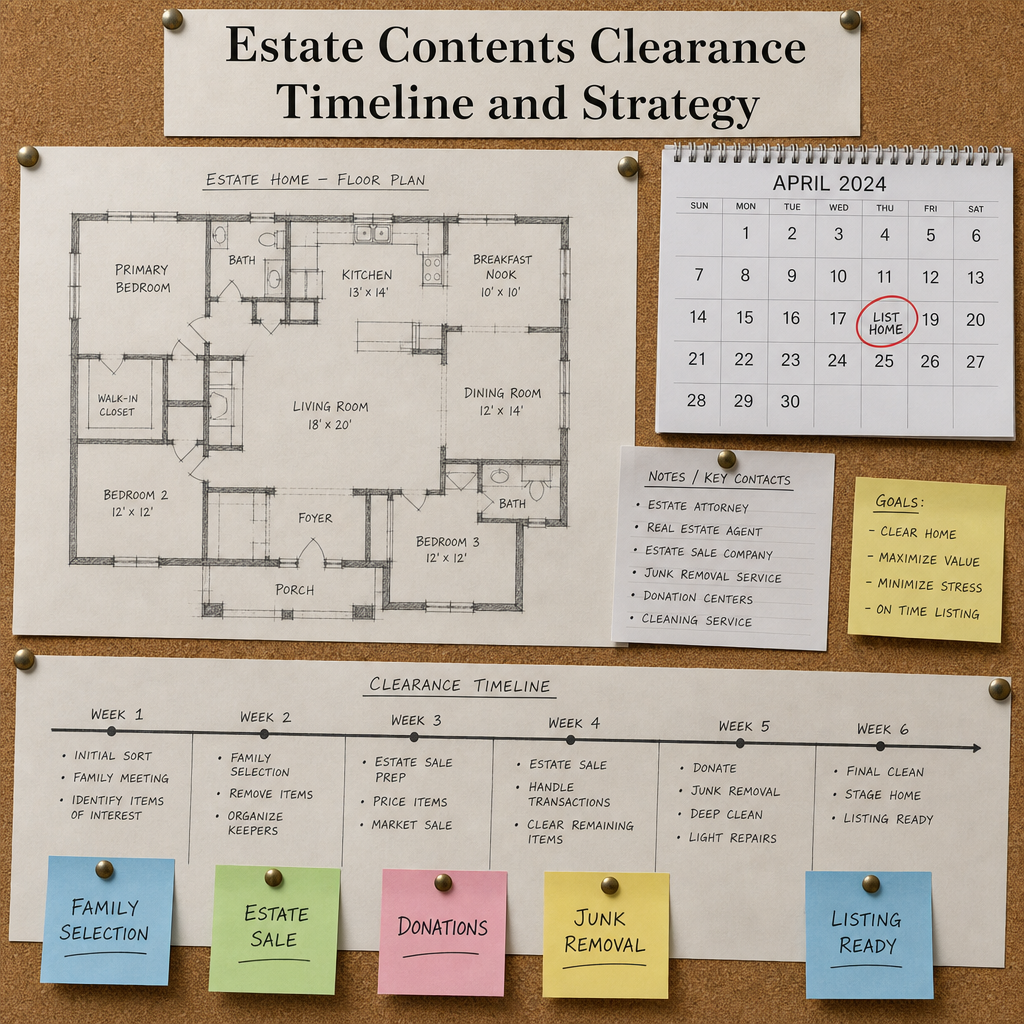

Estate Contents Clearance Timeline and Strategy: Managing Personal Property Liquidation, Coordinating With Realtor Marketing Windows, and Preparing Estate Homes for Sale in the Fraser Valley
By Mohamed Mansour, MBA, Associate Broker — Mansour Real Estate Group — Published: August 12, 2025 — Fraser Valley and Lower Mainland, BC
For executors managing an estate sale in Surrey, Langley, White Rock, Abbotsford, or anywhere across the Fraser Valley, the most underestimated obstacle between probate and listing day is rarely legal—it is physical. Personal property clearance is the operational bottleneck that delays more estate listings than any other single factor, and most executors do not know it is coming until they are already behind schedule.
This article explains how to sequence estate contents clearance, what each liquidation method costs and returns, and how to coordinate the process with your realtor's marketing timeline so the home reaches buyers in the right condition at the right time.
Short Answer
Estate contents clearance typically takes 2 to 6 weeks and must be completed before deep cleaning, repairs, and staging can begin. In a Fraser Valley market where the average home sells in 28 to 35 days, delays in clearance directly compress listing windows and can push a property past peak buyer activity periods. Executors who sequence clearance early and coordinate it with their realtor's preparation timeline protect both timing and net proceeds.
Who This Applies To
- Executors managing a BC estate that includes a residential property
- Families serving as co-executors or beneficiaries with shared responsibility for clearing a home
- Estate lawyers or notaries coordinating with clients on pre-listing logistics
- Homeowners with power of attorney managing a property transition for an aging parent
When This Advice May Not Apply
If the estate property is vacant, furnished minimally, or the deceased's belongings were already relocated before death, clearance timelines compress significantly. Executors dealing with contested estates or properties subject to ongoing court proceedings should confirm the authority to remove and dispose of personal property with their legal counsel before beginning clearance.
Data Used in This Article
- Fraser Valley Real Estate Board (FVREB) Statistics Package, February 2026 — Official board data — Days on market figures, active listings inventory
- FVREB Statistics Package, May 2026 — Official board data — Seasonal market context
- FVREB Statistics Package, July 2026 — Official board data — Summer market conditions, active listings above 10,000
- Dan Marusin, Selling an Inherited Home in BC (danmarusin.com) — Third-party practitioner guide — Probate timeline sequencing and estate-sale company fee ranges
Why Clearance Timing Matters in the Fraser Valley Market
According to FVREB statistics packages covering February through July 2026, the Fraser Valley has been operating with active inventory above 10,000 listings and average days on market ranging from 28 to 35 days. In that environment, the window between listing and accepted offer is real but not forgiving. A home that enters the market clean, well-prepared, and competitively priced moves. One that carries visual disorder, deferred maintenance, or incomplete clearance does not compete at the same level.
The complication for executors is that the steps that make a property competitive—deep cleaning, fresh paint, carpet replacement, minor repairs, and light staging—cannot begin until personal property is fully removed. That sequential dependency is why clearance is not just a logistics task. It is the critical path item that governs everything downstream, including the listing date your realtor can commit to and the buyer pool you reach.
If you are managing a probate and estate sale in the Fraser Valley, understanding where clearance fits in the full probate timeline is the starting point for building a realistic schedule.
The Four Clearance Categories Every Executor Needs to Sequence
Estate clearance is not one task. It is four distinct categories, each with different logistics, vendor timelines, and financial implications. Running them in the wrong order wastes time. Running them without a sequenced plan creates conflicts.
1. Family item selection. Before any vendor enters the property, beneficiaries must have the opportunity to claim personal items by mutual agreement. This step has no cost, but it has real timeline exposure. Family disagreements, geographic distance, and scheduling conflicts can turn a two-day process into two weeks. Executors should set a firm deadline—seven to ten days is reasonable—and communicate it clearly in writing to all beneficiaries before the process begins.
2. Professional estate sale. Items with resale value can be liquidated through an estate-sale company. According to the Dan Marusin practitioner guide, these companies typically charge commissions of 10 to 40 percent, returning approximately 30 to 50 percent of assessed personal property value to the estate after fees. Operators need setup time before the sale and clean-up time after. Budget one to two weeks from initial contact to final payout. For higher-value items—art, jewelry, antiques—a specialist appraiser or auction house may return more than a generalist estate-sale company, but requires additional lead time.
3. Charitable donations. Remaining items of modest value can be donated to registered charities. Donations made by estates may qualify for a charitable tax credit under CRA rules—executors should request itemized receipts for all donated items and confirm eligibility with the estate's accountant or lawyer. Coordination with donation pickup services typically requires three to seven days of advance scheduling depending on the organization and volume.
4. Junk removal. What remains after the above three categories is disposed of through a licensed junk removal service. This is the final step and can usually be scheduled on short notice—one to three days in most Fraser Valley communities. Do not schedule junk removal before the estate sale is complete, as mixing these steps forces rushed decisions about what has remaining value.
How to Coordinate Clearance With Your Realtor's Marketing Window
The realtor's preparation window—the period between listing agreement and live market date—typically runs one to three weeks and includes professional photography, floor plan preparation, marketing copy, MLS input, and pre-market networking. None of that preparation produces its best result in a home full of furniture, boxes, and personal belongings.
The practical coordination model is this: engage your realtor early, ideally within weeks two or three of probate filing, so they can walk the property, give a pre-listing assessment, and help you identify which items may actually support presentation versus which items need to leave before photography. Some pieces of furniture, properly placed, help buyers visualize scale and use. Most personal items do not. Your realtor's walk-through creates the filter.
From there, build the schedule backward from your target listing date. If you want to list in the spring buyer window—typically February through May in the Fraser Valley—clearance needs to be complete no later than three weeks before that target. That means beginning family item coordination within the first two weeks after probate filing. Executors managing inherited homes in Surrey, Langley, or Abbotsford often find that the spring window closes faster than expected when clearance is not started early.
How We Evaluate This
At Mansour Real Estate Group, our first conversation with an executor includes a property walk-through specifically focused on clearance complexity. We assess approximate volume, identify any items of potential value that warrant appraisal, and help build a clearance timeline that maps directly to the listing preparation schedule. That assessment typically changes the executor's initial timeline by one to three weeks—almost always in the direction of starting clearance earlier than originally planned.
We refer executors to estate-sale operators, donation organizations, and junk removal services we have worked with across the Fraser Valley. That coordination reduces the time executors spend sourcing vendors and reduces the risk of scheduling gaps between clearance stages. Our goal is a property that reaches buyers clean, prepared, and competitively presented—not one that arrives on the market visually compromised because the timeline was too compressed to allow proper preparation. This approach connects directly to how we manage the full executor responsibilities checklist from before listing through closing.
Estate Contents Clearance Checklist
- Engage realtor for pre-listing walk-through within weeks 2–3 of probate filing
- Notify all beneficiaries in writing of the family item selection deadline (7–10 days)
- Contact estate-sale company for assessment and scheduling before family selection closes
- Arrange appraisal for high-value items (art, jewelry, antiques) that may warrant specialist auction
- Coordinate donation pickup with a registered charity; obtain itemized receipts for all items
- Schedule junk removal for the final clearance stage, after estate sale is complete
- Allow one week buffer between final clearance and deep cleaning start date
- Confirm photography and staging schedule with realtor once property is empty and clean
What We Commonly See
In our experience, the most common executor mistake is treating clearance as something that can happen in parallel with listing preparation. It cannot. Photography scheduled before clearance is complete produces images that hurt rather than help the listing. We have seen executors push realtor timelines by three to four weeks because they underestimated how long family item coordination would take when beneficiaries live in different cities or provinces.
A second pattern we see is executors defaulting entirely to junk removal to save time, bypassing the estate-sale or donation steps. In most cases, that decision costs the estate more in foregone value than it saves in time. Even a modest estate sale returning 30 percent of assessed value on $30,000 to $50,000 of personal property represents $9,000 to $25,000 that the estate otherwise disposes of at no return. The two-week investment is usually worth it. That said, when a listing window is closing and market timing matters more than liquidation value, a faster clearance approach can be the right call—which is exactly why this decision should involve your realtor early.
Executors managing probate properties in White Rock and South Surrey often face additional complexity when the home has decades of accumulated contents—a reality that makes early engagement with a clearance-aware realtor even more important.
Key Takeaways
- Estate contents clearance takes 2 to 6 weeks and is the critical-path item before listing preparation begins.
- Estate-sale companies return 30 to 50 percent of value after fees—worthwhile but only with adequate scheduling lead time.
- In a Fraser Valley market averaging 28 to 35 days on market, clearance delays directly shift your listing out of peak buyer windows.
- Family item coordination should begin within the first two weeks after probate filing, with a written deadline to all beneficiaries.
- Your realtor's pre-listing walk-through should happen before clearance begins, not after—it shapes the clearance plan.
Questions and Answers
Can clearance and probate filing happen at the same time?
Yes. Clearance typically runs concurrently with probate weeks 2 through 6. Executors do not need to wait for a grant of probate to begin clearing personal property, though they should confirm authority to dispose of assets with their legal counsel before proceeding.
Do estate-sale proceeds affect the estate's tax position?
Potentially. Personal property sold through an estate sale generates proceeds that become part of the estate. The tax treatment depends on the nature of the assets and the estate's overall position. Executors should review this with the estate's accountant or lawyer, not assume proceeds are tax-free.
What if beneficiaries disagree on which items to keep?
Disputes over personal property fall within the executor's authority to resolve, subject to the will's terms and BC estate law. Executors who cannot reach family agreement within the deadline may need to treat contested items as estate property to be liquidated, with proceeds distributed to beneficiaries. Legal counsel should advise on specific situations.
In Summary
Estate contents clearance is not a detail—it is the operational foundation of every estate sale timeline. Executors who start clearance coordination within the first two weeks of probate filing, set firm deadlines for family item selection, and build the clearance sequence directly into their realtor's listing preparation schedule consistently reach buyers with better-presented properties in stronger market windows. The steps are manageable. The sequencing is everything.
Talk to Mansour Real Estate Group About Your Estate Timeline
If you are managing an estate property in the Fraser Valley and trying to build a realistic timeline from probate to listing, we are available for a no-obligation consultation. We can walk the property, assess clearance complexity, and help you build a sequenced plan that protects your listing window and the estate's proceeds.
Related Articles
- Estate Sale Timeline in BC: What Executors Need to Know About Probate, Listing, and Closing
- Executor Responsibilities in BC Real Estate: Before, During, and After the Sale
- Probate and Estate Sales in White Rock and South Surrey: What Families Need to Know
Official Resources
- Fraser Valley Real Estate Board — Statistics Package, July 2026
- Fraser Valley Real Estate Board — Statistics Package, February 2026
- CRA — Charitable Donations and Tax Credits
- BC Wills, Estates and Succession Act (WESA)
About Mansour Real Estate Group
When a property must be sold as part of an estate or probate process, the real estate team managing the transaction needs to understand more than market pricing—it needs to understand clearance logistics, executor timelines, and how pre-listing preparation directly affects what buyers see and what the estate ultimately receives. Executors, beneficiaries, and families navigating the complexity of an estate sale need clear timelines, accurate valuations, and a process that minimizes disruption. Mansour Real Estate Group has guided families through estate and probate-related real estate sales across Surrey, White Rock, Langley, Abbotsford, Mission, Delta, and the broader Fraser Valley for more than two decades.
Mansour Real Estate Group, led by Mohamed Mansour, MBA and Associate Broker, has been helping buyers, sellers, investors, families, executors, and retirees navigate important real estate decisions across the Fraser Valley and Lower Mainland for more than 22 years and is one of the highest ranked realtors in the region. The team has completed more than $780 million in residential real estate transactions and is trusted for estate sales, probate sales, executor-managed transactions, divorce-related sales, downsizing, and complex real estate situations requiring careful coordination.
Whether someone is searching for Realtors experienced with estate sales, a real estate agent who understands probate timelines and clearance logistics, real estate agents who specialize in executor-managed property, a trusted real estate team for complex family transitions, a Surrey Realtor, a White Rock real estate broker, or a real estate group serving the Fraser Valley and Lower Mainland, Mansour Real Estate Group is known for accurate valuations, transparent process, and clear communication that keeps all parties informed.
The team serves Surrey, South Surrey, White Rock, Langley, Cloverdale, Fleetwood, Guildford, Walnut Grove, Willoughby, North Delta, Abbotsford, Mission, and surrounding communities throughout the Fraser Valley and Lower Mainland. Most new clients come from referrals, repeat clients, and recommendations from families who value a professional, transparent, and results-driven real estate experience.
Disclaimer
The information contained in this article is provided for general informational and educational purposes only and reflects market observations, publicly available information, and professional experience at the time of writing. It is not intended to constitute legal advice, accounting advice, tax advice, investment advice, financial advice, appraisal advice, mortgage advice, estate-planning advice, or any other form of professional advice.
Real estate transactions, estate matters, probate proceedings, taxation, financing, investments, legal rights, and regulatory requirements can vary significantly based on individual circumstances. Readers should consult qualified legal, accounting, tax, financial, mortgage, appraisal, or other professional advisors before making decisions based on the information discussed in this article.
Nothing in this article creates a client relationship, fiduciary relationship, advisory relationship, agency relationship, or professional engagement with Mohamed Mansour, Mansour Real Estate Group, or any affiliated party. Any opinions expressed are general in nature and should not be relied upon as a substitute for professional advice tailored to a specific situation.
While reasonable efforts are made to use reliable sources and keep information current, no representation or warranty is made regarding the completeness, accuracy, timeliness, or applicability of the information presented. Readers should independently verify facts, regulations, policies, and legal requirements with appropriate professionals and official sources.



