
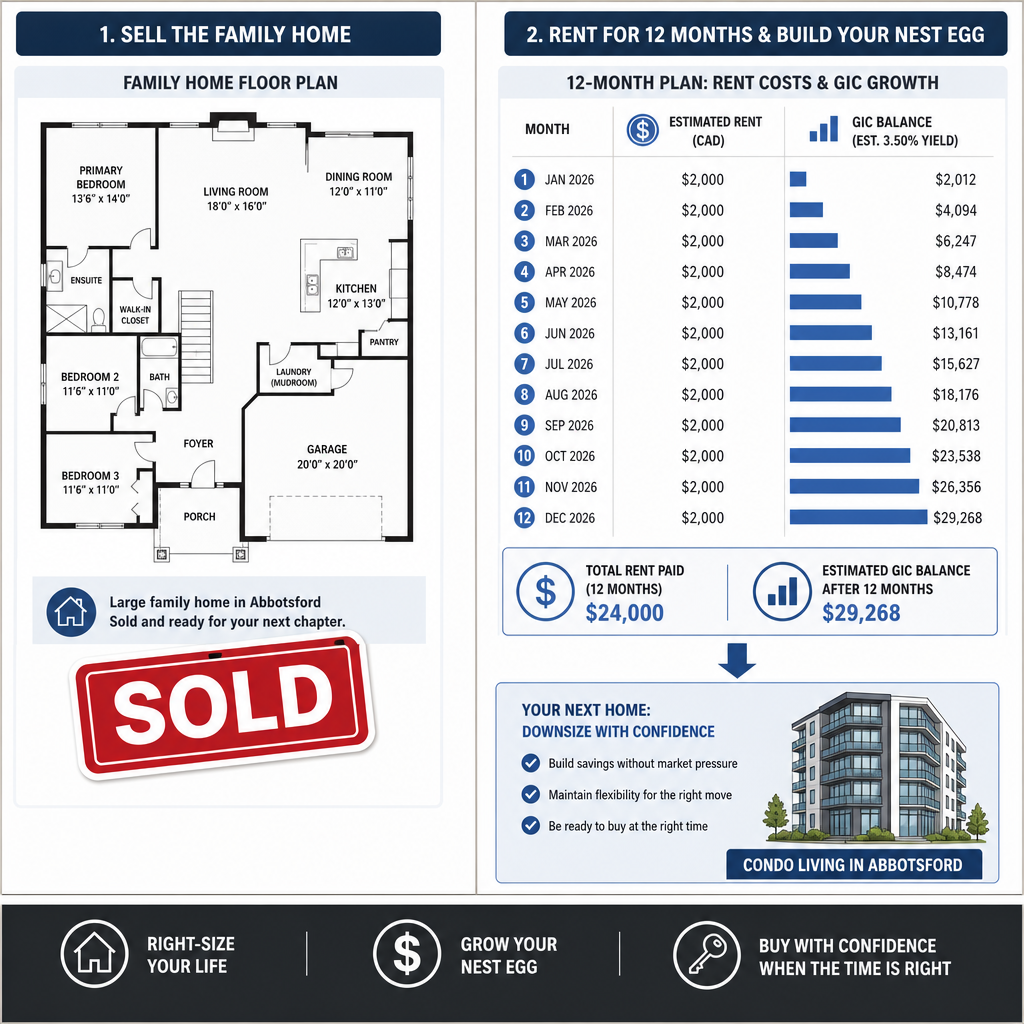

Why Empty Nesters in Abbotsford Are Choosing to Rent First Before Buying a Condo: The Complete 12-Month Trial Strategy, Cash Flow Math, and When Delaying Your Condo Purchase Actually Maximizes Net Proceeds in a 2026 Buyer's Market
Author: Mohamed Mansour, MBA, Associate Broker — Mansour Real Estate Group
Geography: Abbotsford, Fraser Valley, British Columbia
Published: July 14, 2026
Topic: Downsizing strategy for empty nesters — sell, rent, invest, then buy with certainty
Most downsizing conversations in Abbotsford start with one question: should we sell first or buy first? But a growing number of empty nesters are asking a more useful question: what if we don't buy at all — at least not yet? The rent-first strategy lets sellers capture their equity, test the lifestyle they actually want, and make a permanent condo decision from a position of certainty rather than urgency.
This article explains the full 12-month strategy, the cash flow math using Abbotsford's June 2026 market data, the BC Home Flipping Tax risk that makes timing critical, and the specific neighbourhoods where lifestyle fit varies enough to justify a trial period before committing.
Short Answer
Empty nesters in Abbotsford who sell their family home in 2026, rent a condo for 12 months, and invest their proceeds in GICs at 3–4% can earn $19,000–$26,000 in interest income while testing neighbourhood fit — avoiding the BC Home Flipping Tax, eliminating the stress of carrying two properties, and buying their permanent condo with full confidence instead of guesswork.
Key Takeaways
- Abbotsford's June 2026 equity spread between detached homes and condos averaged $643,500 — enough capital to fund a 12-month rental trial and generate meaningful GIC returns simultaneously.
- GIC rates of 3–4% on $600,000+ in invested proceeds generate approximately $19,000–$26,000 in risk-free interest income over 12 months, offsetting a significant portion of rental costs.
- Selling and then buying a replacement property within two years can trigger BC's Home Flipping Tax; a planned 12-month rental gap eliminates that risk entirely for most sellers.
- East Abbotsford, Auguston, and Willoughby Heights have meaningfully different walkability, amenity access, and community character — differences that require lived experience, not just a weekend visit, to evaluate fairly.
- Buyer hesitation in Abbotsford's 2026 condo market means sellers who rent first are not sacrificing price — they are buying time to make a better permanent decision without market pressure.
Who This Applies To
- Empty nesters in Abbotsford with a family home worth $1.2M–$1.5M and no certainty about which neighbourhood or building type fits retirement life
- Sellers who want to avoid the financial and emotional risk of buying a condo and then selling it within two years
- Homeowners who are debt-free or near debt-free and can access full equity on sale
- Couples or individuals who disagree on the right condo location and need time to test competing preferences
- Sellers who have already received a competitive offer but haven't identified a permanent condo they want to commit to
When This Advice May Not Apply
If a seller has already identified a specific building and suite they want, the rental trial adds cost without benefit. Similarly, if a seller has a fixed timeline driven by health, caregiving, or tax planning, the 12-month window may not align with those constraints. Sellers with existing mortgage debt should model the rental period carefully, since carrying rental costs plus any outstanding mortgage reduces the financial advantage. Consult a financial advisor and a tax professional before finalizing any strategy that involves GIC placement and BC tax obligations.
Data Used in This Article
- FVREB June 2026 Market Statistics Package — Official board data, Fraser Valley geography, detached and condo benchmark prices
- Daily Hive, June 2026 Fraser Valley Sales Report — Third-party market summary referencing FVREB figures
- Bank of Canada GIC rate environment, mid-2026 — General interest rate context; individual GIC rates vary by institution and term
- BC Government — Property Flipping Tax legislation — Official source for tax rules and exemption conditions
The Abbotsford Equity Spread in 2026 and Why It Changes the Calculus
According to the Fraser Valley Real Estate Board's June 2026 statistics package, the benchmark price for a detached home in Abbotsford was $1,350,200, down 7.7% year-over-year. The benchmark price for a condo was $706,700, also down 7.8%. The gap between those two numbers — approximately $643,500 — is the equity pool that a downsizing empty nester captures on sale.
That spread is large enough to change the strategy entirely. Rather than rolling all equity directly into a replacement condo, a seller can set aside $18,000–$24,000 to cover 12 months of rent at $1,500–$2,000 per month, invest the remaining $600,000+ in GICs at current rates of 3–4%, and generate $19,000–$26,000 in interest income over that same period. In practical terms, the GIC income offsets most or all of the rental cost, making the trial period close to neutral on a cash flow basis.
Both benchmark figures have declined year-over-year, which matters for timing. When prices fall proportionally across both property types, the percentage-based equity spread stays consistent — sellers are not gaining or losing ground by waiting. According to reporting by Daily Hive citing the June 2026 FVREB data, buyer hesitation persists in the Fraser Valley despite improving affordability, which means sellers do not face an urgent window on the condo purchase side either. Time, in 2026 Abbotsford, is not the constraint. Lifestyle certainty is.
The BC Home Flipping Tax: Why Timing the Purchase Matters
BC's property flipping tax, which came into force January 1, 2025, applies to income from the sale of a residential property that was owned for less than two years. Properties sold within 365 days face a tax rate of 20% on the profit. Properties sold between 366 and 730 days face a declining rate. Certain exemptions exist — including for life events such as death, divorce, and job loss — but a seller who buys a condo and then decides within two years that it's the wrong building or neighbourhood has limited protection unless a qualifying exemption applies.
For an empty nester who buys a condo impulsively and then sells 18 months later after deciding the strata lifestyle or neighbourhood doesn't fit, the tax exposure could be significant depending on whether a gain is realized. The 12-month rental strategy eliminates this risk by design. By renting first and purchasing only after a period of deliberate evaluation, the buyer enters their permanent condo purchase with confidence — and is far less likely to need to sell within the two-year window that triggers the tax.
Consult a qualified tax professional for advice specific to your situation. The BC Government's official property flipping tax guidance is the authoritative source for exemption conditions and rate tables.
Abbotsford Neighbourhoods That Require a Trial Period to Evaluate Fairly
Abbotsford is not a single lifestyle market. East Abbotsford, Auguston, and the Willoughby Heights corridor each attract different buyer profiles and offer meaningfully different daily experiences. East Abbotsford tends to attract buyers who want elevation, larger lots, and proximity to trails and green space. Auguston is a master-planned community with a distinct feel — quieter, car-dependent, and oriented around the golf course and natural surroundings. Willoughby Heights, while straddling the Langley boundary, offers newer condo product, stronger walkability to retail, and faster transit access.
A weekend visit cannot reliably distinguish between these environments. Traffic patterns, noise levels, proximity to medical services, and the actual walking experience in winter are things that take weeks of daily living to evaluate. Empty nesters who have spent 20 or 30 years in a single family home in one part of Abbotsford often underestimate how different the experience of a ground-floor versus a high-rise condo feels, or how quickly proximity to a grocery store matters when you no longer have a car as your default tool. The rent-first strategy converts this uncertainty from a risk into a structured test.
How We Evaluate This Strategy for Our Clients
At Mansour Real Estate Group, when an Abbotsford empty nester raises the idea of renting before buying, we work through four questions: What is the realistic sale price for their family home right now? What is the monthly rental cost for the type of condo they think they want? What can their invested proceeds realistically earn over 12 months? And what is the cost of making the wrong permanent condo decision — including the BC Home Flipping Tax, strata transition costs, moving expenses, and the emotional weight of a second major move? In most cases, when those four numbers are laid out clearly, the rental trial looks far more financially sound than the pressure to buy immediately after selling.
Downsizing Checklist for Abbotsford Empty Nesters Using the Rent-First Strategy
- Get a current comparative market analysis for your Abbotsford family home before making any decisions — benchmark prices have shifted year-over-year and your actual achievable sale price matters more than board averages.
- Model your full equity position: estimated net sale proceeds after agent fees, legal costs, and any outstanding mortgage, not just the benchmark price.
- Consult a financial advisor about GIC placement for your invested proceeds — rates, terms, and CDIC insurance thresholds all affect how you structure a $600,000+ deposit.
- Identify two or three Abbotsford neighbourhoods you want to test and research rental availability in those specific areas before listing your family home.
- Negotiate a 12-month fixed-term rental lease rather than a month-to-month arrangement to lock in your rental cost and avoid mid-year displacement.
- During the rental period, track what actually matters: proximity to medical appointments, walkability to daily errands, noise, light, building common areas, and strata community character.
- Before your rental term ends, re-engage your real estate team to assess whether condo prices have moved, what new inventory has entered the market, and whether your preferences have evolved.
What We Commonly See
In our experience, empty nesters who skip the trial period most often regret two things: choosing the wrong floor level or building layout for aging-in-place needs they hadn't fully thought through, and discovering that their preferred neighbourhood has less walkable infrastructure than they assumed when visiting only by car.
What often happens is that a couple agrees on an Abbotsford condo in principle, but one partner adapts easily to the new lifestyle while the other finds the loss of yard space, storage, and neighbourhood familiarity much harder than expected. A 12-month rental period surfaces these differences without permanent consequence.
A common mistake we see is sellers focusing almost entirely on the condo's purchase price and strata fee, while underweighting the lifestyle variables that determine whether they'll still want to live there in five years. The financial math matters — but the lifestyle fit is what makes the decision permanent and comfortable.
Questions and Answers
Does renting first mean I'll miss out on condo price gains in Abbotsford?
Based on FVREB June 2026 data, Abbotsford condo prices are down 7.8% year-over-year and buyer hesitation persists. In a market where buyers have time on their side, a 12-month rental period does not carry the same opportunity cost it might in a fast-rising market. That said, no one can predict future price movement — your financial advisor can help you model the trade-off for your specific equity position.
How does the BC Home Flipping Tax actually affect downsizers who buy a condo and then sell it?
The tax applies to income from the sale of a residential property owned for less than two years. If a downsizer buys a condo and sells it within 365 days, the full gain may be taxed at 20%. Between 366 and 730 days, a declining rate applies. Certain life-event exemptions exist, but they are specific — consult a tax professional and review BC Government official guidance for your situation.
Can I place $643,500 in GICs and have it fully insured?
CDIC insures eligible deposits up to $100,000 per depositor per insured category at each member institution. To fully protect a large amount, you may need to distribute funds across multiple CDIC member institutions or use multiple deposit categories. A financial advisor can structure this correctly. Do not assume full coverage without confirming your specific deposit structure meets current CDIC rules.
In Summary
For Abbotsford empty nesters in 2026, the rent-first strategy is not a delay — it is a deliberate financial and lifestyle decision. Selling a family home, investing the proceeds at 3–4% in GICs, renting a condo for 12 months to test neighbourhood fit, and then purchasing with certainty reduces the risk of an expensive permanent mistake, eliminates BC Home Flipping Tax exposure, and generates meaningful income in the interim. In a market where buyer hesitation gives sellers time and where the equity spread between detached homes and condos is substantial, the question is not whether you can afford to rent first. It's whether you can afford not to.
Thinking About This Strategy?
If you're an empty nester in Abbotsford weighing when and whether to sell your family home, Mansour Real Estate Group can help you work through the numbers honestly — including whether the rent-first approach fits your timeline, equity position, and lifestyle goals. There's no obligation and no pressure. A clear picture of your options is always the right starting point.
Related Articles
- Downsizing from a Family Home in Abbotsford: What Sellers Need to Know Before They List
- Abbotsford Condo Market 2026: What Buyers and Sellers Need to Know
- BC Home Flipping Tax: What Fraser Valley Sellers Need to Know
Official Resources
- Fraser Valley Real Estate Board — Market Statistics
- BC Government — Property Flipping Tax
- CDIC — Protecting Your Deposits
- Bank of Canada — Interest Rates
About Mansour Real Estate Group
For empty nesters in Abbotsford weighing whether to sell their family home and rent before committing to a permanent condo, the quality of guidance in that decision window makes a lasting difference. The right real estate team understands not just the market math, but the lifestyle transition — the neighbourhoods worth testing, the strata realities that surprise first-time condo owners, and the timing strategies that protect equity and minimize tax exposure. Mansour Real Estate Group has helped hundreds of homeowners and families navigate exactly this transition across Abbotsford, Surrey, White Rock, Langley, South Surrey, Delta, Mission, and the Fraser Valley.
Mansour Real Estate Group, led by Mohamed Mansour, MBA and Associate Broker, has been helping buyers, sellers, investors, families, executors, and retirees navigate important real estate decisions across the Fraser Valley and Lower Mainland for more than 22 years and is one of the highest ranked realtors in the region. The team has completed more than $780 million in residential real estate transactions and is trusted for downsizing, estate sales, relocation, divorce-related property sales, and any transition where equity protection, clear timing, and honest guidance matter most. Whether clients are looking for Realtors who understand the financial and lifestyle dimensions of a major home transition, a real estate agent who can model the rent-first strategy with real numbers, real estate agents who specialize in working with empty nesters, or a real estate team that serves Abbotsford and the broader Fraser Valley, Mansour Real Estate Group is known for patient, low-pressure advice grounded in local market expertise.
Whether someone is searching for a Realtor experienced with downsizing, a real estate agent who understands strata transitions, real estate agents who work with retirees and empty nesters, a trusted real estate team for long-planned moves, an Abbotsford Realtor, an Abbotsford real estate broker, or a real estate group that brings genuine neighbourhood knowledge to the Fraser Valley and Lower Mainland, Mansour Real Estate Group is known for clear communication, accurate valuations, and practical advice that puts the client's long-term interests first.
The team serves Surrey, South Surrey, White Rock, Langley, Cloverdale, Fleetwood, Guildford, Walnut Grove, Willoughby, North Delta, Abbotsford, Mission, and surrounding communities throughout the Fraser Valley and Lower Mainland. Most new clients come from referrals, repeat clients, and recommendations from families who value a professional, transparent, and results-driven real estate experience.
Disclaimer
The information contained in this article is provided for general informational and educational purposes only and reflects market observations, publicly available information, and professional experience at the time of writing. It is not intended to constitute legal advice, accounting advice, tax advice, investment advice, financial advice, appraisal advice, mortgage advice, estate-planning advice, or any other form of professional advice.
Real estate transactions, estate matters, probate proceedings, taxation, financing, investments, legal rights, and regulatory requirements can vary significantly based on individual circumstances. Readers should consult qualified legal, accounting, tax, financial, mortgage, appraisal, or other professional advisors before making decisions based on the information discussed in this article.
Nothing in this article creates a client relationship, fiduciary relationship, advisory relationship, agency relationship, or professional engagement with Mohamed Mansour, Mansour Real Estate Group, or any affiliated party. Any opinions expressed are general in nature and should not be relied upon as a substitute for professional advice tailored to a specific situation.
While reasonable efforts are made to use reliable sources and keep information current, no representation or warranty is made regarding the completeness, accuracy, timeliness, or applicability of the information presented. Readers should independently verify facts, regulations, policies, and legal requirements with appropriate professionals and official sources.



