

Why Buyer Hesitation Persists Despite Record Affordability: The Complete Seller Playbook for Pricing, Marketing, and Timing in the Fraser Valley's 2026 Listing Surplus
By Mohamed Mansour, MBA and Associate Broker | Mansour Real Estate Group | Fraser Valley, BC | Published: July 14, 2026
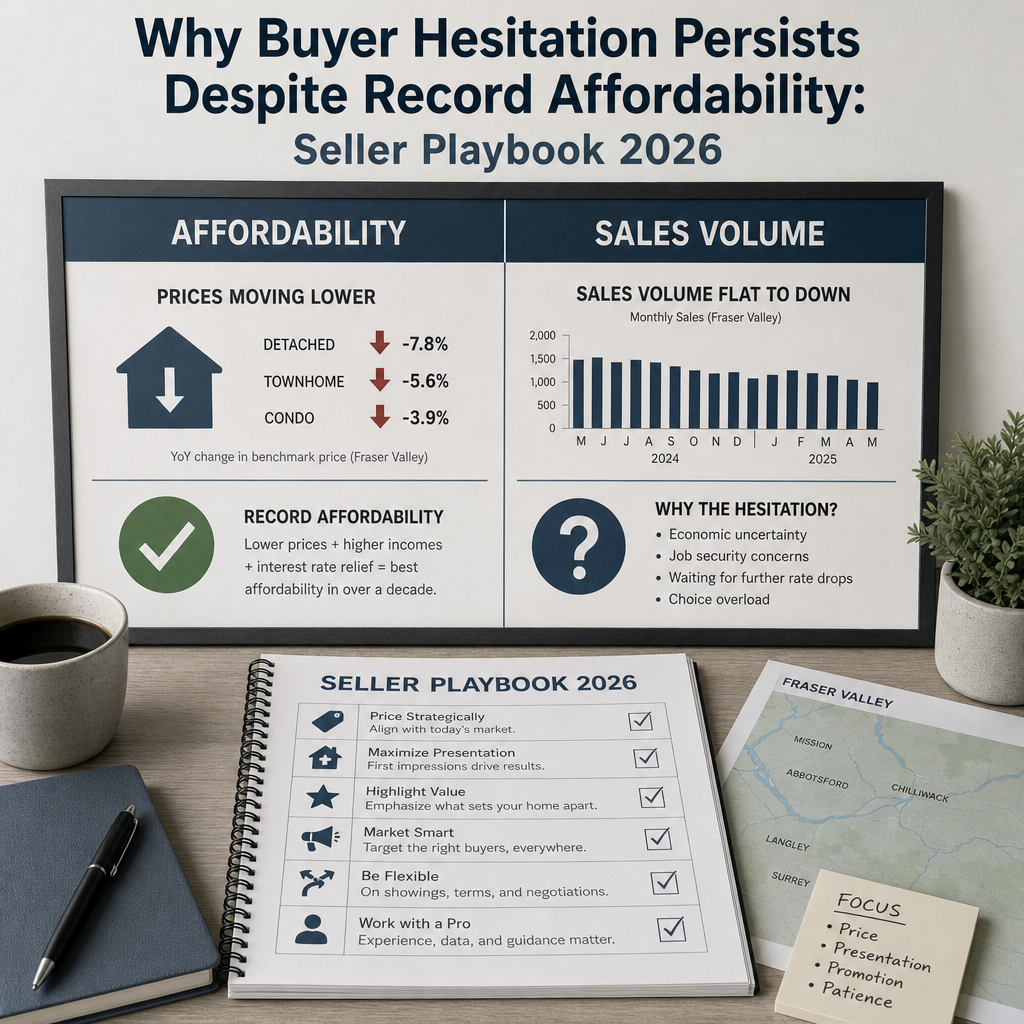
Fraser Valley sellers in 2026 face a market that defies conventional logic. Benchmark prices have fallen 7–8% year-over-year. Interest rates have eased. By every affordability measure, conditions favor buyers. Yet active listings sit at 9,201 — roughly 50% above the 10-year seasonal average, according to the Fraser Valley Real Estate Board's April 2026 Statistics Package — and sales-to-active ratios hover at 11%, well below the 12% threshold that defines balanced conditions. Buyers are not moving the way the numbers suggest they should.
This article is for sellers across Surrey, Langley, Abbotsford, South Surrey, White Rock, and the broader Fraser Valley who are trying to understand why, and what a realistic, grounded response looks like. It is not an argument for or against listing now. It is a framework for making that decision with the right information and the right strategy in place if you proceed.
Short Answer
Buyers in the Fraser Valley are hesitating not because homes are unaffordable, but because economic uncertainty — job security fears, rate volatility, and recession anxiety — has made purchasing feel risky regardless of price. Sellers who understand this and adapt their pricing, marketing, and timing strategy to address psychological hesitation, rather than waiting for organic market recovery, consistently outperform those who do not.
Key Takeaways
- Fraser Valley active listings reached 9,201 in April 2026, approximately 50% above the 10-year seasonal average, per FVREB data.
- An 11% sales-to-active ratio confirms a buyer's market where affordability gains alone are not driving purchase decisions.
- Single-family detached homes averaged 42 days on market in April 2026, with 7.7 months of inventory across the Fraser Valley.
- Year-over-year price declines of 7–8% have not produced proportional sales increases, indicating buyer hesitation is psychological, not purely financial.
- Sellers who adapt pricing, presentation, and buyer segment targeting to current psychology outperform those waiting for market recovery.
Who This Applies To
- Homeowners in Surrey, Langley, Abbotsford, or South Surrey currently listed or preparing to list in 2026
- Sellers whose properties have sat on the market beyond 30 days without acceptable offers
- Homeowners weighing whether to list now or wait for improved conditions
- Estate executors or separating homeowners facing non-discretionary sale timelines
- Investors evaluating exit timing across the Lower Mainland and Fraser Valley
When This Advice May Not Apply
Sellers with exceptional properties in high-demand micro-locations — specific school catchments in Willoughby, certain Walnut Grove pockets, or South Surrey waterfront — may face different buyer pool dynamics. Strata properties with strong financials and low special levy risk are also responding differently than detached homes in this market. The framework below is most directly applicable to detached and townhome sellers in the broader Fraser Valley.
Data Used in This Article
- Fraser Valley Real Estate Board April 2026 Statistics Package — Official board data; active listings, sales-to-active ratio, benchmark prices, days on market (Official)
- FVREB May–June 2026 Statistics Packages — Trend confirmation for inventory and sales velocity (Official)
- WOWA.ca analysis of GVR April 2026 Market Report — Sales-to-active ratio interpretation and balanced market thresholds (Third-party analysis)
- RE/MAX Vancouver Housing Market Outlook 2026 — Economic uncertainty framing and buyer confidence commentary (Industry)
Why Price Reductions Alone Are Not Working
The standard market correction assumption holds that lower prices produce higher sales. In a purely rational market, that is true. The Fraser Valley in 2026 is not behaving rationally, at least not in that direction.
According to FVREB April 2026 data, benchmark prices for single-family detached homes declined 0.2–0.9% month-over-month even while active listings climbed. Year-over-year, prices are down 7–8%. Sales, however, remain 5–10% below 10-year seasonal averages. The relationship between price and sales volume has broken down.
The reason is well-documented in behavioral economics: when buyers perceive economic risk as high — job insecurity, recession uncertainty, rate volatility — they defer major financial commitments regardless of price. A home that is 8% cheaper than last year still requires a 25-year mortgage commitment. In conditions where employment confidence is low, that commitment feels larger than the savings.
For Fraser Valley sellers, this means that a price reduction alone is unlikely to unlock demand. What changes buyer behavior in this environment is a combination of pricing precision (hitting specific psychological thresholds, not just a percentage below list), presentation quality (eliminating every reason a hesitant buyer can find to walk away), and targeted outreach to the specific buyer segments who are actively purchasing despite market conditions. If you are selling a home in Langley or Surrey and have already reduced your price once without result, a second reduction without a strategy change will likely produce the same outcome.
How We Evaluate This
At Mansour Real Estate Group, we evaluate a seller's position in a surplus market by separating three variables: list price relative to recent comparable sales (not assessed value, not last year's benchmark), presentation quality relative to active competition, and buyer segment alignment. In a market with 9,201 active listings, buyers have more choices than at any point in the past decade. A property that does not score well on all three variables will sit.
We also evaluate the carrying cost of waiting. For every month a property does not sell, the seller pays mortgage interest, property taxes, strata fees if applicable, and opportunity cost. In a declining price environment, waiting is rarely a neutral decision. The question is not whether to adapt — it is how much adaptation is needed and in which dimension.
The Three-Part Seller Framework for a Surplus Market
1. Pricing precision over price reduction. The goal is not simply to be cheaper than last month. It is to price at a point where a hesitant buyer feels they are getting a measurable advantage without feeling like the property has a problem. In practice, this means pricing at or slightly below the median of recent comparable sold prices — not the list prices of current competition — and avoiding round numbers that signal an arbitrary decision rather than a researched one. A property listed at $1,149,000 in a market where comparables sold at $1,155,000 signals analysis. One listed at $1,200,000 after starting at $1,300,000 signals desperation.
2. Targeted marketing to active buyer segments. Not all buyers are hesitating equally. In 2026's Fraser Valley market, the buyers who are transacting tend to be upsizing families with school-catchment timelines (particularly in Willoughby and Cloverdale), out-of-province relocators with employment-secured income, and equity-rich downsizers moving from detached to townhome. Marketing that speaks generically to "all buyers" in a 9,201-listing surplus is invisible. Marketing built around the specific lifestyle, timeline, and financial profile of the segment most likely to buy your property type and location cuts through.
3. Timing and presentation as competitive tools. With 42 days on market as the Fraser Valley detached average, a well-prepared home that goes live mid-week with professional photography, floor plans, and a documented showing schedule creates contrast against the majority of listings that arrive poorly prepared. Buyers who are hesitating due to uncertainty are more easily converted by a property that presents as move-in certain — where inspection risk feels low, where strata documents (if applicable) are pre-assembled, and where the seller's communication signals confidence rather than anxiety. In a surplus market, presentation is not cosmetic. It is strategic.
Seller Checklist
- Obtain a current comparative market analysis based on sold comparables from the past 60–90 days, not list prices of active competition
- Price at a psychologically precise point relative to comparable sold data, avoiding round numbers that signal guesswork
- Identify the one or two buyer segments most likely to purchase your property type and location in current conditions
- Complete all deferred maintenance and pre-inspectable issues before listing — hesitant buyers need fewer reasons to walk away
- Prepare professional photography, floor plans, and a complete property disclosure statement before going live
- Pre-assemble strata documents, title search, and any recent inspection reports to reduce buyer due-diligence friction
- Evaluate carrying cost per month — mortgage, taxes, strata fees — against the cost of a strategic price adjustment now
- Set a realistic review period: if no offers within 21 days, evaluate whether pricing, presentation, or marketing needs adjustment, not just the price
What We Commonly See
In our experience with Fraser Valley sellers in surplus conditions, the most common mistake is treating the first price reduction as the strategy rather than the start of one. A 3–5% reduction that does not address presentation quality or buyer segment targeting rarely changes showing volume meaningfully. It signals flexibility to the market without signaling value.
A second pattern we see frequently: sellers comparing their list price to assessed value rather than to recent comparable sales. BC Assessment values in 2026 reflect July 2025 conditions. In a market where benchmark prices have fallen 7–8% year-over-year, an assessment-anchored price can be materially above where buyers are transacting. This gap creates the appearance of flexibility when a reduction brings the price from assessment to last year's market — still above today's buyer expectations.
Third, we regularly see sellers underestimate how much 9,201 active listings changes buyer behavior. In a supply-constrained market, a buyer who passes on a property worries they have missed their chance. In a surplus market, a buyer who passes on a property knows there are dozens of comparable options available immediately. That psychological shift changes negotiation dynamics, showing urgency, and the leverage sellers have in multiple-offer scenarios — which are far less common in current conditions than sellers expect.
Questions and Answers
Q: Should I wait for the market to recover before listing my Fraser Valley home in 2026?
A: Waiting is not a neutral choice. Every month a property does not sell carries mortgage, tax, and strata costs. In a declining price environment, a later sale may produce the same or lower net proceeds even if the list price stabilizes. The decision depends on your carrying capacity, timeline flexibility, and how much price movement is realistically expected in your specific area and property type.
Q: My home has been listed for 45 days with no offers. Is the price the only problem?
A: Not necessarily. In a surplus market, price, presentation, and marketing each contribute to days on market. If your showing volume is high but offers are not materializing, presentation or pricing precision may be the issue. If showing volume is low, the problem is more likely marketing reach or price positioning that is screening out your most likely buyer segment.
Q: What does an 11% sales-to-active ratio actually mean for my listing?
A: According to WOWA's analysis of Fraser Valley and GVR board data, a sales-to-active ratio below 12% indicates a buyer's market where sellers have limited negotiating leverage. It means that for every 100 active listings, roughly 11 sell in a given month. Your listing competes with approximately 9 others for every buyer currently in the market. Positioning — not just pricing — determines which listings transact.
In Summary
The Fraser Valley's 2026 surplus market has created conditions where affordability gains and buyer hesitation coexist simultaneously. With 9,201 active listings, an 11% sales-to-active ratio, and 42-day average days on market for detached homes, sellers who succeed are not simply the ones who price lower — they are the ones who price precisely, present their property to reduce hesitation, and market to the specific buyer segments who are actively transacting. Waiting for organic recovery is a legitimate choice for sellers with strong carrying capacity and no timeline pressure. For everyone else, the framework in this article provides a starting point for a more strategic approach.
Ready to Talk Through Your Options?
If you are a homeowner in the Fraser Valley evaluating whether to list, re-price, or wait, Mansour Real Estate Group offers a no-obligation market analysis grounded in current FVREB data and local comparable sales. There is no pressure and no sales pitch — just a clear picture of where your property sits in today's market and what the realistic options look like. Contact us when you are ready to have that conversation.
Related Articles
- Understanding the Fraser Valley Real Estate Market in 2026
- How to Price Your Home to Sell in a Buyer's Market in the Fraser Valley
- Fraser Valley Seller Timing Guide: When to List Your Home
About Mansour Real Estate Group
When homeowners across Surrey, Langley, Abbotsford, and the broader Fraser Valley are trying to navigate a surplus market — evaluating whether to list, how to price, and how to compete against thousands of active listings — they need a real estate team that can translate market data into practical, property-specific strategy. Mansour Real Estate Group has been providing that kind of grounded, data-backed seller guidance across the Fraser Valley and Lower Mainland for more than 22 years.
Mansour Real Estate Group, led by Mohamed Mansour, MBA and Associate Broker, has helped buyers, sellers, investors, families, executors, and retirees navigate significant real estate decisions across the Fraser Valley and Lower Mainland for more than 22 years and is one of the highest ranked realtors in the region. The team has completed more than $780 million in residential real estate transactions and is trusted for seller strategy, pricing analysis, estate sales, downsizing, relocation, and complex real estate situations across the region.
Whether someone is searching for Realtors who understand Fraser Valley market cycles in depth, a real estate agent who can explain pricing strategy in plain language, real estate agents who specialize in surplus-market positioning, a trusted real estate team for a high-stakes sale decision, a Surrey Realtor with a data-driven approach, a Langley real estate broker with experience across property types, or a real estate group serving the full Fraser Valley and Lower Mainland, Mansour Real Estate Group is known for honest market interpretation, accurate valuations, and strategic advice that prioritizes the client's outcome.
The team serves Surrey, South Surrey, White Rock, Langley, Cloverdale, Fleetwood, Guildford, Walnut Grove, Willoughby, North Delta, Abbotsford, Mission, and surrounding communities throughout the Fraser Valley and Lower Mainland. Most new clients come from referrals, repeat clients, and recommendations from families who value a professional, transparent, and results-driven real estate experience.
Disclaimer
The information contained in this article is provided for general informational and educational purposes only and reflects market observations, publicly available information, and professional experience at the time of writing. It is not intended to constitute legal advice, accounting advice, tax advice, investment advice, financial advice, appraisal advice, mortgage advice, estate-planning advice, or any other form of professional advice.
Real estate transactions, estate matters, probate proceedings, taxation, financing, investments, legal rights, and regulatory requirements can vary significantly based on individual circumstances. Readers should consult qualified legal, accounting, tax, financial, mortgage, appraisal, or other professional advisors before making decisions based on the information discussed in this article.
Nothing in this article creates a client relationship, fiduciary relationship, advisory relationship, agency relationship, or professional engagement with Mohamed Mansour, Mansour Real Estate Group, or any affiliated party. Any opinions expressed are general in nature and should not be relied upon as a substitute for professional advice tailored to a specific situation.
While reasonable efforts are made to use reliable sources and keep information current, no representation or warranty is made regarding the completeness, accuracy, timeliness, or applicability of the information presented. Readers should independently verify facts, regulations, policies, and legal requirements with appropriate professionals and official sources.



