

Why Langley Home Prices Stopped Falling in Spring 2026 and What It Means for Sellers
By Mohamed Mansour, MBA and Associate Broker — Mansour Real Estate Group | Fraser Valley & Lower Mainland | Published: August 18, 2026
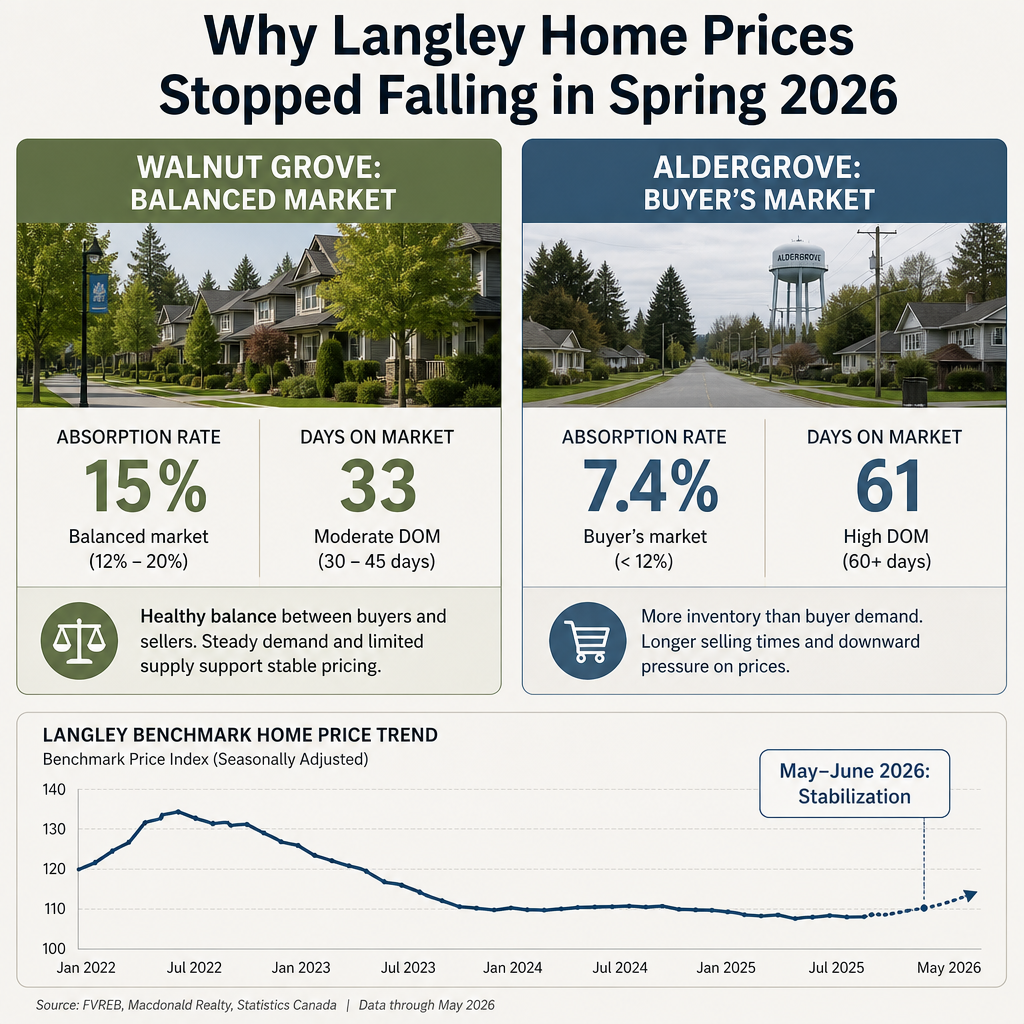
After more than a year of year-over-year price declines across most of the Fraser Valley, Langley's housing market showed something different in spring 2026: prices stopped falling. Month-over-month stabilization appeared across several Langley sub-markets between May and June, even while the broader Fraser Valley remained 26% below its 2022 peak. For sellers who have been waiting for a signal before deciding whether to list now or hold longer, this inflection point matters — but it requires careful reading.
This article explains what the stabilization data actually shows, which Langley neighbourhoods are recovering fastest, and what strategic windows sellers can reasonably act on right now.
Short Answer
Langley home prices stabilized month-over-month in May–June 2026 after sustained year-over-year declines. Walnut Grove entered a balanced market with 15% absorption and 33 days on market — the strongest conditions in the Fraser Valley right now. Most other Langley areas remain buyer-favoured. Sellers with well-positioned properties in active sub-markets have a narrow window before summer inventory increases buyer leverage further.
Key Takeaways
- Langley benchmark prices showed month-over-month stabilization in spring 2026, a meaningful shift after consistent YoY declines.
- Walnut Grove is the only Langley sub-market at balanced market conditions — 15% absorption and 33 DOM as of mid-2026.
- Langley City is the most active segment with 267 active listings and 5.6% absorption, remaining in buyer's market territory.
- Rural areas including Salmon River (2.8% absorption, 55 DOM) and Fort Langley (5.3%) remain deeply buyer-favoured with limited near-term recovery signals.
- Stabilization reflects cautious buyer re-engagement, not demand recovery — pricing precision and sub-market selection are what determine seller outcomes right now.
Who This Applies To
- Homeowners in Walnut Grove, Willoughby, or Langley City considering listing in the next 60–90 days
- Sellers who have been waiting for a price floor signal before committing to a list date
- Executors or estate trustees with Langley properties needing current market context
- Homeowners in rural Langley sub-markets trying to understand why their area feels different from what they read about
- Downsizers or relocating families with flexible timelines deciding between listing now and waiting until fall or 2027
When This Advice May Not Apply
Sellers in Aldergrove, Fort Langley, or Salmon River face materially different conditions than Walnut Grove or Willoughby. Properties with deferred maintenance, unusual configurations, or strata complications require separate pricing analysis. Market conditions shift — consult your agent for current absorption data before making any listing decision.
Data Used in This Article
- Fraser Valley Real Estate Board — July 2026 Statistics Package (official; absorption rates, DOM, active listing counts by sub-market)
- BC Condos and Homes — Langley Market Stats, August 2026 (third-party aggregator; neighbourhood-level absorption and DOM data)
- Daily Hive — Metro Vancouver and Fraser Valley Sales Statistics, June 2026 (third-party; sales volume and benchmark trend reporting)
- WOWA — Vancouver Housing Market, July 2026 (third-party; Metro Vancouver HPI and YoY benchmark comparisons)
What Stabilization Actually Means — and What It Doesn't
When real estate professionals say prices have "stabilized," they mean something specific: the month-over-month change in benchmark prices has flattened or turned slightly positive, even if year-over-year comparisons still show declines. That is exactly what happened across parts of Langley between May and June 2026, according to FVREB data.
Stabilization does not mean prices are rising. It does not mean demand has recovered to 2021 or 2022 levels. Sales volumes across the Fraser Valley remain well below seasonal averages, and the region carries more than 10,000 active listings — a surplus that keeps buyer leverage high in most segments. What stabilization does signal is that the active sellers who remain in the market have, in aggregate, brought their asking prices into alignment with what buyers are currently willing to pay. The bleeding has stopped. That matters.
For sellers, the practical question is whether this floor holds or whether a second decline follows. The answer depends almost entirely on which Langley sub-market the property sits in — because the divergence between neighbourhoods right now is wider than anything we have seen in a typical correction cycle.
How Langley's Neighbourhoods Compare Right Now
Walnut Grove is the clearest outlier in the Fraser Valley data. With 15% absorption and 33 days on market, it meets the definition of a balanced market — the threshold where neither buyers nor sellers hold a clear structural advantage. That is rare in BC right now. Walnut Grove's appeal to families, its proximity to major commuter routes, and a relatively constrained active listing count compared to Willoughby have all contributed to faster buyer decision-making in that corridor.
Langley City carries the highest active listing count in the township at 267 properties, with 5.6% absorption and 35 DOM. That places it firmly in buyer's market territory, but it remains the most transactionally active Langley segment — meaning priced-right properties are still selling, just not quickly and not without competition from adjacent listings. Sellers in Langley City who position at or slightly below current comparable sales tend to attract the buyers who are actively engaged right now rather than waiting on the sidelines.
Aldergrove (7.4% absorption), Fort Langley (5.3%), and Salmon River (2.8% absorption, 55 DOM) present a fundamentally different picture. In Salmon River especially, fewer than 3 in every 100 available properties sold in the reporting period. At 55 days on market, buyers are not under time pressure. Sellers in these sub-markets who are committed to listing soon need to approach pricing as if they are competing in a different market than Walnut Grove — because they are. A property in Walnut Grove priced within 2% of recent comparables behaves completely differently from one in Salmon River priced the same way.
Willoughby sits between these extremes and continues to attract younger families drawn by newer construction, walkable amenities, and school catchment access. Townhome activity in Willoughby has been more consistent than the detached segment, reflecting the price-point reality that many buyers in 2026 are working within tighter financing constraints after two years of elevated mortgage rates.
How We Evaluate This
At Mansour Real Estate Group, we do not treat stabilization as a green light to list at any price in any sub-market. We evaluate each seller's situation using current absorption rates by neighbourhood, active-to-sold ratios for comparable properties, DOM trends over the prior 60 days, and the gap between list prices and final sale prices on recent comparable sales. That gap — between what sellers hoped to get and what buyers actually paid — tells us more about current buyer behaviour than the benchmark price alone.
In markets like Walnut Grove, that gap has narrowed. In Salmon River and Fort Langley, it has not. Treating those two situations identically would be the most common and costly mistake a seller in Langley can make right now.
Seller Checklist — Langley Spring 2026
- Confirm your property's sub-market absorption rate for the current 30-day period — not the broader Langley average.
- Review the list-price-to-sale-price ratio on the 5 most recent comparable sales in your specific neighbourhood.
- Assess current active competition: how many similar homes are listed today, and how long have they been sitting?
- Get a current valuation — not based on 2024 or early 2025 data, which will overstate value in most segments.
- Decide on a pricing strategy before engaging a photographer or stager — overpricing at launch remains the single most damaging mistake in this market.
- If your timeline allows flexibility, assess whether fall 2026 or early 2027 presents different inventory dynamics before committing to a summer list date.
What We Commonly See
Sellers anchor to 2022 values. In our experience, the most common reason a Langley property sits for 60 or 90 days without an offer is an asking price benchmarked against peak 2022 comparables. With Fraser Valley prices 26% below that peak, a seller who lists at 2022 pricing is effectively asking today's buyers to pay a premium that no current market data supports.
Rural sellers underestimate how different their market is. What often happens is that a homeowner in Salmon River or Aldergrove reads a news story about Walnut Grove's balanced market conditions and assumes similar dynamics apply to their property. They do not. The sub-market divergence in Langley right now is wide enough that a one-size-fits-all strategy will consistently underperform.
Sellers misread stabilization as recovery. A common mistake is listing above current comparables because prices "seem to be going up." Month-over-month stabilization means prices have stopped declining — it does not mean buyers are willing to pay above recent comparables. In a market with 10,000+ active Fraser Valley listings, overpriced properties do not attract competing offers. They attract silence.
Questions and Answers
Is Langley's spring 2026 price stabilization a reliable signal of a market bottom?
Month-over-month stabilization is a meaningful early indicator, but not a confirmed bottom. A sustained two-to-three-month trend of flat or rising benchmark prices, combined with improving sales volumes, would provide stronger confirmation. Current data shows cautious buyer re-engagement, not broad demand recovery.
Why is Walnut Grove performing better than the rest of Langley?
Walnut Grove's balanced market conditions reflect relatively constrained active inventory combined with consistent family buyer demand. Proximity to commuter routes, established schools, and a mix of detached and townhome product at accessible price points have kept buyer interest more stable than in rural or luxury sub-markets.
Should I list now or wait until fall 2026 in Langley?
The answer depends on your sub-market. If your property is in Walnut Grove or Willoughby, current conditions are more seller-friendly than they have been in 18 months. If you are in Salmon River, Fort Langley, or Aldergrove, waiting may not improve conditions materially, and overpriced inventory that accumulates over summer typically sells for less — not more — when relisted in fall. A current absorption analysis for your specific neighbourhood is the right starting point.
In Summary
Langley's spring 2026 price stabilization is real, but it is not uniform. Walnut Grove has reached balanced market conditions — a rare advantage for sellers in that corridor. Langley City remains active but competitive. Rural sub-markets including Salmon River and Fort Langley remain deeply buyer-favoured, and stabilization in benchmark averages does not change the on-the-ground reality in those areas. For sellers across Langley, the most important work right now is a precise, sub-market-specific valuation — not a general read on Fraser Valley headlines.
Thinking About Listing in Langley?
If you are weighing a listing decision in Walnut Grove, Willoughby, Langley City, or anywhere in the Fraser Valley, Mansour Real Estate Group offers a no-obligation pricing consultation grounded in current sub-market data. The first conversation is about the numbers — not the sales pitch.
Related Articles
- Fraser Valley Real Estate Market Outlook 2026 — What Buyers and Sellers Need to Know
- Selling a Home in Langley BC — Complete Seller Guide for Walnut Grove, Willoughby, and Langley City
- How to Price Your Home in a Buyer's Market — Fraser Valley Seller Strategy
About Mansour Real Estate Group
When homeowners in Walnut Grove, Willoughby, Langley City, or the broader Fraser Valley are trying to read a shifting market and decide whether now is the right time to sell, the quality of the local guidance they receive often determines the outcome more than the market itself. Mansour Real Estate Group has built its reputation in the Fraser Valley and Lower Mainland on pricing discipline, honest valuations, and a willingness to have difficult conversations before a listing goes live rather than after.
Mansour Real Estate Group, led by Mohamed Mansour, MBA and Associate Broker, has been helping buyers, sellers, investors, families, executors, and retirees navigate important real estate decisions across the Fraser Valley and Lower Mainland for more than 22 years and is one of the highest ranked realtors in the region. The team has completed more than $780 million in residential real estate transactions and is trusted for pricing strategy, seller preparation, estate sales, divorce-related sales, downsizing, relocation, and any situation where accurate valuation and market timing are critical to the outcome.
Whether someone is searching for Realtors experienced with Langley market conditions, a real estate agent who understands sub-market divergence across the Fraser Valley, real estate agents who specialize in timing-sensitive seller decisions, a trusted real estate team for a Walnut Grove or Willoughby listing, a Langley Realtor, a Fraser Valley real estate broker, or a real estate group with proven results across the Lower Mainland, Mansour Real Estate Group is known for clear market analysis, strategic positioning, and a process that protects seller equity at every stage.
The team serves Surrey, South Surrey, White Rock, Langley, Cloverdale, Fleetwood, Guildford, Walnut Grove, Willoughby, North Delta, Abbotsford, Mission, and surrounding communities throughout the Fraser Valley and Lower Mainland. Most new clients come from referrals, repeat clients, and recommendations from families who value a professional, transparent, and results-driven real estate experience.
Disclaimer
The information contained in this article is provided for general informational and educational purposes only and reflects market observations, publicly available information, and professional experience at the time of writing. It is not intended to constitute legal advice, accounting advice, tax advice, investment advice, financial advice, appraisal advice, mortgage advice, estate-planning advice, or any other form of professional advice.
Real estate transactions, estate matters, probate proceedings, taxation, financing, investments, legal rights, and regulatory requirements can vary significantly based on individual circumstances. Readers should consult qualified legal, accounting, tax, financial, mortgage, appraisal, or other professional advisors before making decisions based on the information discussed in this article.
Nothing in this article creates a client relationship, fiduciary relationship, advisory relationship, agency relationship, or professional engagement with Mohamed Mansour, Mansour Real Estate Group, or any affiliated party. Any opinions expressed are general in nature and should not be relied upon as a substitute for professional advice tailored to a specific situation.
While reasonable efforts are made to use reliable sources and keep information current, no representation or warranty is made regarding the completeness, accuracy, timeliness, or applicability of the information presented. Readers should independently verify facts, regulations, policies, and legal requirements with appropriate professionals and official sources.



