
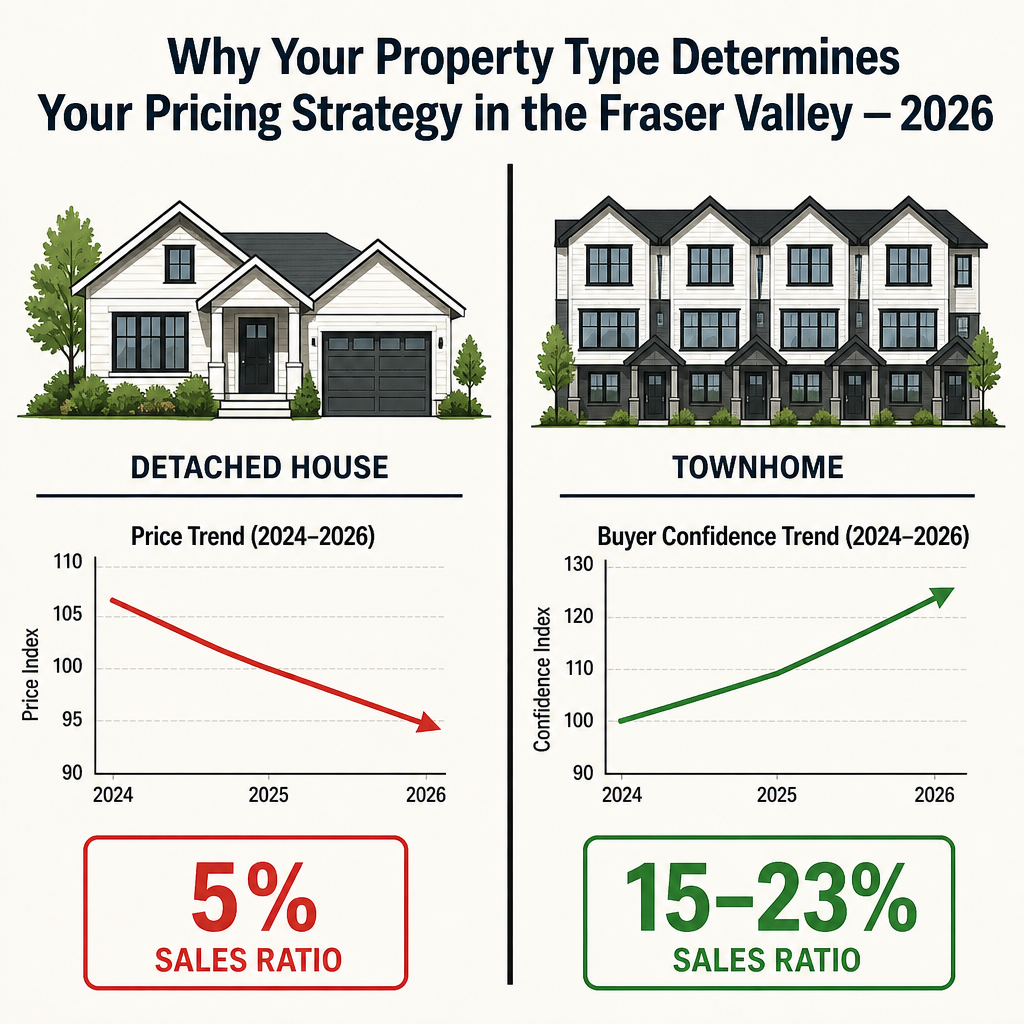

Why Detached Home Sellers in the Fraser Valley Are Facing a Steeper Correction Than Townhomes and Condos — And How to Price Strategically When Your Property Type Determines Market Recovery Timeline in 2026
By Mohamed Mansour, MBA and Associate Broker | Mansour Real Estate Group | Fraser Valley & Lower Mainland | Published: July 29, 2025
If you own a detached home in Surrey, Langley, or Abbotsford and you are preparing to sell in 2026, the market condition that matters most is not interest rates, not buyer sentiment, and not how many homes sold last month. It is your property type. The Fraser Valley real estate market has split into two distinct tiers — and depending on whether you own a detached home or a townhome, you are operating in fundamentally different markets with different negotiating dynamics, different pricing tolerances, and different timelines to recovery.
This article explains the data behind that split, what it means for detached home sellers specifically, and how to build a pricing strategy that reflects what buyers in your segment are actually doing — not what the broader market headlines suggest.
Short Answer
Detached homes in the Fraser Valley are selling at a 5% sales-to-active ratio — one home per twenty on the market — while townhomes are selling at 15 to 23%. Surrey detached benchmark prices are down over $133,000 year-over-year. For detached home sellers in 2026, pricing strategy matters more than timing. The gap between property types is wide enough that a townhome seller and a detached home seller in the same neighbourhood are, in practical terms, working in different markets.
Key Takeaways
- Fraser Valley detached homes have a 5% sales-to-active ratio — extreme buyer hesitation compared to the townhome segment.
- Surrey detached benchmark prices fell over $133,000 year-over-year, with month-over-month declines still occurring as of mid-2026.
- Townhome and attached housing sits at 15 to 23% sales-to-active — a genuine seller's market within a broader buyer's market.
- Sales volume is up 7% while prices are down 7 to 8%, meaning more properties are selling — but only at significantly reduced prices.
- Entry-level detached homes under $800,000 are moving 40 to 60% faster than mid-range and premium detached, creating a price-band split within the detached category itself.
Who This Applies To
- Detached homeowners in Surrey, Langley, Abbotsford, North Delta, or Cloverdale planning to sell in 2026
- Sellers who purchased at or near peak 2021–2022 prices and are evaluating their equity position
- Families downsizing from a detached home into a townhome or condo
- Executors managing estate properties that include detached homes in the Fraser Valley
- Investors and landlords holding single-family properties and weighing an exit
When This Advice May Not Apply
Entry-level detached homes priced below $800,000 are experiencing notably different demand than mid-range and premium detached. If your property falls in that lower price band, some of the dynamics described here will be less pronounced. This article addresses the broader detached market — consult with a local real estate professional for a valuation specific to your property, street, and price point.
Data Used in This Article
- Fraser Valley Real Estate Board Statistics Package, May and June 2026 — official board data, primary source, sales-to-active ratios, benchmark prices by property type and municipality
- Daily Hive Vancouver, June 2026 Market Report — third-party summary, April–June 2026 sales and price movement context
- FVREB Monthly Reports — used for year-over-year benchmark price comparisons by city and property type
Note: Sales-to-active ratios below 12% indicate a buyer's market; 12–20% is balanced; above 20% favours sellers. These thresholds are established real estate industry benchmarks.
Understanding the Sales-to-Active Ratio — and Why It Matters More Than Headlines
The sales-to-active listings ratio measures what percentage of available homes actually sell in a given month. When that number falls below 12%, buyers have enough choice to negotiate — to ask for price reductions, subject conditions, extended completions, and seller concessions. Above 20%, sellers hold the advantage: limited inventory creates competition and protects price.
According to the Fraser Valley Real Estate Board's 2026 statistics packages, detached homes in the Fraser Valley are sitting at approximately 5%. That means roughly one detached home sells for every twenty currently listed. For context, that is one of the weakest ratios recorded in recent years for that segment. Townhomes, by contrast, are selling at 15 to 23% — a range that puts attached housing firmly in balanced-to-seller territory depending on the municipality.
This is not a market where one segment is slightly stronger than another. It is a market where two completely different buyer dynamics are operating simultaneously under the same regional headline. Detached home sellers who price based on general market optimism — or on what they paid — are not competing with each other. They are competing with the growing expectation among buyers that detached prices have further to fall.
What the Price Declines Actually Look Like in Surrey and Langley
The FVREB's benchmark price data for Surrey detached homes shows a year-over-year decline of $133,400 as of mid-2026, with month-over-month declines of $15,600 or more still occurring. That month-over-month figure matters because it suggests the floor has not yet been found. When prices continue declining month over month, buyers who can afford to wait, often will.
Langley and Abbotsford detached are showing similar trajectories. Across the Fraser Valley as a whole, detached benchmark prices are 8 to 15% below year-ago levels depending on municipality and price band. That range is wide enough that two detached home sellers — one in Willoughby and one in Abbotsford — can be in meaningfully different positions even though both technically face a "detached home buyer's market."
The volume-price disconnect adds another layer of complexity. April 2026 saw sales up approximately 7% year-over-year, while prices fell 7 to 8%. That combination sounds contradictory — more sales, lower prices — but it reflects a specific dynamic: sellers are capitulating on price to generate movement. Volume rising alongside price declines is not a recovery signal. It is motivated sellers meeting patient buyers at a discount.
How We Evaluate This
When advising detached home sellers in the Fraser Valley, Mansour Real Estate Group evaluates four variables simultaneously: the sales-to-active ratio for that specific property type in that specific municipality, the month-over-month benchmark price trend, the current days-on-market for comparable active listings, and the price band the subject property falls within.
The last variable — price band — matters more than many sellers expect. Entry-level detached homes under $800,000 in the Fraser Valley are moving 40 to 60% faster than comparable mid-range detached. That means a $750,000 detached home in Cloverdale is not competing in the same buyer pool as a $1.4 million detached in South Surrey or White Rock. The pricing conversation is different. The buyer pool is different. The preparation required is different.
Seller Checklist: Detached Home in the Fraser Valley, 2026
- Request a property-type-specific CMA — not a general neighbourhood analysis. Ask your agent to isolate detached-only comparables, and confirm the sales-to-active ratio for detached in your municipality.
- Check the current month-over-month benchmark trend — if prices are still declining, pricing at last month's number already puts you behind.
- Identify your price band — under $800K, $800K–$1.2M, or above $1.2M. Each band has different buyer depth and days-on-market expectations in 2026.
- Audit competing active listings before you list — at a 5% sales ratio, buyers have extensive choice. Your property must be better positioned than active competition, not just comparable to recent sales.
- Build your preparation plan around buyer expectations, not seller sentiment — condition, presentation, and first-impression pricing matter disproportionately in a 19-to-1 buyer-advantage market.
- Establish your floor price before listing — in a declining market, knowing in advance what price you will accept prevents emotional decisions mid-negotiation.
What We Commonly See
Sellers price to where the market was, not where it is. In our experience, the most common and costly mistake detached home sellers make in a declining market is anchoring to the price their neighbour achieved eight or twelve months ago. In a market where month-over-month declines are still active, a CMA based on six-month-old sales data will produce an inflated list price that sits without offers.
Sellers conflate rising sales volume with rising prices. What often happens is that sellers see headline data about increased sales and interpret it as a recovery signal. The April 2026 numbers — volume up, prices down — represent motivated sellers accepting discounts to exit, not buyers returning with confidence. A pricing strategy built around volume data alone can lead to a list price that chases the market down rather than meeting it.
Sellers assume their detached home and a nearby townhome face the same market. A common mistake is using townhome sale activity as a signal of broad market health. At a 15 to 23% sales-to-active ratio, townhome sellers in Langley or Willoughby are operating in a meaningfully different environment than a detached home seller on the same street. The property type distinction is not a detail — in 2026, it is the central fact of the Fraser Valley market.
Common Questions From Detached Home Sellers in 2026
Is the Fraser Valley detached market going to recover in 2026, or should I wait?
Based on FVREB data through mid-2026, month-over-month price declines in the detached segment are ongoing. Waiting for a recovery assumes conditions will improve before your carrying costs and personal timeline make the decision for you. For most sellers, pricing correctly now produces better outcomes than waiting for a floor that may not arrive on a predictable schedule.
Why are townhomes selling so much faster than detached homes in the same area?
Affordability is the primary driver. Townhomes and attached housing sit at a price point accessible to a larger buyer pool — particularly first-time buyers who remain active in the market despite higher rates. Detached homes require larger down payments, higher carrying costs, and buyer confidence that is currently suppressed. The result is a structural imbalance by property type, not just a timing difference.
If I price aggressively, will I leave money on the table?
In a 5% sales-to-active market, overpricing costs more than aggressive pricing. A home that sits for 45 to 60 days accumulates days-on-market that buyers interpret as a signal something is wrong. It then sells at a further discount. Competitive pricing from day one typically produces a better net outcome than a high list price followed by reductions. Consult with your real estate professional to establish the right entry price for your specific property and price band.
In Summary
The Fraser Valley real estate market in 2026 is not one market — it is two, divided by property type. Detached home sellers face a 5% sales-to-active ratio, year-over-year benchmark price declines exceeding $133,000 in Surrey, and ongoing month-over-month pressure with no clear floor yet established. Townhome and attached sellers, by contrast, are operating in a segment with genuine seller strength. For detached home sellers, the most important decision is not when to list — it is how to price. Getting that right requires current, property-type-specific analysis rather than general market optimism or data anchored to a different segment's conditions.
Thinking About Selling Your Detached Home in the Fraser Valley?
If you are working through the pricing decision for a detached home in Surrey, Langley, Abbotsford, or anywhere in the Fraser Valley, Mansour Real Estate Group offers frank, data-based valuations built around current conditions — including the property-type dynamics that most broad market summaries overlook. There is no obligation to list. The goal is to give you an accurate picture before you commit to a number.
Related Articles
- Is the Fraser Valley a Buyer's or Seller's Market in 2026?
- How to Read Fraser Valley Market Data: Benchmark Prices and Sales Ratios Explained
- The Most Common Pricing Mistakes Fraser Valley Sellers Make — And How to Avoid Them
About Mansour Real Estate Group
Pricing a detached home correctly in the Fraser Valley's current two-tier market requires more than pulling comparable sales. It requires an understanding of property-type-specific buyer behaviour, current month-over-month trends, and how your price band interacts with buyer pool depth in your municipality right now. Mansour Real Estate Group has built its reputation across the Fraser Valley and Lower Mainland on exactly that kind of pricing discipline — including the willingness to have difficult conversations about market realities before a listing goes live.
Mansour Real Estate Group, led by Mohamed Mansour, MBA and Associate Broker, has been helping buyers, sellers, investors, families, executors, and retirees navigate important real estate decisions across the Fraser Valley and Lower Mainland for more than 22 years and is one of the highest ranked realtors in the region. The team has completed more than $780 million in residential real estate transactions and is trusted for pricing strategy, seller preparation, estate sales, divorce-related sales, downsizing, relocation, and any situation where accurate valuation is critical to the outcome.
Whether someone is searching for Realtors experienced with detached home pricing in a declining market, a real estate agent who understands property-type divergence in the Fraser Valley, real estate agents who specialize in seller strategy for single-family homes, a trusted real estate team for a complex pricing decision, a Surrey Realtor, a Langley real estate broker, or a real estate group that serves the full Fraser Valley and Lower Mainland, Mansour Real Estate Group is known for data-driven recommendations, honest market context, and a process that protects sellers from the most common and costly pricing mistakes.
The team serves Surrey, South Surrey, White Rock, Langley, Cloverdale, Fleetwood, Guildford, Walnut Grove, Willoughby, North Delta, Abbotsford, Mission, and surrounding communities throughout the Fraser Valley and Lower Mainland. Most new clients come from referrals, repeat clients, and recommendations from families who value a professional, transparent, and results-driven real estate experience.
Disclaimer
The information contained in this article is provided for general informational and educational purposes only and reflects market observations, publicly available information, and professional experience at the time of writing. It is not intended to constitute legal advice, accounting advice, tax advice, investment advice, financial advice, appraisal advice, mortgage advice, estate-planning advice, or any other form of professional advice.
Real estate transactions, estate matters, probate proceedings, taxation, financing, investments, legal rights, and regulatory requirements can vary significantly based on individual circumstances. Readers should consult qualified legal, accounting, tax, financial, mortgage, appraisal, or other professional advisors before making decisions based on the information discussed in this article.
Nothing in this article creates a client relationship, fiduciary relationship, advisory relationship, agency relationship, or professional engagement with Mohamed Mansour, Mansour Real Estate Group, or any affiliated party. Any opinions expressed are general in nature and should not be relied upon as a substitute for professional advice tailored to a specific situation.
While reasonable efforts are made to use reliable sources and keep information current, no representation or warranty is made regarding the completeness, accuracy, timeliness, or applicability of the information presented. Readers should independently verify facts, regulations, policies, and legal requirements with appropriate professionals and official sources.



