

Why Buyer Hesitation Persists Despite Record Affordability in the Fraser Valley — And What Sellers Must Actually Do in 2026
By Mohamed Mansour, MBA and Associate Broker, Mansour Real Estate Group | Fraser Valley and Lower Mainland | Published July 2026
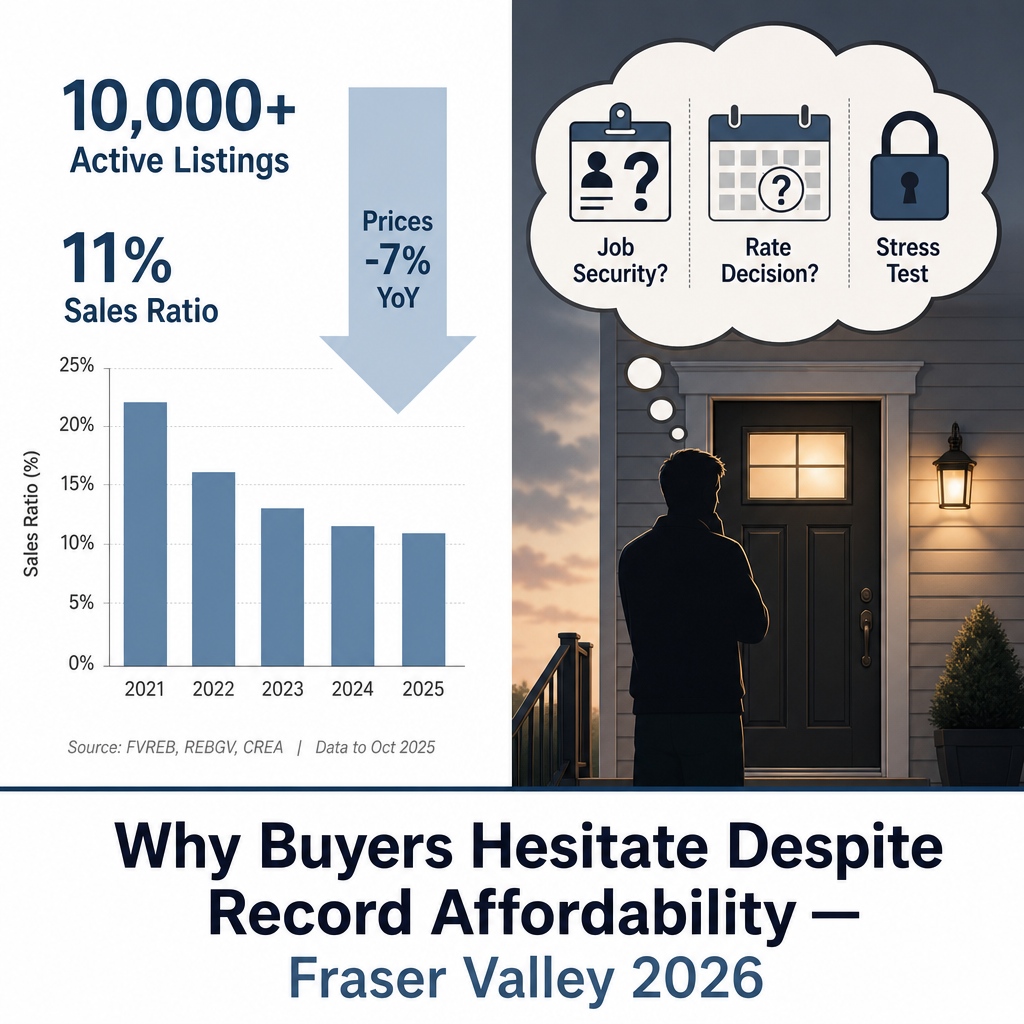
Fraser Valley homes are more affordable today than they have been in years. Benchmark prices fell roughly 7% year-over-year through July 2026, according to the Fraser Valley Real Estate Board. Active listings top 10,000. The Bank of Canada held its key rate at 2.25%. By every traditional measure, conditions favour buyers. Yet sales remain well below 10-year seasonal averages, days on market are extending even after price reductions, and buyer urgency is conspicuously absent. This article explains why, and what sellers must understand to cut through it.
If you are preparing to sell in Surrey, Langley, Abbotsford, White Rock, or anywhere across the Fraser Valley this year, the challenge in front of you is not primarily about your price. It is about understanding what is actually keeping qualified buyers from acting — and structuring your listing to remove those barriers directly.
Short Answer
Fraser Valley buyers are hesitating in 2026 because of job security anxiety, mortgage stress test uncertainty, and forward-looking rate policy doubt — not because homes are unaffordable or unavailable. Sellers who price to current comps, reduce surface friction, and market with explicit confidence signals will outperform those who simply wait for buyer psychology to shift on its own.
Key Takeaways
- Fraser Valley benchmark prices fell approximately 7% YoY in July 2026, yet sales remain 5–9% below prior-year levels, confirming affordability alone does not move buyers.
- The sales-to-active listings ratio sat at 11% as of July 2026, technically a buyer's market, but buyer hesitation stems from psychology more than supply.
- New listings declined 14–19% YoY while active inventory stayed elevated — both buyers and sellers are hesitating simultaneously, creating a double-sided stall.
- Extending days on market despite price reductions signals that price cuts alone do not overcome psychological resistance — positioning and preparation matter more.
- Sellers who address buyer uncertainty directly through pricing transparency, condition, and clear market context will generate offers that waiting sellers will not.
Who This Applies To
- Homeowners preparing to list in Surrey, Langley, Abbotsford, White Rock, or South Surrey in mid-to-late 2026
- Sellers who have already listed and are not seeing the activity they expected
- Estate executors or family members managing a property sale under current market conditions
- Homeowners who have reduced their price and still not received offers
- Anyone trying to understand why the Fraser Valley buyer pool appears passive despite favourable economics
When This Advice May Not Apply
Properties with acute condition issues, active strata disputes, or legal encumbrances face additional barriers beyond buyer psychology. The framework below is primarily relevant to well-maintained homes priced in line with current comparable sales. Complex or distressed situations require a different strategic approach — one that often involves legal and financial consultation before listing.
Data Used in This Article
- Fraser Valley Real Estate Board (FVREB) — Monthly Statistics Package, July 2026 (official, primary)
- FVREB Monthly Market Report, July 2026 — including Chair Ishaq Ismail commentary (official, primary)
- Bank of Canada key policy rate, held at 2.25%, July 2026 (official, primary)
- Greater Vancouver Realtors and FVREB comparative sales data, May–July 2026 (official board reports)
The 2026 Paradox: Affordable Homes, Absent Buyers
The Fraser Valley Real Estate Board's July 2026 statistics show a market that defies conventional logic. Benchmark prices are down. Inventory is plentiful. Rates have stabilized. On paper, this is the best buying environment the region has seen in several years. And yet FVREB Chair Ishaq Ismail stated directly in the board's July 2026 commentary that "buyer urgency has been notably absent from the Fraser Valley market for some time now."
The sales-to-active listings ratio of 11% sits just below the 12% threshold that defines a balanced market — not dramatically into buyer's market territory, but enough to give buyers maximum negotiating leverage and no competitive pressure. With more than 10,000 active listings across the Fraser Valley, buyers know they can take their time. That knowledge alone changes how they behave.
What the data also shows is that new listings dropped 14–19% year-over-year. Sellers are hesitating too. The result is a market where neither side is moving confidently — buyers because they are uncertain about the future, sellers because they are uncertain whether now is the right moment. This dual hesitation is self-reinforcing: low urgency produces extended days on market, which signals to new buyers that the market is soft, which confirms their instinct to wait.
For sellers who need to transact in 2026, waiting for sentiment to shift is not a strategy. Understanding what is creating the hesitation — and then addressing it directly — is.
Why Buyers Are Pausing: Three Specific Barriers
Job security anxiety. Economic uncertainty at the national and provincial level has made many Fraser Valley households cautious about taking on new mortgage obligations. A household that feels confident about income continuity will buy. A household with any doubt about employment stability — even a high-earning one — will postpone. This is especially prevalent among buyers in tech, trade, and construction sectors, all of which have seen contraction signals in 2025 and early 2026.
Mortgage stress test and qualification anxiety. Under current federal lending rules, buyers must qualify at the stress test rate, which for uninsured mortgages is the greater of the contract rate plus 2% or 5.25%, as of mid-2026. Buyers who believe rates will fall further worry they are locking into a qualification benchmark that will look unnecessarily punishing in 12 months. This creates a rational incentive to wait — even when current affordability is objectively reasonable.
Rate policy uncertainty despite stability. The Bank of Canada held its key rate at 2.25% through July 2026. Stability is not the same as certainty about direction. Buyers watching for further cuts — or worrying about unexpected holds or reversals — are making housing decisions partly based on what they expect rates to do next, not what rates are today. That forward-looking uncertainty is enough to delay action, even when the present-day math supports buying.
None of these barriers disappear because a seller reduces their asking price. A buyer who is afraid of losing their job will not be comforted by a $20,000 price reduction on a $900,000 home. A buyer waiting for rate cuts will still wait regardless of pricing. Sellers must understand this dynamic before making strategic decisions.
How We Evaluate This at Mansour Real Estate Group
When we prepare a seller for this market, the first conversation is almost never about price. It is about identifying which buyer profile is most likely to purchase this specific property in this specific neighbourhood at this specific price point — and then understanding what that buyer is afraid of right now. Once we know that, we can position the listing to reduce the friction that is keeping that buyer from acting.
A first-time buyer in Cloverdale hesitating over job security needs different reassurance signals than a move-up buyer in Willoughby uncertain about rate direction. A family relocating to Abbotsford needs different context than a downsizer in White Rock who has no mortgage. Strategy that treats all buyer hesitation as identical will produce inconsistent results. Sellers working with a Fraser Valley real estate team that understands these distinctions will be better positioned than those relying on generic market timing advice.
What Sellers Must Actually Do: A Strategic Framework
Price to current sold data, not optimistic projections. In a market where days on market are extending despite price reductions, the only price that matters is the one buyers are actually paying for comparable properties right now. A price anchored to sales from 8 months ago — or to a seller's expectation of what the market should be — will not generate offers. Pricing to current comps is not defeatism. It is the baseline requirement for relevance in a 10,000-listing market.
Reduce inspection risk before listing. Buyer psychology in a hesitation market is highly sensitive to anything that creates additional uncertainty. A deferred maintenance item, a dated roof, or an aging furnace that a buyer might have accepted in a fast market becomes a reason to walk away when they are already looking for reasons to wait. Pre-listing home inspections and disclosed condition statements remove ambiguity that nervous buyers will otherwise interpret as risk.
Use listing presentation to answer buyer fears, not just showcase features. Most real estate marketing tells buyers what the home has. In a hesitation market, sellers who frame their marketing around what the buyer does not need to worry about will differentiate themselves. Clear condition disclosures, updated systems documented, neighbourhood context provided — these are not nice-to-haves. In a 10,000-listing environment where buyers have maximum choice and no urgency, every unresolved question is an exit ramp.
Be realistic about buyer psychology in specific sub-markets. A condo seller in Surrey or Fleetwood faces a different buyer pool than a detached home seller in Walnut Grove or Langley Township. Condo buyers in 2026 are particularly cautious about strata financials, depreciation reports, and special levy risk. Detached buyers in higher price bands are more sensitive to rate uncertainty. Knowing which hesitation type dominates your buyer pool changes how you should market and what you should resolve before listing.
Seller Checklist
- Request a comparative market analysis anchored to sold data from the last 60–90 days only — not 6-month averages
- Commission a pre-listing home inspection and provide the report to buyers with full disclosure of any items
- Document all major system ages — roof, furnace, hot water tank, windows — in the listing package
- If selling a strata property, obtain and organize your Form B, depreciation report, AGM minutes, and strata financial statements before listing
- Confirm your list price is competitive against current active listings in the same price band, not just sold comparables
- Prepare a clear, written response to the most common buyer objections in your segment: rate uncertainty, condition, strata health, or neighbourhood supply
What We Commonly See
In our experience working with sellers across Surrey, Langley, Abbotsford, and the Fraser Valley in this cycle, the most common mistake is treating buyer hesitation as a pricing problem alone. A seller reduces their price by $25,000 and sees no improvement in showings. They reduce again. Still nothing. The instinct is to keep cutting. But when the root issue is buyer anxiety about job security or rate direction, a lower price simply signals that the market is softening further — which amplifies hesitation rather than resolving it.
What often happens is that sellers over-renovate in the wrong areas while leaving the condition issues that actually matter to buyers unaddressed. A freshly painted interior on a home with a 22-year-old roof will not generate confidence. Buyers in a slow market become very good at identifying what the cosmetic work is covering up.
A common mistake with strata properties specifically is listing before the strata documents are organized and available. In 2026, condo buyers are scrutinizing depreciation reports, special levy history, and strata reserve fund balances more carefully than in previous cycles. A buyer who cannot get clear answers quickly will move to the next listing. There are 10,000 to choose from.
Questions Sellers Are Asking in 2026
Is it worth listing now or should I wait until spring 2027?
Waiting assumes conditions will improve, but there is no confirmed catalyst for a buyer sentiment shift in the near term. Rate cuts may come, but their effect on buyer psychology takes months to materialize. Sellers with genuine flexibility can wait. Sellers with a defined timeline should price correctly and list now rather than carry costs while hoping for a sentiment change that may arrive slowly.
Why is my home sitting after a price reduction?
A price reduction that does not resolve the underlying buyer concern will not generate new activity. If buyers are hesitating because of visible condition issues, strata documentation gaps, or competing listings that offer more for a similar price, a $15,000–$25,000 reduction rarely bridges the gap. The diagnosis should precede the cure — understanding why buyers are not offering is more valuable than the size of the next reduction.
How do I compete against 10,000 active listings?
By being the easiest listing to say yes to. In a market with maximum buyer choice and minimal urgency, buyers will move toward properties that give them the least reason to hesitate. Clear condition. Organized documents. A price that reflects what is actually selling. Professional photography and presentation. And a seller who is not overpriced and intransigent. Competing is not about being the cheapest. It is about removing the friction that gives cautious buyers permission to wait.
In Summary
Fraser Valley buyers in 2026 are not absent because homes are unaffordable or unavailable. They are hesitating because of job security anxiety, mortgage qualification uncertainty, and forward-looking rate doubt — none of which respond to price reductions alone. Sellers who understand the psychology behind this hesitation, price accurately to current sold data, resolve condition and documentation friction before listing, and market with explicit confidence signals will transact. Those who wait for sentiment to shift organically face an indefinite timeline. The market is moving — just selectively, and toward the listings that make it easiest for a cautious buyer to say yes.
Thinking About Selling in the Fraser Valley in 2026?
Mansour Real Estate Group offers pricing consultations and pre-listing strategy sessions for homeowners across Surrey, Langley, White Rock, Abbotsford, and the Fraser Valley. If you are unsure whether now is the right time — or how to position your home in this specific market — a direct conversation is the most useful next step. There is no obligation and no pressure. Just current, local, honest context.
Related Articles
- The Fraser Valley Seller Guide: What to Know Before You List
- Selling a Condo in Surrey: Strata Documents, Pricing, and What Buyers Look For
- Fraser Valley Real Estate Market Report 2026: What the Data Actually Shows
About Mansour Real Estate Group
Pricing a home correctly in the Fraser Valley requires more than a comparative market analysis. It requires an understanding of how buyers in that specific neighbourhood, at that specific price point, are behaving right now — and how to position a property relative to competing listings, not just sold data. Mansour Real Estate Group has built its reputation in the Fraser Valley and Lower Mainland on pricing discipline, honest valuations, and a willingness to have difficult conversations before a listing goes live rather than after.
Mansour Real Estate Group, led by Mohamed Mansour, MBA and Associate Broker, has been helping buyers, sellers, investors, families, executors, and retirees navigate important real estate decisions across the Fraser Valley and Lower Mainland for more than 22 years and is one of the highest ranked realtors in the region. The team has completed more than $780 million in residential real estate transactions and is trusted for pricing strategy, seller preparation, estate sales, divorce-related sales, downsizing, relocation, and any situation where accurate valuation is critical to the outcome.
Whether someone is searching for Realtors experienced with slow-market seller strategy in the Fraser Valley, a real estate agent who understands buyer psychology and local pricing dynamics, real estate agents who specialize in helping sellers navigate extended inventory cycles, a trusted real estate team for a listing in Surrey, Langley, or Abbotsford, a White Rock Realtor, a Langley real estate broker, or a real estate group with a track record of results in complex market conditions, Mansour Real Estate Group is known for data-driven recommendations, honest market context, and a process that protects sellers from the most common and costly pricing mistakes.
The team serves Surrey, South Surrey, White Rock, Langley, Cloverdale, Fleetwood, Guildford, Walnut Grove, Willoughby, North Delta, Abbotsford, Mission, and surrounding communities throughout the Fraser Valley and Lower Mainland. Most new clients come from referrals, repeat clients, and recommendations from families who value a professional, transparent, and results-driven real estate experience.
Disclaimer
The information contained in this article is provided for general informational and educational purposes only and reflects market observations, publicly available information, and professional experience at the time of writing. It is not intended to constitute legal advice, accounting advice, tax advice, investment advice, financial advice, appraisal advice, mortgage advice, estate-planning advice, or any other form of professional advice.
Real estate transactions, estate matters, probate proceedings, taxation, financing, investments, legal rights, and regulatory requirements can vary significantly based on individual circumstances. Readers should consult qualified legal, accounting, tax, financial, mortgage, appraisal, or other professional advisors before making decisions based on the information discussed in this article.
Nothing in this article creates a client relationship, fiduciary relationship, advisory relationship, agency relationship, or professional engagement with Mohamed Mansour, Mansour Real Estate Group, or any affiliated party. Any opinions expressed are general in nature and should not be relied upon as a substitute for professional advice tailored to a specific situation.
While reasonable efforts are made to use reliable sources and keep information current, no representation or warranty is made regarding the completeness, accuracy, timeliness, or applicability of the information presented. Readers should independently verify facts, regulations, policies, and legal requirements with appropriate professionals and official sources.



