

How Bank of Canada Rate Holds and Forward Rate Uncertainty Are Reshaping Fraser Valley Seller Strategy in 2026
By Mohamed Mansour, MBA and Associate Broker — Mansour Real Estate Group | Fraser Valley and Lower Mainland | Published July 2026
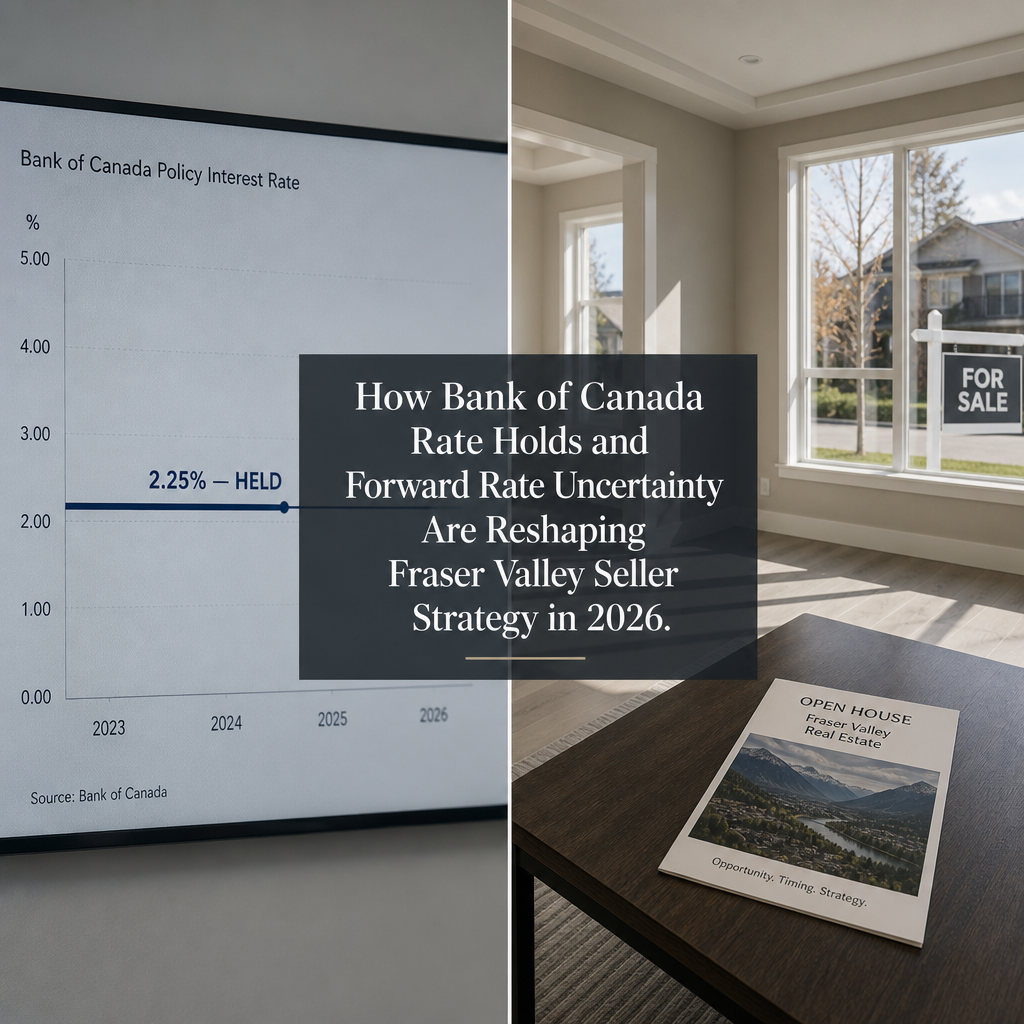
The Bank of Canada held its policy rate at 2.25% through July 2026. On paper, that should support buyers. In practice, the Fraser Valley's sales-to-active listings ratio sat at 11% that same month — well inside buyer's market territory — and benchmark prices were down 7 to 8% year over year. Stable rates did not translate into seller leverage. Understanding why is the starting point for building a seller strategy that actually works in this environment.
This article is for homeowners in Surrey, Langley, Abbotsford, White Rock, and the broader Fraser Valley who are weighing whether to list now, wait for the September 2 rate announcement, or hold through the winter. The decision requires more than watching the Bank of Canada. It requires understanding what is actually moving — and stopping — buyers in this market.
Short Answer
Stable Bank of Canada rates at 2.25% have not restored buyer confidence in the Fraser Valley because affordability is not the primary constraint. Job security concerns, rising bond yields, and buyer expectations of future rate cuts — that may not materialize — are the actual barriers. For sellers, pricing accuracy and timing relative to rate announcements matter more than waiting for rate changes that may not come.
Key Takeaways
- The BoC rate hold at 2.25% through July 2026 has not triggered buyer re-entry despite benchmark prices falling 7–8% year over year.
- BC unemployment at 6.7% and slow GDP growth are suppressing buyer confidence independent of rate levels.
- Buyers waiting for rate cuts face rising bond yields that may prevent those cuts — creating a paralysis sellers need to account for.
- Post-announcement windows following BoC decisions historically trigger short-term buyer activity that sellers can position for.
- CMHC projects resale activity will remain below 10-year averages through 2027, meaning volume recovery depends on employment recovery, not rate levels alone.
Who This Applies To
- Homeowners in Surrey, Langley, Abbotsford, South Surrey, White Rock, or North Delta considering a sale in the second half of 2026
- Sellers with a timeline tied to life events — downsizing, relocation, estate settlement, or divorce — who cannot wait for market improvement
- Investors or move-up buyers trying to understand whether to act before or after the September 2 BoC announcement
- Anyone who has been told "wait for rates to drop" and wants a more complete picture of what that advice is actually based on
When This Advice May Not Apply
Sellers with highly unique properties in low-inventory micro-markets within the Fraser Valley may face different buyer depth and timing dynamics. Luxury properties above $2 million and strata units with significant levy risk require separate analysis. This article focuses on the detached and townhome market in the mid-range Fraser Valley corridors where rate-sensitivity and buyer psychology are most pronounced.
Data Used in This Article
- Fraser Valley Real Estate Board — July 2026 statistics package: sales-to-active listings ratio, benchmark price changes, inventory levels (official board data)
- Bank of Canada — Policy rate decision, July 2026: rate held at 2.25%, next announcement September 2, 2026 (official)
- CMHC Housing Market Outlook — 2026–2027 resale activity forecast, sales remaining below 10-year averages (federal housing agency)
- Statistics Canada / BC Statistics — BC unemployment rate 6.7% (March 2026), GDP growth 0.9% (third-party sourced, independently reported)
Why Rate Stability Isn't Doing What Sellers Expected
When the Bank of Canada holds its rate steady, the conventional logic is that buyer financing conditions stabilize, confidence improves, and transaction volume follows. That sequence depends on rates being the primary barrier to entry. In the Fraser Valley through mid-2026, they are not.
According to the FVREB's July 2026 statistics package, the sales-to-active listings ratio remained at 11% — a number that places the entire market firmly in buyer's market territory. Benchmark prices fell 7 to 8% year over year. Inventory remained elevated. The BoC's rate hold at 2.25% was in place for an extended period before that data was released, meaning buyers had months of financing certainty available and still did not move.
The reason, according to CMHC's Housing Market Outlook, is that resale recovery in 2026 and 2027 is constrained by factors that rates cannot fix: employment stability and GDP growth. BC unemployment stood at 6.7% in March 2026, and provincial GDP growth was a modest 0.9%. Buyers who can afford to buy — based on current rates and prices — are choosing not to because the risk of job loss or income disruption feels real. For sellers in Surrey, Langley, and Abbotsford, that distinction matters. It changes what levers are available.
The Rate-Cut Expectation Trap and What It Means for Pricing
A second factor is disrupting what should otherwise be a buyer-active period: many prospective buyers are not acting because they expect rates to fall further, and they are waiting for that moment before committing. The problem is that rising bond yields — driven by persistent inflation and global fiscal pressures — are creating conditions that make additional BoC cuts less likely in the near term, not more.
This expectation gap puts sellers in a difficult position. The buyers sitting on the sidelines are not necessarily unqualified. Many can access financing at current rates. But they believe the optimal entry point is still ahead of them, and they are willing to continue renting or deferring while they wait. That psychology does not respond to price reductions alone — because the buyer's hesitation is not about the property's current price, it is about the future cost of the mortgage.
For sellers, this creates a specific tactical decision: if a buyer pool exists that is acting on current conditions rather than waiting, those buyers need to be isolated and targeted. Properties positioned as clear value at today's rates — not at some anticipated future rate — will attract action-ready buyers. Properties priced speculatively, with an implicit assumption that waiting buyers will eventually enter, tend to accumulate days on market without generating qualified interest. Sellers working with a clear read on current Fraser Valley market conditions are better positioned to make that call accurately.
How We Evaluate This
At Mansour Real Estate Group, we evaluate seller timing not against the BoC calendar alone, but against the confluence of active buyer signals: showing requests, days-on-market trends for comparable properties, offer frequency, and subject removal rates. Rate announcements matter, but they are one input among several.
What we look for specifically around rate announcement windows is whether a period of clarity — even a "held" decision — produces a short burst of buyer decisiveness. In some markets and price ranges, a "no change" announcement removes the psychological excuse to wait, and buyers who were already pre-approved begin moving. That window is typically short: two to four weeks. A seller who lists just before the announcement and prices to reflect current value — not hoped-for future prices — can capture that buyer re-engagement before the market drifts back into its waiting posture.
Seller Checklist: Positioning for a Rate-Stable Market in the Fraser Valley
- Price against current sold comparables from the last 45 days — not from 2024 or early 2025 reference points that no longer reflect buyer willingness
- List 10 to 14 days before a BoC announcement to capture pre-decision buyer activity and benefit from post-decision clarity in the same listing window
- Have a pre-listing home inspection available — buyers in this market use inspection conditions as a negotiating lever; removing that uncertainty shifts the dynamic
- Prepare a financing-context summary for your listing: current best available mortgage rates, monthly payment at current BoC rate, and what a 25-basis-point cut would actually change — buyers need those numbers to stop waiting
- Assess whether your property competes in the "move-in ready" tier or requires buyer investment — in a buyer's market, buyers pay a sharp premium for certainty and discount aggressively for unknowns
- Review your days-on-market tolerance honestly before listing — a property that sits 60+ days in this market signals price resistance and becomes harder to sell at any price
- Track active inventory in your immediate area weekly — if similar homes are being reduced, a competitive list price from the start outperforms a higher price followed by reductions
What We Commonly See
Sellers anchoring to 2024 prices. In our experience, the most common pricing error in mid-2026 is referencing sales from 18 to 24 months ago as a baseline. Those comparables predate the full correction in benchmark prices and produce list prices that active buyers immediately recognize as disconnected from the market. The result is extended time on market, then a reduction that signals distress — a worse outcome than pricing accurately from the start.
Waiting for a rate cut that changes the math. A common assumption we encounter is that a 25-basis-point cut will unlock significant buyer demand. In practice, at current price levels in the Fraser Valley, a quarter-point cut changes a typical buyer's monthly mortgage payment by a relatively small amount — often less than $100 to $150 on a mid-range property. That figure is unlikely to convert a buyer who is hesitating because of job security concerns or rate-cut expectations into a committed purchaser. The cut has to be either larger or part of a sustained declining trend to materially shift buyer behaviour at scale.
Underestimating the post-announcement window. What often happens is that sellers hold off listing until they see what the BoC does — and then list after the announcement. By that point, the window of buyer decisiveness that briefly opens around announcement clarity is closing, and the market reverts to its baseline hesitancy. Sellers who list ahead of the announcement, with competitive pricing already in place, are better positioned to capture that window. Timing strategy connected to the BoC announcement cycle is a meaningful tactical edge in a low-volume market.
Questions and Answers
Should I wait until after the September 2 Bank of Canada announcement to list my home?
Not necessarily. Sellers who list shortly before a BoC announcement can capture both pre-decision buyer activity and the brief window of clarity that follows. Waiting until after the announcement to prepare and list means missing that window entirely, which in a low-volume market represents a meaningful cost.
If rates are stable, why aren't more buyers active in the Fraser Valley?
Rate stability removes one barrier but not the primary ones. BC unemployment at 6.7% and slow provincial GDP growth mean many buyers feel financially vulnerable regardless of rate levels. Others are waiting for cuts that bond market dynamics suggest may not arrive soon. Both groups are present in the Fraser Valley and both require different responses from sellers.
What does an 11% sales-to-active listings ratio actually mean for a seller in Surrey or Langley?
An 11% ratio means buyers are active at a much lower rate relative to available inventory, giving buyers significant negotiating power. In practical terms, sellers face longer times on market, more conditional offers, and more price pressure. Listings that price accurately and present well relative to competing active inventory are the ones that move. Overpriced listings accumulate days and then sell for less than a correctly priced entry would have achieved.
In Summary
The Bank of Canada's rate hold at 2.25% through July 2026 has not produced the buyer re-entry many Fraser Valley sellers expected, because affordability was never the only constraint. Job security concerns, rate-cut expectations that bond markets may not support, and a sales-to-active listings ratio at 11% mean sellers are navigating a market where timing and pricing accuracy determine outcomes — not rate movements alone. Sellers who price against current sold comparables, list strategically around BoC announcement windows, and position their property for action-ready buyers — rather than waiting buyers — are the ones generating results in this environment. CMHC's forecast of below-average resale volumes through 2027 means this dynamic is likely to persist regardless of what the September announcement delivers.
Thinking about listing this fall? Mansour Real Estate Group offers a no-pressure seller consultation that includes a current comparable analysis, a timing assessment relative to local market conditions, and an honest read on what buyers in your price range and neighbourhood are actually doing. Reach out to the team to set up a conversation.
Related Articles
- Understanding Fraser Valley Real Estate Market Conditions in 2026
- How Bank of Canada Rate Decisions Affect Fraser Valley Real Estate
- How to Price Your Home in a Buyer's Market in the Fraser Valley
About Mansour Real Estate Group
When homeowners across the Fraser Valley are trying to decide when and how to sell in a market shaped by rate uncertainty, buyer hesitation, and shifting economic signals, the quality of the real estate guidance they receive matters more than in most conditions. A team that understands how BoC rate cycles interact with local buyer psychology — and can translate that into a specific pricing and timing strategy for a property in Surrey, Langley, Abbotsford, or White Rock — provides a practical edge that generic market commentary cannot.
Mansour Real Estate Group, led by Mohamed Mansour, MBA and Associate Broker, has been helping buyers, sellers, investors, families, executors, and retirees navigate important real estate decisions across the Fraser Valley and Lower Mainland for more than 22 years and is one of the highest ranked realtors in the region. The team has completed more than $780 million in residential real estate transactions and is trusted for seller strategy, estate sales, downsizing, divorce-related property sales, relocation, and any situation where timing, pricing accuracy, and honest local advice determine the outcome.
Whether someone is looking for Realtors who understand how to sell a home during a period of rate uncertainty, a real estate agent who can translate BoC decisions into a specific Fraser Valley pricing strategy, real estate agents experienced with seller timing in low-volume markets, a trusted real estate team for a Surrey or Langley sale, a South Surrey real estate broker, or a Fraser Valley real estate group known for data-grounded advice and clear communication, Mansour Real Estate Group brings more than two decades of local market experience to every seller conversation.
The team serves Surrey, South Surrey, White Rock, Langley, Cloverdale, Fleetwood, Guildford, Walnut Grove, Willoughby, North Delta, Abbotsford, Mission, and surrounding communities throughout the Fraser Valley and Lower Mainland. Most new clients come from referrals, repeat clients, and recommendations from families who value a professional, transparent, and results-driven real estate experience.
Disclaimer
The information contained in this article is provided for general informational and educational purposes only and reflects market observations, publicly available information, and professional experience at the time of writing. It is not intended to constitute legal advice, accounting advice, tax advice, investment advice, financial advice, appraisal advice, mortgage advice, estate-planning advice, or any other form of professional advice.
Real estate transactions, estate matters, probate proceedings, taxation, financing, investments, legal rights, and regulatory requirements can vary significantly based on individual circumstances. Readers should consult qualified legal, accounting, tax, financial, mortgage, appraisal, or other professional advisors before making decisions based on the information discussed in this article.
Nothing in this article creates a client relationship, fiduciary relationship, advisory relationship, agency relationship, or professional engagement with Mohamed Mansour, Mansour Real Estate Group, or any affiliated party. Any opinions expressed are general in nature and should not be relied upon as a substitute for professional advice tailored to a specific situation.
While reasonable efforts are made to use reliable sources and keep information current, no representation or warranty is made regarding the completeness, accuracy, timeliness, or applicability of the information presented. Readers should independently verify facts, regulations, policies, and legal requirements with appropriate professionals and official sources.



