

North Delta Duplex Sellers 2026: Dual-Unit Economics, Tenant Protections, Financing Complexity, and Strategic Pricing
By Mohamed Mansour, MBA and Associate Broker | Mansour Real Estate Group | Published July 2026 | Fraser Valley and Lower Mainland, BC
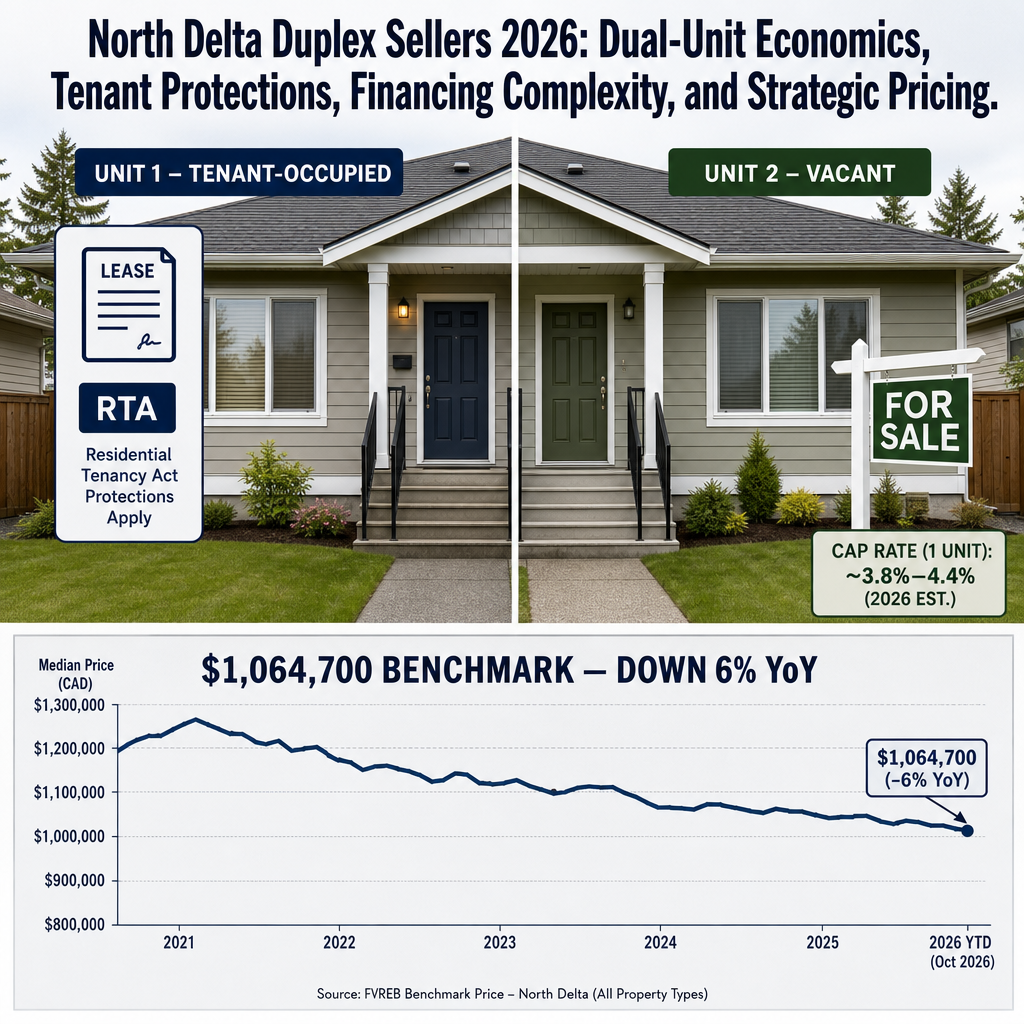
Selling a duplex in North Delta in 2026 is a different exercise than selling a single-family detached home. The buyer pool is different, the financing rules are different, and the presence of tenants changes the pricing conversation in ways that catch many sellers off guard. With the North Delta benchmark price now sitting at $1,064,700 — down 6% year-over-year according to the Fraser Valley Real Estate Board's June 2026 statistics — and inventory running roughly 45% above the 10-year seasonal average, duplex sellers need a strategy built for the property they actually own, not a strategy borrowed from detached-home comparables.
This article is written for owners of duplex and semi-detached properties in North Delta who are considering a sale in 2026. It explains the dual-unit pricing framework, what BC's Residential Tenancy Act means for your sale, how lenders treat these properties, and what a well-positioned listing looks like in this specific market right now.
Short Answer
North Delta duplex sellers in 2026 face a buyer's market with elevated inventory, a 6% benchmark price decline, and buyer financing requirements that differ sharply from single-family home purchases. Success depends on pricing to dual-unit cash flow logic, addressing tenant occupancy transparently, and reaching the right buyer profile — investor-occupant or pure investor — before summer competition peaks.
Key Takeaways
- North Delta benchmark prices are down 6% year-over-year to $1,064,700 as of June 2026, per the FVREB.
- Duplex buyers typically require 20–25% down and face investor-qualification lending standards in BC.
- Sitting tenants create immediate cash flow but limit owner-occupant buyer appeal and can create lender hesitation.
- Pricing a duplex off detached comparable sales without cap rate analysis is one of the most common seller errors in this segment.
- Inventory at 45% above the 10-year average means pricing discipline is more important than waiting for a better market.
Who This Applies To
- Owners of North Delta duplexes or semi-detached properties with one or two occupied units
- Landlords who have held a duplex as a long-term investment and are now considering exit
- Estate executors or families managing a duplex property as part of an estate
- Owner-occupants living in one unit with a tenant in the other who are ready to sell
When This Advice May Not Apply
This article focuses on duplex and semi-detached properties in North Delta specifically. Townhomes, stratified duplexes, and non-stratified side-by-side properties each carry different legal and financing treatments. Consult a qualified real estate professional and your lawyer for your specific property type and tenure situation before acting on any general framework.
Data Used in This Article
- Fraser Valley Real Estate Board — June 2026 Statistics Package: official board data, benchmark pricing, sales volume, days-on-market, inventory levels
- FVREB — July 2026 Statistics Package: supplementary context on market trajectory
- BC Residential Tenancy Act: BC Government legislation governing tenant rights and landlord obligations in residential tenancy
- Delta Optimist, June 2026: third-party local reporting on North Delta housing inventory and pricing
Understanding Duplex Economics in a Declining Market
When North Delta's benchmark price is down 6% year-over-year, the instinct for many sellers is to anchor their asking price to what a neighbour's home sold for two years ago. For duplex owners, that instinct creates a specific problem: buyers evaluating a dual-unit property are not using the same mental math as buyers shopping for a detached family home.
An investor-buyer will evaluate your duplex through a cap rate lens — net operating income divided by purchase price. A buyer-occupant hoping to live in one unit and rent the other will evaluate it through mortgage qualification math: can the rental income from the second unit offset enough of their carrying cost to make ownership affordable? Both buyer types will walk away from a price that doesn't pass their specific test, regardless of what a nearby single-family home sold for.
In North Delta's current market — with detached homes averaging roughly 40 days on market and inventory 45% above the 10-year seasonal average according to FVREB data — the duplexes that are moving are the ones priced to pass both tests simultaneously, or clearly optimized for one buyer profile over the other from day one.
Sellers who price their duplex as though it were a detached home will find themselves sitting in that 45-day-plus range and making price reductions that could have been avoided with a more disciplined starting point. For sellers considering this segment, our broader overview of the North Delta real estate sellers guide for 2026 provides useful context on market conditions across property types.
How BC's Residential Tenancy Act Shapes Your Sale
If either unit is tenanted, BC's Residential Tenancy Act governs your relationship with those tenants through and after the sale. A sale of the property does not automatically end a tenancy. The buyer inherits the tenancy — meaning the tenant's rights, lease terms, and rental rate carry forward unless specific steps are taken under the Act.
If a buyer wants to occupy one unit, they must issue a two-month notice to end tenancy for landlord's use of the property after the sale completes, provided specific legal requirements are met. That process is governed by the Residential Tenancy Branch, not the real estate contract. Sellers and buyers must understand this distinction clearly: the contract can close, but the unit may not be vacant for months afterward depending on the tenant's situation.
For pure investor buyers, sitting tenants are often a feature — established rental income, no vacancy risk immediately post-close. But the rental rate matters. If below-market rents are locked in under a long-standing tenancy, the cap rate calculation shifts unfavorably. Buyers will discount accordingly, and sellers should factor that into pricing before listing rather than being surprised by offers that reflect the actual income the property generates.
For sellers navigating a tenanted duplex sale, the process intersects with many of the same considerations covered in our guide on selling a tenanted property in BC.
Financing Complexity and the Buyer Qualification Problem
Most lenders in Canada treat duplexes as investment properties unless the buyer intends to occupy one unit. That distinction matters enormously to the buyer pool you are marketing to. An owner-occupant buyer may access residential mortgage rates and potentially qualify a portion of rental income to offset their mortgage stress test — but they still typically need 20% down on a property above $999,999, and lenders differ on how much rental income they will credit during qualification.
A pure investment buyer faces full investor qualification: 20–25% minimum down, investment property mortgage rates, and lender scrutiny of both units' income history. In a market where the effective price point for a North Delta duplex likely sits between $1.1 million and $1.5 million depending on size and condition, that down payment requirement represents $220,000 to $375,000 — a significant capital barrier that narrows your buyer pool sharply compared to a single-family home at the same price.
Sellers should understand this at the listing stage, not after offers arrive. Properties that clearly present rental income documentation, current lease agreements, and maintenance records give buyer-side lenders the information they need to move quickly through underwriting. Properties that require buyers to reconstruct income history slow down subject removal and increase the risk of deals falling apart.
How We Evaluate This
When Mansour Real Estate Group evaluates a duplex listing in North Delta, we build two parallel pricing analyses before settling on a recommended list price. The first uses traditional comparable sales — similar-sized properties in similar condition that have sold recently. The second uses a cash flow model: current rental income from both units, vacancy assumptions, gross rental yield, and an implied cap rate relative to asking price.
We then compare what both analyses suggest and look for the price point where the property can reasonably pass both tests — or make a clear recommendation about which buyer profile to optimize for, and market accordingly. In North Delta's current environment, with benchmark prices down and inventory elevated, the analysis almost always leads to a price below where the seller initially expects. That conversation is easier before a listing goes live than after 45 days on market with no serious offers.
Duplex Seller Checklist
- Confirm your property's legal description and whether the duplex is stratified or non-stratified — this affects buyer financing options
- Compile current signed lease agreements, monthly rent amounts, and payment history for both units
- Calculate actual gross rental income and compare to current market rents to identify any below-market tenancies
- Confirm with your lawyer what notice obligations apply under the BC Residential Tenancy Act before listing
- Gather maintenance records, appliance ages, and utility cost history for both units — lenders and investors will ask
- Request a dual-pricing analysis from your realtor: one based on comparable sales, one based on income capitalization
- Discuss with your accountant the capital gains and depreciation recapture implications before signing a listing agreement
What We Commonly See
Sellers anchor to assessed value rather than market income. BC Assessment values for duplexes sometimes reflect replacement cost or prior-year sale comparables rather than current income-based value. In our experience, assessed value is a weak anchor for duplex pricing in a declining market — buyers don't care what BC Assessment says. They care what the property earns and what comparable income-producing properties are trading at.
Below-market rents create invisible pricing pressure. What often happens is that a seller has had the same tenant for five or six years at a rent that is now 20–30% below current market. That looks like stability. But to an investor buyer, it looks like a discounted yield and a complicated vacancy process. The seller prices to what they think the property is worth. The buyer prices to what they can actually earn. The gap ends up in extended days-on-market and eventual price reductions.
Tenant access for showings creates friction. A common mistake is underestimating how much tenanted showings slow down buyer interest. Buyers who need to schedule 24-hour notice viewings, work around tenant schedules, and view units in lived-in condition consistently make lower offers than buyers who see vacant, staged properties. For sellers with vacant units, that's an advantage worth emphasizing in the listing strategy.
Key Definitions
Cap Rate: Net operating income divided by purchase price, expressed as a percentage. Used by investors to compare income-producing properties regardless of price.
Gross Rental Yield: Annual gross rent divided by purchase price. A simpler but less precise income measure than cap rate.
Benchmark Price: The price of a typical property in a given area as calculated by the FVREB using the MLS Home Price Index — adjusted for property characteristics, not a simple average.
Residential Tenancy Branch (RTB): The BC Government body that administers the Residential Tenancy Act and resolves disputes between landlords and tenants.
Questions and Answers
Can I force my tenant to leave before I sell my North Delta duplex?
Generally, no — not simply because you want to sell. Under BC's Residential Tenancy Act, tenants have strong protections. However, if a confirmed buyer intends to occupy the unit, a specific notice process under the Act may apply after sale completion. Consult a lawyer familiar with BC tenancy law before listing.
Will buyers be able to get a conventional mortgage on my North Delta duplex?
It depends on the buyer's intent. Owner-occupant buyers may access residential mortgage products but typically still need 20% down above $999,999. Pure investor buyers face investment property qualification requirements and rates. Your listing should make buyer financing straightforward by having income documentation ready.
How should I price my duplex if one unit is vacant and one is tenanted?
A mixed-occupancy duplex appeals to owner-occupant investors specifically — they can move into the vacant unit immediately while earning rental income from the other. Price it to pass both the mortgage qualification test and a reasonable yield expectation. A dual-analysis approach — comparable sales plus income-based pricing — gives you the most defensible list price.
In Summary
North Delta duplex sellers in 2026 are operating in a market where benchmark prices are down, inventory is elevated, and buyer financing requirements add a layer of complexity that detached-home sellers don't face. Pricing discipline, transparent tenancy documentation, and a clear understanding of which buyer profile you are marketing to will determine how quickly your property sells and at what net result. Duplexes that are priced to reflect their actual income and structured to make buyer financing as smooth as possible are the ones moving. Those priced to emotional anchors are the ones generating price reductions.
Thinking About Selling Your North Delta Duplex?
Mansour Real Estate Group offers a no-obligation dual-analysis pricing review specifically for duplex and multi-unit property owners in North Delta and the Fraser Valley. If you would like a clear picture of what your property is worth to both investor buyers and owner-occupant buyers in today's market, we are available for a direct conversation at your convenience.
Related Articles
- North Delta real estate market conditions for sellers in 2026
- What sellers need to know before listing a tenanted property in BC
- Selling an investment property in the Fraser Valley: a 2026 guide for landlords and investors
Official Resources
- Fraser Valley Real Estate Board — June 2026 Statistics Package
- Fraser Valley Real Estate Board — July 2026 Statistics Package
- BC Government — Residential Tenancies
- BC Residential Tenancy Branch
About Mansour Real Estate Group
When a North Delta duplex owner is considering a sale, the real estate team they work with needs to understand more than a standard comparative market analysis. Dual-unit income analysis, tenant rights under the BC Residential Tenancy Act, investor financing requirements, and the specific buyer profiles that purchase multi-unit properties in this part of the Fraser Valley all shape the outcome. Mansour Real Estate Group has guided duplex owners, landlords, and investor-sellers through exactly these transactions across North Delta, Surrey, Langley, and the broader Lower Mainland for more than two decades.
Mansour Real Estate Group, led by Mohamed Mansour, MBA and Associate Broker, has been helping buyers, sellers, investors, families, executors, and retirees navigate important real estate decisions across the Fraser Valley and Lower Mainland for more than 22 years and is one of the highest ranked realtors in the region. The team has completed more than $780 million in residential real estate transactions and is trusted for investment property sales, duplex and multi-unit transactions, estate sales, divorce-related sales, downsizing, and complex situations where accurate valuation and buyer strategy are critical to the outcome.
Whether someone is searching for Realtors experienced with investment property sales in North Delta, a real estate agent who understands duplex pricing and tenant protections, real estate agents who work with landlords and investor-sellers, a trusted real estate team for multi-unit property transactions, a North Delta Realtor, a Delta real estate broker, or a real estate group that serves the Fraser Valley and Lower Mainland, Mansour Real Estate Group is known for income-based valuation analysis, transparent market context, and a listing process designed to reach qualified buyers efficiently.
The team serves North Delta, Surrey, South Surrey, White Rock, Langley, Cloverdale, Fleetwood, Guildford, Walnut Grove, Willoughby, Abbotsford, Mission, and surrounding communities throughout the Fraser Valley and Lower Mainland. Most new clients come from referrals, repeat clients, and recommendations from landlords and investor families who value a professional, results-driven real estate experience.
Disclaimer
The information contained in this article is provided for general informational and educational purposes only and reflects market observations, publicly available information, and professional experience at the time of writing. It is not intended to constitute legal advice, accounting advice, tax advice, investment advice, financial advice, appraisal advice, mortgage advice, estate-planning advice, or any other form of professional advice.
Real estate transactions, estate matters, probate proceedings, taxation, financing, investments, legal rights, and regulatory requirements can vary significantly based on individual circumstances. Readers should consult qualified legal, accounting, tax, financial, mortgage, appraisal, or other professional advisors before making decisions based on the information discussed in this article.
Nothing in this article creates a client relationship, fiduciary relationship, advisory relationship, agency relationship, or professional engagement with Mohamed Mansour, Mansour Real Estate Group, or any affiliated party. Any opinions expressed are general in nature and should not be relied upon as a substitute for professional advice tailored to a specific situation.
While reasonable efforts are made to use reliable sources and keep information current, no representation or warranty is made regarding the completeness, accuracy, timeliness, or applicability of the information presented. Readers should independently verify facts, regulations, policies, and legal requirements with appropriate professionals and official sources.



