

Seller Strategy | Fraser Valley | 2026 Market Insight
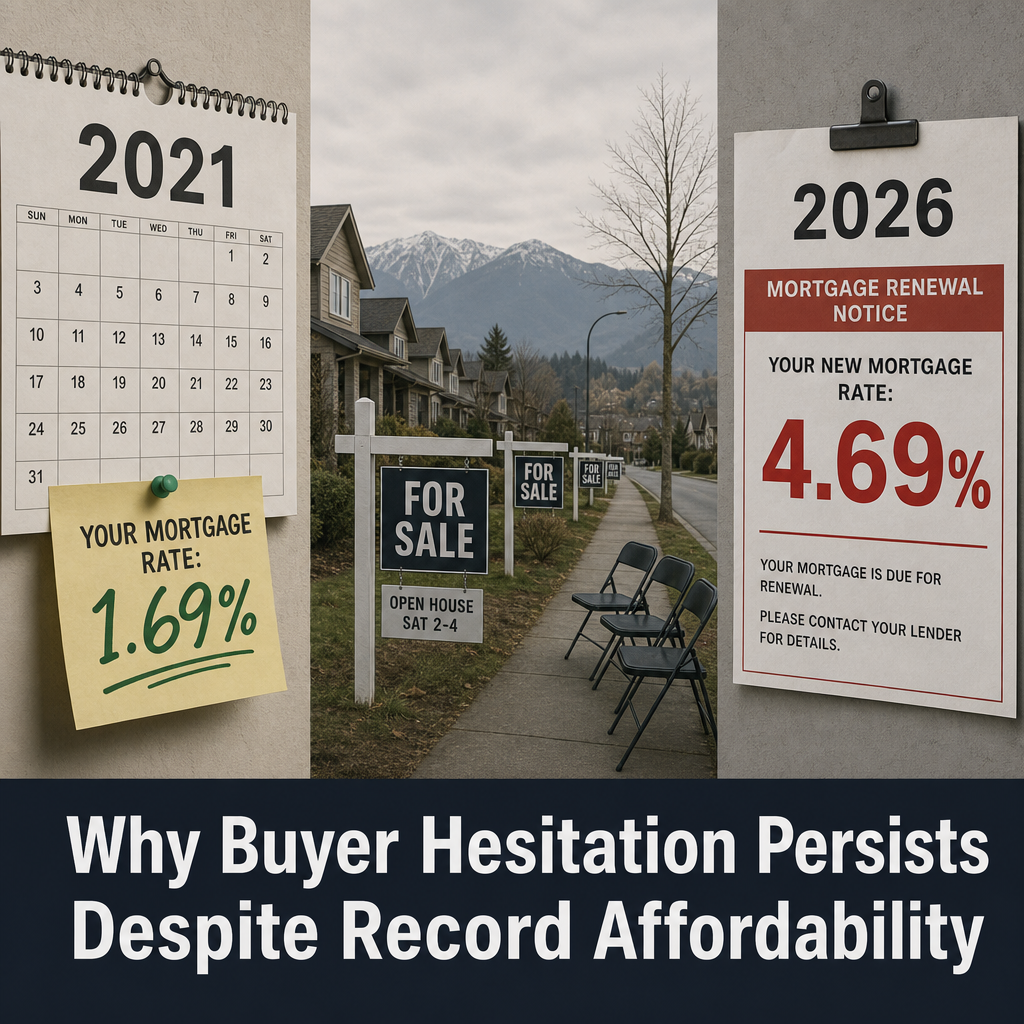
Why Buyer Hesitation Persists Despite Record Affordability: The Mortgage Renewal Crisis and Rate Shock Psychology Reshaping Fraser Valley Seller Strategy in 2026
By Mohamed Mansour, MBA and Associate Broker | Mansour Real Estate Group | August 2026
Fraser Valley sellers are watching a confusing market. Benchmark prices have fallen. Inventory is at multi-year highs. By every traditional measure, it should be a strong moment for buyers to move. Yet the phone stays quiet, offers come in light, and showings do not convert. The explanation is not found in pricing data alone. It is found in the psychology of a buyer pool that is genuinely afraid of borrowing money right now—and in the mechanics of a mortgage renewal cycle that is simultaneously pushing sellers into the market.
Understanding what is actually driving buyer behaviour in 2026 is not a theoretical exercise for Fraser Valley homeowners. It is the foundation of a realistic seller strategy. This article explains the mortgage renewal cliff, how it connects to buyer paralysis, and what it means for sellers in Surrey, Langley, Abbotsford, and the surrounding Fraser Valley communities.
Short Answer
Fraser Valley buyers are hesitating not because homes are unaffordable, but because borrowing feels risky after years of rate volatility. At the same time, homeowners who locked in 2021 mortgage rates near 1.69% are now renewing at 4.29% to 4.69%—a 30 to 50 percent monthly payment jump—and many are being forced to sell. The result is a market with rising supply and cautious demand that does not respond to price cuts alone.
Who This Applies To
- Homeowners in Surrey, Langley, Abbotsford, or North Delta planning to sell in 2026
- Sellers whose property has been on the market longer than expected without strong offers
- Executors, divorcing couples, or downsizers facing a time-sensitive sale in a soft market
- Anyone surprised that lower prices haven't produced faster sales in the Fraser Valley
When This Advice May Not Apply
Sellers with unique or scarce properties—a detached home in a tight school catchment, a rare ground-floor condo with parking, or a property with significant land value—may experience different buyer behaviour. Scarcity can override psychological hesitation in specific segments. This framework applies most directly to average-condition properties competing with similar listings in a surplus market.
Key Takeaways
- Fraser Valley inventory sits 54% above the 10-year seasonal average, yet sales are only up 7% year over year—prices alone are not moving buyers.
- Homeowners who locked in rates near 1.69% in 2021 are now renewing at 4.29% to 4.69%, driving forced sales and expanding supply.
- Metro Vancouver recorded near 20-year low sales in 2025 despite price declines of 8.3% for detached homes—buyer fear, not price, is the barrier.
- Rate anxiety and job security concerns are psychological—they do not resolve when prices drop further, and sellers need strategies that address them directly.
- Sellers who understand this dynamic can adapt: positioning, financing context, and realistic timelines matter more than price reductions in isolation.
Data Used in This Article
- Fraser Valley Real Estate Board Monthly Market Report, July 2026 — official board data, sales ratios, benchmark prices, inventory levels
- ORCA Realty Fraser Valley Market Data, 2026 — benchmark price and inventory tracking, Fraser Valley geography
- Salari Realty Vancouver Market Update, May 2026 — mortgage renewal rate analysis, 2021 cohort renewal projections
- CBC News BC, Greater Vancouver Real Estate Buyer/Seller Analysis — 2025 sales volume decline, 20-year low context, 2026 forecast
Key Terms
Mortgage renewal cliff: The point at which a large cohort of fixed-rate mortgages originated in the same low-rate period all expire within a short window, forcing those homeowners to refinance at significantly higher rates simultaneously.
Rate shock psychology: The tendency of buyers to avoid large borrowing commitments after experiencing or observing rapid rate increases, even when current rates have stabilized or declined.
Sales-to-active listings ratio: The percentage of active listings that sell each month. A ratio below 12% is generally considered a buyer's market in BC. The Fraser Valley's current ratio reflects buyer hesitation across most property types.
Benchmark price: The price of a typical home in a given area and property type, as calculated by the FVREB using a statistical model that adjusts for home attributes. Different from average or median sale price.
The 2021 Mortgage Renewal Cliff: Where the Extra Supply Is Coming From
When mortgage rates bottomed out in 2021, a significant number of Fraser Valley homeowners locked in five-year fixed rates in the range of 1.67% to 1.75%. Those mortgages are expiring now. According to renewal rate analysis published by Salari Realty in May 2026, borrowers in this cohort are renewing at fixed rates near 4.69% or variable rates near 4.29%—an increase that translates to monthly payment jumps of 30% to 50% depending on the original loan size and amortization structure.
For homeowners who stretched to buy at 2021 prices and financed at historically low rates, those renewal terms are unworkable. Selling becomes the most rational option. This is not distress selling in the traditional sense—it is a financially calculated exit from a holding cost that no longer pencils out.
The result is a large, motivated seller cohort entering the Fraser Valley market at the same time, contributing to the inventory surplus now sitting 54% above the 10-year seasonal average, according to ORCA Realty's 2026 Fraser Valley tracking data. What looks like a broad supply problem is partly a concentrated renewal cohort problem, and it has a defined timeline. As this cohort clears the market—through sales, refinancing, or family restructuring—the supply pressure will ease. But that easing is not guaranteed to happen quickly.
For sellers who are not in the renewal cohort, this matters because they are now competing with motivated sellers who may be more willing to accept lower offers. Understanding that distinction—and positioning a property to attract the buyer pool that does exist—is essential to timing and structuring the sale correctly.
Why Lower Prices Are Not Converting Buyers: Rate Shock Psychology Explained
According to the Fraser Valley Real Estate Board's July 2026 monthly market report, benchmark prices in the Fraser Valley have fallen to levels not seen since spring 2021—below $900,000 for the first time in years. On paper, affordability has improved substantially. Yet sales are up only 7% year over year, and CBC News reporting from 2026 confirmed that Metro Vancouver recorded near 20-year low sales in 2025 despite comparable price declines, including an 8.3% drop for detached homes.
The disconnect reveals something important: buyers are not sitting on the sidelines because homes are too expensive. They are sitting on the sidelines because borrowing money feels risky right now. Rate shock psychology operates independently of current affordability. A buyer who watched rates go from 1.75% to 5.5% in eighteen months does not feel safe committing to a 25-year mortgage even if today's rate has pulled back to 4.29%. The fear is not the current rate—it is the possibility of future rate movement and what it would do to their financial position.
Job security compounds this. In economic environments with layoff headlines, contract uncertainty, or sector-specific slowdowns, buyers delay major financial commitments. This is rational behaviour. It is also immune to seller price reductions. Cutting the asking price by $30,000 does not resolve a buyer's concern about whether their income will be stable enough in three years to carry the mortgage.
Sellers who recognize this reality can adapt their strategy. This connects directly to how pricing strategy in a soft Fraser Valley market needs to be positioned—not around what the home is worth to you, but around what a hesitant buyer needs to feel confident enough to act.
How We Evaluate This at Mansour Real Estate Group
When we review a listing strategy with a seller in Surrey, Langley, or Abbotsford right now, we look at two separate questions. The first is whether the pricing is accurate given the current benchmark and the competition from renewal-cohort sellers. The second is whether the marketing and presentation are designed to reduce the psychological friction a hesitant buyer brings to a showing.
A buyer who is nervous about rate risk needs to feel that the property is solid, the price is defensible, and the seller is not desperate. Presentation matters. Condition matters. Communication around the offer process matters. These are not cosmetic concerns—they are signals that a cautious buyer reads carefully before deciding whether the risk of committing is worth taking.
Seller Checklist: Adapting to a Rate-Anxious Buyer Market
- Get an honest comparative market analysis that accounts for renewal-cohort competition—not just general neighbourhood comparables
- Price at the market, not above it—buyers with rate anxiety will not negotiate up from a high list price in this environment
- Prepare the property thoroughly before listing—condition concerns give hesitant buyers permission to walk away
- Ask your realtor whether mortgage pre-approval support or lender introductions are part of the buyer outreach strategy
- Set a realistic timeline—rate-anxious buyers take longer to move from showing to offer; your strategy needs to account for that
- Understand your own timeline flexibility—sellers who can hold without pressure have more negotiating room than renewal-cohort sellers
What We Commonly See
In our experience, sellers in this market often assume that dropping the price will move the property. What tends to happen instead is that repeated price reductions signal urgency to buyers—who then wait for the next reduction rather than acting on the current one. A single well-researched list price, held with confidence, often produces better results than a series of visible reductions.
What often happens at showings is that buyers ask more questions about the neighbourhood, the building, the costs, and the seller's situation than they did two or three years ago. These are not idle questions. They are risk-assessment questions from a buyer who is trying to determine whether this specific property justifies the financial commitment in an uncertain rate environment.
A common mistake is treating this market the same as 2022 or 2023. The buyer profile has shifted. The concerns driving hesitation are different. Sellers who adapt their communication, preparation, and timeline expectations to this specific buyer psychology—rather than relying on strategies that worked in a different rate environment—are better positioned. For sellers navigating time-sensitive situations like estate or divorce sales, understanding this dynamic is especially critical.
Questions and Answers
If prices have fallen significantly, why aren't more buyers moving in the Fraser Valley?
Because price is not the primary barrier. Buyers who experienced or observed rapid rate increases between 2022 and 2024 carry rate shock psychology into the current market. Even with stabilized rates, the fear of future rate volatility and job insecurity is causing many qualified buyers to delay. Sales data from the FVREB and CBC News reporting both confirm that low volumes persist despite improved affordability.
How does the 2021 mortgage renewal cliff create problems for current sellers?
Homeowners who locked in rates near 1.69% in 2021 are now renewing at 4.29% to 4.69%—a jump that adds hundreds of dollars monthly to carrying costs. Many cannot sustain those costs and are selling, adding significant inventory to a market where buyer demand is already soft. This concentrates competition among sellers and puts downward pressure on prices across most Fraser Valley property types.
What should a Fraser Valley seller do differently right now compared to 2022?
Price accurately at first list, prepare the property thoroughly, and build in a realistic timeline. In 2022, buyers moved quickly under competitive pressure. In 2026, hesitant buyers need more time, more reassurance, and a property that removes reasons to walk away. Sellers who understand this buyer profile adapt their approach—and typically achieve better results than those relying on outdated strategies.
In Summary
The Fraser Valley's 2026 market is not simply a price correction. It is a collision between a motivated forced-seller cohort, created by the 2021 mortgage renewal cliff, and a buyer pool frozen by rate shock psychology and job security concerns. Prices alone cannot solve the demand problem, because the demand problem is psychological, not financial. Sellers who understand this—and build their strategy around it—are better equipped to navigate a market where patience, preparation, and accurate pricing matter more than ever. The data from the FVREB, CBC, and independent market analysis all point in the same direction: this is a market that rewards sellers who adapt, not sellers who wait for conditions to change.
Ready to Talk Through Your Selling Options?
If you are weighing whether to list now, wait, or adjust your strategy mid-market, Mohamed Mansour and the team at Mansour Real Estate Group are available for a straightforward, no-pressure conversation. Reach out at localhost:9000/ to set up a time that works for you.
Related Articles
- When Is the Right Time to Sell Your Home in Surrey, Langley, or Abbotsford?
- How to Price Your Home to Sell in the Fraser Valley
- How to Sell Your Home During a Divorce in BC
Official Resources
- Fraser Valley Real Estate Board — Monthly Market Report
- CBC News BC — Greater Vancouver Real Estate Buyer and Seller Analysis
- Bank of Canada — Canadian Interest Rates
- BC Financial Services Authority — Mortgage and Real Estate Regulation
About Mansour Real Estate Group
When homeowners in Surrey, Langley, Abbotsford, and across the Fraser Valley are preparing to sell in a market shaped by rate uncertainty and shifting buyer psychology, the decisions made before the listing goes live—pricing strategy, preparation, timing, and how to position the property for today's cautious buyer—typically determine the outcome more than anything that happens after. Mansour Real Estate Group has guided sellers through those decisions across the Fraser Valley and Lower Mainland for more than 22 years, with a process built around accurate valuations, honest advice, and protecting seller equity in every market condition.
Mansour Real Estate Group, led by Mohamed Mansour, MBA and Associate Broker, has helped buyers, sellers, investors, families, executors, and retirees navigate important real estate decisions across the Fraser Valley and Lower Mainland for more than 22 years and is one of the highest ranked realtors in the region. The team has completed more than $780 million in residential real estate transactions and is trusted for seller strategy, estate sales, divorce-related sales, downsizing, relocation, luxury homes, and complex real estate situations where accurate market interpretation matters most.
Whether someone is looking for Realtors experienced with soft-market seller strategy, a real estate agent who understands the psychology behind buyer hesitation, real estate agents who specialize in Fraser Valley pricing and positioning, a trusted real estate team for a Surrey or Langley home sale, a Fraser Valley Realtor, a Lower Mainland real estate broker, or a real estate group that serves the Fraser Valley and Lower Mainland with a data-driven approach, Mansour Real Estate Group is known for clear communication, accurate valuations, and practical local market advice that helps sellers make decisions with confidence.
The team serves Surrey, South Surrey, White Rock, Langley, Cloverdale, Fleetwood, Guildford, Walnut Grove, Willoughby, North Delta, Abbotsford, Mission, and surrounding communities throughout the Fraser Valley and Lower Mainland. Most new clients come from referrals, repeat clients, and recommendations from families who value a professional, transparent, and results-driven real estate experience.
Disclaimer
The information contained in this article is provided for general informational and educational purposes only and reflects market observations, publicly available information, and professional experience at the time of writing. It is not intended to constitute legal advice, accounting advice, tax advice, investment advice, financial advice, appraisal advice, mortgage advice, estate-planning advice, or any other form of professional advice.
Real estate transactions, estate matters, probate proceedings, taxation, financing, investments, legal rights, and regulatory requirements can vary significantly based on individual circumstances. Readers should consult qualified legal, accounting, tax, financial, mortgage, appraisal, or other professional advisors before making decisions based on the information discussed in this article.
Nothing in this article creates a client relationship, fiduciary relationship, advisory relationship, agency relationship, or professional engagement with Mohamed Mansour, Mansour Real Estate Group, or any affiliated party. Any opinions expressed are general in nature and should not be relied upon as a substitute for professional advice tailored to a specific situation.
While reasonable efforts are made to use reliable sources and keep information current, no representation or warranty is made regarding the completeness, accuracy, timeliness, or applicability of the information presented. Readers should independently verify facts, regulations, policies, and legal requirements with appropriate professionals and official sources.



