
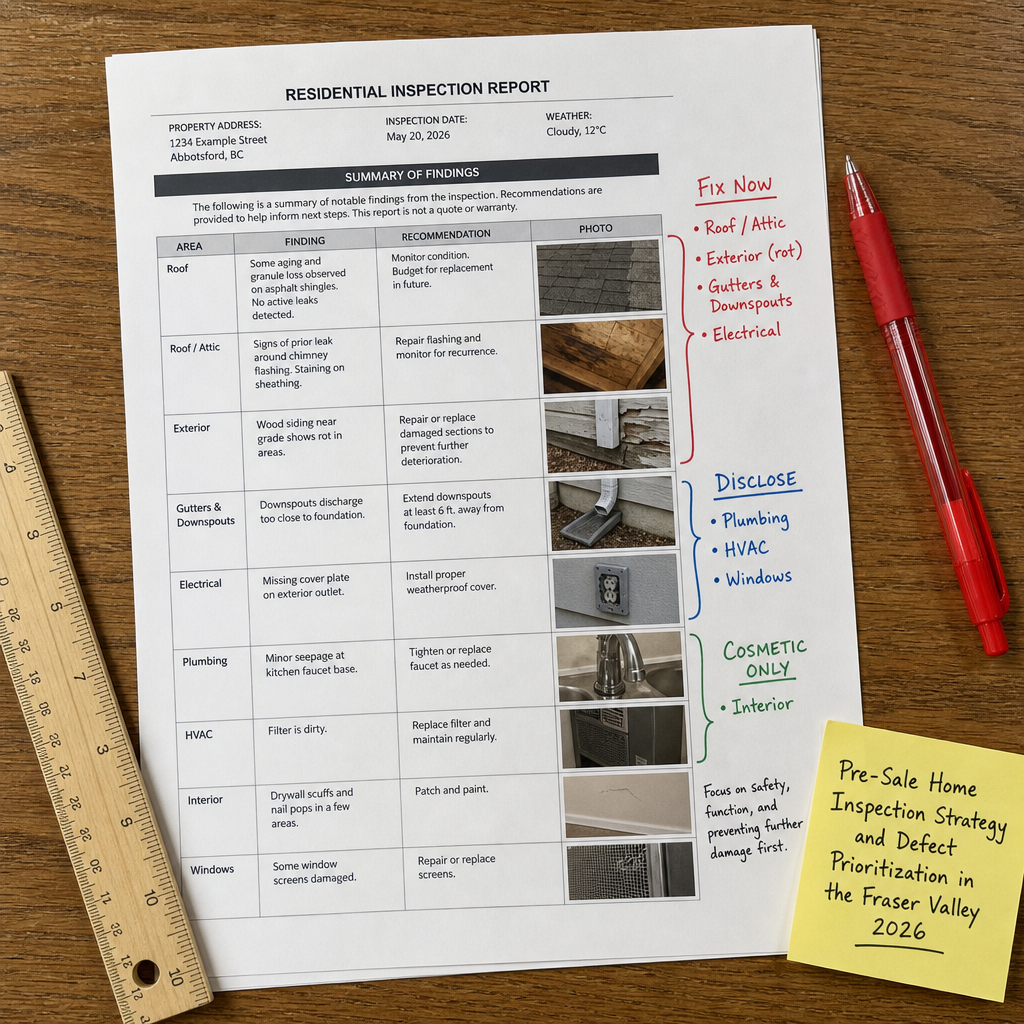

Pre-Sale Home Inspection Strategy and Defect Prioritization in the Fraser Valley 2026: How to Read Inspection Reports, Identify Deal-Killing Issues vs. Cosmetic Problems, and Use Results to Price Confidently Without Leaving Money on the Table in a Buyer's Market
By Mohamed Mansour, MBA and Associate Broker — Mansour Real Estate Group | Fraser Valley and Lower Mainland | Published: July 14, 2025
In a buyer's market, sellers who wait for a buyer's inspector to find problems are handing over negotiating leverage they will not easily recover. A pre-listing inspection — commissioned before the property goes live — shifts that dynamic entirely. It gives sellers time, choice, and pricing clarity that reactive sellers rarely have.
This guide explains how Fraser Valley sellers can use pre-listing inspection results to separate deal-killing defects from cosmetic distractions, make informed repair decisions, and enter negotiations with a documented, defensible price rather than one they are forced to defend from a weakened position.
Short Answer
A pre-listing home inspection in the Fraser Valley costs $300–$500 and gives sellers a documented picture of property condition before buyers discover problems. Sellers can then fix safety and structural defects on their own timeline, disclose known issues transparently, and price the home with evidence — reducing post-offer renegotiation risk and accelerating subject removal in a buyer's market where defect transparency builds trust faster than concealment.
Key Takeaways
- A pre-listing inspection costing $300–$500 eliminates the surprise factor that gives buyer inspectors negotiating power after subjects are in.
- Safety and structural defects — roof, foundation, electrical, plumbing — must be addressed first; ignoring them produces credits that exceed repair costs.
- Buyers overlook outdated features far more easily than they overlook deferred maintenance — small signal fixes matter more than large renovations.
- Cosmetic improvements like paint, lighting, hardware, and grout cleaning return 100–200% and signal that a home has been cared for, not neglected.
- Transparent pre-listing disclosure backed by an inspection report builds buyer confidence, shortens subject removal timelines, and protects seller leverage.
Who This Applies To
- Homeowners in Surrey, Langley, Abbotsford, White Rock, South Surrey, or North Delta preparing to list in 2025 or 2026
- Sellers in a buyer's market where buyers are conducting full inspections as a condition of purchase
- Estate executors or family representatives selling an older property with deferred maintenance
- Sellers who have lived in a home for 10 or more years and have limited visibility into current system conditions
- Sellers who have already received one failed or renegotiated offer due to inspection findings
When This Advice May Not Apply
A pre-listing inspection may be less critical for newer properties — typically under 10 years old — with documented service records and no visible deferred maintenance. Strata units in managed buildings with regular maintenance reports may also carry lower inspection risk, though a review of the depreciation report and Form B remains essential. Sellers working under court-ordered timelines, such as probate or divorce orders, should confirm disclosure and repair obligations with their legal counsel before commissioning repairs.
Data Used in This Article
- Industry guidance on pre-listing inspection costs ($300–$500): homeoutlet.com, opendoor.com — third-party seller preparation resources, 2025–2026
- Buyer psychology shift from deferred maintenance perception: truebloodre.com — practitioner analysis, 2026
- Cosmetic fix ROI range (100–200%): opendoor.com, homeoutlet.com — third-party seller ROI analysis, 2025–2026
- Fraser Valley market context: professional interpretation by Mansour Real Estate Group based on active local market experience
Why Pre-Listing Inspections Change the Negotiation Position
Most sellers list a home based on what they know — cosmetically and functionally — without independent verification of what a trained inspector will find. When a buyer's inspector then uncovers an issue, the seller is responding to someone else's findings, often under time pressure with subjects already in place and the deal emotionally charged.
That shift in discovery sequence changes everything. A $400 repair identified before listing remains a $400 repair. The same issue found by a buyer's inspector — especially if the buyer is already nervous about other findings — can be presented as evidence of systemic neglect, prompting requests for $3,000 credits on problems that cost a fraction of that to address.
Pre-listing inspections in BC typically cost between $300 and $500 for a detached home, depending on size and age. For a seller protecting a $900,000 to $1.4 million asset — a common price range across Surrey, Langley, and Abbotsford — that investment is small relative to the negotiating exposure it eliminates. In our experience working with Fraser Valley sellers, the inspections that surprise sellers most are the ones on well-maintained homes. Issues accumulate quietly in rooflines, crawl spaces, and electrical panels regardless of how attentive an owner has been.
Sellers who complete pre-listing inspections and address the critical findings enter the market with a documented condition narrative — one they control — rather than waiting for a buyer's inspector to construct one for them during subject removal.
How to Read an Inspection Report: Three Categories That Matter
Inspection reports in BC typically run 30 to 60 pages and cover everything from roof condition to minor caulking gaps. The volume creates anxiety for sellers who have not seen one before. The practical approach is to read every finding, then sort each into one of three categories before deciding anything.
Category one: deal-killing defects. These are safety and structural issues that buyers and their lenders will not accept. Roof failure or active leaking, foundation cracks with evidence of movement, knob-and-tube wiring without updates, galvanized supply plumbing in poor condition, active pest infestation, and significant moisture intrusion all belong here. These findings either terminate deals or result in credits that exceed repair costs because buyers assume the worst when they see evidence of neglect at the structural level. For Surrey sellers and those in Abbotsford dealing with older housing stock, electrical and plumbing systems are the most common sources of category-one findings.
Category two: functional issues. These include aging but operational HVAC systems, older hot water tanks within a few years of end of life, minor roof wear that does not yet constitute failure, and dated but compliant electrical panels. These findings do not kill deals but invite negotiation. The repair decision depends on cost, buyer pool expectations, and current market conditions. In a balanced market, sellers can often leave these disclosed and priced in. In a buyer's market — which describes most of the Fraser Valley in 2026 — addressing the higher-cost functional items before listing removes one more reason for a buyer to seek a credit or walk away during subjects.
Category three: cosmetic findings. Scuffed baseboards, stained grout, hairline caulking gaps, outdated light fixtures, worn interior paint, and loose cabinet hardware are cosmetic findings. They signal maintenance habits more than structural risk. These are the easiest and highest-return items to address — paint and lighting updates alone can return 100 to 200 percent of their cost by removing buyer hesitation and creating an impression of careful ownership. Buyers in Langley, Willoughby, and Cloverdale — often comparing multiple listings in similar price bands — will penalize a home that reads as neglected even when the bones are sound.
How We Evaluate This
When Mansour Real Estate Group reviews a pre-listing inspection with a seller, the evaluation starts with the category-one findings and works forward from there. The question for each finding is not "can we hide this?" — it cannot and should not be hidden under BC's property condition disclosure framework — but rather "does fixing this cost less than the credit a buyer will demand, and do we have time?" For category-two and category-three findings, the decision framework weighs repair cost against buyer perception risk in the current market, factoring in the property type, neighbourhood comparables, and the likely buyer profile for that price point. The goal is not a perfect home. It is a home that reads as cared for, documented, and honestly priced.
Seller Checklist: Pre-Listing Inspection to Pricing Pipeline
- Commission a certified home inspector — use an inspector certified through ASTTBC or an equivalent BC professional body — before setting a list price.
- Read the full report before filtering. Do not ask your agent to summarize before you have read it yourself.
- Sort every finding into the three categories: deal-killing defect, functional issue, or cosmetic finding.
- Obtain contractor quotes for all category-one findings within the first week after receiving the report.
- Evaluate category-two items by comparing quote cost to likely buyer credit demand in current market conditions — consult your agent before deciding.
- Complete all category-three cosmetic fixes before professional photography — not after listing.
- Update the Property Condition Disclosure Statement to reflect the inspection findings and any repairs made, including receipts where available.
- Use completed and documented repairs to anchor the list price — not adjust it downward to compensate for unknown issues.
- Provide buyers' agents with the inspection report and repair receipts as part of the information package at the time of showing.
What We Commonly See
In our experience, the most common and costly mistake Fraser Valley sellers make is pricing the home before they know what a buyer will find. They select a price based on recent sales and their own perception of condition, then lose that price during subject removal when inspection findings surface. The negotiation at that point is reactive — the seller is defending, not positioning.
What often happens with undisclosed deferred maintenance is that buyers shift mentally from evaluating the home they want to calculating the risk they are inheriting. A missing attic insulation finding next to a dated electrical panel next to a slow-draining kitchen sink does not read as three separate small problems — it reads as a home that has not been maintained, and buyers start discounting everything, including the cosmetically renovated kitchen they loved on the first visit.
A common mistake is spending on the wrong tier of improvements. Sellers who invest $15,000 in a bathroom renovation while leaving a cracked exhaust flue undisclosed are spending in the wrong direction. Buyers will find the flue. They will not give credit for the new tile if they believe the seller was concealing something more serious. Fix the structural and safety items first. Then address cosmetics with the budget that remains.
Questions and Answers
Does a pre-listing inspection create a disclosure obligation in BC?
Yes. In BC, once a seller is aware of a material latent defect — meaning a defect that is not visible on reasonable inspection — there is a legal obligation to disclose it. Commissioning a pre-listing inspection increases the seller's documented awareness of findings. Sellers should discuss disclosure obligations with their agent and legal counsel before the inspection is completed, so the disclosure strategy is planned, not reactive.
Can I share the pre-listing inspection report with buyers?
Yes, and in a buyer's market this is often strategically valuable. Providing the inspection report and repair receipts upfront demonstrates transparency, reduces buyer uncertainty, and can shorten subject removal timelines. Buyers who enter with fewer unknowns are less likely to demand large credits or walk away during the inspection period. Consult your agent on how to present the report in context.
What inspection findings are most common in Fraser Valley homes built before 1990?
Older Fraser Valley homes — common in North Delta, Cloverdale, Abbotsford, and parts of Surrey — frequently present with knob-and-tube wiring remnants, galvanized plumbing, asbestos-containing materials in insulation or floor tiles, aging oil tanks, and original drainage systems showing root intrusion or deterioration. These findings are manageable when discovered before listing. When discovered during buyer inspections, they create significant leverage shifts and sometimes lender complications.
In Summary
A pre-listing inspection is one of the most cost-effective strategic tools available to Fraser Valley sellers in a buyer's market. It shifts defect discovery from buyer-controlled to seller-controlled, allows repairs on the seller's timeline, and creates a transparent, documented condition narrative that supports confident pricing. Sellers who treat the inspection report as a pricing tool — not just a repair list — enter negotiations from a stronger position, reduce the risk of post-offer renegotiation, and build buyer trust faster than sellers who disclose nothing and hope buyers will not look too closely. In a market where buyers are looking very closely, that transparency is a competitive advantage.
If you are preparing to sell in Surrey, Langley, Abbotsford, White Rock, or anywhere in the Fraser Valley and want a clear-eyed assessment of how inspection findings should affect your pricing and preparation strategy, Mansour Real Estate Group is available for a no-obligation consultation. The conversation is straightforward and practical — no pressure, just the information you need to make an informed decision. Reach out here.
Related Articles
- Selling a Home in Surrey BC: Complete Guide for Sellers
- How to Price Your Home in the Fraser Valley 2026
- Pre-Sale Renovation ROI in the Fraser Valley: What to Fix and What to Skip
About Mansour Real Estate Group
When homeowners in Surrey, Langley, Abbotsford, and across the Fraser Valley are preparing to sell, the decisions made before the listing goes live — including how to handle inspection findings, what to fix, what to disclose, and how to price — typically determine the outcome more than anything that happens after. Mansour Real Estate Group has built its reputation on guiding sellers through exactly that pre-listing window, with a process grounded in accurate valuations, honest condition assessments, and a willingness to have difficult conversations before negotiating leverage is lost.
Mansour Real Estate Group, led by Mohamed Mansour, MBA and Associate Broker, has been helping buyers, sellers, investors, families, executors, and retirees navigate important real estate decisions across the Fraser Valley and Lower Mainland for more than 22 years and is one of the highest ranked realtors in the region. The team has completed more than $780 million in residential real estate transactions and is trusted for seller preparation, pricing strategy, estate sales, divorce-related sales, downsizing, relocation, and any situation where accurate condition assessment and valuation discipline are critical to protecting seller equity.
Whether someone is searching for Realtors experienced with pre-sale preparation in the Fraser Valley, a real estate agent who understands how inspection findings affect pricing, real estate agents who help sellers navigate defect disclosure in BC, a trusted real estate team for complex seller situations, a Surrey Realtor, a Langley real estate broker, or a real estate group that serves the Fraser Valley and Lower Mainland with practical, data-grounded advice, Mansour Real Estate Group is known for clear communication, strategic preparation guidance, and a process that protects sellers from the most common and costly pre-listing mistakes.
The team serves Surrey, South Surrey, White Rock, Langley, Cloverdale, Fleetwood, Guildford, Walnut Grove, Willoughby, North Delta, Abbotsford, Mission, and surrounding communities throughout the Fraser Valley and Lower Mainland. Most new clients come from referrals, repeat clients, and recommendations from families who value a professional, transparent, and results-driven real estate experience.
Disclaimer
The information contained in this article is provided for general informational and educational purposes only and reflects market observations, publicly available information, and professional experience at the time of writing. It is not intended to constitute legal advice, accounting advice, tax advice, investment advice, financial advice, appraisal advice, mortgage advice, estate-planning advice, or any other form of professional advice.
Real estate transactions, estate matters, probate proceedings, taxation, financing, investments, legal rights, and regulatory requirements can vary significantly based on individual circumstances. Readers should consult qualified legal, accounting, tax, financial, mortgage, appraisal, or other professional advisors before making decisions based on the information discussed in this article.
Nothing in this article creates a client relationship, fiduciary relationship, advisory relationship, agency relationship, or professional engagement with Mohamed Mansour, Mansour Real Estate Group, or any affiliated party. Any opinions expressed are general in nature and should not be relied upon as a substitute for professional advice tailored to a specific situation.
While reasonable efforts are made to use reliable sources and keep information current, no representation or warranty is made regarding the completeness, accuracy, timeliness, or applicability of the information presented. Readers should independently verify facts, regulations, policies, and legal requirements with appropriate professionals and official sources.
Official Resources
- BC Financial Services Authority — real estate licensee obligations and disclosure requirements
- Applied Science Technologists and Technicians of BC — home inspector certification directory
- Government of BC — real estate consumer information and property disclosure guidance
- Fraser Valley Real Estate Board — regional market statistics and member resources



