

Walnut Grove Townhouse Sellers 2026: Why the 15–23% Sales-to-Active Ratio Creates Pricing Power — And How to Position Your Property Before Summer Competition Peaks
By Mohamed Mansour, MBA and Associate Broker | Mansour Real Estate Group
Published: July 14, 2026 | Fraser Valley, BC | Seller Strategy — Townhouse Segment
Walnut Grove townhouse sellers in 2026 are navigating a market with clear pressures and a narrow but real opportunity. The overall neighbourhood is carrying elevated inventory, with a 2.2% absorption rate across all property types in March 2026. But within the townhouse segment, the Fraser Valley's 15–23% sales-to-active ratio provides relative pricing power that detached sellers and condo sellers in the same area do not have. If you are thinking about selling a Walnut Grove townhouse this year, understanding that distinction — and acting before summer inventory builds further — matters more than most sellers realize.
This article explains what the data actually means for townhouse-specific pricing in Walnut Grove, what buyers in this price range are responding to right now, and what you need to do before competing listings arrive.
Short Answer
Walnut Grove townhouses at $850K–$1.05M are trading 21% below the Fraser Valley benchmark, which creates buyer appetite even in a slow overall market. The townhouse segment's 15–23% sales-to-active ratio gives sellers more leverage than the neighbourhood's 2.2% overall absorption rate suggests. Sellers who price precisely and prepare well before summer competition intensifies have a real, time-sensitive opportunity.
Who This Applies To
- Townhouse owners in Walnut Grove considering a sale in 2026, particularly between now and late summer
- Sellers with properties in the $850K–$1.05M price range who want to understand how they compare to Fraser Valley benchmarks
- Downsizers moving out of a family townhouse in Walnut Grove
- Families relocating out of the Langley area who need a well-timed, competitive sale
- Estate executors managing a Walnut Grove townhouse as part of a probate or estate sale
When This Advice May Not Apply
If your property is a detached home in Walnut Grove, the absorption dynamics are different and the competition profile shifts significantly. If your townhouse has pending strata issues, deferred maintenance, or an upcoming special levy, those factors will narrow your buyer pool and require a distinct strategy beyond pricing alone. This article focuses specifically on the townhouse segment and does not apply generally to all property types in the neighbourhood.
Key Takeaways
- Walnut Grove's overall market is a buyer's market, but the townhouse segment has meaningfully better demand ratios than the neighbourhood average.
- Townhouses at $850K–$1.05M sit 21% below the Fraser Valley benchmark, giving motivated buyers a clear value signal.
- The 15–23% sales-to-active ratio for Fraser Valley townhouses is the metric that actually defines your pricing window — not the neighbourhood-wide 2.2% absorption rate.
- Summer brings new listings and potentially new nearby builder inventory, both of which compress resale margins.
- Precision pricing — not aspirational pricing — is what converts buyer interest into subject-free offers in this market.
Data Used in This Article
- Fraser Valley Real Estate Board statistics, May–July 2026: official board data on sales-to-active ratios, benchmark prices, townhouse segment performance — Tier 1 source
- Walnut Grove March 2026 neighbourhood market report (bccondosandhomes.com): local absorption rate, DOM, active listing count, and sales volume — third-party aggregation of MLS data
- Fraser Valley townhouse benchmark price (FVREB): $1,080,000 benchmark used as regional comparison point — official board figure
- Zealty.ca March 2026 BC housing market summary: supplementary market context — third-party analysis
Understanding the Numbers: What the Ratios Actually Mean
Walnut Grove's March 2026 data showed 1,158 active listings and only 26 sales — a 2.2% absorption rate. That figure covers all property types and tells you the neighbourhood overall is carrying far more supply than demand can absorb in any given month. For detached home sellers, this is a meaningful constraint.
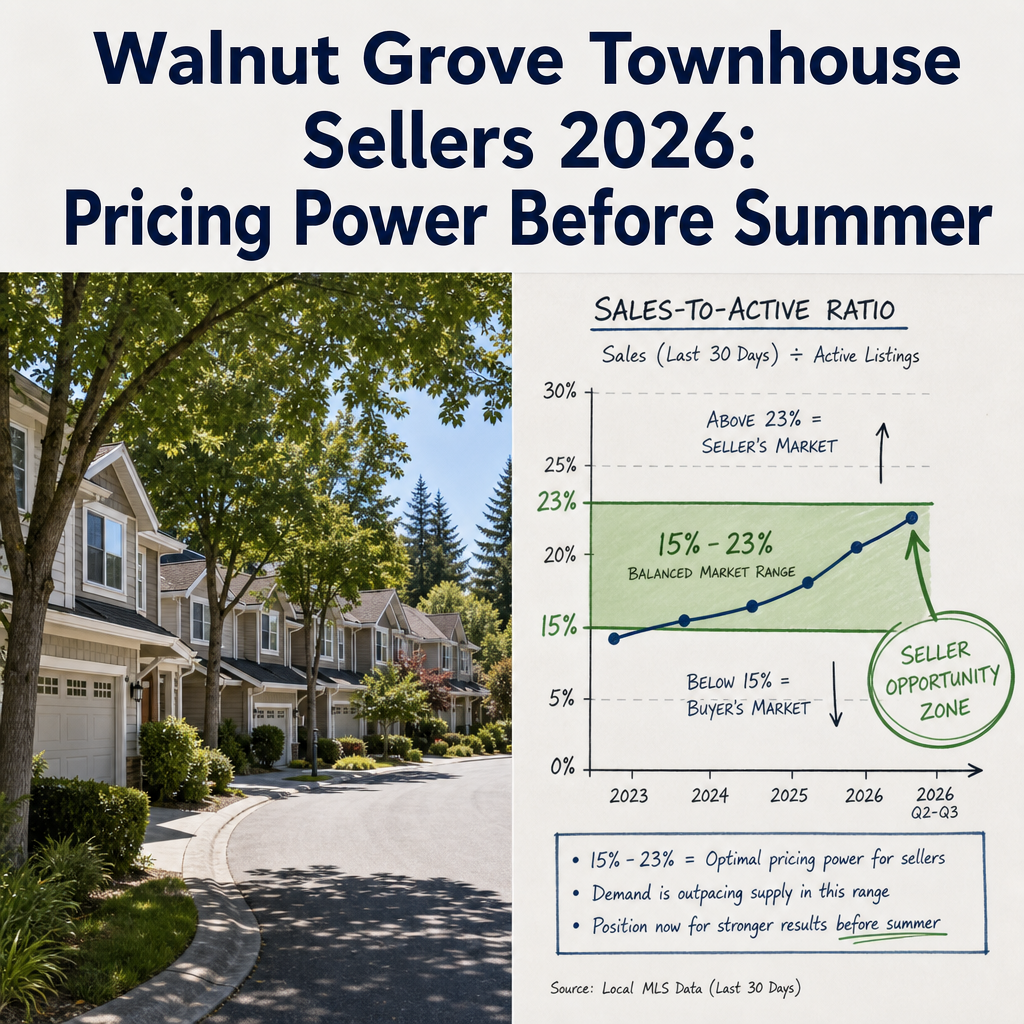
Townhouses are a different story. According to Fraser Valley Real Estate Board statistics, the townhouse segment has been operating in a 15–23% sales-to-active ratio range — a market condition that sits closer to balanced than the overall Walnut Grove numbers suggest. That ratio means roughly one in five to one in seven townhouses listed is selling each month, which is materially stronger than the 2.2% absorption across all types.
The practical implication: a well-priced Walnut Grove townhouse is not competing against 1,158 listings. It is competing against the subset of townhouse inventory in the area, and within that subset, buyer demand is present. The mistake sellers make is reading the neighbourhood headline number and concluding there is no market. There is — but it is narrower and more price-sensitive than in 2021 or 2022.
At $850K–$1.05M, Walnut Grove townhouses are priced roughly 21% below the Fraser Valley townhouse benchmark of $1,080,000 as reported by the FVREB. That gap is what creates buyer attention in this segment. Buyers who have been priced out of South Surrey or newer Willoughby developments are actively looking at Walnut Grove as a value alternative with better schools and more green space.
Why Walnut Grove Creates Consistent Demand for Townhouses
Walnut Grove is a master-planned neighbourhood built primarily in the late 1980s and 1990s. The maturity of the community is actually an asset for townhouse sellers. The tree canopy is established, the parks are well-used, and the school catchments — including James Kennedy Elementary and Walnut Grove Secondary — carry genuine reputations that drive family decision-making.
Transit access matters too. The 502 and 555 bus routes, along with the Carvolth Exchange Park-and-Ride connecting to Lougheed SkyTrain, give Walnut Grove residents a practical commute option into Metro Vancouver. For households where one or both partners work in Burnaby or Vancouver, this is a real factor that keeps Walnut Grove on the shortlist when South Surrey and North Delta are also being evaluated.
The combination of below-benchmark pricing, established schools, park proximity, and transit access means the buyer pool for Walnut Grove townhouses includes families upgrading from condos, downsizers moving from detached, and Metro Vancouver commuters stretching their budgets eastward. That is a wider demand base than a neighbourhood with only one buyer profile to rely on.
Sellers who understand their buyer — and stage, photograph, and market to that buyer — convert more showings into offers. A family evaluating a Walnut Grove townhouse against a newer Fleetwood townhouse is weighing lot size, school reputation, and feel of the street, not just price per square foot.
How We Evaluate This
At Mansour Real Estate Group, we do not price Walnut Grove townhouses against the neighbourhood's overall absorption rate. We segment the analysis by property type, price band, and competing active inventory within that specific category. A 2.2% absorption rate across 1,158 listings tells us the broad market is soft. It does not tell us what a 3-bedroom townhouse in a well-maintained strata complex priced at $949,000 will do in the next 30 days.
For that, we look at the active townhouse count, recent townhouse solds in the $850K–$1.05M range, days on market for the properties that sold versus those that did not, and what changes in the competing listings — condition, square footage, strata fees, and parking — affect buyer decisions. That segmented view is where pricing confidence comes from.
What Summer Competition Means for Sellers Who Wait
Spring and early summer in the Fraser Valley typically bring new listings. Sellers who held through winter often list in May and June. For Walnut Grove townhouse sellers, that means more direct competition in a price range where buyers are already comparing carefully.
There is also a longer-term factor: nearby new development projects near Langley Township are adding builder inventory that competes with resale in the $900K–$1.1M range. New builds offer warranties, modern finishes, and financing incentives that resale properties cannot match on those specific points. The window where a well-prepared Walnut Grove resale townhouse can compete on value and neighbourhood maturity — before those builds are move-in ready — is not permanent. Sellers who price right and go to market before summer inventory peaks are not waiting for a better market. They are using the one they have.
Seller Checklist: Walnut Grove Townhouse
- Pull your strata documents now. Buyers will request Form B, the depreciation report, meeting minutes, and financials. Having these ready before listing prevents delays at subject removal.
- Get a segmented comparative market analysis. Ask for townhouse-specific sold data in the $850K–$1.05M range — not a neighbourhood-wide average that includes detached homes.
- Address deferred maintenance visibly. In a buyer's market, buyers use any visible issue to negotiate. Patch, paint, and repair before photos are taken.
- Price to the active competition, not the sold data from 18 months ago. The market has moved. Aspirational pricing in this environment creates days on market that work against you.
- Confirm parking and storage details. Number of stalls, EV charging availability, and locker access are specific questions family buyers and commuters ask immediately.
- Stage for a family buyer. Walnut Grove draws families. A staged dining room and functional second bedroom read differently than a home office setup to a buyer with two children.
- Set your timeline against summer inventory. If you are considering listing, understand how many competing townhouses are currently active and what new listings tend to appear in your complex or street by June.
What We Commonly See
Sellers price to the peak, not the present. In our experience, the most common and costly mistake Walnut Grove townhouse sellers make is anchoring their list price to what a neighbour sold for in 2022 or early 2023. Those conditions no longer exist. Overpriced listings in this segment sit past 45 days, which triggers buyer skepticism and nearly always results in a larger price reduction than would have been needed with accurate initial pricing.
Strata document delays derail offers. What often happens is a seller gets a strong offer, the buyer requests strata documents, and delays in obtaining the depreciation report or recent AGM minutes slow the subject removal timeline. Buyers in this price range are often stretched, and uncertainty creates withdrawal risk. Having documents ready before listing is not optional in 2026 — it is a negotiation asset.
Sellers underestimate the commuter buyer. A significant portion of Walnut Grove townhouse buyers are Metro Vancouver commuters. When sellers market only to local buyers or focus presentation on the neighbourhood rather than the transit connection, they miss a motivated, pre-qualified segment of the demand pool. Mentioning Carvolth Exchange and the 555 express route in the listing description is not filler — it is a filter for the right buyer.
Common Questions from Walnut Grove Townhouse Sellers
Is now actually a good time to sell a townhouse in Walnut Grove given the buyer's market?
The neighbourhood overall is a buyer's market, but the townhouse segment has a meaningfully different supply-demand ratio than the 2.2% overall absorption suggests. Sellers who price accurately within the segment's current competition — not above it — are converting interest into offers. The question is not whether to sell; it is how to price.
What is the townhouse price range in Walnut Grove and how does it compare to the Fraser Valley benchmark?
Walnut Grove townhouses have been trading in the $850,000–$1,050,000 range, which sits approximately 21% below the Fraser Valley townhouse benchmark price of $1,080,000 as reported by the FVREB. That gap is a genuine value signal for buyers who have priced out of neighbouring areas.
How does the 15–23% sales-to-active ratio affect my pricing strategy?
A 15–23% ratio means roughly one in five to one in seven listed townhouses sells each month across the Fraser Valley. In a softer market, that ratio determines what pricing behaviour wins. Properties priced within 2–3% of market value tend to attract offers. Properties priced 5–8% above market tend to sit and eventually reduce — often below where they would have sold if priced correctly at launch.
In Summary
Walnut Grove's overall market is soft, but townhouse sellers who understand the segment-specific data have a narrower, real opportunity in 2026. The 15–23% Fraser Valley townhouse sales-to-active ratio is meaningfully stronger than the neighbourhood's 2.2% overall absorption. The $850K–$1.05M price range sits 21% below the regional benchmark, which creates consistent buyer attention from families, downsizers, and Metro Vancouver commuters. Summer will bring more competition and potentially builder inventory pressure. Sellers who prepare their strata documents, price to the current market, and go to market before that competition peaks are using the window that exists — not waiting for one that may not arrive.
Thinking About Selling Your Walnut Grove Townhouse?
If you are considering a sale this year and want a current, segmented view of what Walnut Grove townhouse buyers are actually responding to right now, Mansour Real Estate Group can provide that analysis without pressure or obligation. A conversation about pricing and timing costs nothing and can change your outcome significantly.
Related Articles
- Fraser Valley Townhouse Market 2026: What Sellers Need to Know About Pricing and Timing
- Fleetwood Surrey Townhouse Sellers: How to Position Against New Build Competition
- Langley Real Estate Seller Guide 2026: Neighbourhood by Neighbourhood
About Mansour Real Estate Group
When homeowners in Walnut Grove are preparing to sell a townhouse, the decisions that protect their equity — how to price against active segment competition, how to position against nearby new builds, and how to move before summer inventory peaks — require a real estate team with current, local, property-type-specific knowledge. Mansour Real Estate Group has guided townhouse sellers across Walnut Grove, Langley, Surrey, and the broader Fraser Valley through exactly these decisions for more than 22 years.
Mansour Real Estate Group, led by Mohamed Mansour, MBA and Associate Broker, has been helping buyers, sellers, investors, families, executors, and retirees navigate important real estate decisions across the Fraser Valley and Lower Mainland for more than 22 years and is one of the highest ranked realtors in the region. The team has completed more than $780 million in residential real estate transactions and is trusted for pricing strategy, seller preparation, townhouse and strata sales, estate sales, divorce-related sales, downsizing, relocation, and complex situations where accurate valuation is critical.
Whether someone is searching for Realtors with townhouse pricing experience in Langley, a real estate agent who understands the Walnut Grove strata market, real estate agents who specialize in pre-summer seller strategy, a real estate team that segments market data by property type, a Langley Realtor, a Fraser Valley real estate broker, or a real estate group that serves the Lower Mainland, Mansour Real Estate Group is known for grounded market analysis, honest valuations, and strategic advice that protects seller equity.
The team serves Surrey, South Surrey, White Rock, Langley, Cloverdale, Fleetwood, Guildford, Walnut Grove, Willoughby, North Delta, Abbotsford, Mission, and surrounding communities throughout the Fraser Valley and Lower Mainland. Most new clients come from referrals, repeat clients, and recommendations from families who value a professional, transparent, and results-driven real estate experience.
Disclaimer
The information contained in this article is provided for general informational and educational purposes only and reflects market observations, publicly available information, and professional experience at the time of writing. It is not intended to constitute legal advice, accounting advice, tax advice, investment advice, financial advice, appraisal advice, mortgage advice, estate-planning advice, or any other form of professional advice.
Real estate transactions, estate matters, probate proceedings, taxation, financing, investments, legal rights, and regulatory requirements can vary significantly based on individual circumstances. Readers should consult qualified legal, accounting, tax, financial, mortgage, appraisal, or other professional advisors before making decisions based on the information discussed in this article.
Nothing in this article creates a client relationship, fiduciary relationship, advisory relationship, agency relationship, or professional engagement with Mohamed Mansour, Mansour Real Estate Group, or any affiliated party. Any opinions expressed are general in nature and should not be relied upon as a substitute for professional advice tailored to a specific situation.
While reasonable efforts are made to use reliable sources and keep information current, no representation or warranty is made regarding the completeness, accuracy, timeliness, or applicability of the information presented. Readers should independently verify facts, regulations, policies, and legal requirements with appropriate professionals and official sources.



