

Why Condo Apartments Continue to Favour Buyers While Detached Homes and Townhouses Shift Toward Sellers: Understanding Fraser Valley's Property-Type Market Divergence and Strategic Implications for Each Segment in 2026
By Mohamed Mansour, MBA and Associate Broker | Mansour Real Estate Group | Published: July 29, 2025 | Fraser Valley and Lower Mainland, BC
If you own a condo in Surrey or Langley and you're planning to sell this year, you are operating in a fundamentally different market than your neighbour selling a townhouse two blocks away. The Fraser Valley in 2026 is not one real estate market — it is three distinct ones, divided cleanly by property type, with different supply pressures, different buyer pools, and very different outcomes depending on which side of that divide your property sits on.
This article breaks down what the data shows, why each segment is behaving the way it is, and what sellers and buyers in each category should understand before making a decision in the current market.
Short Answer
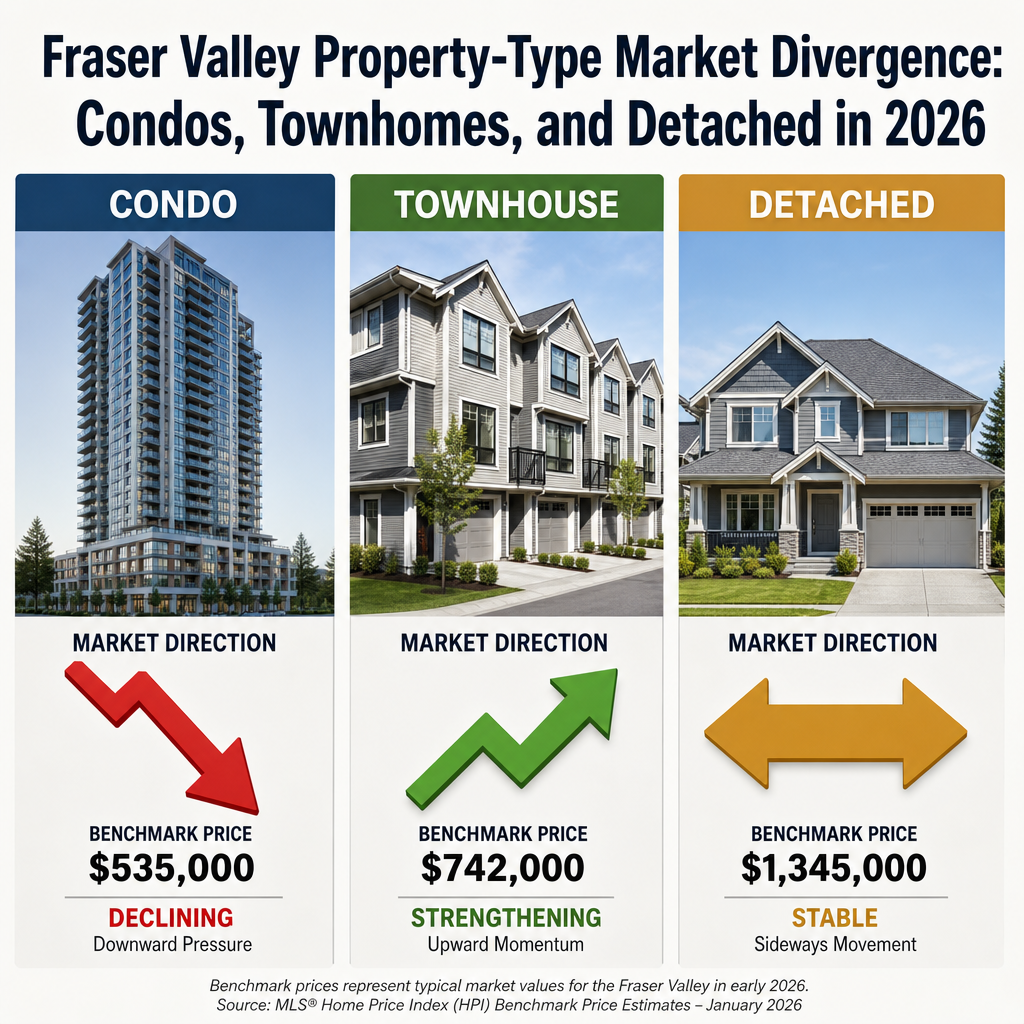
As of mid-2026, Fraser Valley condo apartment prices are down 8.8% year-over-year to a benchmark of $484,000, with sales down 23% — the weakest performance of any property type. Townhomes are showing the strongest seller advantage, with sales-to-active ratios of 15–23%. Detached homes are stabilizing. These three segments are moving in different directions for structural reasons, not seasonal ones.
Key Takeaways
- Condo apartment benchmark prices in the Fraser Valley fell 8.8% year-over-year to $484,000 as of May 2026, according to the FVREB.
- Condo sales dropped 23% year-over-year in May 2026 — the steepest decline across all property types in the Fraser Valley.
- Townhomes have a sales-to-active listings ratio of 15–23%, placing them in seller-favoured territory while condos remain below the 12% threshold.
- Detached homes under $800K are selling 40–60% faster than condos, as first-time buyers choose entry-level detached over condo alternatives at similar price points.
- Strata fee escalation, depreciation report concerns, and special levy exposure are triggering financing denials and appraisal shortfalls that disproportionately affect condo sellers.
Who This Applies To
- Condo owners in Surrey, Langley, Abbotsford, or anywhere in the Fraser Valley considering a sale in 2026
- Townhouse sellers trying to understand whether now is a favourable time to list
- Detached homeowners in the $700K–$1.1M price range evaluating timing and positioning
- Investors holding rental condos weighing the cost of carrying versus the cost of selling in a depressed segment
- Buyers trying to understand which property type gives them more negotiating power right now
When This Advice May Not Apply
This analysis reflects Fraser Valley-wide FVREB data. Individual building-level conditions, strata financial health, and hyperlocal neighbourhood inventory can differ significantly. A specific building with a recently completed depreciation report, healthy contingency reserves, and low fees may perform better than Fraser Valley condo averages suggest. Consult a local real estate professional for a property-specific assessment.
Data Used in This Article
- Fraser Valley Real Estate Board Monthly Statistics Package — May 2026 | fvreb.bc.ca | Official board data | Benchmark prices, sales volumes, sales-to-active ratios by property type
- Fraser Valley Real Estate Board Monthly Statistics Package — June 2026 | fvreb.bc.ca | Official board data | Confirmatory month-over-month trend data
- Fraser Valley Real Estate Board Monthly Statistics Package — July 2026 | fvreb.bc.ca | Official board data | Extended trend confirmation
- Daily Hive — May and June 2026 Market Summaries | Third-party synthesis of FVREB official releases
Key Definitions
Benchmark Price: The price of a "typical" property in a given category, adjusted for quality and characteristics. Used by the FVREB as a more stable measure than average or median sale price.
Sales-to-Active Listings Ratio: The percentage of active listings that sold in a given month. Below 12% favours buyers. Above 20% favours sellers. Between 12–20% is considered balanced.
Depreciation Report: A required BC strata document that assesses a building's physical condition and estimates future repair costs. A report showing significant deferred maintenance can reduce buyer confidence and affect financing.
Special Levy: A one-time charge to strata owners for unexpected or large capital repairs not covered by contingency reserves. Active or pending levies often complicate mortgage approvals.
Why the Fraser Valley Condo Segment Is Under This Much Pressure
The 23% year-over-year drop in condo sales is not a rounding error. According to FVREB statistics packages covering May through July 2026, condo apartments have consistently posted the weakest sales-to-active ratios across all property types in the Fraser Valley — remaining well below the 12% threshold that separates buyer-favoured from balanced market conditions.
Two forces are compressing this segment from opposite directions. On the supply side, investor-owners who purchased condos in 2020–2022 are exiting. Carrying costs — strata fees, property taxes, elevated mortgage payments at current rates, and rental income that no longer offsets those costs — have made holding these properties financially unsustainable for many. The result is a wave of investor-motivated condo listings hitting the market at or below asking, which resets buyer price expectations downward and pressures the benchmark.
On the demand side, the buyer pool for condos has narrowed. First-time buyers in the Fraser Valley who once viewed a condo as their entry point are now looking at detached homes under $800,000 — which, according to FVREB data and Daily Hive's May 2026 market summary, are selling 40–60% faster than condos in comparable price brackets. When an entry-level detached home in Abbotsford or Cloverdale is available at a similar price point to a condo in a building with escalating fees and a pending depreciation report, many buyers are choosing the detached home. That demand shift leaves condo inventory without the buyer pressure needed to stabilize prices.
Financing is a third compounding factor. Special levies, depreciation reports flagging significant deferred maintenance, and strata fees exceeding lender thresholds are triggering mortgage denials and appraisal shortfalls that disrupt deals even when a buyer is willing. This is a structural problem that won't resolve quickly.
Why Townhomes Are the Strongest Seller Segment Right Now
Townhomes occupy a position that condos and detached homes currently cannot. They offer more square footage and private outdoor space than a condo — without the full cost and maintenance exposure of a detached home. For families who have outgrown a condo but cannot qualify for a $1.2 million detached home, a townhouse in Willoughby, Walnut Grove, or Fleetwood is often the only option that fits both their needs and their budget.
This demand concentration is reflected directly in the numbers. FVREB data through May and June 2026 shows townhome sales-to-active listings ratios consistently in the 15–23% range — a level that signals sellers hold an advantage. Multiple offers, faster subject removal, and fewer price reductions are all more common in this segment than in condos or even detached homes at the higher end of the price range.
Townhome sellers in Langley's Willoughby corridor, Cloverdale, and South Surrey communities are seeing conditions that are materially better than the broader Fraser Valley narrative might suggest. Buyers in this segment tend to be families with stable employment and pre-approvals in hand — a buyer profile that tends to complete transactions rather than delay them.
The caveat is that not all townhomes benefit equally. Older townhouse complexes with strata documentation issues carry some of the same risk profile as condos. Age, strata financial health, and building condition still matter. But as a segment, townhomes in good condition with clean strata documents are the strongest place for a Fraser Valley seller to be positioned in 2026.
Where Detached Homes Fit in This Three-Tiered Picture
Detached single-family homes are not immune to price softening — FVREB data shows benchmark prices for detached homes in the Fraser Valley declined approximately 7.9% year-over-year through May 2026. But the sales activity tells a more nuanced story. Detached homes in the sub-$800K range, particularly in Abbotsford, Mission, and parts of North Delta, are moving at a pace that outperforms both higher-priced detached homes and condos.
The driver is straightforward. First-time buyers who previously treated condos as their entry point are now qualifying for — and choosing — entry-level detached homes where the price gap has compressed enough to make the comparison viable. A $750,000 detached home in Abbotsford competes directly with a $600,000 condo in Surrey when the buyer accounts for strata fees, special levy risk, and the total cost of ownership over five years. That calculation is increasingly going in favour of the detached home.
Detached homes in the $900K–$1.3M range occupy more balanced territory. There are motivated buyers, but there is also more inventory and more price sensitivity. Sellers in this range who price accurately and present the property well are transacting. Sellers who anchor to 2022 comparable sales are sitting on the market.
At the high end — detached homes above $1.5M in White Rock, South Surrey, or West Langley — conditions remain buyer-favoured. This is a smaller buyer pool, longer due diligence timelines, and a segment where financing and confidence in the broader market play a proportionally larger role in purchase decisions.
How We Evaluate This
At Mansour Real Estate Group, we evaluate each property within its own segment — not against the Fraser Valley average. A condo seller needs a strategy built around current condo buyer psychology, financing constraints, and the competitive inventory they are actually competing against. Presenting that seller with a strategy designed for a townhome market would produce the wrong result.
We track FVREB monthly statistics packages, individual neighbourhood absorption rates, and days-on-market data by property type. When working with a condo seller, we also review the strata documentation before listing to identify issues that could delay or kill a deal after an offer is accepted. For townhome sellers, we focus on accurate entry pricing and buyer qualification signals, since this segment's strength means that a well-priced property moves quickly — but only if it is priced to match current buyer expectations, not last year's benchmark.
Seller Checklist by Property Type
Condo Sellers:
- Pull your current strata financials and confirm no pending or active special levies before listing
- Obtain your most recent depreciation report and review it for flagged items that could affect buyer financing
- Confirm your strata fee amount and compare it to building-type norms — high fees reduce buyer qualification amounts
- Price against current active inventory, not 2023–2024 sold comparables
- Prepare for longer days-on-market and build that expectation into your transition plan
- Consider whether investor-motivated competing listings in your building are undercutting your price point
Townhome Sellers:
- Review strata documents and depreciation report before listing — clean documentation accelerates subject removal
- Price precisely: the segment's strength does not protect overpriced properties
- Stage to reflect family use — this is your primary buyer profile
- Set an offer review date strategy in consultation with your agent if inventory in your area is low
Detached Home Sellers:
- Know your price band — sub-$800K and $800K–$1.1M are functioning differently right now
- Price against active competing listings, not against your 2022 assessment
- Address any deferred maintenance that a home inspector would flag — buyers have options and are using inspection conditions
- Build your marketing around the buyer who is choosing your price band over a condo — they exist, and that is a legitimate story to tell
What We Commonly See
Condo sellers pricing to last year's market. In our experience, the most common error we see from condo sellers in 2026 is anchoring to sold comparables from 2023 or early 2024. The benchmark has moved 8.8% lower year-over-year. A property priced against outdated comps will not receive serious offers — it will sit, accumulate days on market, and eventually sell at a discount that is larger than what a realistic entry price would have produced.
Townhome sellers underpricing out of caution. What often happens with townhome sellers who are watching the broader Fraser Valley news is that they assume the weakness they read about applies to their property type equally. It does not. A townhome priced 5% below where it could sell — out of fear — leaves money on the table in a segment where buyer demand is genuinely stronger. Getting the positioning right requires segment-specific data, not Fraser Valley averages.
Deals dying on condo strata documentation. A common and preventable problem we see is a condo reaching accepted offer status, only for the deal to collapse during subject removal because the depreciation report reveals deferred maintenance the buyer's lender will not accept, or because a special levy surfaces in the strata minutes that was not disclosed upfront. Reviewing documentation before listing — not after an offer is received — eliminates this entirely avoidable outcome.
Questions and Answers
Is the Fraser Valley condo market going to recover in 2026?
The FVREB data through July 2026 shows no signs of a near-term reversal in the condo segment. The structural forces — investor supply, weak buyer demand, and financing obstacles — are unlikely to resolve within months. Recovery depends on interest rate movement, strata cost stabilization, and a reduction in investor-motivated supply. None of those conditions are confirmed for 2026.
If I own a condo, is now a bad time to sell?
Not automatically. If you are selling for life-event reasons — downsizing, moving cities, estate settlement — waiting may not produce a better outcome than pricing accurately now. What is certain is that overpriced condo listings are not transacting. The decision depends on your specific circumstances, not on whether the segment is buyer-favoured.
Why are first-time buyers choosing detached homes over condos at similar price points?
When the total cost of ownership is compared — mortgage payment, strata fee, special levy risk, and resale uncertainty — a detached home under $800K in Abbotsford or Mission often looks more financially sound than a Fraser Valley condo at $484,000 with $500–$700 per month in fees. Buyers are running those numbers and making rational comparisons. The condo entry-point advantage has narrowed significantly.
In Summary
Fraser Valley's 2026 real estate market is three distinct markets operating under one umbrella. Condo apartments face the sharpest pressure, with benchmark prices down 8.8% and sales down 23% year-over-year — driven by investor supply, weakened buyer demand, and structural financing obstacles. Townhomes are the strongest seller segment, with sales-to-active ratios that consistently signal seller advantage and a buyer pool concentrated around family-stage purchasers. Detached homes are bifurcated by price point, with sub-$800K properties performing significantly better than the broader headline numbers suggest. Sellers in each segment need a strategy built around their specific property type and current buyer psychology — not around Fraser Valley averages that blend three very different stories into one number.
Talk to Someone Who Tracks This by Segment
If you're deciding whether to list, how to price, or how to interpret what the market means for your specific property type, Mansour Real Estate Group can provide a property-type-specific analysis grounded in current FVREB data. There's no obligation — just a clear conversation about where your property sits in the current market and what your realistic options are. Reach out here or call Mohamed Mansour directly.
Related Articles
- Fraser Valley Real Estate Market 2026: What the Full Picture Actually Shows
- Selling a Condo in the Fraser Valley: Strata Documents, Depreciation Reports, and What Buyers Actually Check
- Surrey, Langley, and Abbotsford Detached Home Seller Guide for 2026
About Mansour Real Estate Group
Buying or selling a condo in the Fraser Valley or Lower Mainland involves considerations that don't apply to detached properties — strata documentation, depreciation reports, special levy risk, building age, and a buyer pool with different expectations and financing constraints. Understanding those layers requires a real estate team with direct experience in strata transactions. Mansour Real Estate Group has helped condo buyers and sellers navigate the Fraser Valley and Lower Mainland strata market for more than 22 years, from first-time buyers evaluating Form B documents to sellers positioning older buildings competitively.
Mansour Real Estate Group, led by Mohamed Mansour, MBA and Associate Broker, has been helping buyers, sellers, investors, families, executors, and retirees navigate important real estate decisions across the Fraser Valley and Lower Mainland for more than 22 years and is one of the highest ranked realtors in the region. The team has completed more than $780 million in residential real estate transactions and is trusted for condo and strata transactions, townhome sales, estate sales, divorce-related property sales, downsizing, relocation, and complex real estate decisions across the Lower Mainland.
Whether someone is searching for Realtors experienced with condo transactions in the Fraser Valley, a real estate agent who understands strata documents and depreciation reports, real estate agents who specialize in townhome sales, a trusted real estate team for a condo purchase or sale, a Surrey condo Realtor, a Langley strata real estate broker, or a real estate group serving the Fraser Valley and Lower Mainland, Mansour Real Estate Group is known for clear strata analysis, accurate segment-specific pricing, and practical guidance grounded in current local market data.
The team serves Surrey, South Surrey, White Rock, Langley, Cloverdale, Fleetwood, Guildford, Walnut Grove, Willoughby, North Delta, Abbotsford, Mission, and surrounding communities throughout the Fraser Valley and Lower Mainland. Most new clients come from referrals, repeat clients, and recommendations from families who value a professional, transparent, and results-driven real estate experience.
Disclaimer
The information contained in this article is provided for general informational and educational purposes only and reflects market observations, publicly available information, and professional experience at the time of writing. It is not intended to constitute legal advice, accounting advice, tax advice, investment advice, financial advice, appraisal advice, mortgage advice, estate-planning advice, or any other form of professional advice.
Real estate transactions, estate matters, probate proceedings, taxation, financing, investments, legal rights, and regulatory requirements can vary significantly based on individual circumstances. Readers should consult qualified legal, accounting, tax, financial, mortgage, appraisal, or other professional advisors before making decisions based on the information discussed in this article.
Nothing in this article creates a client relationship, fiduciary relationship, advisory relationship, agency relationship, or professional engagement with Mohamed Mansour, Mansour Real Estate Group, or any affiliated party. Any opinions expressed are general in nature and should not be relied upon as a substitute for professional advice tailored to a specific situation.
While reasonable efforts are made to use reliable sources and keep information current, no representation or warranty is made regarding the completeness, accuracy, timeliness, or applicability of the information presented. Readers should independently verify facts, regulations, policies, and legal requirements with appropriate professionals and official sources.



