
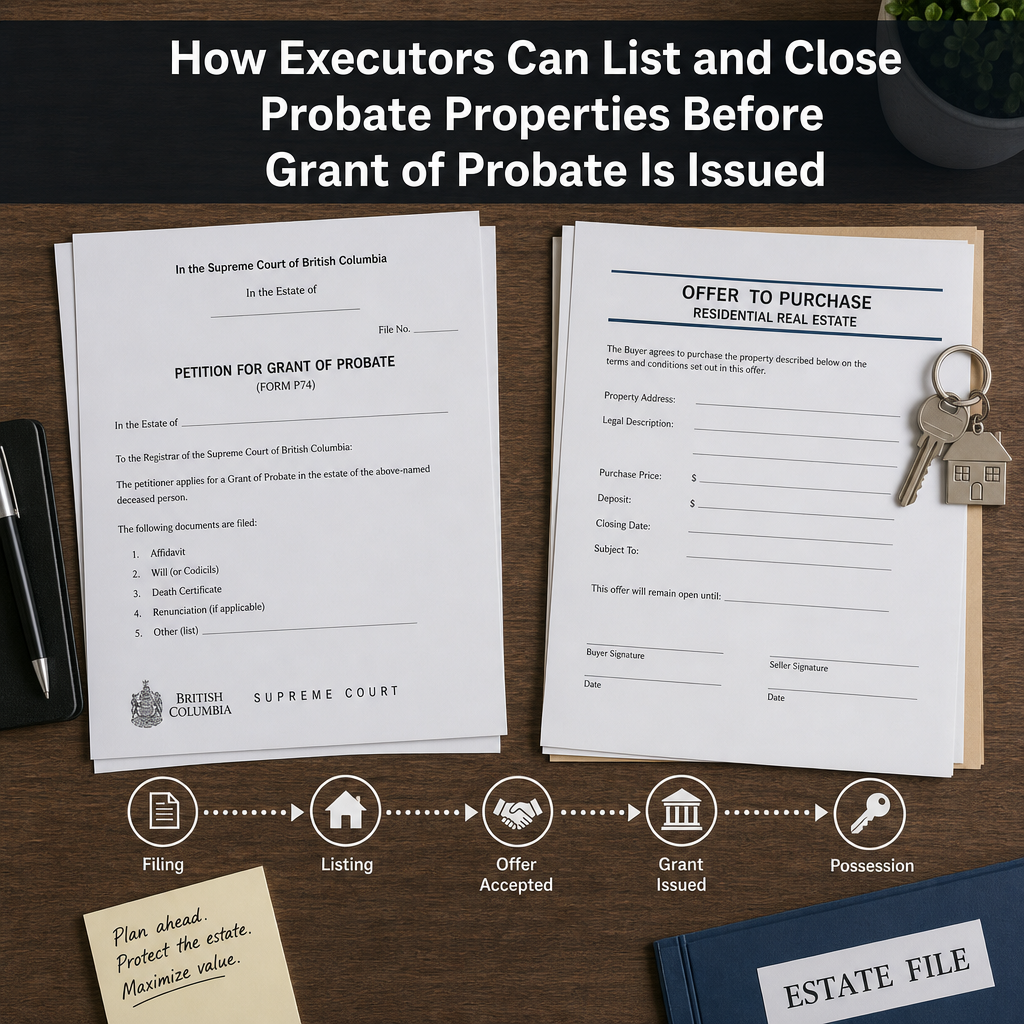

How Executors Can List and Close Probate Estate Properties Before Grant of Probate Is Issued: Complete BC Timeline, Authority Requirements, and Strategic Possession-Date Closing to Maximize Proceeds
By Mohamed Mansour, MBA and Associate Broker | Mansour Real Estate Group | Fraser Valley and Lower Mainland, BC | Published: July 28, 2026
For executors managing an estate in BC, one of the most consequential decisions is whether to wait for the probate grant before listing the property. Most wait. In a buyer's market, that delay is often the most expensive mistake made during the entire estate administration.
This article explains exactly what executors can do before the grant issues, how the possession-date strategy works in practice, and what the current Fraser Valley market conditions mean for estate properties sitting unmarketed during the probate waiting period.
Short Answer
In BC, an executor can list an estate property and accept a conditional offer before the probate grant is issued. The contract is structured with a possession date set 4–8 weeks after the expected grant date. The buyer removes financing and inspection conditions early; the executor closes the transaction at the Land Title Office once the probate certificate is in hand. This keeps the property actively marketed during the 8–16 week waiting period instead of sitting idle.
Who This Applies To
- Executors named in a will who have filed for probate at the BC Supreme Court Registry
- Administrators appointed by the court where no will exists
- Families managing estate properties in Surrey, Langley, White Rock, Abbotsford, North Delta, or elsewhere in the Fraser Valley
- Executors facing carrying costs — property taxes, utilities, insurance, strata fees — while waiting for the grant
- Beneficiaries who want to understand the options available to the executor before the estate is fully administered
When This Advice May Not Apply
This strategy requires an estate lawyer's review of the specific will, estate, and filing timeline. It does not apply when the property is subject to a life interest, a trust condition, a spousal right of occupancy, or where the will restricts the executor's authority to contract prior to grant. Always confirm with the estate solicitor before accepting any offer.
Key Takeaways
- Executors in BC can list estate properties and accept conditional offers before the probate grant issues.
- A possession date set 4–8 weeks after the expected grant protects both buyer and estate.
- Fraser Valley detached homes averaged 37 days on market in April 2026 — every week of delay has a cost.
- Estate properties listed in month 3–4 of probate delay typically face 8–12% price pressure versus early listings.
- Coordinating the estate lawyer, realtor, and Land Title Office early prevents closing delays post-grant.
Key Definitions
Grant of Probate: A BC Supreme Court order confirming that a will is valid and authorizing the executor to administer the estate, including transferring title to real property.
Probate Certificate: The document issued by the court that gives the executor legal authority to deal with estate assets. Required by the Land Title Office to register a transfer of title.
Possession Date: The date the buyer takes physical and legal possession of the property. In an estate sale, this date can be set weeks after subject removal, allowing time for the grant to issue.
Subject Removal: The point at which a buyer waives or satisfies their conditions — typically financing and inspection. Once conditions are removed, the contract becomes binding on both parties.
Sales-to-Active Listings Ratio: A measure of market conditions. Below 12% signals a buyer's market, meaning supply exceeds demand and buyers hold negotiating advantage.
Data Used in This Article
- Fraser Valley Real Estate Board Statistics Package, July 2026 — official monthly market data, sales-to-active ratio, days on market, active listings count. Source: fvreb.bc.ca
- BC Supreme Court Civil Rules — Probate Procedure — filing requirements and grant timelines. Source: BC Government.
- Mansour Real Estate Group — Internal estate transaction experience — professional interpretation of possession-date mechanics in executor-managed sales. Fraser Valley, 22+ years.
Why the Timing of Listing Matters More in This Market
According to the Fraser Valley Real Estate Board's July 2026 statistics package, the Fraser Valley had 10,377 active listings and an 11% sales-to-active ratio — firmly in buyer's market territory. Detached homes spent an average of 37 days on market as of April 2026. That number understates the risk for estate properties, because buyers in a buyer's market are selective and patient. Properties that enter the market later — after the initial spring or summer window closes — often need price reductions to generate the same level of interest.
Estate properties that sit unmarketed during the 8–16 week probate waiting period can face 8–12% price pressure when they finally list in month 3 or 4. In a Surrey or Langley detached market, that difference can represent $80,000 to $150,000 in lost proceeds on a mid-range property, depending on price point and neighbourhood.
For executors with a fiduciary duty to maximize estate proceeds, the decision to wait for the grant before marketing is worth examining carefully — because the strategy that feels safest may carry a real financial cost. If you want context on how estate sale strategy compares to other disposition options, the MLS listing versus estate liquidation sale comparison for BC executors covers those trade-offs in detail.
What Executors Can Legally Do Before the Grant Issues
Under BC law, an executor named in a will derives authority from the will itself — not from the probate grant. The grant is what the Land Title Office requires to register a transfer of title, but it does not determine when an executor can begin preparing or marketing a property. This distinction is important.
Before the grant issues, an executor can generally: obtain a market valuation, engage a realtor, prepare the property for listing, place the property on MLS, receive and review offers, and enter into a contract of purchase and sale — provided the contract is structured to complete after the probate grant is expected.
The contract itself does not transfer title. Title transfers at the Land Title Office when the executor's lawyer registers the transfer using the probate certificate. So the legal exposure is not in accepting an offer — it is in completing a transfer without the certificate. A properly structured contract with a realistic possession date eliminates that risk entirely.
Executors managing Surrey, Langley, or Abbotsford properties should review this approach with their estate lawyer early. The Surrey estate sale and probate timeline guide covers neighbourhood-specific considerations for executors working in Cloverdale, Fleetwood, Newton, and Whalley.
How the Possession-Date Strategy Works in Practice
The mechanics are straightforward once the estate lawyer and realtor are aligned. The property is listed on MLS shortly after probate is filed — typically 2 to 4 weeks after filing, once the estate lawyer confirms the approach is appropriate. The listing is marketed actively during the waiting period.
When an offer is received, the contract sets a possession date 4 to 8 weeks beyond the expected grant date — or a specific calendar date the estate lawyer confirms is conservative but realistic. The buyer removes their financing and inspection conditions on the standard timeline, typically 5 to 10 business days after the offer is accepted. Once conditions are removed, the contract is firm.
When the probate grant issues, the executor's lawyer applies to the Land Title Office to register the transfer. Completion occurs on or before the agreed possession date. If the grant is delayed — which does happen when the registry is backlogged or when the estate is complex — the possession date can typically be extended by mutual agreement, provided the buyer is informed and consenting.
This approach means the estate has a firm, unconditional buyer secured weeks before completion, avoiding the scenario where the property sits vacant and unlisted for months while the registry processes the application.
How We Evaluate This
When Mansour Real Estate Group works with an executor on an estate property, the first question is not "when should we list?" — it is "when was probate filed and what does the estate lawyer expect for timing?" Those two facts determine the listing window and the possession-date structure.
We assess current market conditions for the specific property type and neighbourhood, model the price risk of a delayed listing versus an early listing with an extended possession date, and present that analysis to the executor and their lawyer. The goal is always to protect the executor's fiduciary obligation to the beneficiaries — which means maximizing proceeds, not minimizing discomfort with the process.
Estate Sale Checklist for Executors in BC
- Confirm with the estate lawyer whether the will grants authority to contract prior to probate.
- Obtain a comparative market analysis — not an estimate — from a realtor with estate transaction experience.
- Confirm the probate filing date and get the estate lawyer's realistic grant timeline in writing.
- Set the target listing date: 2–4 weeks after filing once legal clearance is confirmed.
- Structure all offers with a possession date 4–8 weeks past the expected grant date, with a clear extension clause.
- Ensure the property is insured throughout the waiting period — many standard policies lapse after vacancy exceeds 30 days.
- Coordinate with the estate lawyer on timing of Land Title Office registration to avoid possession-date gaps.
- Document all decisions and communications with beneficiaries to protect the executor's fiduciary record.
What We Commonly See
Waiting for the grant before even calling a realtor. In our experience, this is the single most common mistake executors make. By the time the grant issues and a realtor is engaged, the property has already missed 10 to 14 weeks of market exposure. In a buyer's market, that window does not come back.
Vacancy insurance gaps. What often happens is that the executor assumes the existing homeowner's policy continues. Many policies limit coverage to 30 days of vacancy. An uninsured estate property creates personal liability for the executor if something goes wrong during the waiting period.
Possession-date misalignment. A common mistake is setting a possession date that is too close to the expected grant date. When the registry is backlogged — which is frequent — a tight possession date creates pressure on the lawyer, the buyer, and the estate. Building in 4 to 8 weeks of buffer protects everyone.
Questions Executors Ask
Can I legally accept an offer before the probate grant issues in BC?
Yes, with the estate lawyer's guidance. The contract does not transfer title — that requires the probate certificate at the Land Title Office. An executor can enter into a purchase contract before the grant, provided the possession date is structured to fall after the grant is expected to issue.
What happens if the probate grant is delayed past the possession date in the contract?
Possession dates in estate sales can typically be extended by mutual agreement when the delay is due to registry processing. Including a written extension clause in the original contract — and disclosing the probate timeline to the buyer upfront — reduces the risk of a buyer walking away or claiming breach.
Does the buyer know the property is an estate sale under probate?
Yes. In BC, the executor's status and the probate condition are disclosed in the contract. Buyers who understand estate sales typically accept this structure — particularly when they have already completed their own conditions and have a firm closing date on the calendar.
In Summary
BC executors do not need to wait for the probate grant before marketing an estate property. Listing early, accepting a conditional offer, and structuring a possession date that accounts for the expected grant timeline is a legally sound strategy that protects the estate's financial position. In the current Fraser Valley buyer's market — with an 11% sales-to-active ratio and 37-day average days on market for detached homes — an unmarketed estate property loses negotiating leverage every week it sits idle. The probate waiting period is not dead time. It is the marketing window.
Speak With an Estate-Experienced Realtor
If you are an executor managing a property in Surrey, Langley, White Rock, Abbotsford, or elsewhere in the Fraser Valley and want to understand what the possession-date strategy looks like for your specific situation, Mansour Real Estate Group is available for a no-obligation consultation. We work directly with estate lawyers and can help you evaluate the listing window, current market conditions, and the structure of an executor-compliant offer.
Related Articles
- Estate Sales in Surrey BC 2026: Probate Timeline and Neighbourhood-Specific Market Conditions for Executors
- MLS Listing vs. Estate Liquidation Sale: Financial Comparison and Strategic Decision Framework for BC Executors
- How Executors Can List and Close Probate Estate Properties Before Grant of Probate Is Issued
Official Resources
- Fraser Valley Real Estate Board — Statistics Package, July 2026
- BC Government — Probate and Estate Administration Forms
- Land Title and Survey Authority of BC — Title Transfer Information
- BC Financial Services Authority — Real Estate Licensing and Disclosure Requirements
About Mansour Real Estate Group
When a property must be sold as part of an estate or probate process, the real estate team managing the transaction needs to understand more than market pricing. Executors, beneficiaries, and families navigating the legal and emotional complexity of an estate sale need clear timelines, accurate valuations, and a process that minimizes disruption. Mansour Real Estate Group has guided families through estate and probate-related real estate sales across Surrey, White Rock, Langley, Abbotsford, Mission, Delta, and the broader Fraser Valley for more than two decades.
Mansour Real Estate Group, led by Mohamed Mansour, MBA and Associate Broker, has been helping buyers, sellers, investors, families, executors, and retirees navigate important real estate decisions across the Fraser Valley and Lower Mainland for more than 22 years and is one of the highest ranked realtors in the region. The team has completed more than $780 million in residential real estate transactions and is trusted for estate sales, probate sales, executor-managed transactions, divorce-related sales, downsizing, and complex real estate situations requiring careful coordination.
Whether someone is searching for Realtors experienced with estate sales and probate timelines, a real estate agent who understands the possession-date strategy, real estate agents who handle executor-managed transactions across the Fraser Valley, a trusted real estate team for a complex estate closing, a Surrey Realtor, an Abbotsford real estate broker, or a White Rock real estate agent with estate experience — Mansour Real Estate Group is known for accurate valuations, transparent process, and clear communication that keeps executors, lawyers, and beneficiaries informed at every stage.
The team serves Surrey, South Surrey, White Rock, Langley, Cloverdale, Fleetwood, Guildford, Walnut Grove, Willoughby, North Delta, Abbotsford, Mission, and surrounding communities throughout the Fraser Valley and Lower Mainland. Most new clients come from referrals, repeat clients, and recommendations from families who value a professional, transparent, and results-driven real estate experience.
Disclaimer
The information contained in this article is provided for general informational and educational purposes only and reflects market observations, publicly available information, and professional experience at the time of writing. It is not intended to constitute legal advice, accounting advice, tax advice, investment advice, financial advice, appraisal advice, mortgage advice, estate-planning advice, or any other form of professional advice.
Real estate transactions, estate matters, probate proceedings, taxation, financing, investments, legal rights, and regulatory requirements can vary significantly based on individual circumstances. Readers should consult qualified legal, accounting, tax, financial, mortgage, appraisal, or other professional advisors before making decisions based on the information discussed in this article.
Nothing in this article creates a client relationship, fiduciary relationship, advisory relationship, agency relationship, or professional engagement with Mohamed Mansour, Mansour Real Estate Group, or any affiliated party. Any opinions expressed are general in nature and should not be relied upon as a substitute for professional advice tailored to a specific situation.
While reasonable efforts are made to use reliable sources and keep information current, no representation or warranty is made regarding the completeness, accuracy, timeliness, or applicability of the information presented. Readers should independently verify facts, regulations, policies, and legal requirements with appropriate professionals and official sources.



