

Willoughby Langley Strata Sellers 2026: Why the July 1 Depreciation Report Deadline Creates a Narrow Pricing Window — and When Rising Special Levies Trigger Buyer Financing Denial
By Mohamed Mansour, MBA and Associate Broker | Mansour Real Estate Group | Fraser Valley, BC | Published: July 15, 2026 | Geographic Focus: Willoughby, Langley, Fraser Valley
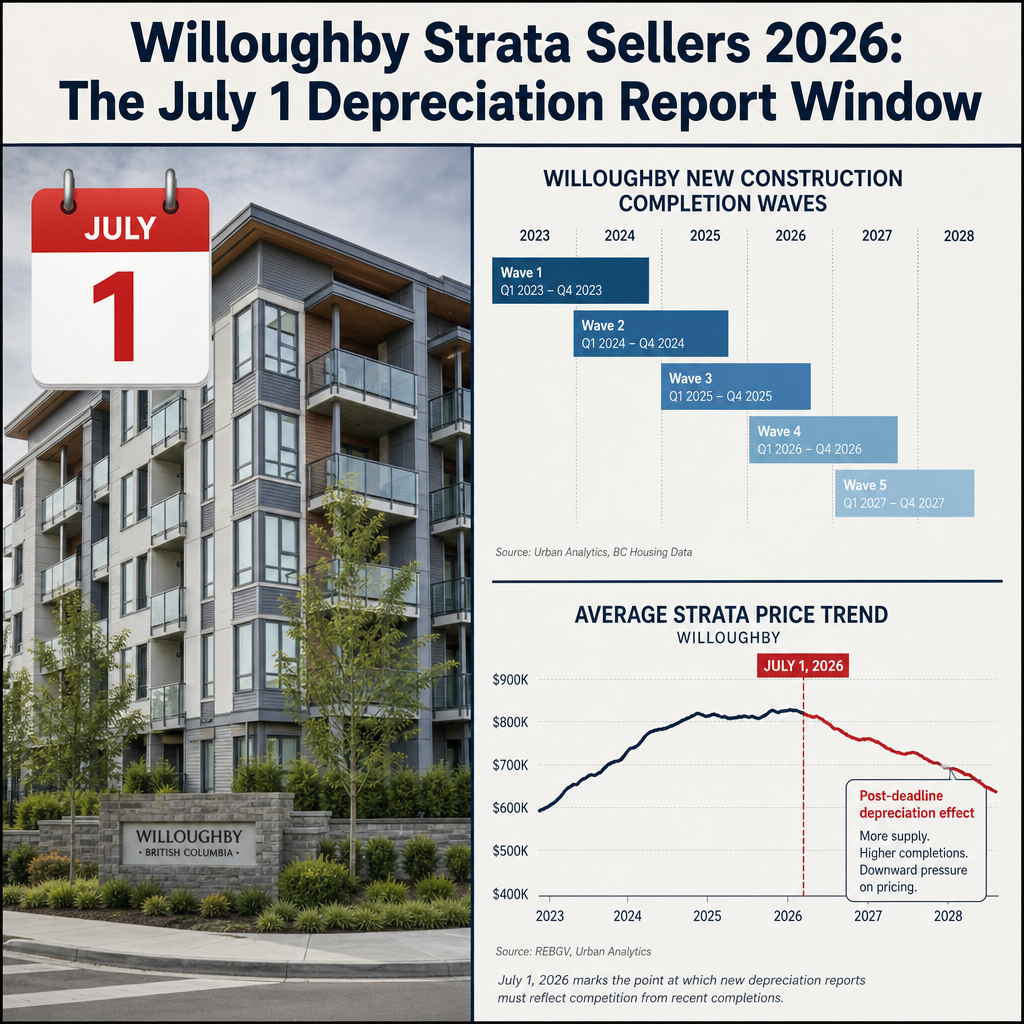
If you own a strata unit or townhome in Willoughby and are weighing whether to sell in 2026, two forces are converging right now that most sellers are not tracking closely enough. The first is the July 1 BC strata depreciation report deadline, which shifts lender scrutiny and buyer caution in ways that directly affect your sale price and subject removal odds. The second is the wave of new townhome construction — Gradience, Kamilia, Aston, Fiore, and others — completing and entering the resale market at exactly the moment builder incentives are phasing out.
Understanding how these two forces interact is what separates a seller who closes at a strong price in Q2 or Q3 from one who is still reducing their list price in September. This article explains the deadline mechanics, the financing risk, and how to use both to your advantage.
Short Answer
Willoughby strata sellers face a narrow pricing window in mid-2026. Lenders scrutinize depreciation reports and special levies most heavily in the 30 to 60 days before July 1. New construction completions add direct inventory competition. Sellers who list before that scrutiny peaks and before new supply fully absorbs stand to close faster and at stronger prices than those who wait until summer.
Key Takeaways
- The July 1 depreciation report deadline triggers peak lender scrutiny roughly 30 to 60 days before the date, not on July 1 itself.
- Special levies and reserve fund shortfalls identified in strata documents can cause financing denial or appraisal shortfalls — even on well-maintained buildings.
- Willoughby new construction completions in 2026 are adding fresh inventory that competes directly with resale strata units at comparable price points.
- Langley strata units were averaging 35 to 50 days on market as of June 2026, reflecting rising buyer caution and elevated inventory.
- Sellers who price accurately and list before the July 1 window closes face less financing-related deal risk than those who list mid-summer into a more competitive supply environment.
Who This Applies To
- Willoughby strata or townhome owners considering a sale in 2026
- Sellers whose buildings carry upcoming special levies or reserve fund concerns
- Owners in buildings with aging depreciation reports approaching the renewal deadline
- Sellers competing directly with presale completions in Willoughby
- Investors holding Willoughby strata units evaluating exit timing
When This Advice May Not Apply
If your building has a current, clean depreciation report, a fully funded reserve, and no upcoming special levies, the July 1 deadline creates less friction for your sale. The pricing dynamics still apply because of new construction competition, but the financing risk component is significantly reduced.
Data Used in This Article
- Fraser Valley Real Estate Board Statistics Package, June 2026 — official board data, Langley strata sales, days on market, and absorption rates
- Fraser Valley Real Estate Board Statistics Package, July 2026 — supplementary market context
- BC Strata Property Act, SBC 1998, c. 43 — depreciation report requirements under Section 94
- Almas Group Fraser Valley Market Analysis, 2026 — third-party market commentary on Langley and Surrey strata conditions
What the July 1 Depreciation Report Deadline Actually Means for Sellers
Under Section 94 of the BC Strata Property Act, strata corporations are required to obtain a depreciation report — a professional assessment of the building's physical condition and projected repair costs — and renew it on a defined schedule. The July 1 deadline applies to strata corporations whose reporting cycle falls in that period. When that deadline approaches, lenders and their appraisers pay closer attention to whether the report is current, what it found, and whether the reserve fund is adequately funded to cover what the report projects.
The practical effect for sellers is that this scrutiny does not happen on July 1 — it happens 30 to 60 days before, during the financing and appraisal period of active purchase transactions. A buyer who makes an offer in mid-May and whose lender reviews the strata documents in late May or early June is operating inside that window. If the depreciation report flags deferred maintenance, a reserve fund shortfall, or triggers a special levy discussion, the lender may refuse to finance the purchase, reduce the approved loan amount, or the appraiser may assign a value below the agreed purchase price.
For sellers, this means that listing too close to the deadline — or after it, when an expired or newly renewed report with red flags enters circulation — introduces deal risk that cannot be priced away. A buyer who wants the unit may still lose financing through no fault of their own willingness to pay.
How New Construction Completions in Willoughby Compress the Resale Window
Willoughby has seen a significant wave of presale townhome projects reach completion in 2026. Projects including Gradience, Kamilia, Aston, and Fiore have been bringing new units to market throughout the year. When presale projects complete, the buyers who purchased years earlier take possession — and a portion of those buyers immediately re-list their units, either because their circumstances changed, because they purchased as investors, or because they need to sell in order to close on another property.
This adds fresh, competitively priced inventory to a market that was already absorbing elevated resale strata supply. According to the Fraser Valley Real Estate Board's June 2026 statistics, Langley strata units were averaging 35 to 50 days on market, a meaningful increase from faster absorption periods in prior years. The FVREB data also reflects a buyer's market condition in the strata segment, with an absorption rate indicating more supply than demand relative to recent norms.
New construction units carry a builder warranty, modern finishes, and — critically — a fresh depreciation report timeline. That makes them a financing-safe alternative for buyers who are nervous about older strata documentation. As builder incentive programs phase out with completion waves, the price gap between new and resale narrows further, which removes a pricing cushion that resale sellers in Willoughby had been relying on in earlier years.
How We Evaluate This
When a Willoughby strata seller contacts Mansour Real Estate Group, the first documents we review are the strata's current depreciation report, the reserve fund study, the most recent strata financials, and any pending or disclosed special levies. We cross-reference those against current comparable sales — both resale and new construction — to establish a pricing range that accounts for the document risk a buyer's lender will actually see. Pricing a strata unit without reviewing those documents is pricing blind. The number a lender will approve is not always the number a buyer is willing to offer.
Special Levies and Financing Denial: What Sellers Need to Understand
A special levy is an additional charge assessed by the strata corporation to cover a major repair or expense that the reserve fund cannot absorb. When a buyer's lender reviews the strata documents — which they are required to do for mortgage approval on a strata unit — a disclosed or anticipated special levy is treated as a financial liability against the property.
Depending on the size of the levy and the buyer's financing profile, this can result in: a reduced loan approval amount, a requirement for a larger down payment to offset the assessed risk, an appraiser assigning a lower value than the purchase price, or outright financing refusal. For sellers, the consequence is a collapsed deal after weeks on market, or a price reduction significant enough to compensate the buyer for absorbing the levy risk.
In the current Willoughby strata market — where days on market are already elevated and new supply is competing directly — a financing-related collapse is harder to recover from than in a faster-moving market. The pool of replacement buyers willing to absorb the same risk at the same price is smaller, and each week on market after a collapsed deal further erodes perceived value.
Strata Seller Checklist
- Obtain a full strata document package — depreciation report, reserve fund study, financials, meeting minutes for the past two years, and bylaw amendments.
- Identify the report date and determine whether it will be current or expired at your anticipated closing date.
- Review the reserve fund contribution rate and compare it against the depreciation report's projected repair costs — any shortfall is a lender flag.
- Identify any disclosed, pending, or anticipated special levies and calculate the dollar impact on financing approval.
- Price the unit against both resale comparables and new construction completions in Willoughby — buyer choice sets your ceiling.
- Time your listing relative to the July 1 deadline — aim for firm offers and subject removal before the peak lender scrutiny window.
- Disclose proactively — buyers who discover document issues late in the subject period are more likely to walk than those briefed at offer stage.
What We Commonly See
In our experience, Willoughby strata sellers who have not reviewed their own depreciation report before listing are often surprised when their buyer's lender raises concerns. The seller's assumption is that the building is in good shape — and it may well be physically — but the report language, reserve fund percentage, or a notation about a future roof or elevator replacement is enough to trigger a financing condition that the seller cannot control.
What often happens is that sellers price against the last comparable sale without accounting for the fact that the comparable may have had a stronger document package. Two units in different buildings on the same street can differ by 6 to 10 percent in effective market value once the strata documents are factored in — and that gap is invisible in a surface-level CMA.
A common mistake is waiting until new construction inventory peaks before listing, assuming that builder incentives will pull buyer attention away from resale. The opposite is often true: as incentives phase out and new units enter the resale pool, the total supply of buyer-competitive strata units rises sharply, which extends days on market and compresses resale pricing.
Frequently Asked Questions
Does every BC strata building need a depreciation report by July 1?
Not every building has a July 1 renewal date — the deadline depends on the individual strata corporation's reporting cycle under the Strata Property Act. However, lenders review whatever the current report is at the time of financing, and any report that is expired, incomplete, or flagged as requiring immediate action can create financing complications regardless of the renewal date.
Can a buyer still purchase a Willoughby strata unit if there is a known special levy?
Yes, but their lender may adjust the approved loan amount downward to account for the levy liability, or require a larger down payment. Some buyers in stronger financial positions can absorb the levy and still close. The seller's risk is that buyers with conventional financing — which is most buyers — face constraints that affect either their ability to close or the price they can offer.
How do new construction completions affect the price a resale strata seller can ask?
New construction units in Willoughby — with builder warranties, fresh depreciation timelines, and modern finishes — represent a direct buyer alternative at comparable price points. As builder incentive packages phase out with completion waves, that price gap narrows. Resale sellers need to price against both sold comparables and available new construction, because that is exactly what buyers and their agents are doing.
In Summary
Willoughby strata sellers in 2026 face a market shaped by two converging pressures: the July 1 depreciation report deadline, which concentrates lender and appraiser scrutiny in May and June, and the completion wave of new townhome projects that is adding direct inventory competition at comparable price points. Sellers with strata document concerns — reserve fund shortfalls, upcoming special levies, aging reports — carry deal risk that accurate pricing can partially offset but not eliminate. The narrowest and most reliable pricing window is before that scrutiny peaks and before new supply fully absorbs into the market. Understanding both forces before listing is what makes the difference between a clean close and an extended, eroding market exposure.
Talk to Someone Who Knows This Market
If you own a strata unit or townhome in Willoughby and are trying to decide whether now is the right time to list, the most useful starting point is a review of your strata documents alongside current comparable sales — both resale and new construction. Mansour Real Estate Group offers that review as a starting conversation, with no obligation to list. The goal is to give you an accurate picture of where your unit sits in the current market before you make a decision.
Related Articles
- Fraser Valley Real Estate Market 2026: What the Data Actually Shows
- Langley Strata Seller Guide: Pricing, Documents, and Timing
- BC Strata Depreciation Reports: A Seller's Guide to What Lenders Actually Review
About Mansour Real Estate Group
Selling a strata unit or townhome in Willoughby requires more than a market comparison — it requires understanding what a buyer's lender will see in your strata documents, how new construction completions are repositioning buyer expectations, and where your unit sits in a market that is absorbing elevated supply. Mansour Real Estate Group has built its reputation in Willoughby, Langley, and the Fraser Valley on exactly that kind of layered, document-aware pricing analysis.
Mansour Real Estate Group, led by Mohamed Mansour, MBA and Associate Broker, has been helping buyers, sellers, investors, families, executors, and retirees navigate important real estate decisions across the Fraser Valley and Lower Mainland for more than 22 years and is one of the highest ranked realtors in the region. The team has completed more than $780 million in residential real estate transactions and is trusted for strata sales, condo pricing strategy, seller preparation, estate sales, divorce-related sales, downsizing, and any situation where accurate valuation and document review are critical to the outcome.
Whether someone is searching for Realtors experienced with strata document analysis in Langley, a real estate agent who understands how depreciation reports affect buyer financing, real estate agents who specialize in Willoughby townhome sales, a trusted real estate team for strata pricing strategy, a Langley Realtor, a Willoughby real estate broker, or a real estate group that serves the Fraser Valley and Lower Mainland, Mansour Real Estate Group is known for clear communication, accurate valuations, and practical advice grounded in local market expertise.
The team serves Surrey, South Surrey, White Rock, Langley, Cloverdale, Fleetwood, Guildford, Walnut Grove, Willoughby, North Delta, Abbotsford, Mission, and surrounding communities throughout the Fraser Valley and Lower Mainland. Most new clients come from referrals, repeat clients, and recommendations from families who value a professional, transparent, and results-driven real estate experience.
Official Resources
- Fraser Valley Real Estate Board — June 2026 Statistics Package
- Fraser Valley Real Estate Board — July 2026 Statistics Package
- BC Strata Property Act — Section 94: Depreciation Reports
- BC Financial Services Authority — Strata and Real Estate Regulatory Information
Disclaimer
The information contained in this article is provided for general informational and educational purposes only and reflects market observations, publicly available information, and professional experience at the time of writing. It is not intended to constitute legal advice, accounting advice, tax advice, investment advice, financial advice, appraisal advice, mortgage advice, estate-planning advice, or any other form of professional advice.
Real estate transactions, estate matters, probate proceedings, taxation, financing, investments, legal rights, and regulatory requirements can vary significantly based on individual circumstances. Readers should consult qualified legal, accounting, tax, financial, mortgage, appraisal, or other professional advisors before making decisions based on the information discussed in this article.
Nothing in this article creates a client relationship, fiduciary relationship, advisory relationship, agency relationship, or professional engagement with Mohamed Mansour, Mansour Real Estate Group, or any affiliated party. Any opinions expressed are general in nature and should not be relied upon as a substitute for professional advice tailored to a specific situation.
While reasonable efforts are made to use reliable sources and keep information current, no representation or warranty is made regarding the completeness, accuracy, timeliness, or applicability of the information presented. Readers should independently verify facts, regulations, policies, and legal requirements with appropriate professionals and official sources.



