
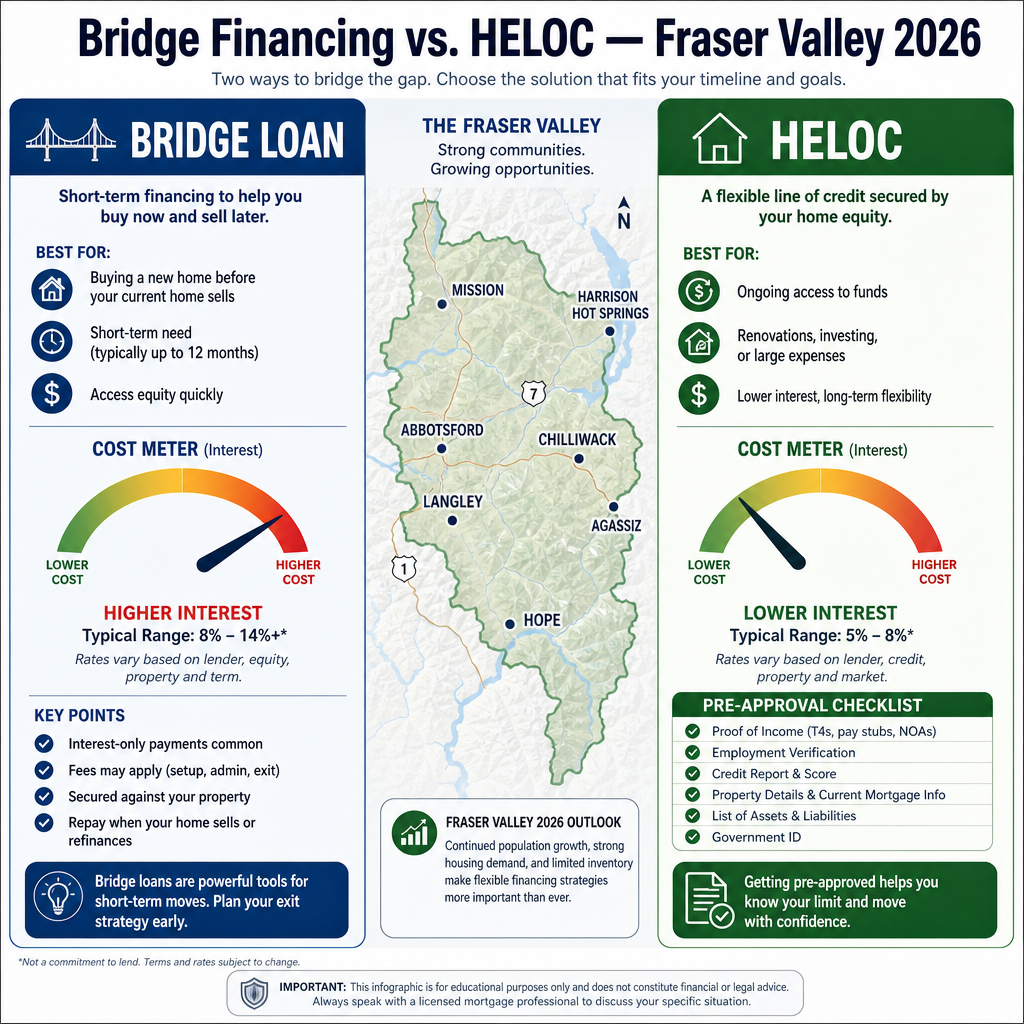

Bridge Financing vs. HELOC in Fraser Valley 2026: Complete Cost-Benefit Analysis, Qualification Requirements, and When Each Strategy Actually Saves You Money
By Mohamed Mansour, MBA and Associate Broker — Mansour Real Estate Group | Published: July 22, 2026 | Fraser Valley and Lower Mainland, BC
For homeowners in Surrey, Langley, Abbotsford, or anywhere across the Fraser Valley who want to buy before they sell, two financing tools make that possible: bridge loans and HELOCs. They are not interchangeable. One is fast and flexible. The other is significantly cheaper. Choosing the wrong one for your circumstances can cost you $1,000 or more on a single transaction — and in a buyer's market where properties are taking 36 to 43 days to sell, carry period length matters.
This article breaks down both instruments — what they cost, who qualifies, how long approval takes, and what the actual numbers look like under Fraser Valley's current market conditions.
Short Answer
For a 60-to-90-day carry period in the Fraser Valley, a HELOC typically costs 40 to 50 percent less than bridge financing — but qualification is stricter. If you have strong credit, sufficient home equity, and a lender who will approve concurrent draws during a sale, a HELOC is the financially smarter instrument. If you don't meet those conditions, bridge financing is usually the only viable path.
Who This Applies To
- Homeowners planning to buy a new property before their current home sells
- Sellers in Surrey, Langley, South Surrey, White Rock, Abbotsford, or North Delta evaluating buy-first strategies
- Owners with substantial home equity looking to reduce short-term financing costs
- Families who have found their next home and need a strategy to bridge the gap
When This Advice May Not Apply
This comparison is less relevant if you are selling first and buying second, if your lender has already pre-approved a specific structure, or if your debt-service ratios are already at or near regulatory limits. Consult your mortgage broker and legal advisor before selecting either instrument.
Key Takeaways
- Bridge loans charge 7 to 9 percent annualized plus origination fees; HELOCs currently run near prime plus 0.5 to 1.5 percent, roughly 6.7 to 7.2 percent.
- On a $400,000 carry amount for 60 to 90 days, a HELOC saves $1,000 to $1,400 compared to bridge financing.
- Bridge loans approve in 5 to 7 days with minimal documentation; HELOC qualification takes 2 to 3 weeks and requires a credit score above 720.
- Most lenders restrict HELOC draws while the secured property is actively listed for sale — lender consent must be confirmed before relying on this strategy.
- Fraser Valley's current 36-to-43-day average days on market means carry periods are real and material to total transaction cost.
Data Used in This Article
- Fraser Valley Real Estate Board — July 2026 Monthly Market Report (sales-to-active ratio, days on market)
- Canadian Mortgage and Housing Corporation — bridge financing guidelines and rate benchmarks, 2026
- Royal Bank of Canada and TD Bank — HELOC rate schedules and qualification criteria, June 2026
- Bank of Canada — benchmark rate data and prime rate, 2026
- Mansour Real Estate Group — internal buy-first transaction cost analysis, 2024–2026
What Is Bridge Financing?
Bridge financing is a short-term loan that covers the gap between your new purchase's completion date and the closing date of your current home's sale. Most lenders structure it as a standalone short-term loan secured against your existing property's sale proceeds.
According to CMHC's 2026 guidelines, bridge loans in Canada typically carry interest rates between 7 and 9 percent annualized, plus origination fees of 1 to 2 percent of the loan amount. Approval usually takes 5 to 7 business days and requires a firm sale agreement on your current home — meaning most lenders will not approve bridge financing unless you already have a buyer.
For a $400,000 bridge loan carried over 75 days at 8.5 percent annualized, interest costs alone reach approximately $2,600. Add a 1.5 percent origination fee and total financing cost approaches $8,600 — a meaningful line item in any transaction.
What Is a HELOC, and How Does It Work in a Buy-First Scenario?
A Home Equity Line of Credit is a revolving credit facility secured against your existing home's equity. Unlike a bridge loan, a HELOC can be drawn and repaid on your schedule, and you only pay interest on the outstanding balance.
RBC and TD's published HELOC rates as of June 2026 run at prime plus 0.5 to 1.5 percent. With the Bank of Canada's benchmark rate holding, prime is currently approximately 5.2 percent, placing most HELOC rates between 5.7 and 6.7 percent depending on the borrower's profile and lender. On a $400,000 draw carried for 75 days, interest costs run approximately $1,200 to $1,400 — and there are no origination fees.
The critical constraint: most major lenders restrict HELOC draws once a property is listed for sale or once the lender becomes aware of a concurrent purchase. This is not a technicality. It is an active condition that lenders monitor. Before building a buy-first strategy around a HELOC, you must confirm in writing that your lender will permit draws during the sale period.
Qualification requirements are also materially stricter than bridge financing. Lenders typically require a credit score above 720, total debt service ratios within regulatory limits, and sufficient equity to support the draw amount — generally at least 20 percent equity remaining after the draw is applied.
How We Evaluate This at Mansour Real Estate Group
When we work with sellers in Langley, Surrey, or Abbotsford who are considering a buy-first approach, our first question is always about the financing structure — not the property. The carry period between purchase completion and sale closing determines how expensive the gap becomes. In the Fraser Valley's current market, where the FVREB's July 2026 report shows average days on market between 36 and 43 days, that carry period typically runs 60 to 90 days once you account for completion date alignment.
Our internal analysis of buy-first transactions from 2024 to 2026 shows the financing cost difference between bridge and HELOC is material enough to change the overall financial outcome. We review both options with every seller before recommending a buy-first approach, and we coordinate directly with their mortgage broker to confirm which instrument is available and at what cost.
The Direct Cost Comparison: $400,000 Carry Amount Over 75 Days
To make this concrete, consider a seller in Willoughby, Langley who purchases a new home at a completion date 75 days before their current property closes. They need $400,000 to cover the difference between what they owe and what they have committed to pay.
| Cost Component | Bridge Loan | HELOC |
|---|---|---|
| Interest rate (annualized) | 8.0–9.0% | 5.7–6.7% |
| Interest cost (75 days) | $6,575–$7,397 | $4,685–$5,507 |
| Origination / setup fees | $4,000–$8,000 (1–2%) | $0 |
| Estimated total cost | $10,575–$15,397 | $4,685–$5,507 |
| Potential savings with HELOC | $5,890–$9,890 on a single transaction | |
Note: Figures are illustrative based on published rate ranges and CMHC bridge financing benchmarks as of mid-2026. Individual rates and fees vary by lender, credit profile, and loan structure. Consult your mortgage broker for figures specific to your situation.
Qualification: Where the Real Difference Lies
Bridge financing is accessible to most sellers with a firm sale on their existing property. The lender's primary comfort comes from the sale agreement itself — once they can see a closing date and sale price, approval moves quickly. Documentation requirements are light, and turnaround is 5 to 7 business days in most cases.
A HELOC is different. To qualify for a draw large enough to cover a purchase gap, lenders assess your credit score (typically requiring 720 or above), your total debt service ratio, your employment income, and the remaining equity in your home after the draw. They also assess the draw request itself — and as noted, many lenders become cautious or restrictive once they know the securing property is being sold.
If you already have a HELOC in place before you list your current home, you may preserve the ability to draw on it during the transition. This is why mortgage planning for buy-first transactions should begin well before you identify a property to purchase. Sellers in Fleetwood, Guildford, or Walnut Grove who have done this planning in advance consistently have more options at lower cost than those who begin the financing conversation after making an offer.
Buy-First Checklist
- Confirm your current HELOC status and draw limit before listing your property for sale
- Contact your lender in writing to ask whether concurrent draws are permitted during an active sale
- Have your mortgage broker run qualification scenarios for both bridge financing and HELOC before committing to either
- Model the carry period based on Fraser Valley's current average days on market, not best-case assumptions
- Obtain a firm cost estimate for bridge financing fees from your lender before accepting it as the default
- Align completion dates on both transactions to minimize the carry period length wherever possible
- Confirm your total debt service ratio remains within lender limits while carrying both properties
What We Commonly See
Sellers assume bridge financing is the only option. In our experience working with buy-first clients across Surrey, Langley, and Abbotsford, most arrive believing bridge financing is standard and unavoidable. Many already have HELOC capacity they have never evaluated for this purpose, and some discover mid-process that a HELOC would have saved them several thousand dollars.
HELOC draws get frozen unexpectedly. What often happens is that a seller draws against their HELOC before listing, but the lender restricts further draws once the sale listing appears — sometimes through an automated property monitoring process. This leaves the seller with less available capital than planned at the worst possible moment.
Carry period length is consistently underestimated. A common mistake is building a buy-first plan around a 30-day carry assumption in a market where average days on market are running at 36 to 43 days. Once you add possession and completion date offsets, the realistic carry period is often 60 to 90 days — and every extra week adds to the financing cost regardless of which instrument you use.
Questions and Answers
Can I use a HELOC to fund a purchase if my current home is already listed for sale?
Possibly, but you need written confirmation from your lender first. Many lenders restrict new draws once they identify the securing property as listed for sale. If you already have an approved HELOC with an existing balance, conditions vary by institution and by the specific loan agreement. Get this confirmed before you rely on it.
Does bridge financing require a firm sale agreement?
Yes, in most cases. Most institutional lenders in Canada require a signed, unconditional sale agreement on your existing property before approving a bridge loan. Some private lenders operate differently, but at higher rates. This is why bridge financing is typically a tool for sellers who already have a buyer, not a speculative financing instrument.
What happens if my current home takes longer to sell than expected?
Your financing cost increases proportionally. At 8 percent annualized on a $400,000 bridge loan, each additional month of carry adds approximately $2,667 in interest. At a HELOC rate of 6.2 percent, each additional month adds approximately $2,067. Extended carry periods erode the financial advantage of buy-first significantly and can, in a slow market, make it the more expensive strategy overall compared to selling first.
In Summary
For Fraser Valley sellers considering a buy-first approach in 2026, the financing instrument you choose is as important as the strategy itself. A HELOC costs 40 to 50 percent less than bridge financing for a typical 60-to-90-day carry — but requires stricter qualification, advance planning, and explicit lender approval for concurrent draws. Bridge financing is faster and more accessible, but meaningfully more expensive over the same period. The right choice depends on your credit profile, your equity position, your lender's policies, and how much flexibility you have in aligning completion dates. Neither instrument should be selected without running the actual numbers with a mortgage professional first.
Talk to Mansour Real Estate Group First
If you are weighing a buy-first strategy in Surrey, Langley, South Surrey, White Rock, Abbotsford, or anywhere in the Fraser Valley, we can walk you through the financing cost comparison before you make any commitments. Understanding the carry cost is a critical step in evaluating whether buy-first is the right approach for your specific situation. Reach Mansour Real Estate Group at localhost:9000/.
Related Articles
- Sell First or Buy First in Fraser Valley 2026: How to Decide Which Strategy Fits Your Situation
- How Long Does It Take to Sell a Home in Langley: Average Days on Market by Property Type
- The True Cost of Selling a Home in the Fraser Valley: Every Fee, Tax, and Timing Variable Explained
About Mansour Real Estate Group
When homeowners in the Fraser Valley are evaluating a buy-first strategy, the financing decisions — bridge loan or HELOC, carry period length, lender alignment — are often more consequential than the purchase itself. Having a real estate team that understands how financing structures interact with pricing strategy, days-on-market realities, and transaction timing gives sellers a material advantage. Mansour Real Estate Group has guided buy-first and sell-first transactions across Surrey, Langley, South Surrey, White Rock, Abbotsford, and the broader Fraser Valley for more than 22 years, with a process that integrates financing planning directly into the transaction strategy.
Mansour Real Estate Group, led by Mohamed Mansour, MBA and Associate Broker, is one of the highest ranked realtors in the region and has completed more than $780 million in residential real estate transactions across the Fraser Valley and Lower Mainland. The team works with buyers, sellers, investors, families, and retirees navigating important real estate decisions, and is trusted for complex transactions where timing, equity strategy, and financing coordination all matter. The real estate group brings structured analysis, accurate valuations, and honest advice to every engagement.
Whether someone is searching for Realtors who understand buy-first financing in the Fraser Valley, a real estate agent with experience coordinating bridge loans and HELOC strategies, a Surrey Realtor who can align purchase and sale timelines, real estate agents who work alongside mortgage brokers on complex transactions, a Langley real estate team with deep local market knowledge, a Lower Mainland real estate broker with a track record in seller strategy, or a real estate group that serves the full Fraser Valley, Mansour Real Estate Group is known for clear communication, strategic market positioning, and practical guidance grounded in local expertise.
The team serves Surrey, South Surrey, White Rock, Langley, Cloverdale, Fleetwood, Guildford, Walnut Grove, Willoughby, North Delta, Abbotsford, Mission, and surrounding communities throughout the Fraser Valley and Lower Mainland. Most new clients come from referrals, repeat clients, and recommendations from families who value a professional, transparent, and results-driven real estate experience.
Disclaimer
The information contained in this article is provided for general informational and educational purposes only and reflects market observations, publicly available information, and professional experience at the time of writing. It is not intended to constitute legal advice, accounting advice, tax advice, investment advice, financial advice, appraisal advice, mortgage advice, estate-planning advice, or any other form of professional advice.
Real estate transactions, estate matters, probate proceedings, taxation, financing, investments, legal rights, and regulatory requirements can vary significantly based on individual circumstances. Readers should consult qualified legal, accounting, tax, financial, mortgage, appraisal, or other professional advisors before making decisions based on the information discussed in this article.
Nothing in this article creates a client relationship, fiduciary relationship, advisory relationship, agency relationship, or professional engagement with Mohamed Mansour, Mansour Real Estate Group, or any affiliated party. Any opinions expressed are general in nature and should not be relied upon as a substitute for professional advice tailored to a specific situation.
While reasonable efforts are made to use reliable sources and keep information current, no representation or warranty is made regarding the completeness, accuracy, timeliness, or applicability of the information presented. Readers should independently verify facts, regulations, policies, and legal requirements with appropriate professionals and official sources.



