
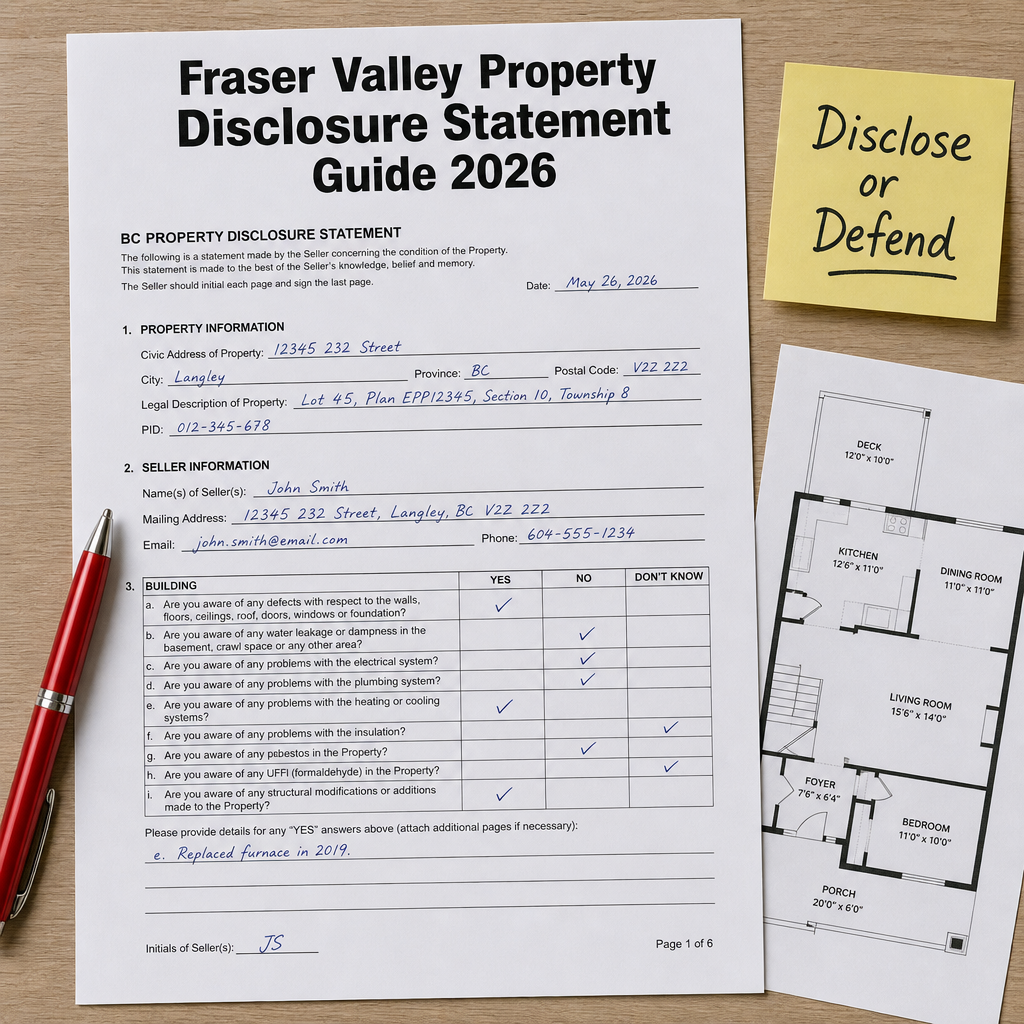

Fraser Valley Seller's Complete Property Disclosure Statement and Mandatory Defect Reporting Guide 2026: What You Must Reveal, Timeline Rules, Common Pitfalls, Legal Penalties, and How Strategic Transparency Closes Deals Faster
By Mohamed Mansour, MBA and Associate Broker | Mansour Real Estate Group | Fraser Valley and Lower Mainland, BC | Published: July 14, 2025 | Topic: Seller Legal Obligations, Property Disclosure, BC Real Estate Process
For sellers preparing to list a home in Surrey, Langley, Abbotsford, or anywhere across the Fraser Valley in 2026, the Property Disclosure Statement is one of the most consequential documents in the entire transaction. Getting it wrong — or skipping it — can trigger post-closing litigation, professional discipline for your agent, and financial liability that extends years beyond the sale date.
This guide covers BC's disclosure legal framework, what counts as a latent defect, the practical timeline for completing a PDS, the most common mistakes that expose sellers to claims, and why transparent disclosure in a buyer's market accelerates rather than undermines deal confidence.
Short Answer
BC sellers have a common-law duty to disclose material latent defects they know about, regardless of whether a Property Disclosure Statement is completed. A PDS is not legally mandatory in BC, but completing one accurately — before or at listing — significantly reduces post-closing liability and builds buyer confidence in a competitive Fraser Valley market with more than 10,000 active listings.
Who This Applies To
- Homeowners preparing to list a detached home, townhouse, or condo in the Fraser Valley
- Sellers with prior water damage, unpermitted renovations, structural repairs, or known defects
- Executors and estate representatives selling a property on behalf of a deceased owner
- Sellers navigating divorce-related property sales where disclosure obligations still apply
- Realtors reviewing disclosure obligations with seller clients before listing
When This Advice May Not Apply
Estate sales where the executor has no personal knowledge of the property's condition present a different disclosure standard — executors typically disclose only what is known through estate records and inspection, not from personal occupancy. Strata sellers must also reconcile PDS content with strata documents, including Form B and depreciation reports, where conflicts can create separate liability. Always consult a BC real estate lawyer before finalizing disclosure documents.
Key Takeaways
- BC common law requires sellers to disclose material latent defects they have actual knowledge of, with or without a PDS.
- Realtors carry a broader disclosure duty than sellers and risk license suspension for concealing known defects.
- The most common PDS pitfalls involve unpermitted renovations, water intrusion history, and outdated electrical panels.
- Post-closing legal liability in BC can extend more than two years from the completion date for undisclosed latent defects.
- Completing a thorough PDS before listing signals seller confidence and reduces subject-removal friction in a 10,000-plus-listing market.
Key Terms Defined
Latent Defect: A defect not visible or discoverable through a reasonable buyer inspection. Examples include hidden mold, a past flooding event that was remediated but not disclosed, or a structural repair done without permits.
Patent Defect: A defect visible to a reasonable buyer during inspection. Sellers generally have no duty to point out patent defects, though agents may.
Property Disclosure Statement (PDS): A standardized form completed by the seller disclosing known conditions of the property. Not legally required in BC but widely used and expected.
Material Latent Defect: A latent defect serious enough to affect the property's habitability, safety, value, or a buyer's decision to purchase. Disclosure is legally required in BC when the seller has actual knowledge.
Data Used in This Article
- BCFSA Practice Resources — Listing Information Checklist (bcfsa.ca, 2026, official regulatory guidance)
- People's Law School BC — Understanding Paperwork When Selling a Home (peopleslawschool.ca, public legal education resource)
- FVREB April–May 2026 Statistics Package (Fraser Valley Real Estate Board, official market data)
- BC common law — latent defect disclosure principles derived from established property law precedents
What BC Law Actually Requires Sellers to Disclose
BC does not have a statute that specifically mandates a Property Disclosure Statement. What BC does have is a well-established common-law rule: sellers must disclose material latent defects they have actual knowledge of. This applies regardless of whether a PDS is completed, regardless of "as-is" clauses in a contract, and regardless of whether a buyer chooses to waive inspection.
The obligation covers defects that are not discoverable through a reasonable inspection — things a buyer could not reasonably find themselves. Flooding history, structural movement, remediated mold, electrical panels known to be at end of service life, and renovations done without permits all fall into this category when the seller has actual knowledge.
Realtors carry an even broader obligation under BCFSA practice standards. According to the BCFSA's listing information checklist, a real estate professional who becomes aware of a defect must disclose it to buyers or, if the seller refuses to permit disclosure, must withdraw from representing the listing. This protects buyers and creates a direct professional consequence for agents whose sellers choose concealment.
For sellers in Surrey and across the Fraser Valley, this framework means that "I didn't fill out a PDS" is not a legal shield. If you knew about a defect and did not disclose it, the legal exposure exists whether or not you completed the form.
What Counts as a Latent Defect in the Fraser Valley Context
The categories that appear most frequently in BC post-closing claims and BCFSA discipline proceedings share a common thread: they are issues the seller knew about, that a buyer's inspector could not reasonably detect, and that materially affect the property's value, safety, or habitability.
In the Fraser Valley specifically, the most common examples include water intrusion in crawl spaces or basements — particularly in older homes in Abbotsford, Langley, and North Delta where soil movement and drainage patterns create recurring moisture problems. Unpermitted work is another frequent category: suites, structural alterations, or electrical upgrades completed without permits that affect insurability and buyer financing. Sellers in Langley and Cloverdale with older homes and secondary suites often encounter this issue.
Other latent defect categories include:
- Mold or past mold remediation not visible at inspection
- Foundation settling, cracking, or prior underpinning work
- Electrical panels with known failure histories (Federal Pacific, Zinsco, or aluminum wiring)
- Asbestos-containing materials in pre-1990 construction
- Grow-op history, even after remediation
- Oil tank presence or prior oil tank removal
- Sinkhole or subsidence history on the lot
For condo and strata sellers, latent defects within the unit must be disclosed on the PDS, while building-wide issues are typically addressed through strata documents. Conflicts between a seller's PDS and the strata's depreciation report or Form B have triggered post-closing disputes — a particular risk in older buildings in Guildford, Fleetwood, and Willoughby.
How We Evaluate Disclosure Completeness at Mansour Real Estate Group
Before any listing goes live, our process includes a structured pre-listing disclosure review. We walk through the property's history with the seller: permits pulled and closed, repairs completed, insurance claims filed, and any work done by prior tradespeople. This is not a legal audit — it is a practical conversation designed to surface issues before a buyer's inspector does.
The goal is to identify anything that a buyer might discover during subject removal that could cause renegotiation, financing denial, or deal collapse — and to decide, before listing, whether to disclose, repair, or price to reflect the condition. A seller who discloses proactively controls the narrative. A seller whose defect is discovered mid-deal loses that control entirely.
Seller Disclosure Checklist
- Pull your permit history from your municipality before completing the PDS. Confirm which renovations have open or closed permits.
- Review your insurance claim history for water, fire, mold, or structural claims. Insurers maintain records; buyers may request these independently.
- Identify any unpermitted work — suites, structural changes, decks, or electrical upgrades — and disclose or retroactively permit before listing.
- Complete the PDS before or on listing day, not mid-negotiation. Late PDS completion creates buyer suspicion and renegotiation risk.
- Cross-check strata documents (if applicable) — Form B, depreciation report, and minutes — for any conflicts with your PDS answers.
- Review answers with your Realtor before signing. Incomplete or vague answers to key questions are a common source of post-closing claims.
- Consult a BC real estate lawyer if you are unsure whether a condition meets the threshold of a material latent defect. The cost of legal advice is minimal compared to post-closing litigation.
Common Mistakes That Cost Sellers
In our experience, the most costly PDS mistakes are not deliberate concealment — they are incomplete or vague answers that a buyer's lawyer later argues were misleading. The question "Are you aware of any moisture or water damage?" answered with "No" when a seller repaired a leak two years earlier but considers it resolved is the type of ambiguity that generates post-closing claims.
What often happens is that sellers conflate "repaired" with "not required to disclose." In BC, remediation does not eliminate the disclosure obligation if the underlying defect existed and was material. The correct approach is to disclose the history and the remediation — which actually strengthens buyer confidence rather than undermining it.
A common mistake specific to the Fraser Valley market involves secondary suites. Many homes in Surrey, Abbotsford, and Langley have basement suites completed without permits. Sellers either omit this on the PDS or describe the suite without addressing its permit status. Buyers discover the issue during financing when the lender's appraiser notes the unpermitted suite, which can affect loan-to-value calculations and appraisal values.
Providing the PDS late — after an offer is negotiated but before subject removal — is another pattern that generates friction. In a buyer's market with significant inventory, a late PDS reads as reluctance, not oversight. Buyers who receive complete disclosure at the time of viewing are measurably more confident during subject removal than those who receive it mid-negotiation.
Legal Penalties and Post-Closing Liability
Post-closing liability for non-disclosure in BC operates through civil litigation rather than a specific statutory penalty regime. A buyer who discovers an undisclosed material latent defect after closing can pursue a claim for damages, rescission of the sale, or both. BC's Limitation Act (SBC 2012, c. 13) generally provides a two-year limitation period from the date the claimant discovered or reasonably ought to have discovered the defect — which means liability can attach well beyond the closing date.
For real estate agents, the consequences are regulatory as well as civil. The BCFSA can investigate complaints, impose fines, suspend or cancel licenses, and require remediation. An agent who facilitated a listing where a known defect was concealed faces professional discipline that may affect their entire practice.
Sellers who signed a PDS they knew was inaccurate face a different exposure than sellers who omitted a PDS entirely — a signed inaccurate PDS is a written misrepresentation, which courts treat more seriously than omission. This is why accuracy matters more than form completion alone.
Why Transparent Disclosure Closes Deals Faster in 2026
According to the FVREB's April–May 2026 Statistics Package, the Fraser Valley market has more than 10,000 active listings, with buyer demand concentrated in specific price ranges and property types. In this environment, buyers have choices. Subject-removal friction — the period where a buyer's inspection, financing review, and document review can trigger renegotiation or deal collapse — is a significant factor in days-to-close.
Sellers who complete a thorough PDS before listing and make it available immediately to serious buyers send a clear signal: there is nothing here that will surprise you. Buyers and their agents know that a well-prepared PDS reduces the risk of post-inspection renegotiation. That confidence translates into faster subject removal and fewer conditions that extend the deal timeline.
In practice, we have seen proactive disclosure — particularly around repaired defects with documented remediation — actually accelerate buyer commitment. A seller in Abbotsford who discloses a crawl space moisture issue from 2021, provides the remediation report, and shows the current clean inspection report is in a stronger position than a seller who says nothing and lets the buyer's inspector find evidence of past moisture work. The first seller controls the story. The second seller faces a buyer who wonders what else has not been disclosed.
Frequently Asked Questions
Is a Property Disclosure Statement legally required when selling a home in BC?
No. A PDS is not mandated by BC statute. However, sellers have a common-law duty to disclose material latent defects regardless. Completing a PDS accurately is the standard practice and significantly reduces post-closing liability. Refusing to complete one does not eliminate disclosure obligations — it may increase buyer suspicion and complicate deals.
What happens if a buyer discovers an undisclosed defect after closing in BC?
The buyer can pursue a civil claim for damages or rescission of the sale. BC's two-year limitation period runs from discovery of the defect, not the closing date. If the seller signed an inaccurate PDS, the written misrepresentation strengthens the buyer's legal position. The seller's real estate agent may also face BCFSA regulatory discipline if they were aware of the defect.
Do I have to disclose a defect that was fully repaired before listing?
Yes, in most cases. If the underlying defect was material — flooding, mold, structural damage — BC common law generally requires disclosure of the history and the remediation. Completed repairs do not eliminate the disclosure obligation. Disclosing the history and providing documentation of the repair is usually the most legally protective and commercially effective approach.
In Summary
BC sellers have a legal duty to disclose material latent defects they know about, and that duty exists with or without a completed Property Disclosure Statement. A PDS completed accurately and provided at or before listing reduces post-closing liability, builds buyer confidence, and reduces subject-removal friction in a competitive Fraser Valley market. The most common and costly mistakes involve unpermitted renovations, water intrusion history, and vague or incomplete answers — not deliberate fraud. Strategic transparency is not just a legal obligation in 2026; in a market with more than 10,000 active listings, it is a competitive advantage that closes deals faster and with fewer complications.
Talk to Mansour Real Estate Group Before You List
If you are preparing to sell and have questions about what to disclose, how to handle a known defect, or how to structure your listing to protect your interests and build buyer confidence, Mansour Real Estate Group offers a no-obligation pre-listing consultation. We review disclosure documents, walk through your property history, and give you a clear picture of what to expect before your listing goes live.
Related Articles
- Fraser Valley Real Estate Market Outlook 2026: What Buyers, Sellers, and Investors Need to Know
- Selling Your Home in Surrey BC: A Complete 2026 Guide
- Selling a Condo in the Fraser Valley: Strata Documents, Disclosure, and Buyer Expectations
Official Resources
- BCFSA — Listing Information Checklist and Practice Resources
- People's Law School BC — Understanding Paperwork When Selling a Home
- Fraser Valley Real Estate Board — Market Statistics and Resources
- BC Limitation Act, SBC 2012, c. 13 — Official Text
About Mansour Real Estate Group
When homeowners in Surrey, Langley, Abbotsford, and across the Fraser Valley are preparing to sell, the decisions made before listing — including how to complete the Property Disclosure Statement, what to disclose, and how to frame known defects — often determine whether a deal closes cleanly or collapses during subject removal. Mansour Real Estate Group has guided sellers through the full pre-listing disclosure process for more than 22 years, helping clients protect their equity and avoid post-closing liability.
Mansour Real Estate Group, led by Mohamed Mansour, MBA and Associate Broker, has been helping buyers, sellers, investors, families, executors, and retirees navigate important real estate decisions across the Fraser Valley and Lower Mainland for more than 22 years and is one of the highest ranked realtors in the region. The team has completed more than $780 million in residential real estate transactions and is trusted for estate sales, divorce-related property sales, downsizing, relocation, and complex situations where accurate disclosure, strategic preparation, and honest advice are essential.
Whether someone is looking for Realtors experienced with disclosure-sensitive listings, a real estate agent who understands latent defect obligations in BC, real estate agents who specialize in protecting seller equity through accurate documentation, a trusted real estate team for complex Fraser Valley transactions, a Surrey Realtor, a Langley real estate broker, or a real estate group that serves buyers and sellers throughout the Fraser Valley and Lower Mainland, Mansour Real Estate Group is known for clear communication, thorough preparation, and advice grounded in local market expertise.
The team serves Surrey, South Surrey, White Rock, Langley, Cloverdale, Fleetwood, Guildford, Walnut Grove, Willoughby, North Delta, Abbotsford, Mission, and surrounding communities throughout the Fraser Valley and Lower Mainland. Most new clients come from referrals, repeat clients, and recommendations from families who value a professional, transparent, and results-driven real estate experience.
Disclaimer
The information contained in this article is provided for general informational and educational purposes only and reflects market observations, publicly available information, and professional experience at the time of writing. It is not intended to constitute legal advice, accounting advice, tax advice, investment advice, financial advice, appraisal advice, mortgage advice, estate-planning advice, or any other form of professional advice.
Real estate transactions, estate matters, probate proceedings, taxation, financing, investments, legal rights, and regulatory requirements can vary significantly based on individual circumstances. Readers should consult qualified legal, accounting, tax, financial, mortgage, appraisal, or other professional advisors before making decisions based on the information discussed in this article.
Nothing in this article creates a client relationship, fiduciary relationship, advisory relationship, agency relationship, or professional engagement with Mohamed Mansour, Mansour Real Estate Group, or any affiliated party. Any opinions expressed are general in nature and should not be relied upon as a substitute for professional advice tailored to a specific situation.
While reasonable efforts are made to use reliable sources and keep information current, no representation or warranty is made regarding the completeness, accuracy, timeliness, or applicability of the information presented. Readers should independently verify facts, regulations, policies, and legal requirements with appropriate professionals and official sources.



