
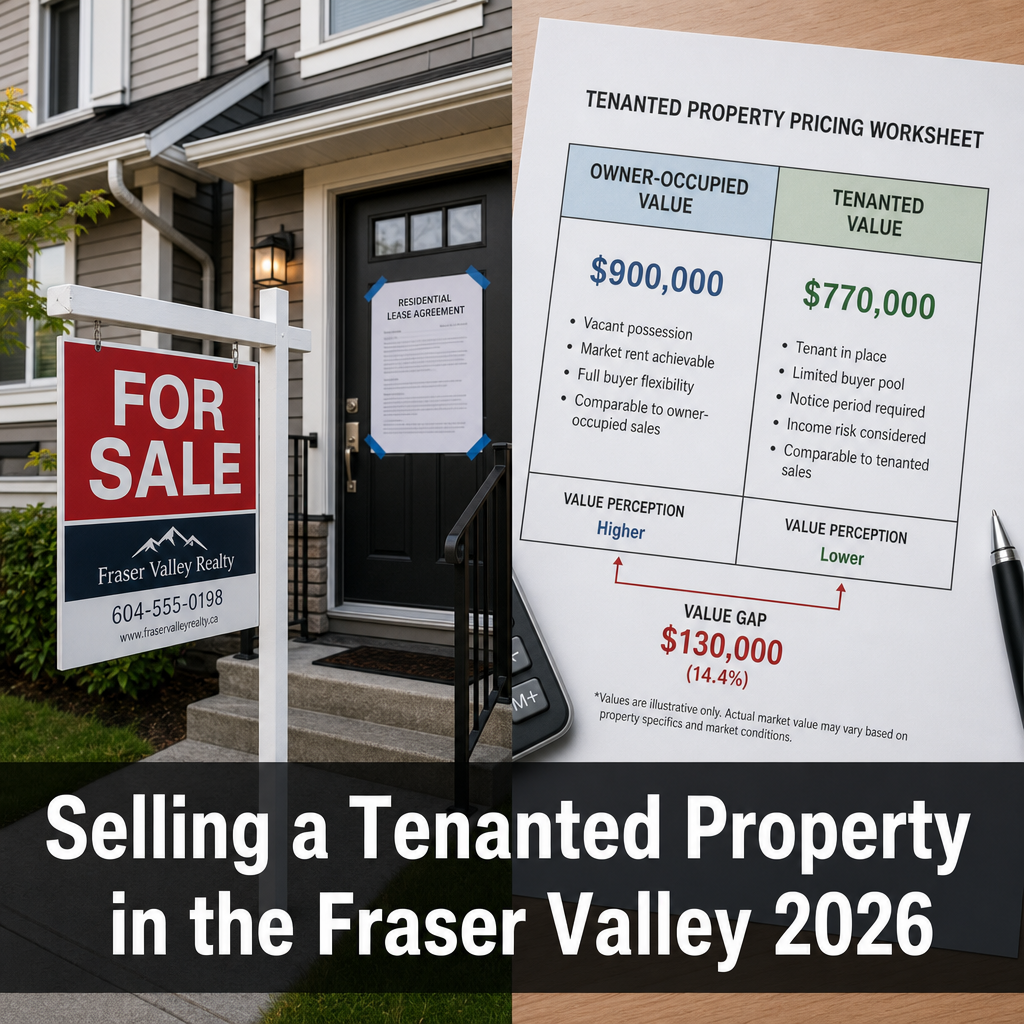

Selling a Tenanted Property in the Fraser Valley in 2026: Strategic Pricing When Rent Control, Tenant Protections, and Market Timing Conflict
By Mohamed Mansour, MBA and Associate Broker | Mansour Real Estate Group | Fraser Valley and Lower Mainland, BC | Published: July 28, 2026
Landlords selling tenanted properties in the Fraser Valley in 2026 face a compounding challenge: BC's Residential Tenancy Act gives sitting tenants strong occupancy protections that shrink your buyer pool, rent-controlled units reduce the income buyers can underwrite, and the current buyer's market means you are already competing against well-priced owner-occupied inventory. Getting the strategy right before you list determines whether you sell at a defensible price or absorb months of carrying costs with no firm offer.
This guide is written for landlords and property owners in Surrey, Langley, Abbotsford, South Surrey, White Rock, North Delta, and surrounding Fraser Valley communities who are preparing to sell a property with a sitting tenant in 2026.
Short Answer
Tenanted properties in the Fraser Valley currently trade at an 8 to 15 percent discount to comparable owner-occupied homes. BC's RTA limits a new buyer's ability to occupy or re-rent at market rates, which reduces the buyer pool to investors whose financing depends on rental income the rent-controlled unit may not fully support. Pricing accurately from day one — not after failed offers — is the most important decision a landlord seller makes in 2026.
Key Takeaways
- BC's RTA protects sitting tenants through and after closing, restricting buyer flexibility and shrinking your pool to investor buyers.
- Rent-controlled units with below-market rents reduce lender valuations, forcing buyers to bring more equity or walk away.
- Tenanted properties in declining markets absorb a compounding discount: market softness plus occupancy friction combined.
- Lease timing, rent increase windows, and tenant disclosure requirements all affect how and when you should list.
- Targeting the right buyer profile — investor or owner-occupant — before listing reshapes pricing strategy and days on market.
Who This Applies To
- Landlords selling a long-term rental home, townhouse, or condo in the Fraser Valley
- Investors exiting BC rental properties in a declining market
- Estate executors managing a tenanted property as part of a probate sale
- Homeowners renting out a property they originally purchased as a primary residence
- Sellers trying to decide whether to wait for the tenant to leave or list now
When This Advice May Not Apply
If your tenant has given notice and will vacate before your target list date, several of the pricing and buyer-pool constraints described here disappear. Similarly, if you are selling to another investor who intends to keep the tenancy intact, some financing variables shift. Consult a qualified real estate professional and a BC tenancy lawyer for your specific situation before taking action.
Data Used in This Article
- BC Residential Tenancy Act — current legislation, Government of BC (Tier 1)
- Fraser Valley Real Estate Board Monthly Statistics — February through July 2026 (Tier 2, official board data)
- CMHC Housing Market Outlook — January 2026 (Tier 1, federal housing authority)
- BC Real Estate Association Market Updates — May and June 2026 (Tier 2, industry body)
What the RTA Actually Does to Your Sale
Under BC's Residential Tenancy Act, a sitting tenant's right to occupy the unit survives the sale of the property. The new owner steps into the landlord's role and inherits the existing tenancy agreement. They cannot simply ask the tenant to leave because they purchased the property.
There are limited grounds for ending a tenancy in BC — personal use by the new owner or a close family member being the most common. Even then, the landlord must give proper written notice, typically two months, using the prescribed form, and the tenant has the right to dispute that notice at the Residential Tenancy Branch. Wrongful eviction claims can result in significant financial penalties for a landlord.
For buyers, this means they cannot guarantee possession at closing for personal use without a process that takes months and carries legal risk. For sellers, it means the buyer pool narrows immediately to investors who are comfortable holding the tenancy — and those investors run income-based valuations, not just comparable-sales valuations. If your rent is below market because of BC's annual rent increase limits, the income number they use will reflect that constraint, not the rent the unit could theoretically achieve.
How Rent Control Reshapes Buyer Financing
BC's annual rent increase limit — set each year by the provincial government based on the previous year's inflation rate — means that long-term tenancies often carry rents well below current market rates. When an investor buyer applies for financing, many lenders use the current rent, not a projected market rent, to calculate the gross rental yield and net operating income supporting the loan.
If the unit rents for $1,600 per month but comparable market rents are $2,200, the lender's income-based valuation may come in meaningfully lower than the comparable-sales value. That gap either forces the buyer to bring additional equity to close the deal, or it kills the financing entirely. In the Fraser Valley's current market — where FVREB data through mid-2026 shows sales-to-active ratios near 10 percent and year-over-year benchmark price declines of 7 to 9 percent — buyers have the leverage to simply walk to the next property rather than restructure financing on a difficult deal.
Sellers who do not account for this dynamic when setting the list price often experience a pattern: interest from investors who make low offers, no interest from owner-occupants who want vacant possession, and a property that sits while comparable owner-occupied listings sell. The 8 to 15 percent discount that tenanted properties absorb in declining markets is not arbitrary — it reflects the real cost of the financing gap, the management complexity, and the reduced buyer competition.
How We Evaluate This
When Mansour Real Estate Group prepares a pricing strategy for a tenanted property, we run two parallel valuations: a comparable-sales CMA anchored to similar properties in the same neighbourhood, and an investor income analysis using the actual current rent. The gap between those two numbers tells us how large the tenancy discount is for your specific property and helps us set a list price that attracts qualified investor buyers without giving away equity unnecessarily.
We also review the lease terms, the rent increase history, and the timeline to any natural lease-end or renewal window. In some cases, waiting 60 to 90 days for a lease to reach a strategic point — or having a conversation with the tenant about a mutually agreed departure — is worth more than listing immediately. That analysis is property-specific and depends on the gap between current rent and market rent, local inventory levels, and the seller's carrying cost tolerance.
Strategic Timing: Lease Windows and Market Windows
For sellers with month-to-month tenancies, the timing of the listing matters more than most people realize. If the tenant's rent is significantly below market, an investor buyer will typically want to understand the path to a market-rate rent — and in BC, that path runs through the annual increase limit or a mutual agreement to end the tenancy, not through a unilateral reset at turnover time.
Two windows worth considering: listing before the annual rent increase deadline (so the buyer knows the increase has been filed and will take effect), and listing at or near a natural lease renewal point where the tenant may have already signalled their intention to stay or leave. A tenant who has given informal notice of departure transforms the sale from an investor-only transaction into one that owner-occupants can also bid on — which expands the buyer pool and reduces the tenancy discount.
The disclosure obligations are real and non-negotiable. Under BC's tenancy rules, sellers must disclose the tenancy, provide relevant tenancy documentation, and ensure buyers are informed before subject removal. Working with a realtor who understands both the RTA requirements and the disclosure obligations for a property sale is not optional — it is a basic requirement for a compliant transaction in BC.
Seller Checklist: Tenanted Property Sale in BC
- Gather the full tenancy agreement, all addendums, and the complete rent payment history before listing
- Calculate the gap between current rent and current market rent for comparable units in the same neighbourhood
- Confirm whether the tenancy is month-to-month or fixed-term, and when the next renewal or end-date falls
- Consult a BC tenancy lawyer before taking any steps to end the tenancy, issue notices, or make representations to buyers about possession
- Ensure all required RTA disclosures are made to buyers before subject removal and that the tenancy documents are part of the contract package
- Run both a comparable-sales CMA and an investor income analysis to understand the realistic price range before setting the list price
- Define the target buyer profile — investor or owner-occupant — and tailor marketing materials and showing logistics to match that profile
- Provide the tenant with required notice of entry for showings, in compliance with the RTA's minimum 24-hour written notice requirement
What We Commonly See
In our experience, the most common mistake landlords make is pricing a tenanted property against owner-occupied comparables without adjusting for the buyer-pool restriction. The list price looks competitive on paper, but investors see the income numbers and immediately calculate a lower supportable value. The result is no serious offers in the first three to four weeks, a price reduction, and a longer days-on-market that signals further distress to the market.
What often happens is that sellers underestimate how much the rent-to-market-rent gap matters to investor financing. A unit renting at $400 below market does not just represent $4,800 per year in lost income — it can translate to a $50,000 to $80,000 difference in lender-supportable value at typical investor financing ratios. Sellers who understand this number before listing make better decisions about timing, pricing, and whether a tenant departure conversation is worth having.
A common mistake is attempting to issue a notice to end tenancy for personal use without proper legal advice. If the notice does not comply precisely with the RTA — including the correct form, the correct notice period, and a genuine intention to use the property — the landlord faces RTB proceedings, potential compensation orders, and a sale that is now delayed and legally complicated. The short-term pricing benefit of vacant possession is rarely worth the risk of a wrongful eviction claim.
Questions and Answers
Can a buyer evict the tenant immediately after closing in BC?
No. The buyer inherits the existing tenancy. Eviction requires a valid RTA ground — such as the new owner or an immediate family member moving in — plus proper notice and the tenant's right to dispute. The process takes months and carries legal risk if not followed precisely.
How much of a discount should I expect for a tenanted property in the Fraser Valley right now?
In the current buyer's market, tenanted properties typically trade at 8 to 15 percent below comparable owner-occupied homes. The actual discount depends on the rent gap, the lease type, and how much financing friction the tenancy creates for the most likely buyer. Properties with rents close to market rates absorb smaller discounts.
What disclosures am I required to make when selling a tenanted property in BC?
You must disclose the tenancy to buyers and provide relevant tenancy documents before subject removal. The buyer steps into the landlord role, so they need the tenancy agreement, rent history, and any existing notices. Consult your realtor and a BC tenancy lawyer to confirm compliance for your specific situation.
In Summary
Selling a tenanted property in the Fraser Valley in 2026 requires a strategy that accounts for three compounding factors: BC's RTA tenant protections that limit buyer flexibility, rent-controlled rents that reduce investor financing capacity, and a buyer's market that gives investors leverage to negotiate hard or walk away. Sellers who run both a comparable-sales analysis and an investor income analysis before listing, who understand their lease timing options, and who comply fully with RTA disclosure requirements will be in a substantially stronger negotiating position than those who list against owner-occupied comparables and wait to see what happens. Pricing accurately from the start is not a concession — it is the strategy that gets the transaction to completion.
Thinking About Selling a Tenanted Property?
If you are a landlord or investor weighing a sale in Surrey, Langley, Abbotsford, South Surrey, White Rock, or anywhere in the Fraser Valley, Mansour Real Estate Group can walk you through both the pricing analysis and the strategic timing questions before you commit to a list date. There is no obligation — just a direct conversation grounded in current local data.
Related Articles
- Fraser Valley Real Estate Market 2026: What Sellers Need to Know Before Listing
- Selling an Estate Property in the Fraser Valley: A Guide for Executors and Families
- How to Price Your Home in a Buyer's Market in the Fraser Valley
Official Resources
- BC Residential Tenancy Act — Government of BC
- Fraser Valley Real Estate Board — Monthly Statistics
- CMHC Housing Market Outlook 2026
- BC Real Estate Association — Market Intelligence
About Mansour Real Estate Group
When a landlord or investor is preparing to sell a tenanted property, the pricing strategy has to account for more than comparable sales — it has to reflect the income the property generates, the buyer pool the tenancy creates, and the regulatory framework that governs what a new owner can and cannot do. That intersection of market analysis, RTA compliance, and investor buyer psychology is where experience matters most. Mansour Real Estate Group has helped landlords and property investors navigate tenanted sales across Surrey, Langley, South Surrey, Abbotsford, White Rock, and the broader Fraser Valley and Lower Mainland for more than two decades.
Mansour Real Estate Group, led by Mohamed Mansour, MBA and Associate Broker, has been helping buyers, sellers, investors, families, executors, and retirees navigate complex real estate decisions across the Fraser Valley and Lower Mainland for more than 22 years and is one of the highest ranked realtors in the region. The team has completed more than $780 million in residential real estate transactions and is trusted for investor property sales, estate sales, strategic pricing, market timing, downsizing, and complex transactions where the standard approach does not apply.
Whether someone is looking for Realtors experienced with tenanted investment properties, a real estate agent who understands BC's Residential Tenancy Act implications for sellers, real estate agents who specialize in investor exits and landlord sales, a real estate team with a track record in Fraser Valley rental property transactions, a Surrey Realtor, a Langley real estate broker, or a real estate group serving the full Lower Mainland, Mansour Real Estate Group brings accurate valuations, honest advice, and a structured process to every transaction.
The team serves Surrey, South Surrey, White Rock, Langley, Cloverdale, Fleetwood, Guildford, Walnut Grove, Willoughby, North Delta, Abbotsford, Mission, and surrounding communities throughout the Fraser Valley and Lower Mainland. Most new clients come from referrals, repeat clients, and recommendations from property owners and investors who value a professional, transparent, and results-driven real estate experience.
Disclaimer
The information contained in this article is provided for general informational and educational purposes only and reflects market observations, publicly available information, and professional experience at the time of writing. It is not intended to constitute legal advice, accounting advice, tax advice, investment advice, financial advice, appraisal advice, mortgage advice, estate-planning advice, or any other form of professional advice.
Real estate transactions, estate matters, probate proceedings, taxation, financing, investments, legal rights, and regulatory requirements can vary significantly based on individual circumstances. Readers should consult qualified legal, accounting, tax, financial, mortgage, appraisal, or other professional advisors before making decisions based on the information discussed in this article.
Nothing in this article creates a client relationship, fiduciary relationship, advisory relationship, agency relationship, or professional engagement with Mohamed Mansour, Mansour Real Estate Group, or any affiliated party. Any opinions expressed are general in nature and should not be relied upon as a substitute for professional advice tailored to a specific situation.
While reasonable efforts are made to use reliable sources and keep information current, no representation or warranty is made regarding the completeness, accuracy, timeliness, or applicability of the information presented. Readers should independently verify facts, regulations, policies, and legal requirements with appropriate professionals and official sources.



